

For U.S. healthcare founders raising capital in 2026, the firms worth prioritizing include Andreessen Horowitz's Bio + Health practice, General Catalyst, New Enterprise Associates, Flare Capital Partners, Oak HC/FT, and OrbiMed Advisors. Each earns its spot for a different reason: multi-stage muscle, healthtech-specific operating support, or deep payer and provider relationships. The right fit depends less on brand recognition and more on whether a firm's stage focus, clinical depth, and network match where your company actually stands.
TL;DR:
- Founders should prioritize VC firms with healthcare-specific operational support and deep payer/provider relationships over just fund size or brand name.
- Match your company's stage and clinical milestones precisely with a firm's typical investment focus to avoid wasted effort and delays.
- Prepare comprehensive clinical and regulatory documentation, including pilot results and payer conversations, before engaging with investors.
- Expect fundraising to take three to six months in healthcare, with longer timelines at later stages, depending on regulatory and clinical diligence.
- Focus on investors who offer operating support and proven track records of helping companies land pilots, navigate regulations, and achieve exits.
Table of Contents
- What Are the Best Healthcare VC Firms for Founders in 2026?
- How Do You Choose the Right Healthcare VC Firm?
- What to Expect by Fundraising Stage, From Seed to Late
- Practitioner Checklist: Preparing for Healthcare VC Diligence
- What Is the Average Fund Size and Check Size Per Firm?
- How Do Fund Performance and Notable Exits Shape Firm Reputation?
- How Long Does Fundraising With a Healthcare VC Typically Take?
- What Equity Stakes and Terms Should Founders Expect?
- How Should Founders Approach and Pitch Healthcare VC Firms?
- Why Operating Support Matters More Than Brand Name
- How The StartupMD Prepares Founders to Win the Right Investors
- Sources
What Are the Best Healthcare VC Firms for Founders in 2026?
Ranking healthcare investment firms by AUM alone misses what actually matters to a founder raising a seed or Series A round: does this firm's team understand clinical workflows, regulatory pathways, and payer contracting well enough to help you close deals, not just write a check? The list below ranks firms by that standard, drawing on how each positions itself publicly and what its portfolio pattern signals about stage focus and specialty.
1. Andreessen Horowitz (Bio + Health) a16z's healthcare arm runs an unusually deep bench of physicians, PhDs, and former operators inside its Bio + Health practice, and that operating team is the reason founders court the firm beyond its checkbook. It invests from seed through growth, with a growing appetite for AI infrastructure plays that touch care delivery and reimbursement, not just point solutions. Best for: founders building platform technology who want in-house regulatory and talent support. Hub: Menlo Park, with reach into Boston and New York.
2. New Enterprise Associates (NEA) NEA is one of the longest-running multi-stage investors in venture capital, with a healthcare portfolio spanning biotech, digital health, and medtech. Its scale gives founders a partner that can lead a Series A and still participate meaningfully at growth stage. Best for: companies that want one investor relationship across multiple rounds. Hub: Menlo Park and Washington, D.C.
3. Flare Capital Partners Flare built its reputation on strategic investor relationships rather than sheer fund size, supported by industry specialization for healthcare and fintech. The firm maintains industry advisory boards and payer/provider partnerships that founders use to land pilots faster than a cold outbound campaign ever could. Best for: digital health startups whose growth depends on health system or payer adoption. Hub: Boston.
4. Oak HC/FT Oak HC/FT invests specifically in companies that change how care gets delivered and paid for, and its team's payer and provider expertise shows up in how it diligences a deal. Founders selling into value-based care or Medicare Advantage contracts find this firm asks sharper questions than most. Best for: fintech-adjacent healthcare models and value-based care platforms. Hub: Stamford, Connecticut and New York.
5. Versant Ventures Versant is a life-science specialist with a long track record backing therapeutic and device companies through preclinical and early clinical stages. Best for: biotech and medtech founders who need investors fluent in FDA pathways. Hub: San Francisco and Boston.
6. OrbiMed Advisors OrbiMed spans public and private healthcare investing, giving it unusual insight into how a company's story needs to evolve for a future IPO. Best for: growth-stage biotech and specialty pharma companies eyeing a public exit. Hub: New York.
7. Third Rock Ventures Third Rock builds companies from the ground up more often than it simply funds existing teams, embedding operational leadership into biotech ventures from day one. Best for: scientific founders who need a co-building partner, not just capital. Hub: Boston.
8. General Catalyst General Catalyst has pushed hard into healthcare infrastructure and health system transformation, including direct relationships with provider networks. Best for: founders building AI-driven clinical or operational infrastructure at scale. Hub: Cambridge, Massachusetts and San Francisco.
9. Civilization Ventures A newer, focused fund built around genomics, diagnostics, and digital health, Civilization Ventures brings a tight domain network rather than broad reach. Best for: early-stage founders in precision medicine and diagnostics. Hub: San Francisco.
10. Define Ventures Define Ventures invests exclusively in digital health, giving founders a partner whose entire team speaks the language of care delivery, payers, and clinical workflow from the first meeting. Best for: seed and Series A digital health startups seeking a specialist lead investor. Hub: San Francisco.
A few other names deserve a place on your research list even if they didn't make the top ten: SV Health Investors and Deerfield Management for life-science depth, Vivo Capital and Qiming Venture Partners for firms with cross-border biotech reach, General Atlantic and Insight Partners for growth-stage healthtech, Kaiser Permanente Ventures and CVS Health Ventures for strategic payer-aligned capital, and Wellington Management, Khosla Ventures, Kleiner Perkins, Lightspeed Venture Partners, Accel Partners, Venrock, Greycroft, Silversmith Capital Partners, Maverick Ventures, Redmile Group, LRVHealth, and Springbank Collective for founders casting a wider net across stages and specialties. Pfizer's venture arm, TMV, 25madison, Creative Ventures, Antler, Global Founders Capital, and Plug and Play Ventures round out the ecosystem for founders exploring corporate venture and accelerator-adjacent capital.
How Do You Choose the Right Healthcare VC Firm?
Picking the wrong investor costs you more than a bad term sheet. It costs you board seats occupied by people who can't help you navigate a payer contract or a regulatory submission. Run every prospective firm through this filter before you take a first meeting:
- Stage fit: does their typical check match your round size, or will you be their smallest or largest deal?
- Clinical and regulatory depth: do partners have MD, PhD, or former FDA/CMS backgrounds, or is healthcare just a sector tag on their website?
- Operating team: does the firm employ dedicated regulatory, reimbursement, or clinical affairs staff who work with portfolio companies directly?
- Payer and provider access: can they introduce you to a health system or payer for a pilot, or do you have to find that door yourself?
- Check size and follow-on capacity: will they still be able to write a check in your Series B, or does their fund size cap out here?
When you get a partner on the phone, ask direct questions: "Which portfolio companies did you help land their first health system pilot, and how?" "Who on your team handles regulatory or reimbursement strategy?" "What's your typical timeline from term sheet to close?" Then call two founders from their existing portfolio and ask what the partner does after the wire lands, not just before.
Watch for red flags: a firm that talks AUM but can't name a specific operating resource, a partner who's never sat on a healthcare board, or an associate pushing a term sheet without a partner-level conversation about your clinical evidence.
Pro Tip: Ask a prospective investor for one specific, recent example of how their team shortened a portfolio company's time to a signed payer contract. If they can't name one, their "operating support" is likely marketing copy.
What to Expect by Fundraising Stage, From Seed to Late
Healthcare VCs behave differently depending on where your company sits, and matching your pitch to a firm's actual stage focus saves months of wasted outreach.
- Seed stage: investors want early clinical validation, not full trial data. A signed pilot letter of intent or a small cohort of usage data matters more than a five-year revenue model. Firms like Define Ventures and Civilization Ventures specialize here.
- Series A and B: the bar shifts to commercial traction. Investors want evidence of payer engagement, a repeatable sales motion, and regulatory milestones hit on schedule. This is where firms with dedicated reimbursement and clinical affairs staff, a resource a16z built directly into its Bio + Health team, start to matter more than pure capital.
- Growth and late stage: the conversation moves to scaling playbooks, channel expansion, and exit preparation. Firms like OrbiMed and General Atlantic bring public-market fluency that helps a company prepare for an IPO or strategic acquisition.
Founders should match a VC's stated stage focus to their own milestones before reaching out. Pitching a seed-focused specialist for a growth round wastes everyone's time, and pitching a growth fund before you have payer traction gets you a polite pass.
Practitioner Checklist: Preparing for Healthcare VC Diligence
Before your first partner meeting, assemble a clinical evidence summary written for a nonclinical audience, a HIPAA and security posture overview, documented pilot results, and a record of payer conversations. Frame clinical milestones as commercial KPIs, not just outcomes data. If your evidence story is complex or your regulatory pathway is unclear, that's the moment to bring in a fractional Chief Medical Officer or stand up a medical advisory board before, not during, diligence.
What Is the Average Fund Size and Check Size Per Firm?
Fund sizes among top healthcare investment firms vary widely by strategy. Multi-stage generalists like NEA and a16z manage funds in the billions of dollars and can write checks ranging from a few million dollars at seed to tens of millions at growth. Specialist funds like Flare Capital, Civilization Ventures, and Define Ventures tend to run smaller, more concentrated funds, often writing initial checks in the low single-digit millions with reserved capital for follow-on rounds.
Growth-stage firms like General Atlantic and Insight Partners operate at a different scale entirely, with checks that can exceed $50 million for companies with proven commercial traction. Strategic corporate venture arms, including Kaiser Permanente Ventures and CVS Health Ventures, often write smaller checks relative to their parent company's size but bring something specialist funds can't: direct access to a payer or provider network as a built-in pilot partner.
The practical takeaway for founders: match your ask to the firm's typical check size before you pitch. A seed round pitched to a growth fund gets ignored not because the idea is weak, but because the math doesn't work for their fund structure. Ask directly, early in a first call, what their typical initial check and reserve ratio look like for a company at your stage.
How Do Fund Performance and Notable Exits Shape Firm Reputation?
Healthcare VC firms build their reputations on exit history as much as on fund size, and founders should study that history before assuming a firm's brand name guarantees results. Biotech-focused firms like Versant Ventures and Third Rock Ventures have built portfolios with multiple companies that reached IPO or were acquired by larger pharmaceutical players, a track record that matters if your own path runs toward a public listing or strategic sale.
Digital health and healthtech specialists measure success differently, often through successful health system or payer partnerships that led to acquisition by larger platform companies. When you're evaluating a firm's performance history, ask about outcomes for companies at your specific stage and specialty, not just headline exits from a decade-old fund. A firm's best-known success story from 2015 tells you less than how its more recent seed investments have performed through Series B.
Public performance data for individual VC funds is rarely disclosed in detail, so the most reliable diligence method is direct reference calls with founders from the firm's existing portfolio, ideally companies now two or three rounds past where you currently stand.
How Long Does Fundraising With a Healthcare VC Typically Take?
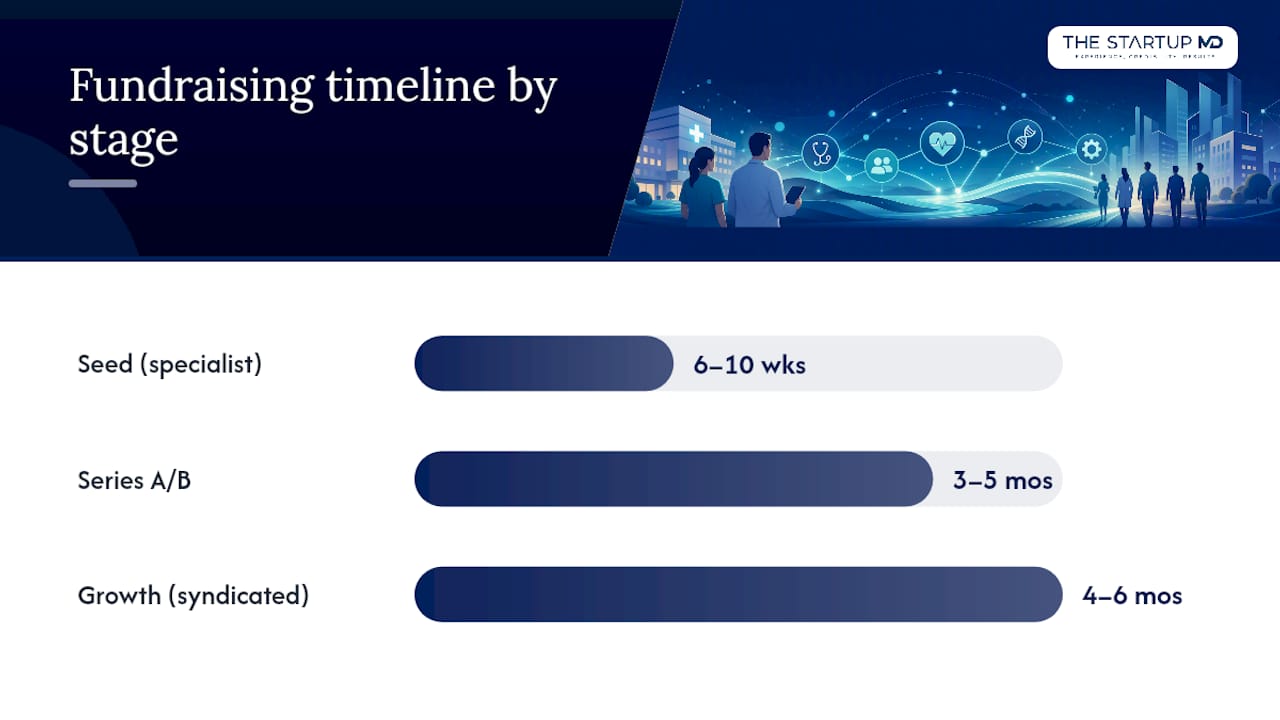
Fundraising timelines in healthcare tend to run longer than in general tech, largely because clinical and regulatory diligence takes more time than a typical software due diligence process. A seed round with a specialist firm can close in six to ten weeks once a lead investor commits, but that timeline stretches when a firm wants to verify clinical claims or run reference calls with pilot health systems.
Series A and B rounds usually take three to five months from first meeting to signed term sheet, with additional weeks for legal closing. Growth-stage rounds, especially those involving multiple investors syndicating a larger check, can run four to six months given the added complexity of coordinating diligence across several firms simultaneously.
The biggest lever founders control is preparation. Companies that walk into a first meeting with clean clinical evidence summaries, documented pilot outcomes, and a clear regulatory narrative consistently move faster through diligence than companies assembling that material reactively, mid-process.
What Equity Stakes and Terms Should Founders Expect?
Typical equity dilution per round varies by stage but follows recognizable patterns across healthcare venture deals. Seed rounds commonly result in founders giving up 15% to 25% of the company, while Series A rounds often dilute founders by another 15% to 20%. These ranges shift depending on how competitive the round is and how much leverage a founder has from multiple term sheets.
Standard terms in a healthcare VC deal include a liquidation preference (typically 1x, non-participating, at healthy firms), a board seat for the lead investor, pro rata rights for future rounds, and standard protective provisions around major company decisions. Founders should pay particular attention to anti-dilution provisions and any unusual milestone-based tranching, which some healthcare-specific deals include when a large portion of value depends on a regulatory approval or payer contract landing on schedule.
Negotiating leverage comes from having more than one term sheet on the table, and from clinical or commercial milestones that reduce an investor's perceived risk. A founder walking in with a signed payer letter of intent negotiates from a materially stronger position than one still validating basic product-market fit.
How Should Founders Approach and Pitch Healthcare VC Firms?
Warm introductions still outperform cold outreach in healthcare venture capital, largely because the space runs on trust between a small number of repeat players. Ask your clinical advisors, existing investors, or health system contacts for introductions rather than relying solely on cold emails to a firm's general inbox.
When you do pitch, lead with clinical and commercial evidence, not just vision. Investors in this category have heard hundreds of pitches promising to transform healthcare. What separates the ones that get funded is specific, verifiable proof: a pilot result, a signed letter of intent, a payer conversation that's moved past the exploratory stage. Build your pitch deck and supporting documents around evidence a nonclinical investor can verify quickly, rather than dense clinical language that requires translation.
Finally, treat the first meeting as a two-way diligence process. Ask the partner what they see as the biggest risk in your business, and listen closely to whether their answer reflects real healthcare experience or generic venture pattern matching.
Why Operating Support Matters More Than Brand Name
Most founders rank prospective investors by name recognition first and diligence depth second. That ordering is backwards, and it costs companies real time. A firm with a recognizable name but no dedicated regulatory or reimbursement staff will hand you the same generic advice a business school case study would offer, dressed up in a partner meeting.
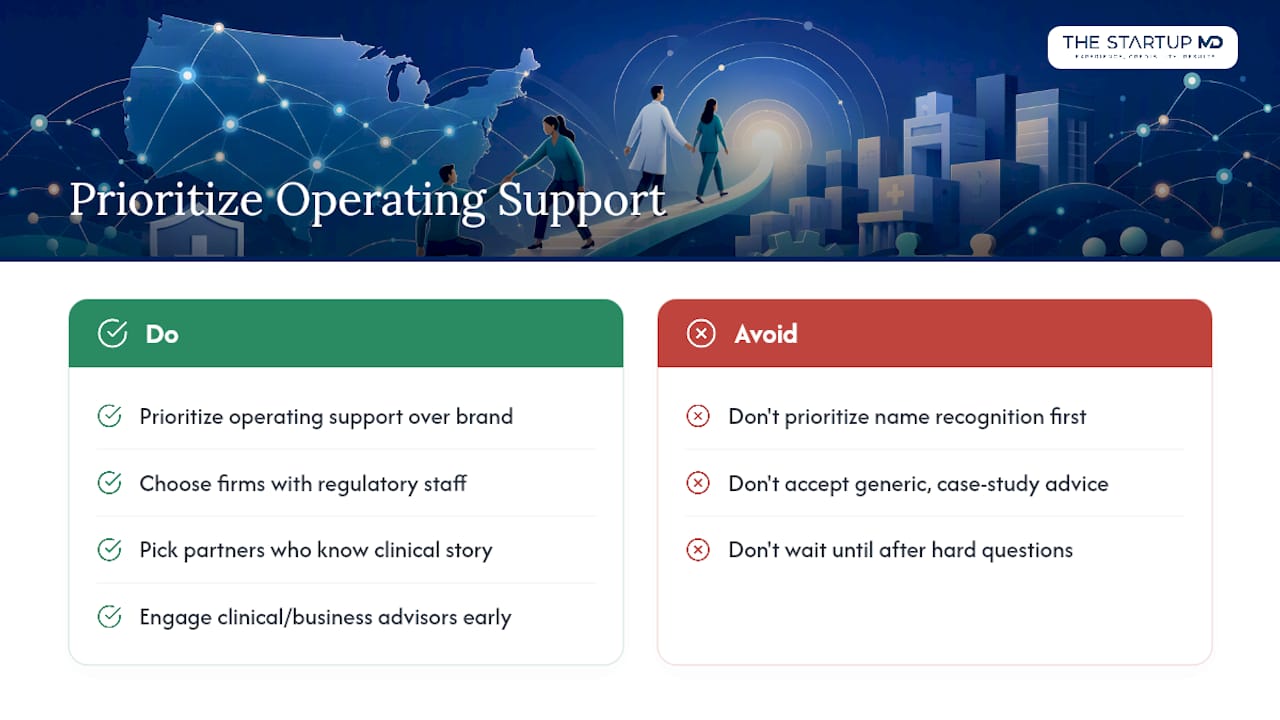
The firms that actually move the needle for healthcare companies are the ones that treat operating support as core infrastructure, not a marketing line. That's a deliberate structural choice, not a marketing claim, and it shows up in how quickly a portfolio company gets a pilot signed or a regulatory question answered. Founders who select investors this way close pilots faster and raise follow-on rounds with fewer surprises in diligence, because someone on the cap table already understood the clinical story before the term sheet was signed.
Advisory input from someone who has sat on both sides of the table, medicine and business, tends to surface these gaps before a term sheet is signed rather than after. That's when a fractional advisory relationship pays for itself: not by writing the pitch deck, but by pressure-testing the clinical narrative an investor will eventually stress-test anyway. Founders should engage that kind of support as soon as clinical evidence becomes central to the fundraising story, not after a firm has already asked a hard question they weren't ready to answer.
— Paul Bergeron MD, MBA
How The StartupMD Prepares Founders to Win the Right Investors
Raising from a top-tier healthcare VC firm starts long before the first pitch meeting, and it depends on a clinical story that holds up under scrutiny from partners who've seen hundreds of decks. The StartupMD is the alternative to hiring a full-time Chief Medical Officer before you're ready for one: fractional clinical leadership that translates pilot data, regulatory milestones, and payer conversations into the commercial language investors actually diligence.
Founders navigating early clinical pilots, complex Medicare Advantage or value-based care contracting, or a first institutional round benefit most from this kind of advisory support. Healthcare SaaS founders can work directly with clinical leadership advisors to build the clinical narrative, evaluate product readiness, and prepare documentation expected in a serious diligence process. If your next raise depends on investors trusting your clinical evidence as much as your growth numbers, evaluate your fundraising readiness with The StartupMD before your next pitch meeting.
Sources
- a16z Bio + Health | Andreessen Horowitz
- 15 Best Healthcare VC Firms: The 2025 Investor List
- Homepage - Flare Capital Partners
- Oak HC/FT