

What is a care management platform and why does your startup need one?
A care management platform is specialized software that automates the clinical workflows, documentation, and billing tasks required to run value-based care programs like Chronic Care Management (CCM), Principal Care Management (PCM), and Transitional Care Management (TCM). For healthcare startups, this distinction matters immediately; consulting guidance on scaling and adapting care management solutions as healthcare startups scale in international markets is available through Raki Solutions. These are not generic scheduling tools or EHR add-ons. They are purpose-built systems that handle the specific CMS compliance requirements that determine whether your Medicare reimbursements get paid or clawed back.
The gap between administrative software and a true care management platform is where most early-stage startups lose money. A platform built for CCM automates time-tracking, patient enrollment, care plan documentation, and outreach in ways that satisfy Medicare billing codes. One that does not will expose you to audit risk before you have the revenue to absorb it.
Core functionalities you should expect from any serious platform:
- Automated patient enrollment and eligibility verification
- Time-tracking and documentation tied directly to CMS billing codes
- Care plan creation and real-time updates across care teams
- Secure patient outreach and communication logs
- EHR integration via HL7/FHIR standards
- Revenue cycle management (RCM) with claims submission
- Performance analytics and quality reporting dashboards
- HIPAA-compliant data storage and access controls
Startups running CCM, PCM, and TCM within a single unified platform avoid the workflow disruption that comes from stitching together separate tools. Consolidated dashboards reduce administrative overhead and give your clinical staff a single source of truth across all three programs.
Table of Contents
- Key features and benefits that matter most for startup growth
- Which startups are reshaping care management in 2026?
- How do you choose the right platform for your startup?
- What do care management platforms actually cost for startups?
- What US regulatory requirements must your platform meet?
- How do leading platforms protect patient data?
- What does platform success look like in practice?
- Does your platform connect cleanly to existing EHRs?
- Key Takeaways
- Thestartupmd brings clinical leadership to your platform decision
Key features and benefits that matter most for startup growth
The features that separate a platform worth buying from one that will slow you down come down to four areas: interoperability, compliance automation, modular design, and vendor responsiveness.

Interoperability is non-negotiable. Your platform must connect to the EHRs your clinical partners already use. HL7/FHIR-based integration is the current standard, and any vendor that cannot demonstrate it cleanly is a risk. Platforms designed by clinicians with direct workflow experience tend to reduce the "swivel-chair" problem, where staff toggle between disconnected systems, losing time and introducing documentation errors.
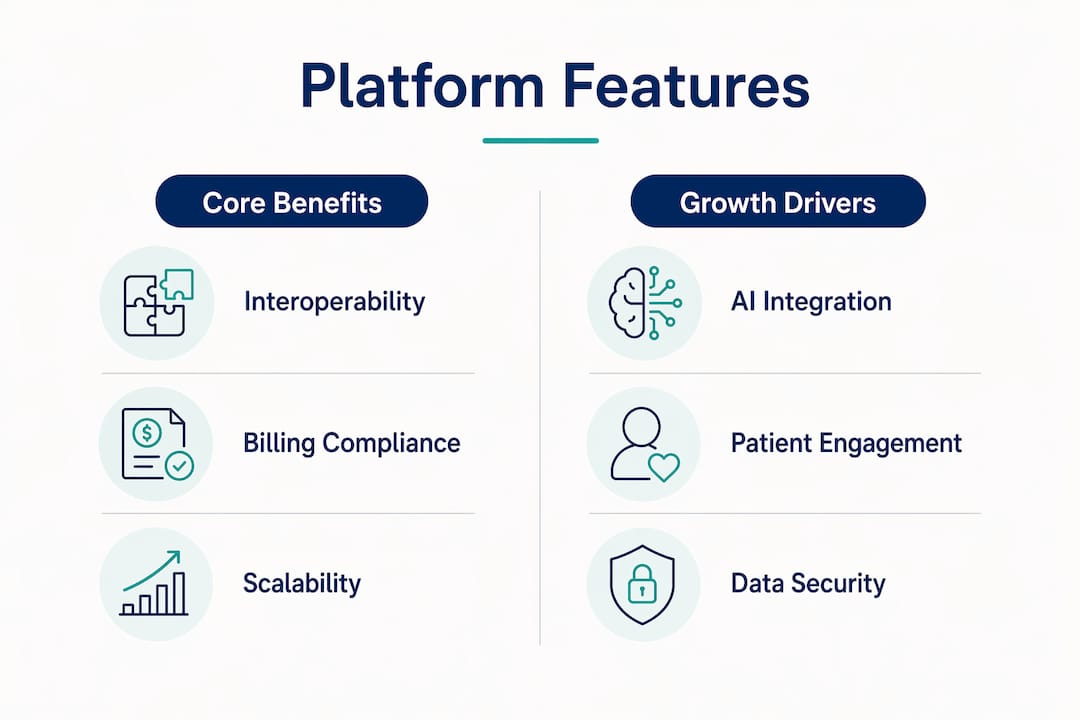
Compliance automation covers the tasks that kill startup margins when done manually: time-tracking per patient per month, billing code documentation, outreach logs, and care plan version control. Platforms that automate these functions protect your revenue and your audit trail simultaneously.
Must-have features for any startup evaluation:
- Modular architecture so you pay for what you use and add capabilities as you grow
- HIPAA compliance built into the infrastructure, not bolted on
- RCM tools with high first-pass claim acceptance rates
- Real-time patient data exchange and remote monitoring support
- Configurable care plan templates aligned to CMS program requirements
- Dedicated onboarding support with rapid deployment timelines
- Performance dashboards tracking HEDIS measures and care gap closure
Pro Tip: When evaluating vendors, ask specifically how their platform handles time-tracking documentation for CCM billing. If the answer requires manual staff entry, that is a compliance gap waiting to become an audit finding.
Modular scalability is where startups often underestimate their needs. A platform that works for 500 patients may break operationally at 5,000 if the architecture was not built to scale. Prioritize vendors who can show you live deployments at the patient volume you expect to reach in 18 months, not just where you are today. The population health strategy you build now will only work if your platform can grow with it.
Which startups are reshaping care management in 2026?
The most interesting development in care management software right now is the shift from static data dashboards to AI orchestration layers that maintain persistent patient context across workflows. Two companies illustrate this clearly. ManageCare uses autonomous AI agents to coordinate the entire patient journey from referral to survivorship, integrating across 20+ EMR systems with HIPAA and SOC 2 compliance. Caremaze takes a narrower but equally sharp approach: its voice AI agents complete 1,000+ care coordination calls weekly at a 93% success rate, and the platform integrates with hospital EMRs in 10 hours of IT time.

| Platform | Key Features | Best For | Innovation Focus |
|---|---|---|---|
| The Startup MD | Clinical executive advisory, platform selection, go-to-market strategy | Startups needing strategic and operational guidance on platform adoption | Physician-led clinical governance and digital health advisory |
| ManageCare | 18 AI agents, 20+ EMR integrations, scheduling, referrals, analytics | Startups automating complex clinical workflows | AI-native patient journey orchestration |
| Caremaze | Voice AI calls, discharge task management, EMR integration in 10 hours | Post-acute care management and discharge planning | Voice AI and rapid EMR deployment |
| Arcadia | Data aggregation, population health analytics, value-based care reporting | Startups needing advanced analytics for VBC programs | Population health data infrastructure |
| Innovaccer | Cloud-based data activation, modular EHR integration, care coordination | Startups seeking fast, modular EHR connectivity | Interoperability and modular deployment |
| Addis Care | AI care plans, scheduling, billing automation, proactive coordination | Chronic condition management and home care agencies | AI-generated care plans with real-time updates |
| Vim | Referral automation, provider communication, care continuity tools | Startups reducing manual referral burden | Provider collaboration and referral workflow automation |
| Medisolv | Quality reporting, CMS metrics analytics, compliance tracking | Startups prioritizing quality improvement and regulatory reporting | Clinical quality measure analytics |
| HealthHelper | Task management, patient engagement, team collaboration tools | Startups wanting intuitive interfaces and workflow automation | Simplified care coordination for clinical teams |
| Athenahealth | Integrated EHR, RCM, care coordination, clinical workflows | Startups needing combined clinical and administrative integration | Comprehensive EHR plus RCM platform |
| AssureCare | Home health scheduling, EVV, compliance tracking, shift management | Startups scaling home health operations | EVV and shift management for home care |
| HealthEdge | Health plan management, payer administration, care coordination | Startups working with payers and health plans | Unified payer and care management administration |
| ShiftCare | Cloud scheduling, billing, client management for home care | Home care agencies needing end-to-end operational tools | Scheduling and billing for in-home care |
| Helios Care Management | Real-time analytics, care gap closure, patient engagement tracking | Startups focused on outcome tracking and gap closure | Real-time data for care gap identification |
| Cognizant Health | Custom care platform development, technology consulting, integration | Startups requiring tailored platform builds and IT strategy | Consulting-led technology integration |
Beyond ManageCare and Caremaze, the field breaks into distinct specializations. Arcadia and Innovaccer both serve the population health analytics space, but Arcadia leans heavily into data aggregation for value-based care reporting while Innovaccer's modular architecture makes it faster to deploy alongside existing EHR investments. Addis Care targets home care agencies specifically, with AI-generated care plans that update automatically as patient needs change and a claimed full ROI within 90 days of deployment.
Medisolv fills a gap that many startups overlook until it costs them: CMS quality measure reporting. If your growth strategy involves ACO participation or MIPS compliance, a platform with dedicated quality analytics is not optional. HealthEdge sits at a different layer entirely, connecting care management functions to payer administration, which matters if your startup is working on the health plan side of the market.
How do you choose the right platform for your startup?
The single most common mistake founders make is treating platform selection as a technology decision rather than a clinical governance decision. The platform you choose will determine how your care team documents, bills, and coordinates. That means a physician or clinical executive needs to be in the room when you evaluate vendors, not just your engineering lead.
Clinical governance is the piece most startups underinvest in. AI-driven platforms require ongoing clinical oversight to validate automation and maintain clinician trust. Without transparent decision processes and clear escalation frameworks, clinical staff will reject the automation, and your investment stalls. This is not a theoretical risk. It is the pattern that plays out repeatedly when founders treat AI as a "set and forget" layer on top of clinical workflows.
Expert evaluation criteria for platform selection:
- Does the platform automate CMS-compliant time-tracking and documentation, or does it require manual staff entry?
- Can it support CCM, PCM, and TCM within a single workflow, or will you need separate tools?
- What is the vendor's EHR integration track record? Ask for specific named health systems and deployment timelines.
- How does the platform handle AI decision transparency? Can clinical staff see why a recommendation was made?
- What are the escalation protocols when AI confidence is low?
- Is the security posture HIPAA-compliant and SOC 2 certified?
- What does onboarding look like, and what is the vendor's support response time?
Regulatory compliance is not a checkbox. CMS billing standards for CCM and PCM require specific documentation that only purpose-built platforms produce correctly. Using a general administrative tool for care management billing is the fastest path to a revenue clawback. Understanding your regulatory basics before you sign a vendor contract will save you months of remediation later.
Pro Tip: Ask every vendor for a live demo of their billing documentation workflow for a CCM patient who misses their monthly contact threshold. How the platform handles that edge case tells you more about compliance readiness than any sales deck.
What do care management platforms actually cost for startups?
Pricing in this market is almost never published openly, which creates real friction for founders trying to build a budget. Most enterprise platforms like Arcadia, Innovaccer, and HealthEdge use custom contract pricing based on patient volume, number of programs, and integration complexity. Expect multi-year agreements with per-member-per-month (PMPM) structures for population health tools.
For startups at earlier stages, modular platforms tend to offer more accessible entry points. Addis Care and Caremaze both position themselves as fast-to-deploy options with onboarding measured in days rather than months. ShiftCare and AssureCare, which focus on home care operations, typically offer tiered subscription plans designed for agencies at different growth stages, though specific pricing is not publicly listed for either.
The cost calculation that matters most for a startup is not the subscription fee. It is the revenue at risk if your platform fails a CMS audit. A platform that costs more but automates compliant documentation correctly will almost always generate a better return than a cheaper tool that leaves your billing team exposed. Build your cost model around the reimbursement you are trying to protect, not just the software line item.
What US regulatory requirements must your platform meet?
CMS compliance is the floor, not the ceiling. Any platform you deploy for CCM, PCM, or TCM billing must produce documentation that satisfies Medicare's specific requirements for each program: monthly time logs, care plan version history, patient consent records, and outreach documentation. Platforms that do not automate these functions put your billing team in a position where manual documentation errors become audit findings.
Beyond CMS, the regulatory stack for a US healthcare startup includes HIPAA for data privacy, state-specific telehealth regulations if you are delivering remote care, and EVV (Electronic Visit Verification) requirements if you operate in the home health space. EVV is now federally mandated for Medicaid-funded personal care and home health services, and platforms like AssureCare and ShiftCare have built EVV compliance directly into their scheduling and billing workflows.
If your startup participates in an ACO or value-based contract, HEDIS measure tracking and MIPS reporting add another compliance layer. Medisolv specializes precisely here, with analytics built around CMS quality metrics. Getting your care model innovation strategy aligned with these requirements from day one prevents the costly retrofitting that derails growth-stage companies.
How do leading platforms protect patient data?
HIPAA compliance is the baseline, but the platforms that enterprise health systems will actually integrate with go further. ManageCare and Caremaze both carry SOC 2 Type II certification, which means an independent auditor has verified their security controls over time, not just at a point in time. Caremaze also holds ISO 27001 certification, the international standard for information security management systems.
For startups, the practical security requirements include end-to-end encryption for data in transit and at rest, Business Associate Agreements (BAAs) with every vendor who touches protected health information, comprehensive audit logging, and role-based access controls that limit who can see patient records. Platforms built on HIPAA-aligned infrastructure from day one, like Addis Care and ManageCare, avoid the expensive security retrofits that come when startups bolt compliance onto a system that was not designed for it.
One area founders consistently underestimate is the security posture of integration points. Every EHR connection, every API call, every third-party data exchange is a potential exposure. Ask vendors specifically how they secure HL7/FHIR API connections and what their breach notification protocols look like.
What does platform success look like in practice?
The clearest example of AI-driven care management delivering measurable results comes from the discharge coordination space. Caremaze's voice AI agents handle parallel outreach to skilled nursing facilities, insurance verifiers, and transportation providers simultaneously, tasks that previously consumed hours of case manager time daily. A hospital using Caremaze for a patient requiring oxygen placement can have voice AI agents call 40 SNFs in parallel, confirm which facilities accept the patient's requirements, and return options to the case manager for a final decision, all before the patient's estimated discharge date is at risk.
ManageCare's approach to patient journey orchestration demonstrates a different kind of ROI. By maintaining a unified patient context across all 18 AI agents, the platform ensures that a change in one workflow, say a referral update, automatically propagates to every dependent workflow. That eliminates the coordination gaps where patients fall through the cracks between referral and follow-up.
For home care startups, Addis Care's model of AI-generated care plans that update automatically as patient needs change addresses one of the most labor-intensive parts of home care operations. The platform's positioning around full ROI within 90 days reflects a real cost structure: agencies that replace manual care planning and scheduling coordination with automated workflows recover that investment quickly.
Does your platform connect cleanly to existing EHRs?
EHR integration is where platform promises most often diverge from reality. The standard to look for is HL7/FHIR-based connectivity, which allows platforms to read and write data to major EHR systems without requiring custom builds for each connection. ManageCare integrates with Epic, Cerner, and Athenahealth, among others, without requiring health systems to replace their existing infrastructure. Caremaze completes EMR integration in 10 hours of IT time, a figure that reflects a pre-built integration architecture rather than a custom project.
Innovaccer's modular design is specifically built around interoperability, making it a strong option for startups that need to connect to multiple EHR environments across different health system partners. Athenahealth, as both an EHR and a care management platform, offers the advantage of native integration between clinical and administrative workflows, though that comes with the trade-off of deeper vendor lock-in.
For startups building on top of existing health system relationships, the integration question is often the deciding factor. A platform that requires six months of IT work to connect to your primary hospital partner is not a platform you can go to market with quickly. Ask vendors for their median integration timeline and for references from health systems with comparable EHR environments to yours. Scaling your physician engagement strategy depends directly on how smoothly your platform connects to the workflows physicians already use.
Key Takeaways
The right care management platform is the difference between a startup that bills compliantly and scales, and one that faces audit risk before it reaches profitability.
| Point | Details |
|---|---|
| Platform type determines compliance | Only purpose-built care management platforms automate CMS-compliant documentation for CCM, PCM, and TCM billing. |
| AI governance requires clinical oversight | AI-driven platforms need transparent decision processes and escalation frameworks or clinical staff will reject the automation. |
| Integration speed varies significantly | Caremaze integrates with hospital EMRs in 10 hours of IT time; enterprise platforms can take months without pre-built connectors. |
| Security standards beyond HIPAA | SOC 2 Type II and ISO 27001 certifications signal the security posture enterprise health systems require for integration. |
| Thestartupmd for strategic guidance | For startups that need clinical executive leadership to govern platform selection and adoption, Thestartupmd provides fractional CMO advisory grounded in 25+ years of value-based care experience. |
Thestartupmd brings clinical leadership to your platform decision
Selecting a care management platform is a clinical decision with financial consequences. Most founders get the technology evaluation right and the clinical governance wrong. That gap is exactly what Thestartupmd is built to close.
Paul Bergeron, MD, MBA brings 25+ years of value-based care leadership, including $17.2M in Medicare Shared Savings earned and ACOs covering 375,000+ lives, directly to your platform strategy. As a fractional CMO, he works with healthcare SaaS startups to define the clinical use case, evaluate vendor compliance claims with a physician's eye, and build the governance structure that makes AI-driven platforms actually stick with clinical staff. That is a different kind of support than any of the platforms listed above can offer. Understanding what a CMO brings to a healthcare startup's technology decisions is the first step. If your platform selection process needs a clinical executive in the room, reach out to Thestartupmd to start that conversation.