

Covered lives growth strategy evaluation is the process of assessing how a healthcare organization can sustainably scale its member population by aligning clinical deployment, physician workforce capacity, and financial risk modeling. For healthcare executives managing large populations, this is not an abstract exercise. Getting it wrong means margin erosion, workforce gaps, and operational collapse in new markets. Getting it right means compounding earnings, higher-acuity member mix, and a replicable growth engine. This guide draws on 2026 industry data to show you exactly how to build and stress-test that engine.
How does covered lives growth strategy evaluation work?
Covered lives growth strategy evaluation measures whether an organization's clinical, operational, and financial capabilities can support a larger member population without degrading quality or margin. The industry term for the underlying framework is "population health growth modeling," though executives increasingly use "covered lives analysis" to describe the same discipline at the payer and ACO level. Both terms describe the same core challenge: growing membership without outpacing your ability to serve it.
The stakes are high. 2026 Medicare Advantage payments increased 14% per person over prior baselines. That payment increase creates real opportunity, but it also raises the cost of getting your growth model wrong. Organizations that chase raw membership volume without matching clinical infrastructure end up with adverse member mix, higher medical loss ratios, and shrinking margins.

The most effective coverage growth strategies share three characteristics. They target high-acuity populations deliberately. They replicate clinical and operational systems across markets. They treat physician workforce planning as a prerequisite, not an afterthought.
How do franchise-like clinical models drive sustainable growth?
Sustainable covered lives growth shifts focus from volume to clinically integrated franchise models that reliably replicate competencies across markets. The franchise analogy is precise: just as a franchise standardizes operations so any location can perform at the same level, a clinical franchise model standardizes care delivery so any new market can launch with predictable quality and cost.
Alignment Health reported 30.9% year-over-year growth in Medicare Advantage membership in Q1 2026, reaching 284,800 members. That growth did not come from broad market saturation. It came from a disciplined playbook built around four replicable components:
- Clinical resources: Standardized provider networks with defined care protocols
- Call center operations: Centralized member engagement and care navigation
- Claims processing: Claims auto-adjudication rates that jumped from under 15% to over 60% within 12 months, cutting administrative drag
- Utilization management: Consistent medical necessity review across all markets
Population targeting is equally deliberate. 50% of growth in leading Medicare Advantage plans came from C-SNP, LIS, and dual-eligible populations. These are high-acuity, high-need members. They generate higher per-member revenue and, when managed well, produce better long-term margin than standard Medicare Advantage enrollees.
Pro Tip: Target C-SNP and dual-eligible populations first when entering a new market. Their higher acuity demands more clinical infrastructure upfront, but the embedded earnings potential over a three-to-five-year cohort maturation cycle far exceeds standard Medicare Advantage populations.
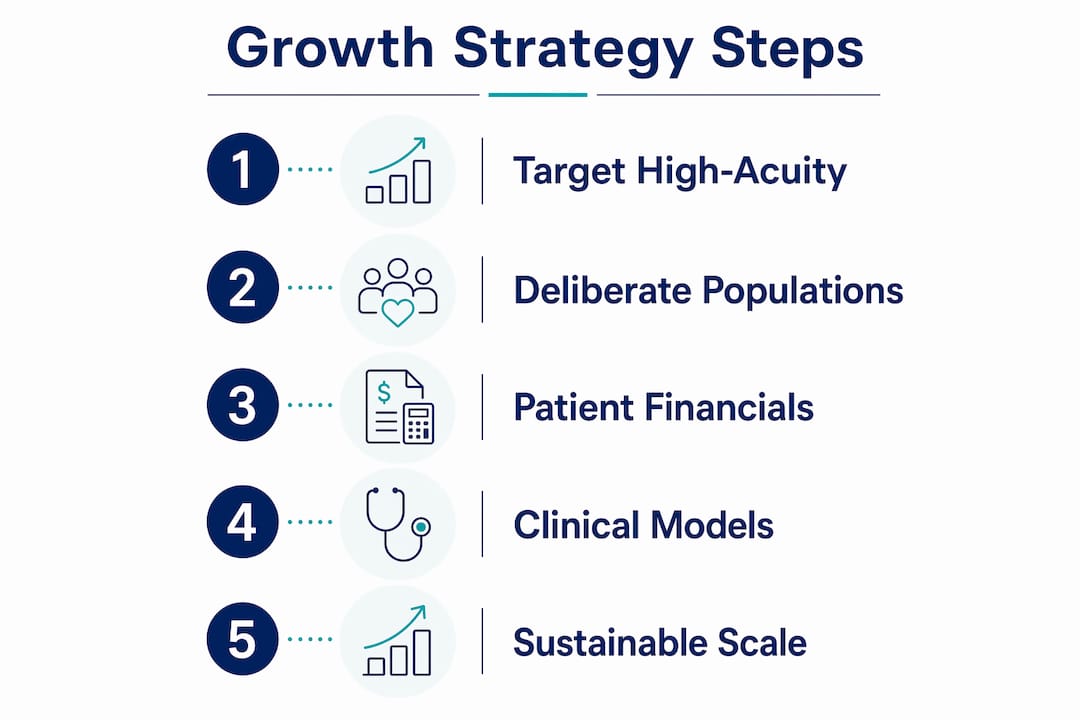
The financial case for patience is compelling. Gross profit per member grows from $90 for new members to $230 at Year 5 and beyond in capitated models. That trajectory rewards organizations that build the clinical infrastructure to retain and manage members over time, not those that chase enrollment numbers alone.
What prerequisites are needed to evaluate coverage growth strategies?
Before selecting or scaling a growth strategy, executives need a clear picture of four data inputs. Missing any one of them produces a flawed model.
| Data Input | Why It Matters |
|---|---|
| Membership demographics and acuity | Determines clinical resource requirements and risk-adjusted revenue projections |
| Claims data and utilization patterns | Reveals cost drivers and identifies where clinical intervention reduces spend |
| Risk adjustment scores (HCC, RAF) | Directly affects capitated payment rates and margin forecasting |
| Physician workforce supply and turnover | Sets realistic timelines for market entry and clinical capacity ramp-up |
Proactive physician workforce planning is a critical but often overlooked factor in successful healthcare growth strategy execution. Most organizations finalize their growth targets before asking whether the physician supply exists to support them. That sequence creates execution risk that no amount of financial modeling can fix after the fact.
Specialty-specific recruitment timelines matter here. Primary care physicians in capitated markets can take 9–18 months to recruit and credential. Behavioral health and geriatric specialists take longer in many geographies. Your growth timeline must account for these realities before you commit to a market entry date.
Risk modeling is the third prerequisite. Soft insurance market conditions are uneven, especially for healthcare liability, which requires specialist placements and precise risk analysis. Generic expansion assumptions about liability costs will understate your actual risk exposure in new markets.
Pro Tip: Build your physician recruitment pipeline 12–18 months ahead of your projected market entry date. Recruitment leadership should sit at the growth strategy table, not receive the plan after it is finalized.
What are the steps to execute a covered lives growth strategy evaluation?
A rigorous evaluation follows five sequential steps. Skipping any step creates gaps that surface as operational failures after launch.
-
Define member growth targets and clinical deployment readiness. Set specific membership targets by market, payer mix, and acuity tier. Then audit your current clinical infrastructure against those targets. Identify gaps in provider capacity, care management staffing, and technology before committing to a launch date.
-
Align physician staffing and recruitment pipeline to growth goals. Integrating physician recruitment into organizational growth planning improves execution timelines and recruitment success rates. Map your projected member growth to provider-to-member ratios by specialty. Build a recruitment pipeline that accounts for credentialing timelines, market competition, and turnover rates in the target geography.
-
Conduct detailed risk and financial modeling to project margin impact. Model your medical loss ratio at three membership scenarios: base, upside, and downside. Include risk adjustment revenue projections using current Hierarchical Condition Category (HCC) coding performance. Factor in healthcare liability costs using specialist underwriting analysis rather than market averages.
-
Evaluate market and operational capabilities for geographic or service expansion. Assess whether your franchise playbook, including clinical protocols, call center scripts, claims workflows, and utilization management criteria, can be deployed in the new market without modification. If it requires significant customization, the market may not be ready for your model, or your model may not be ready for that market.
-
Use continuous metrics to monitor cohort maturation and membership mix evolution. Track gross profit per member by cohort year. Monitor acuity ramp-up cycles as new members mature into your care model. Watch your membership mix for drift toward lower-acuity populations that compress margin. A population health strategy built on continuous measurement catches these shifts before they become financial problems.
What challenges arise during covered lives growth evaluations?
The most common failure mode is misalignment between membership growth targets and clinical workforce capacity. Organizations set aggressive enrollment goals, then discover six months before launch that the physician supply in the target market cannot support the projected panel sizes. The result is delayed launches, member dissatisfaction, and quality metric deterioration.
Undisciplined volume growth is the single fastest path to margin erosion in capitated healthcare models. When you grow faster than your clinical infrastructure can absorb, your medical loss ratio rises, your risk adjustment performance falls, and your embedded earnings potential resets to zero with every new cohort.
Risk adjustment complexity is consistently undervalued during strategy assessment for growth. HCC coding accuracy directly determines your capitated payment rate. Organizations entering new markets often inherit provider networks with poor coding documentation practices. That gap takes 12–24 months to close, and it depresses revenue during the exact period when you are investing most heavily in market entry.
Operational scaling in new geographies surfaces a different problem: the assumption that what worked in Market A will work in Market B without modification. Clinical and operational competencies must be standardized and reproducible across all geographic footprints to achieve scale. That standardization requires documentation, training, and governance structures that many organizations have not built before they attempt expansion.
Avoiding common go-to-market mistakes in healthcare requires treating your clinical deployment model as a product, not a process. Products get documented, tested, and iterated. Processes get improvised.
Key Takeaways
Effective covered lives growth strategy evaluation requires aligning clinical deployment models, physician workforce planning, and risk-adjusted financial modeling before committing to membership growth targets.
| Point | Details |
|---|---|
| Franchise clinical models drive scale | Standardize clinical resources, claims, and utilization management before entering new markets. |
| Target high-acuity populations first | C-SNP, dual-eligible, and LIS members generate higher long-term margin as cohorts mature. |
| Physician workforce planning is a prerequisite | Recruit 12–18 months ahead of market entry to avoid clinical capacity gaps at launch. |
| Risk modeling must be market-specific | Use specialist underwriting and HCC coding analysis, not generic expansion assumptions. |
| Cohort maturation compounds earnings | Gross profit per member grows from $90 at enrollment to $230 at Year 5 in capitated models. |
What I've learned from leading ACOs through growth evaluations
I spent years as Regional Executive Medical Director at Steward Health Care Network, overseeing a network of 3,000+ providers and 500,000+ covered lives. I also led ACOs serving 375,000+ covered lives and earned $17.2M in Medicare Shared Savings. That experience taught me something that most growth strategy frameworks miss entirely: the clinical model is the growth strategy.
Executives often treat clinical operations as an input to the financial model. The right sequence is the reverse. Your clinical deployment capability determines how fast you can grow, which markets you can enter, and what member mix you can sustain. Financial modeling that ignores clinical capacity constraints produces projections that look good in a board presentation and collapse in execution.
The shift toward value-based integrated growth models is not optional in 2026. The organizations winning in Medicare Advantage are not the ones with the largest marketing budgets. They are the ones with the most replicable clinical playbooks. Technology and automation, particularly in claims adjudication and care management workflows, are what make those playbooks scalable. But technology without clinical governance is just expensive software.
Cross-disciplinary collaboration between strategy, clinical, and recruitment teams is not a best practice. It is a survival requirement. If your growth strategy team does not include a physician executive and a recruitment leader, you are planning with incomplete information. Treat physician workforce planning as a strategic imperative, not an HR function. The organizations that get this right compound their earnings. The ones that get it wrong spend the next three years unwinding bad market entries.
If something in your current growth model feels misaligned, I'd welcome a conversation.
— Paul
How Thestartupmd supports your growth strategy work
Healthcare executives building or stress-testing a covered lives growth strategy need more than a financial model. They need clinical judgment at the strategy table.
Thestartupmd brings 25+ years of physician executive experience to growth strategy engagements, including direct leadership of ACOs, Medicare Advantage programs, and value-based care networks. Paul Bergeron, MD, MBA, works with health systems, ACOs, and digital health organizations to align clinical deployment models with membership growth targets, physician workforce planning, and risk-adjusted financial projections. Explore the full range of consulting services available for healthcare organizations at every stage of growth. If your strategy needs a credible clinical voice, that is exactly the gap Thestartupmd is built to close.
FAQ
What is covered lives growth strategy evaluation?
Covered lives growth strategy evaluation is the process of assessing whether an organization's clinical, operational, and financial capabilities can support a larger member population without degrading quality or margin. It combines population health modeling, physician workforce planning, and risk-adjusted financial analysis.
Why do franchise clinical models outperform volume-based growth?
Franchise clinical models standardize care delivery across markets, which produces predictable quality and cost at scale. Volume-based growth without clinical standardization leads to rising medical loss ratios and margin erosion as member acuity outpaces clinical capacity.
How does cohort maturation affect covered lives financial performance?
Gross profit per member grows from $90 for new members to $230 at Year 5 and beyond in capitated models. Organizations that retain and manage high-acuity members over time compound their embedded earnings rather than resetting margins with each new enrollment cycle.
When should physician recruitment begin in a growth strategy?
Physician recruitment should begin 12–18 months before the projected market entry date. Specialty-specific credentialing timelines and market competition make late-stage recruitment a leading cause of delayed launches and clinical capacity gaps.
What role does risk adjustment play in coverage growth strategies?
Risk adjustment scores, particularly HCC coding accuracy, directly determine capitated payment rates and margin forecasting. Organizations entering new markets often inherit poor coding documentation practices, which can depress revenue for 12–24 months after launch.