
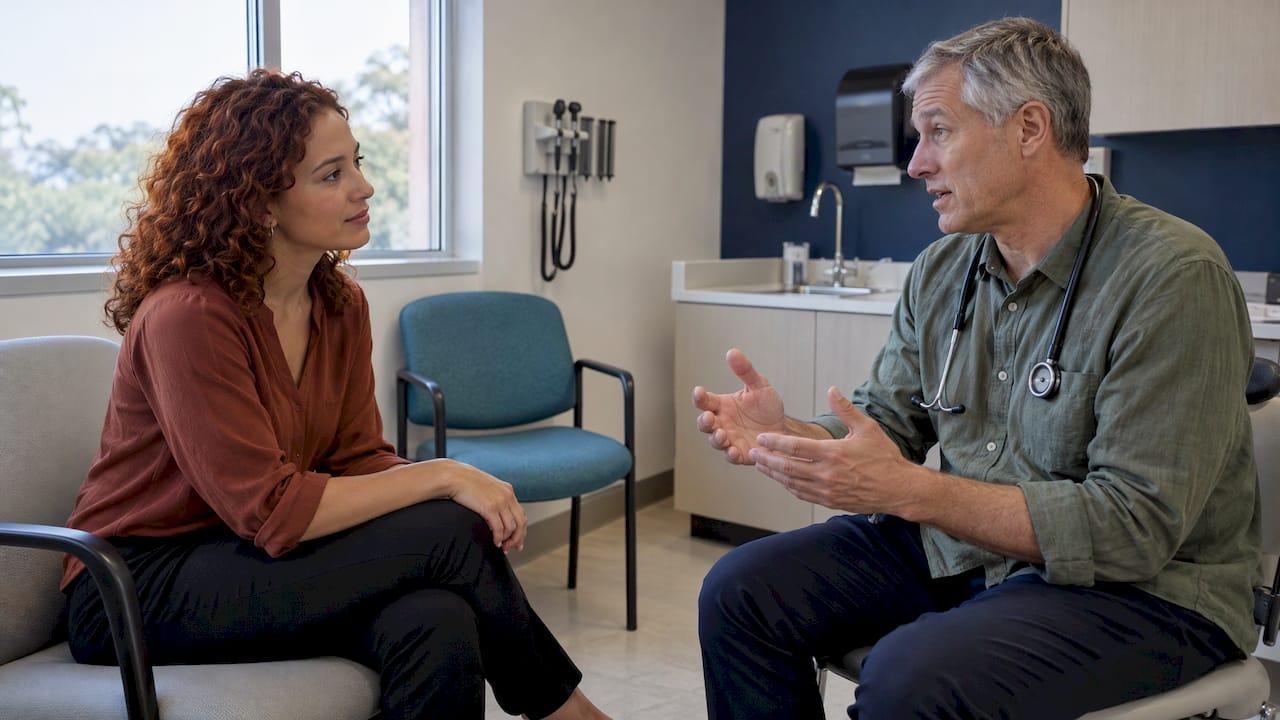
Customer discovery in healthcare is the work of proving that a real, urgent problem exists, that someone with a budget will pay to solve it, and that your product can fit the clinical workflow before you build much of anything. It is harder than in other software categories because the person who feels the pain, the person who approves the purchase and the person who can block the rollout are rarely the same. Founders who bring clinical judgment to the interviews, whether through a cofounder or a fractional Chief Medical Officer, get to usable answers faster and avoid learning the wrong lesson from a polite room.
This guide is written for healthtech founders, healthcare SaaS leaders and the investors who back them. It covers who to interview, how to ask, how to read what you hear and when to stop.
TL;DR
- Healthcare discovery has to map at least four seats: user, champion, economic buyer and blocker. Interviewing only the enthusiastic clinician is the most common failure.
- Ask about the last time the problem happened, not whether someone would use your tool. Past behavior is evidence. Future intent is a guess.
- Plan for at least 15 interviews, and expect patterns to show somewhere between 10 and 20. Stop when the messages repeat.
- Score findings on urgency, buyer clarity, workflow fit, regulatory exposure and budget path. Enthusiasm alone is not a signal.
- A physician leader in the room changes who will talk to you and how candid they are. That is the gap a fractional CMO is built to close.
Table of Contents
- What customer discovery means in healthcare
- Step 1: Define the customer narrowly
- Step 2: Map the stakeholders
- Step 3: Write hypotheses worth testing
- Step 4: Recruit interviewees
- Step 5: Ask questions that do not lead
- Step 6: Run the interviews in two stages
- Step 7: Decide whether the problem is real
- Step 8: Turn interviews into business decisions
- Common mistakes in healthcare discovery
- Bring clinical leadership into your discovery
- FAQ
- Sources
What customer discovery means in healthcare
Customer discovery is the structured process of identifying and validating the problem, the market and the viability of a solution before heavy development spend. In medtech and healthtech, that includes the urgency of the problem and willingness to pay, the stakeholders who experience and fund it, the clinical workflow, the budget and the current alternatives.
Three features separate it from general customer research:
- Split roles. The user, the buyer and the influencer are different people with different incentives.
- Workflow reality. A tool that adds ninety seconds to a nurse's shift handoff dies no matter how good the demo looked.
- Long adoption chains. Procurement, IT security, compliance and clinical governance all get a vote.
Researchers who applied customer discovery to a chronic disease app found the same thing. Adoption needed value for several segments at once: patients as end users, medical center leaders or insurers as decision makers, and clinicians and caregivers as influencers who can champion or sabotage. The study also noted that 6 in 10 US adults have a chronic disease and 4 in 10 have two or more, which is why so many digital health ideas target the same crowded space.
Step 1: Define the customer narrowly
Before a single call, write down who the primary customer is. The University of Minnesota's medical device handbook advises being specific: "interventional cardiologist" rather than "doctor". The same source asks you to answer seven questions up front: purpose, who to interview by title or role, how many, how to find them, what to ask, how to analyze results and the timeline.
Where it goes wrong: founders say "clinicians" and end up with a pile of conversations that do not point the same way. An emergency physician, a hospitalist and an ambulatory nurse manager experience the same product category in completely different ways.
Where clinical leadership helps: a physician advisor knows which role actually owns a given workflow problem and which titles only sound relevant. Our fractional CMO and clinical strategy work gives you direct access to an advisor with both clinical and business expertise, which is useful at exactly this point.
Step 2: Map the stakeholders
A useful discovery map for healthtech has end users such as clinicians, nurses and patients; influencers such as caregivers, hospital technicians and IT; economic buyers such as hospital purchasing teams and payors; distributors and strategic partners; legal and IP advisors; and regulators.
For a healthcare SaaS company selling to a health system, a simpler working version looks like this:
| Seat | Who it usually is | What you need from them |
|---|---|---|
| User | Clinician, nurse, front-line staff | Where the workflow breaks, what workarounds exist |
| Champion | Mid-to-senior clinical or operational leader | Whether the problem is on their priority list |
| Economic buyer | CFO, department head, procurement lead | Budget, approval path, evidence required |
| Blocker | IT security, compliance, skeptical senior clinician | What would make a pilot impossible |
Venture investors know the buyer problem well. One health care VC points out that the people who make purchasing decisions at scale, hold the budget and are accountable for implementation may differ from the people who joined your pilot. A glowing pilot with the wrong sponsor is not product-market fit.
Where it goes wrong: the economic buyer and the blocker are the hardest to reach and the easiest to skip. Skipping them postpones the hardest answer until after you have spent the money.
Step 3: Write hypotheses worth testing
Good hypotheses are specific enough to be wrong. Start with a short product concept, then write out how you think the customer experiences the problem today. NC IDEA recommends a detailed journey hypothesis of the problem before you interview, then testing it against what people tell you.
Specificity matters most with the problem statement. A Georgia Innovation piece on health-tech validation argues that the problem has to be documented at a specific moment of workflow failure: who notices first, what triggers action, where handoffs fail and what consequence matters. "Diagnostic support" is a category. A nurse at shift change who cannot tell whether a flagged result was already acted on is a problem.
A short hypothesis sheet for a healthcare SaaS product might hold:
- The specific user and the specific moment of failure.
- The current workaround and who performs it.
- The buyer who owns the budget for that workaround.
- The outcome that buyer measures, such as minutes saved, denials avoided or readmissions reduced.
- The condition that would prove you wrong.
Step 4: Recruit interviewees
Expect your network to be tested. The Minnesota handbook lists friends, professors, LinkedIn and patient advocacy groups as starting points, and notes that finding interviewees will test the extent of your professional network.
Healthcare adds two obstacles. Physicians have little time, and administrators and procurement leaders rarely answer cold outreach. Warm introductions from a trusted clinician carry far more weight than a polished message from a founder nobody knows.
This is where a clinical cofounder or advisor changes the economics of discovery. If you are still looking for one, our guide on how to find a clinical cofounder walks through the search. If you need clinical credibility now, without a permanent hire, a fractional CMO is the practical route.
How many? The sources give a consistent range. NC IDEA recommends at least 15 interviews, continuing until the messages are consistent. Minnesota suggests looking for commonality after 10 to 20. A published health IT case study ran 55 interviews in six weeks across orthopedic doctors, physical therapists, pharmacists, vendors and patients. More segments means more interviews.

Step 5: Ask questions that do not lead
The single most useful rule is to ask about the past, not the future. "Would you use a tool that does this?" invites politeness. "Tell me about the last time this happened" invites a story.
Carnegie Mellon's NSF I-Corps guide suggests prioritizing five questions and preparing five or more backups, including what a typical day looks like, the top three challenges and how often they occur, a story about the last time the challenge happened, what the person has done to solve it, and who has to approve purchases.
For healthcare, adapt them by seat:
For clinicians and nurses
- Walk me through the last time this slowed you down.
- What do you do to work around it when you are short on time?
- Who else is involved, and what do they need from you?
For operational and clinical leaders
- What happens if nothing changes?
- Who would object to changing this?
- What would make a pilot impossible here?
For economic buyers
- How is this problem funded today?
- What evidence would your organization need before adoption?
- Who has to approve it, and what does that process look like?
The last buyer question comes from the Georgia Innovation guidance, where the author says it separated real buyers quickly.
Keep clinicians from getting defensive
A peer-reviewed health IT study found that shifting the focus to flaws in the system rather than the person's own work helped avoid defensiveness when interviewing clinicians. Ask "How could patient care be improved here?" instead of "What are you doing wrong?"
There is also an obvious point about privacy. Do not ask interviewees for patient names or other identifiable details, and keep recordings and notes restricted. If a conversation might touch protected health information, involve your compliance counsel before you start.
Step 6: Run the interviews in two stages
The Veeva practitioners' guidance describes two rounds: broad, open-ended pain-point interviews first, then a return to the key stakeholders to validate the solution, with one person leading and one taking notes. The Minnesota handbook describes the same arc as needs finding, concept reactions and working prototype reactions. In the first stage you do not pitch. You observe and listen.
Two habits make the evidence usable:
- Review notes immediately after each interview, while the details are fresh.
- Record where permitted, and keep direct quotes. NC IDEA recommends recording interviews so hypotheses are backed by the customer's own words.
Report results qualitatively. Minnesota's advice is to use words like "most," "several" and "few" rather than percentages, because twenty interviews are not a statistical sample.
Step 7: Decide whether the problem is real
The point of discovery is a decision. Georgia Innovation suggests scoring findings against dimensions that predict adoption: problem urgency, user access, buyer clarity, workflow fit, regulatory exposure, data access, technical feasibility, evidence burden, reimbursement or budget pathway and implementation complexity.
A simple version for a board or investor update:
| Signal | Strong | Weak |
|---|---|---|
| Urgency | Interviewees describe recent, costly incidents | Interviewees agree it is "nice to have" |
| Workarounds | Spreadsheets, extra staff, manual checks already in use | Nobody is trying to fix it |
| Buyer | A named owner with a budget line | "Someone in IT, probably" |
| Workflow fit | Fits an existing step | Needs a new role or process |
| Evidence path | Buyer states what proof they need | Evidence requirement unknown |
The Minnesota handbook adds questions for judging an unmet clinical need, including what first-hand evidence you have from clinicians and whether your solution leads to better outcomes, lower cost or both.
Be clear about what discovery does not prove. The same Georgia Innovation guidance notes that early validation does not demonstrate clinical effectiveness, regulatory clearance, reimbursement, cybersecurity readiness or procurement approval. Those are separate workstreams, and they are where clinical operations and regulatory guidance come in. Our guide to clinical operations for a healthtech startup covers that ground.
When the answer is a pivot
A disproven hypothesis is a result, not a failure. The NCI SPRINT program describes testing each business model hypothesis, such as pricing, with stakeholders, and notes that a disproven hypothesis forces a substantive pivot. Pivoting after three weeks of interviews costs far less than pivoting after a year of engineering.
Step 8: Turn interviews into business decisions
Every finding should change something: a feature priority, a target segment, a pricing model or a sales motion. Once you know the buyer and the problem, you can size the opportunity with care. When you do, date every source you use for market sizing, since healthcare figures age quickly.
Interview evidence also feeds your revenue plan. Founders who treat structured customer input as an ongoing habit, not a one-time project, tend to build better growth plans, and there is a useful discussion of how customer feedback connects to revenue growth.
For healthcare SaaS, translate findings into three artifacts:
- A one-page problem brief naming the user, the moment of failure and the cost.
- A buyer map with the champion, economic buyer and blocker for each target account type.
- A usability plan for the workflow tasks that matter most. Our piece on healthcare software usability testing shows how to start with the critical tasks.
Investors reading these artifacts see something concrete: evidence of demand, a path to a buyer and a plan for what comes next.
Common mistakes in healthcare discovery
- Talking only to champions. They like you. They do not sign the contract.
- Pitching in the first call. Once you describe your solution, the conversation becomes feedback on your idea, not a picture of their problem.
- Treating a pilot as proof. A pilot proves a user will try something. It does not prove a buyer will pay.
- Asking about price too early. Ask how the problem is funded today and who owns that budget before you float a number.
- Averaging the answers. Broad surveys can average away the moments where the failure lived. Specific stories beat scores.
What we have learned about discovery in healthcare
Most healthcare startups I meet do not lack interviews. They lack the clinical lens to know which answers matter. A founder hears "this would be great" from a nurse manager and logs it as demand. A physician hears the same sentence and asks who owns the budget, what the workaround is and which committee reviews it.
That is the difference our work is built around. The StartUp MD offers advisory services and fractional Chief Medical Officer leadership for healthcare SaaS startups, with clinical strategy, product evaluation, market readiness assessment and investor support. Clients get direct access to an advisor with both clinical and business expertise, grounded in real patient care and startup growth experience.
In discovery, that means sharper hypotheses, better questions for each seat at the table and a clearer read on whether the problem is real in the clinician's world. If something feels misaligned in your findings, I would welcome a conversation.
Paul Bergeron MD, MBA
Bring clinical leadership into your discovery
If you are planning a discovery sprint, or you have interview notes you cannot yet interpret, The StartUp MD provides advisory services and fractional Chief Medical Officer support for healthcare SaaS and healthtech companies. Engagements run as advisory projects or retainer-based fractional leadership, and they cover clinical strategy, product evaluation and market readiness assessment. Investors can also use us to pressure-test a portfolio company's evidence before the next round.
See our Fractional CMO and advisory services, or start at The StartUp MD.
FAQ
How many customer discovery interviews does a healthcare startup need?
Plan for at least 15, and keep going until the messages stop changing. NC IDEA recommends a minimum of 15, and the Minnesota handbook suggests looking for commonality after 10 to 20. If you serve several stakeholder groups, such as clinicians, administrators and payors, expect to need more in total, because each group needs its own pattern.
What is the difference between a user and a buyer in healthcare?
The user is the person who works with your product, such as a clinician, nurse or patient. The buyer controls the budget, such as a CFO, department head or procurement lead. A third group, blockers like IT security or compliance, can stop a deal that both of the others want. Your discovery work has to cover all three.
What questions should I avoid in a healthcare discovery interview?
Avoid hypotheticals and anything that pitches your solution, such as "Would you use a tool that does this?" or "Would you pay for it?" Ask about the last time the problem occurred, what the person did about it and what happened as a result. With clinicians, focus on flaws in the system rather than on their personal performance.
Can a startup do customer discovery without a clinician on the team?
Yes, but the interviews are easier to book and easier to interpret with clinical input. A physician leader knows which role owns the problem, which follow-up question matters and how a hospital actually approves purchases. A fractional Chief Medical Officer brings that perspective without a full-time hire.
When is discovery finished?
It is finished when you can name the specific user and moment of failure, the buyer with a budget, the current workaround and the evidence the buyer needs. If interviews keep returning the same answers and you can make a go, pivot or stop decision, you have what you came for. Discovery does not replace clinical validation, regulatory work or procurement.
Sources
- Customer Discovery Best Practices for MedTech Startups
- Applying Customer Discovery to a Chronic Disease Self-Management App (JMIR Formative Research, 2023)
- NC IDEA Customer Discovery guide
- Customer Discovery as the First Essential Step for Health IT System Development (JMIR, 2018)
- Gathering Customer Input, Medical Device Innovation Handbook (University of Minnesota)
- Evaluating Your Medical Device Idea, Medical Device Innovation Handbook
- Customer Discovery, iCorps Updates (Carnegie Mellon University)
- Health-Tech Idea Validation: Where Innovators Should Start (Georgia Innovation)
- Ask a health care VC: How do I scale my health tech startup? (VentureBeat)
- Customer discovery as a tool for moving behavioral interventions to market (NCI SPRINT)