

The fastest route to a credible, impact-focused population health program is a multi-stage, iterative design: assess population needs, set SMART goals, build evidence-based interventions, run a scoped pilot, then monitor and iterate continuously. That sequence, drawn from the Milliman stepwise framework, is the foundation every healthcare SaaS startup should build on before writing a single line of code or signing a payer contract.
Start here in a short initial timeframe:
- Pick a test cohort of patients with a clearly defined, impactable condition (e.g., uncontrolled Type 2 diabetes, high-risk heart failure).
- Identify a clinical champion inside your target health system before development begins, not after.
- Write 1–2 SMART KPIs that tie directly to payer contract levers (readmission rate, A1c control, ED utilization).
- Scope a pilot with an explicit go/no-go criteria over an appropriate launch period.
- Assign a data lead who owns integration, normalization, and reporting from the start.
Pro Tip: Engage your physician champion during program design to ensure adoption. Clinicians who co-design the workflow adopt it. Clinicians handed a finished product resist it.
Table of Contents
- Why a Population Health Program Matters for a Healthcare SaaS Startup
- How to Design a Population Health Program: The Five-Stage Startup Playbook
- How to Design and Run a Pilot That Actually Proves Value
- Does Your Product Enable Clinical Decisions or Create More Work?
- What KPIs Should You Track and How Often?
- Who Needs to Be in the Room from Day One?
- What Does a Startup-Led Program Actually Cost and How Long Does It Take?
- Key Takeaways
- The Gap Most Founders Don't See Until It's Expensive
- The StartupMD Can Help You Build This Right
- Authoritative Sources and Recommended Reading
Why a Population Health Program Matters for a Healthcare SaaS Startup
Health systems and payers are not buying software. They are buying outcomes. A well-designed population health strategy gives your startup a concrete ROI story: reduced admissions, lower total cost of care, and measurable quality improvement. Those are the metrics that move enterprise procurement committees.
The business case runs through several stakeholder groups simultaneously. Health system finance teams want cost reduction. Clinical leadership wants care quality and reduced clinician burden. Care management teams want workflow tools that actually fit their day. Patients want outreach that feels relevant, not generic. Your product has to serve all four audiences to close and retain enterprise accounts.
Targeted population health programs have been associated with multi-million dollar reductions in total cost of care when interventions are focused on impactable at-risk populations using analytics-driven risk stratification.
The IHI Pathways to Population Health organizes this work into four portfolios and a 10-step progression, giving your startup a recognized public-health scaffold to stand on when presenting to health system partners. That credibility shortens sales cycles.
How to Design a Population Health Program: The Five-Stage Startup Playbook
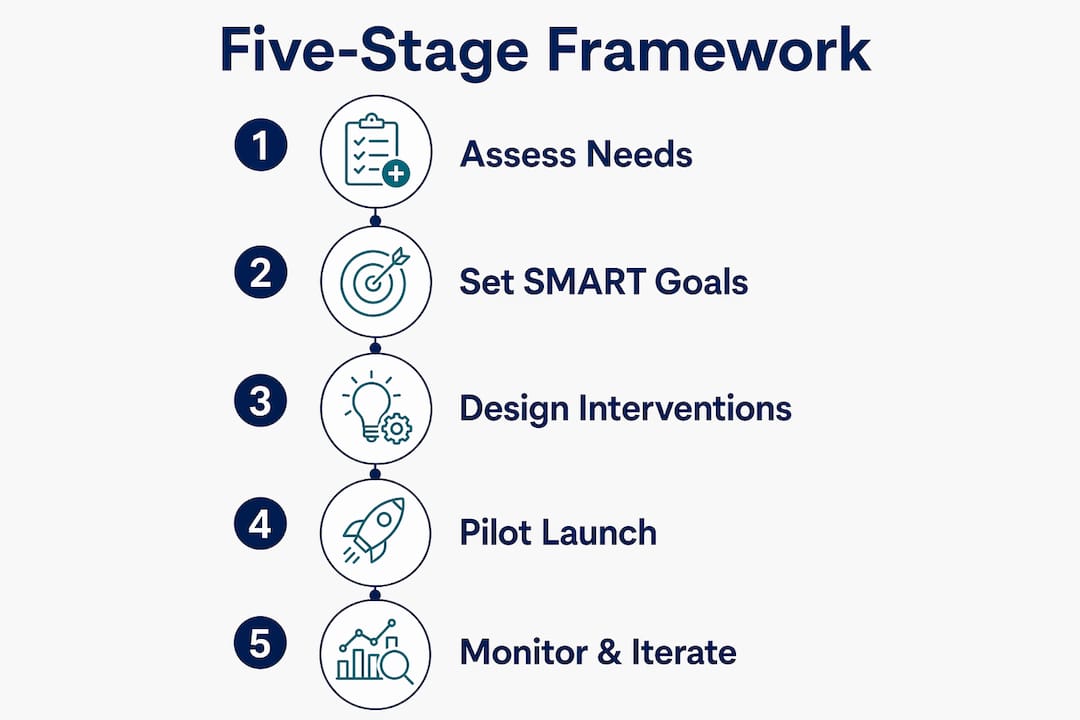
The five-stage design framework is the accepted standard for population health management program development. Here is how each stage maps to startup realities.

| Stage | Key Deliverable | Owner | Minimal Acceptance Criteria |
|---|---|---|---|
| 1. Assess population needs | Data readiness audit + cohort definition | Analytics lead + clinical champion | Data sources identified; cohort size confirmed |
| 2. Set SMART goals | KPI document with payer-aligned metrics | Product + clinical lead | 2–3 KPIs with baseline values and targets |
| 3. Design interventions | Workflow map + evidence-based protocol | Clinical lead + product | Protocol reviewed by clinical champion |
| 4. Pilot and implement | Pilot plan + training materials | Ops + product + clinical | Staff trained; integrations live; consent in place |
| 5. Monitor and iterate | Dashboard + review cadence | Analytics + ops | Weekly data review scheduled; pivot rules defined |
Stage 1: Assess population needs and data readiness. Before designing anything, confirm what data you actually have access to. Claims data, EHR feeds, and social determinants of health (SDoH) inputs each require separate data-sharing agreements. Founders consistently underestimate how long those agreements take to negotiate.
Stage 2: Set SMART goals. Vague goals kill programs. "Improve diabetes outcomes" is not a goal. "Reduce A1c above 9.0 by 1.5 points in 120 days among enrolled patients" is. Every KPI should map to a payer contract lever or a quality measure your health system partner is already reporting.
Stage 3: Design evidence-based interventions. Resist the temptation to build everything. One well-designed intervention, grounded in published evidence and adapted to your target community, outperforms a broad feature set that clinicians ignore. Design adaptable workflows that fit how clinics already operate, not how you wish they would.
Stage 4: Implement with a scoped pilot. Limit your first deployment to one site, one care team, and one cohort. The goal is learning, not scale.
Stage 5: Monitor, evaluate, and iterate. Evaluation is continuous, not a final step. Build the feedback loop into your product architecture from the start.
Pro Tip: Capture SDoH data fields during intake, even minimally. Transportation barriers and food insecurity predict readmission as reliably as clinical variables, and payers are increasingly requiring SDoH documentation in value-based contracts.
How to Design and Run a Pilot That Actually Proves Value
A process evaluation pilot run at small scale is the single best way to de-risk full deployment. Scope it to 60–120 days with a defined cohort, explicit KPIs, and a go/no-go decision point.
Pilot design checklist:
- Confirm EHR integration and data normalization before launch, not during.
- Secure data-sharing and BAA agreements at least 30 days before go-live.
- Define clinical and operational KPIs in writing before enrolling the first patient.
- Assign a dedicated care manager or clinical coordinator to the pilot cohort.
- Establish a weekly rapid-feedback loop with front-line clinical users.
- Schedule executive reviews at 30, 60, and 90 days with pre-defined go/no-go criteria.
| Role | Pilot Responsibility |
|---|---|
| Clinical champion | Validates protocols; escalates clinical issues |
| Data lead | Monitors feed quality; flags anomalies |
| Product owner | Tracks feature adoption; logs workflow friction |
| Operations lead | Manages training, scheduling, and staff questions |
| Executive sponsor | Reviews 30/60/90-day data; makes go/no-go call |
Go/no-go criteria should include: clinician adoption above a pre-set threshold, data completeness above 80%, and at least directional movement on one primary clinical KPI by day 60. If none of those are met, pause and diagnose before expanding.
Does Your Product Enable Clinical Decisions or Create More Work?
Technology must reduce clinician cognitive load, not add to it. Misalignment between product design and clinical workflow is the primary reason population health programs fail. Build your care model workflows around how clinicians already think and act.
Integration and data architecture checklist:
- EHR integration via HL7 FHIR or certified API, with SSO to minimize login friction.
- Data normalization layer to reconcile terminology across sources (ICD-10, SNOMED, LOINC).
- Consent and data-sharing agreements covering all upstream sources before any PHI flows.
- Minimal required data fields defined up front; avoid collecting data you will not act on.
- Latency SLAs for real-time alerts (under 15 minutes for high-acuity triggers is a reasonable target).
- HIPAA-compliant data storage, audit logging, and role-based access controls.
A simple data flow runs: source systems (EHR, claims, labs, SDoH) → ingestion and normalization → risk stratification analytics → clinician-facing alerts and care plans → closed-loop outcome capture. Every step should be auditable.
Pro Tip: Automate the alert, not the decision. Clinicians trust tools that surface the right patient at the right moment and let them act in one click. Tools that require three screens and a manual export get abandoned within 30 days.
What KPIs Should You Track and How Often?
Measure both clinical outcomes and operational efficiency. Programs that track only clinical metrics miss the cost signals payers care about. Programs that track only operational metrics lose clinical credibility.
| KPI | Why It Matters | Data Source | Frequency |
|---|---|---|---|
| A1c control rate | Core diabetes quality measure | EHR lab results | Monthly |
| 30-day readmission rate | Payer contract lever; cost driver | Claims or ADT feed | Monthly |
| ED visit rate (cohort) | Total cost of care signal | Claims | Monthly |
| Referral completion rate | Operational efficiency proxy | Care management platform | Weekly |
| Clinician time per patient | Adoption and burden indicator | Platform usage logs | Weekly |
| Patient outreach response rate | Engagement signal | Outreach platform | Weekly |
Run a weekly operational review with your data and ops leads. Hold a monthly clinical review with your champion to assess outcome trends. Bring executive-level data to a quarterly review that includes payer or health system leadership. Iteration decisions, including protocol changes and workflow adjustments, should follow the monthly clinical review, not wait for quarterly reporting.
Pair quantitative data with qualitative clinician feedback. A metric that looks flat may reflect a workflow problem, not a clinical one. Brief weekly check-ins with two or three front-line users catch those issues before they compound.
Who Needs to Be in the Room from Day One?
Appoint a clinical champion and a joint steering committee before you write your pilot protocol. That is not a governance formality. It is the mechanism by which clinical credibility transfers to your product.
Required governance roles:
- Clinical lead: owns protocol integrity and clinician escalation paths.
- Data steward: accountable for data quality, access controls, and HIPAA compliance.
- Product owner: translates clinical requirements into sprint priorities.
- Operations lead: manages training, scheduling, and day-to-day program execution.
- Finance or payer liaison: tracks cost metrics and aligns KPIs to contract terms.
Stakeholder engagement checklist:
- Hold a clinical kickoff session before pilot launch; present the protocol and invite pushback.
- Train all front-line staff on the tool and the workflow, not just the software.
- Build a structured feedback channel (weekly Slack thread or brief survey) for clinical users.
- Tie at least one staff incentive to program participation during the pilot phase.
Red flags to watch for:
- Clinician adoption below 40% after 30 days without a clear explanation.
- Data feeds arriving more than 48 hours late on a recurring basis.
- KPIs that cannot be tied to any payer contract or quality reporting requirement.
- A steering committee that has not met in more than three weeks.
For deeper guidance on physician engagement strategy, the sequencing of clinical advisory relationships matters as much as the roles themselves.
What Does a Startup-Led Program Actually Cost and How Long Does It Take?
A focused pilot to evaluation runs 3–6 months. Enterprise rollout typically follows over 6–18 months, depending on EHR integration complexity, contract negotiations, and the number of sites involved.
Major cost drivers to plan for:
- Engineering and integration: EHR API work, data normalization, and SSO are the largest variable cost in early-stage programs.
- Analytics and data operations: risk stratification models and reporting dashboards require dedicated data engineering time.
- Clinical staff time: your champion's hours are not free; budget for their involvement explicitly.
- Patient outreach: SMS, IVR, and care coordinator time for high-risk cohort engagement.
- Legal and compliance: data-sharing agreements, BAAs, and HIPAA review take longer and cost more than most founders budget.
In the pilot phase, prioritize spend on integration quality and clinical champion time. Those two inputs determine whether your data is trustworthy and whether clinicians adopt the workflow. At scale, shift budget toward analytics depth, patient outreach infrastructure, and advisory support for payer contract negotiations. Bring fractional clinical leadership on board before pilot launch if your founding team lacks direct clinical credibility. That gap shows up immediately in health system conversations.
Key Takeaways
Designing a population health program for a healthcare SaaS startup requires a five-stage iterative framework, a scoped pilot with explicit KPIs, and a clinical champion engaged before development begins.
| Point | Details |
|---|---|
| Five-stage framework | Assess, set SMART goals, design interventions, pilot, then monitor and iterate continuously. |
| Pilot scope and criteria | Run a 60–120 day pilot with a defined cohort, go/no-go KPIs, and weekly clinical feedback loops. |
| Dual KPI measurement | Track both clinical outcomes (A1c, readmission rate) and operational metrics (clinician time, referral completion). |
| Clinical champion first | Secure a physician champion before design begins; co-design drives adoption more reliably than training alone. |
| The StartupMD advisory | Engage fractional clinical leadership before pilot launch or payer contract negotiations to close the credibility gap. |
The Gap Most Founders Don't See Until It's Expensive
The most common mistake I see healthcare SaaS founders make is treating clinical engagement as a sales problem rather than a design problem. They build the product, then try to convince clinicians to use it. By that point, the workflow is already wrong, and no amount of training fixes a tool that adds clicks instead of removing them.
The Milliman framework and the IHI Pathways both make this explicit: multidisciplinary teams from day one are not optional. Clinical, operational, data, and technical voices need to be in the room during design, not during QA.
A second pattern I see consistently: founders design for the average patient in their target condition. Population health does not work that way. The patients who drive cost and outcomes are a specific, identifiable subset. Impactability modeling, not broad risk scores, tells you who to focus on. A program that targets the right 200 patients outperforms one that loosely serves 2,000.
Finally, SDoH integration is no longer a nice-to-have. Payers are writing it into value-based contracts. If your measurement framework does not capture transportation, housing, and food security at minimum, you are leaving both clinical impact and contract value on the table.
When to bring in outside advisory help: if you are entering payer contract negotiations without a clinical voice at the table, if your EHR integration is stalling a pilot launch, or if your health system partner is asking questions your product team cannot answer, those are the moments where fractional clinical leadership pays for itself quickly.
The StartupMD Can Help You Build This Right
Designing a population health program from scratch while managing product development, fundraising, and enterprise sales is a real resource constraint. The StartupMD provides fractional Chief Medical Officer services, pilot scoping, clinical advisory, integration planning, and measurement framework design, all calibrated to where you are in the startup lifecycle.
The right time to engage is before your pilot launches or before you enter payer and health system contract negotiations. Those are the two moments where clinical credibility and strategic advisory experience change the outcome most directly. Founders who wait until after a failed pilot or a stalled contract negotiation spend significantly more time and capital recovering than those who bring in the right expertise at the start.
If your program design, pilot scope, or clinical advisory structure feels misaligned with where you need to be, a scoping conversation is the right first step. Visit The StartupMD services page to see how fractional clinical leadership maps to your current stage and request a conversation.
Authoritative Sources and Recommended Reading
These are the primary frameworks and references that informed this playbook. Each one adds something distinct for a founder preparing a pilot or approaching payer engagement.
- Milliman: Population Health Management Program Development — The clearest stepwise framework for PHM program development, including the five-stage model and Triple Aim alignment. Start here.
- IHI Pathways to Population Health — Organizes population health work into four portfolios and a 10-step progression. Useful for structuring your health system partnership conversations.
- Milliman: How to Implement a PHM Programme (PDF) — Covers people, processes, and technology enablers in depth, including risk stratification and impactability modeling.
- CDC Workplace Health Program Model — A four-step program development model with governance structure guidance; useful for structuring your steering committee and evaluation cadence.
- Healthy People 2030: Public Health Program Planning — Evidence-based resource framework for intervention design; relevant when building your protocol and SDoH integration strategy.
- Healthcare Startup Regulatory Basics — A founder-facing primer on HIPAA, data-sharing requirements, and BAA basics relevant to pilot launch preparation.