

To develop a care management workflow for a digital health product, follow six steps in this sequence: define scope and outcomes, map the work system, design the data model and integrations, decide on clinical decision support, design the UI, then test, measure, and hand off to engineering.
- Define product scope, personas, jobs-to-be-done, and measurable success metrics
- Map current-state and future-state processes, swimlanes, handoffs, and cadence
- Design the minimal viable data model and prioritize integration points (EHR, payers, devices)
- Decide whether and how to embed clinical decision support (CDS)
- Design UI patterns that deliver the right information to the right user at the right time
- Build a testing plan, define KPIs, and produce engineering-ready artifacts
Pro Tip: Sequence matters. Teams that skip work-system mapping and jump straight to algorithm development almost always rebuild the data model mid-pilot. Lock the workflow and integration architecture before writing a single line of CDS logic.
Key Takeaways
Designing a care management workflow for a digital health product requires locking the work-system map and integration architecture before writing CDS logic, with CMS billing constraints enforced in the data model from sprint one.
| Point | Details |
|---|---|
| Sequence the six steps | Define scope, map the work system, design data/integrations, decide on CDS, design UI, then test and hand off. |
| Map before you build | Current-state process maps surface workarounds that become product requirements; skip this and you rebuild mid-pilot. |
| Enforce billing constraints in the data model | Separate clinical staff time from billing practitioner time in the time ledger; conflating them creates audit liability under CMS CCM rules. |
| Choose CDS last and carefully | Use the 5-item feasibility checklist; lower-fidelity solutions (templates, nudges) often outperform premature algorithms. |
| The StartupMD advisory model | Fractional CMO engagement from discovery through pilot keeps clinical and product decisions aligned at every sprint. |
Table of Contents
- How do you develop a care management workflow for a digital health product?
- Why work-system mapping comes before any feature decision
- What data model and integrations does a care management platform need?
- When should you build CDS, and when should you not?
- What UI patterns work best for care management workflows?
- What CMS billing constraints shape product decisions for CCM and APCM?
- How do you measure whether the workflow is actually working?
- What artifacts does engineering need for a clean handoff?
- What does a realistic phased timeline look like?
- What are the most common pitfalls to avoid?
- The team composition that actually works
- Advisory support for your care management product build
- Sources
How do you develop a care management workflow for a digital health product?
Start by documenting who uses the product and what they need to accomplish. For a care-management platform, that typically means three personas: the care manager (owns task execution, outreach, and documentation), the clinician reviewer (approves care plans, handles escalations), and the patient-facing user (views their plan, completes self-reported data). Each persona needs a distinct jobs-to-be-done statement tied to a measurable outcome.
Acceptance criteria should be concrete. "Enrollment" means a signed consent record exists in the system. "Task completion" means a timestamped acknowledgment is logged against a specific care-plan action. "Time-to-document" is a measurable proxy for cognitive load, not a vanity metric.
Constraints belong in scope documentation from day one:
- HIPAA and SOC 2 Type II requirements affect data storage, access controls, and vendor agreements
- EHR certification expectations matter when the workflow supports Chronic Care Management (CCM) or Advanced Primary Care Management (APCM) billing under CMS rules
- 24/7 care-plan access is a CMS requirement, not a feature request
- API availability from target EHRs limits what integration is feasible in the MVP window
- Revenue eligibility triggers (e.g., the 20-minute monthly threshold for CCM CPT 99490) must be surfaced in the product's time ledger, not left to manual calculation
Pair each constraint with an engineering implication. That single step prevents scope creep from arriving as a surprise during sprint 8.
Why work-system mapping comes before any feature decision
Process maps are not documentation artifacts. They are the primary tool for surfacing where the product actually inserts value. Use a simple template: entry trigger → tasks → owners → outputs → handoff destination. Run one swimlane per role showing responsibilities and cadence (daily, weekly, monthly).
Discovery interviews almost always surface workarounds: care managers pasting data into spreadsheets, clinicians signing off on plans they never reviewed, tasks falling through because no one owns the escalation path. Those workarounds are product requirements in disguise. If you do not capture them, you build a product that fits the stated process but not the real one.
Pro Tip: Ask care managers to walk you through the last patient they enrolled. The gap between their description and the official protocol is your product's most valuable design input.
Deliverables from this phase:
- Current-state process map (with pain points annotated)
- Future-state process map (with product touchpoints marked)
- Handoff matrix (who hands what to whom, and when)
- Role and cadence map (frequency of each task by persona)
What data model and integrations does a care management platform need?
The minimal viable data model for a U.S. care-management product should align to USCDI fields: demographics, problem list, medications, allergies, care-plan elements (goals, interventions, health concerns), and a complete audit trail. Every write operation needs a timestamp, user ID, and action type. Audit logs are not optional when the product supports billing.
Integration priorities, in sequence:
- FHIR R4 reads from the EHR (patient demographics, problem list, medications) as the first integration milestone
- FHIR R4 writes back to the EHR (care-plan updates, clinical notes) as the second
- SMART on FHIR for app launch and context-passing within the EHR environment
- CDS Hooks for event-driven logic that fires at defined EHR workflow moments (e.g., patient chart open, order entry)
- Payer data ingestion (claims, eligibility, risk scores) as a later-phase integration once the core workflow is stable
Auth patterns to plan for from the start: OAuth 2.0 and OpenID Connect underpin SMART on FHIR authorization. Token refresh cycles, consent recording, and audit logging must be designed into the data model before the first EHR integration sprint begins, not retrofitted afterward.
| Integration Layer | Standard / Protocol | Primary Use Case |
|---|---|---|
| EHR data access | FHIR R4 | Read patient records, write care-plan updates |
| App launch in EHR | SMART on FHIR | Context-aware app embedding, SSO |
| Event-driven logic | CDS Hooks | Trigger alerts or tasks at EHR workflow moments |
| Authorization | OAuth 2.0 / OpenID Connect | Secure token-based access, consent management |
| Payer data | HL7 or flat-file ingestion | Risk stratification, eligibility verification |
When should you build CDS, and when should you not?
Most early-stage care-management products build CDS too soon. The human-factors-based CDS guideline developed through iterative stakeholder consultation specifically calls out the need to assess technical feasibility and maintenance burden before committing to algorithmic decision support. That is not a caution about ambition. It is a practical constraint: CDS requires governance, clinical ownership, and ongoing maintenance that most seed-to-Series A teams cannot sustain.
Use this checklist before building CDS:
- Is the clinical problem well-defined and evidence-based?
- Does the work-system map show a clear intervention point where a prompt would change behavior?
- Does the team have a named clinical owner who will maintain the logic?
- Is the technical infrastructure (data quality, latency) sufficient to support reliable firing?
- Is the maintenance burden budgeted for ongoing sprints?
If two or more answers are "no," choose a lower-fidelity solution first. Structured templates, smart defaults, task routing rules, and nudge-style reminders often produce more behavior change with far less engineering risk. Per CDS design principles for quality improvement, effective CDS starts with understanding the work system and evaluating results using use-implementation, process-outcome, and balancing measures.
Pro Tip: The "5 Rights of CDS" (right information, right person, right format, right channel, right time) are a useful design filter. If you cannot answer all five for a proposed alert, it is not ready to build.
Non-interruptive CDS (in-context data display, pre-populated fields, background risk flags) almost always outperforms interruptive alerts on adoption and override rates. Reserve modal interruptions for genuinely time-sensitive safety signals.
What UI patterns work best for care management workflows?
The HFE process model for CDS tools emphasizes iterative prototyping with domain experts and accounting for cognitive demands. That translates directly to UI decisions. Care-management interfaces carry high cognitive load by default; the product's job is to reduce it, not add to it.
Proven UI patterns for this context:
- Focused inbox: tasks sorted by urgency and due date, not by patient name
- Role-based dashboard: care managers see task queues; clinicians see escalation flags and pending approvals
- Care-plan card: a single-screen summary of active goals, interventions, and last-contact date
- In-context quick actions: document a call, log time, or update a goal without leaving the patient record
- Escalation banner: persistent, color-coded, dismissible only after acknowledgment is logged
Wireframes should show where each data field appears and how task acknowledgment is recorded. Design acceptance criteria should center on speed and task completion, not click counts. A care manager who completes documentation in under 90 seconds is a success signal. One who opens three screens to log a phone call is a design failure.
What CMS billing constraints shape product decisions for CCM and APCM?
This is where product decisions become compliance decisions. Per CMS MLN909188, CCM requires patient consent, a comprehensive electronic care plan accessible 24/7, and documentation of the initiating visit. The product must enforce these as data fields, not as optional notes.

Time-threshold rules are precise. The CMS CCM Payment FAQs clarify the 20-minute threshold under OPPS and the distinction between time counted by clinical staff versus time attributed to the billing practitioner. A time ledger that conflates these two categories creates an audit liability.
CMS requires a minimum clinical staff time threshold per calendar month for CPT 99490 (standard CCM), with higher thresholds applying for complex CCM codes.
Engineering must preserve the distinction between clinical staff time and billing practitioner time in the data model. Letting those two values merge into a single "minutes logged" field is one of the most common and costly product mistakes in this category. Build the time ledger with separate attribution fields from sprint one.
Additional required documentation fields: consent date and method, initiating visit source, problem list snapshot at enrollment, and a transmission log for care-plan sharing. For regulatory basics that affect how these fields interact with broader compliance requirements, product teams should review the foundational framework before finalizing the data model.
How do you measure whether the workflow is actually working?
Testing a care-management workflow requires three categories of measures, not just adoption metrics.
| Measure Type | Example KPI | What It Tells You |
|---|---|---|
| Use-implementation | Adoption rate, alert override rate | Whether clinicians use the feature as designed |
| Process-outcome | Task completion rate, care-plan update frequency | Whether the workflow produces the intended clinical actions |
| Balancing | Time-to-document, alert fatigue score | Whether the product creates unintended burden |
Pilot design should specify cohort selection criteria, a defined timeframe (typically 6–12 weeks), data collection responsibilities, and pre-agreed success thresholds. A pilot without pre-agreed thresholds produces data but no decision.
Continuous improvement runs on PDSA cycles with a governance cadence: monthly metric review, quarterly workflow audit, and a named clinical owner who can authorize logic changes. Dashboards should surface all three measure types simultaneously, not just adoption.
What artifacts does engineering need for a clean handoff?
Ambiguous handoffs are the single largest source of rework in healthcare SaaS product development. Prevent them with a defined artifact set:
- Data contracts: field names, types, required/optional status, and validation rules for every entity
- API specs: endpoint definitions, auth flows, error codes, and rate limits
- Sequence diagrams: showing the order of system calls for each major workflow (enrollment, task creation, time logging, care-plan update)
- Wireframes with annotations: linked to specific data fields and audit requirements
- Edge-case test cases: covering failed auth, missing FHIR resources, time-ledger conflicts, and consent revocation
- Sample data sets: de-identified, covering happy path and edge cases
The acceptance checklist should include pass/fail criteria: all required data fields present, audit entries created for every write, auth flows validated against the SMART on FHIR spec, and performance budgets met (page load under 2 seconds for the care-plan card). The handoff template should also include rollout guardrails (feature flags, cohort limits) and explicit rollback criteria.
What does a realistic phased timeline look like?
- Discovery (weeks 0–4): work-system mapping, persona validation, integration feasibility, data model draft
- MVP build (weeks 5–16): core workflow, FHIR R4 reads, time ledger, consent capture, basic UI
- Pilot (weeks 17–28): limited cohort, all three measure types tracked, governance cadence established
- Scale (quarterly sprints): additional integrations, CDS layer, advanced analytics, payer data
Primary cost drivers, in order of impact: EHR integration complexity, CDS governance and maintenance, clinical advisory hours during discovery and pilot, security and compliance work (SOC 2, HIPAA BAAs, penetration testing), and analytics infrastructure. Teams that underestimate integration costs by treating FHIR as "plug and play" routinely miss their MVP dates by 6–8 weeks.
Typical roles needed: product manager, clinical lead, UX designer, frontend engineer, backend engineer, integration engineer, and a site reliability engineer for production. Clinical advisory hours are not optional during discovery; they are the mechanism by which product decisions stay grounded in clinical reality.
What are the most common pitfalls to avoid?
- Skipping work-system mapping: results in a product that fits the stated process but not the real one; fix by scheduling discovery interviews before any design work begins
- Overbuilding CDS before staffing governance: produces alerts no one maintains and override rates above 80%; fix by assigning a named clinical owner before the first CDS sprint
- Counting clicks as success metrics: measures activity, not outcomes; replace with task completion rate and time-to-document
- Unclear task ownership: creates gaps in the handoff matrix that become patient safety risks; fix by assigning every task type to a single role in the swimlane map
- Treating FHIR as a solved problem: EHR FHIR implementations vary significantly; budget for a feasibility sprint with each target EHR before committing to a timeline
The team composition that actually works
The most common gap I see in care-management product builds is not technical. It is clinical. Teams hire strong engineers and experienced product managers, then treat clinical input as a review step rather than a design input. That sequencing produces products that are technically sound and clinically misaligned.
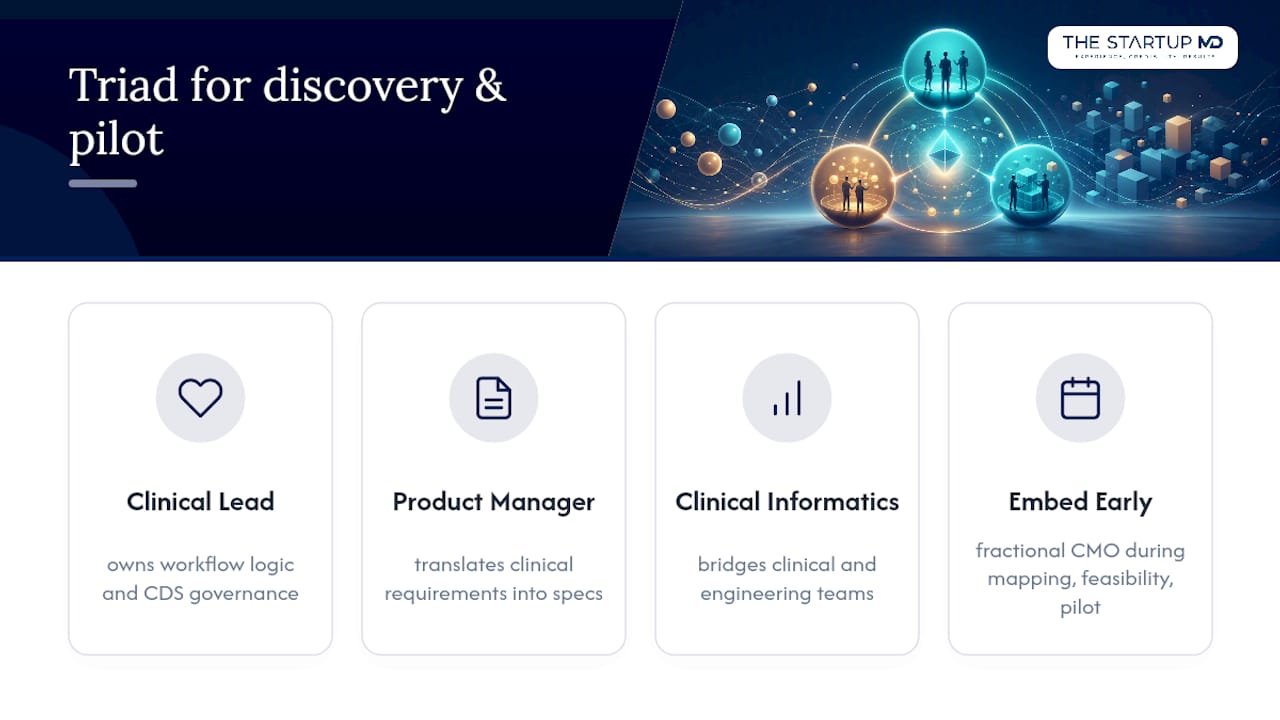
The right composition for discovery and pilot: a fractional or full-time clinical lead who owns the workflow logic and CDS governance, a product manager who translates clinical requirements into engineering-ready specs, and a clinical informatics resource who bridges the two. That triad, working together from week one, is what separates products that pass pilot from products that stall at it.
The StartupMD approaches advisory engagements by embedding clinical leadership at the product level, not as a compliance checkpoint at the end. That means fractional CMO involvement during work-system mapping, integration feasibility, and pilot design, not just at the investor deck stage. The goal is a product team that can make clinical decisions with confidence, not one that waits for a physician to approve every sprint.
Advisory support for your care management product build
Building a care-management workflow that satisfies CMS billing rules, passes clinical usability testing, and ships on schedule requires clinical leadership from the first sprint, not the last.
The StartupMD offers fractional CMO and clinical strategy advisory services specifically for healthcare SaaS teams at the discovery, MVP, and pilot stages. Engagements are scoped to the work your team actually needs: workflow mapping, CDS governance, integration sequencing, or pilot design. No retainer lock-in for work that does not fit your stage. To explore whether an advisory engagement fits your current build, start with a revenue model and product strategy review or reach out directly to schedule a scoping conversation.
Sources
- MLN909188 – Chronic Care Management Services