

EHR integration is a commercial prerequisite for any healthtech company targeting clinical workflows. Whether a product surfaces inside the electronic health record at the point of care is the single most predictive variable for provider adoption, and provider adoption is what separates a funded pilot from a scalable business. For investors evaluating healthcare SaaS, understanding how EHR integration works is not a technical nicety. It is a diligence requirement.
TL;DR for investors:
- Products that require a separate login or portal are routinely abandoned by clinicians, regardless of clinical value. Provider adoption stalls are frequently an integration problem, not a product problem.
- Integration depth directly affects CAC, LTV, and churn. Embedded workflows retain users; standalone apps do not.
- Time-to-first-revenue compresses when a product can connect to a new EHR in weeks rather than months.
- Standards compliance (FHIR, HL7, SMART on FHIR) determines portability and certification risk across your portfolio.
- Integration debt is a valuation haircut at exit. Acquirers price it in.
The single most important diligence question: "Can your product surface inside the EHR at the point of care, and how many production EHR connections do you have live today?"
This article covers the architecture, standards, cost drivers, ROI modeling inputs, and a granular due-diligence checklist. By the end, you will have a working framework for evaluating integration maturity in any healthtech deal.
Table of Contents
- What EHR integration actually covers and who it touches
- Core technical components every investor should be able to map
- How EHR integration creates measurable investor value
- What are the main EHR integration patterns, and which signals product maturity?
- Standards every investor should recognize: FHIR, HL7, SMART, CDA, and DICOM
- Common risks that erode ROI and how to pressure-test them
- How to model ROI and time-to-value for EHR integration projects
- Investor due diligence checklist for EHR integration maturity
- What successful integrations do differently, and what it means for M&A
- Key Takeaways
- What the market keeps getting wrong about EHR integration
- The StartupMD helps investors evaluate and de-risk EHR integration
- Authoritative sources and further reading for diligence
What EHR integration actually covers and who it touches
EHR integration, in clinical and commercial practice, refers to the bidirectional exchange of structured health data between a third-party product and one or more electronic health record systems. The key word is bidirectional. Read-only access to patient context is a starting point. Write-back capability, meaning the ability to push orders, notes, results, or referrals back into the EHR, is where clinical workflow value is created and where defensibility is built.

The scope is broader than most founders initially plan for. A typical integration touches inpatient EHRs (Epic, Oracle Health), outpatient platforms, health information exchanges (HIEs), ancillary systems such as laboratory and radiology, revenue cycle management (RCM) tools, and scheduling systems. On the human side, it involves clinicians who need the product to appear in their existing workflow, IT and informatics teams who govern access and security, and compliance officers who own HIPAA and ONC obligations.
The data flows investors should care about most include:
- Patient context (demographics, problem list, medications, allergies) pulled at launch
- Orders and results (lab orders, imaging requests, result delivery)
- Referrals and care transitions (referral creation, status tracking, specialist notes)
- Scheduling events (appointment creation, no-show flags, follow-up triggers)
- Billing and coding events (charge capture, diagnosis codes, prior authorization triggers)
Concrete use cases that demonstrate scope: a care-gap closure tool that reads a patient's preventive care history and writes a standing order back into the EHR; a medication reconciliation app that pulls the current medication list and flags discrepancies at the point of prescribing; a specialist referral platform that creates a referral record in the primary care EHR and tracks acceptance status in real time. Each of these requires both read and write access, vendor approval, and ongoing maintenance as the EHR vendor updates its API.
Core technical components every investor should be able to map
Understanding the architecture does not require an engineering background. It requires knowing which components drive cost, which drive risk, and which signal product maturity.
Architecture elements that determine effort and cost:
- FHIR endpoints (HL7 FHIR R4 is the current production standard): the API surface through which modern EHRs expose patient data. Compliance with ONC's 21st Century Cures Act mandates that certified EHRs expose FHIR APIs, but implementation quality varies significantly across vendors.
- OAuth 2.0 / SMART on FHIR authorization: the authentication layer that governs which apps can access which patient data and under what conditions. Without it, a product cannot launch inside the EHR.
- Vendor-specific APIs: Epic's App Orchard, Oracle Health's App Market, and similar programs require separate certification, approval timelines of 3–12+ months, and ongoing compliance with each vendor's terms.
- HL7 v2 interfaces: the legacy messaging standard still dominant in inpatient environments for ADT (admit/discharge/transfer) feeds, lab results, and orders. Requires interface engines or middleware to parse.
- Middleware and integration platforms: third-party tools (Mirth Connect, Rhapsody, and commercial no-code platforms) that translate between standards and manage connection logic. They accelerate initial deployment but introduce per-transaction fees that scale poorly.
- On-premises connectors: required for health systems that have not moved to cloud-hosted EHR environments. Adds deployment complexity and ongoing support overhead.
- Data normalization layers: logic that maps inconsistent vendor-specific coding to standard terminologies (SNOMED, LOINC, RxNorm) so the product can reason across multiple EHR sources.
Product-surface considerations that affect adoption:
- Embedded UI vs. standalone app: a product that launches inside the EHR via SMART on FHIR appears as a native panel. A standalone app requires a separate browser tab and a separate login. The friction difference is not trivial.
- Single Sign-On (SSO): clinicians will not manage a second set of credentials. SSO via SAML or SMART launch is a minimum bar for enterprise sales.
- Write-back capability: the ability to push structured data back into the EHR (notes, orders, referrals) is what creates workflow lock-in and defensibility.
Ongoing cost signals to flag in diligence:
- Per-connection engineering effort (each new EHR environment typically requires custom configuration)
- Vendor approval timelines (Epic App Orchard approval alone can take 6–12 months)
- Per-transaction middleware fees that compound with volume
- API version churn requiring quarterly maintenance sprints
- Certification renewal as ONC updates USCDI requirements
How EHR integration creates measurable investor value
Integration is not just a technical feature. It is the mechanism through which a healthtech product earns and keeps clinical adoption, and clinical adoption is what drives the unit economics investors model.
The value levers are specific:
- Provider adoption: clinicians adopt products that live in their workflow. Products that require context-switching are deprioritized within weeks of go-live.
- Referral flow and revenue capture: integrated referral tools that write back into the EHR capture referrals that would otherwise leak to out-of-network providers.
- Retention and LTV: embedded products are harder to remove. Switching costs rise with every workflow dependency the product creates.
- Time-to-revenue: a product that can connect to a new health system in weeks rather than months compresses the sales cycle and accelerates ARR recognition.
- Clinical outcomes that support reimbursement: integration enables the data capture required for value-based care contracts, quality reporting, and risk adjustment.
The empirical evidence is meaningful. A JMIR mixed-methods cohort study found that integrating EMR systems between primary and specialist care reduced specialist wait times by an average of 16.5 days and reduced certain procedures and tests by between 4.08% and 39.7%. Those are not marginal improvements. They are the kind of outcomes that support reimbursement arguments, population health contracts, and health system ROI narratives.
| Outcome Metric | Measured Impact | Source |
|---|---|---|
| Specialist wait time reduction | 16.5 days average | JMIR cohort study |
| Procedure/test reduction range | 4.08%–39.7% | JMIR cohort study |
| Provider adoption (embedded vs. standalone) | Embedded products scale; standalone products stall | Arrowhealth |
| Time-to-first-connection (middleware) | Weeks vs. months for vendor APIs | Monterail |
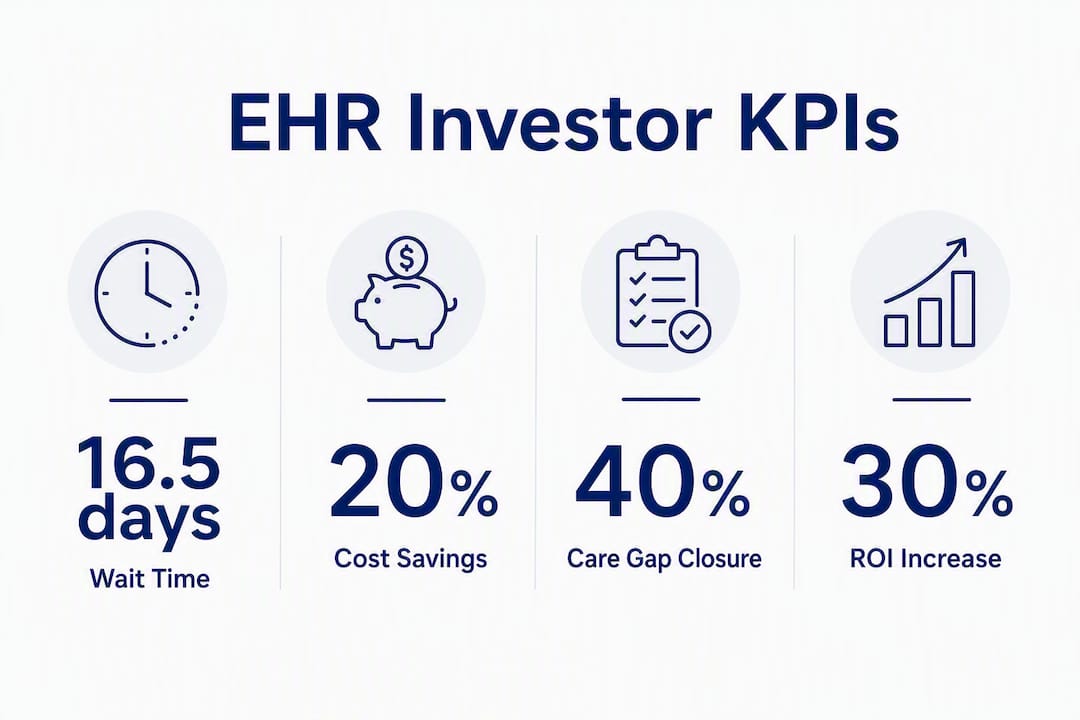
From an investor modeling perspective, integration maturity maps directly to the KPIs that determine valuation. Lower CAC comes from faster implementation cycles. Higher LTV comes from reduced churn in embedded products. Faster time-to-scale comes from multi-EHR infrastructure that maps to dozens of environments without rebuilding from scratch for each new health system.
Bain's 2026 Global Healthcare Private Equity Report documents that top HCIT investments are increasingly judged on a "Rule of 60", the sum of revenue growth rate and EBITDA margin. Integration-driven adoption improvements move both variables simultaneously: faster revenue growth from shorter implementation cycles and better margins from reduced churn and support costs.
What are the main EHR integration patterns, and which signals product maturity?
The choice of integration pattern is one of the most consequential architectural decisions a healthtech founder makes. Each pattern carries different time-to-market, cost, and scalability implications.

| Pattern | Best For | Time to First Connection | Ongoing Cost Profile | Key Risks |
|---|---|---|---|---|
| SMART on FHIR | Read-only patient context; embedded app launch | Weeks to months | Low per-connection; certification overhead | Vendor compliance variance; limited write-back |
| Vendor-specific APIs (Epic, Oracle Health) | Deep write-back; workflow-specific integrations | 3–12+ months including certification | Moderate; vendor approval required per environment | Long approval timelines; vendor lock-in risk |
| Middleware / integration platforms | Multi-EHR coverage at early stage; HL7 v2 translation | Weeks (initial); ongoing per-transaction fees | Per-transaction fees scale poorly at volume | Cost structure erodes margins at scale |
| HL7 v2 adapters | Legacy inpatient environments; ADT feeds, lab results | Weeks to months | Moderate; interface engine licensing | Requires ongoing parsing maintenance |
| Custom on-premises connectors | Health systems with on-prem EHR deployments | Months | High; dedicated support required | Deployment complexity; version drift |
Monterail's practitioner guide frames the strategic logic clearly: SMART on FHIR is standardized and portable, vendor APIs enable deep write-back but require vendor-specific certification work, and middleware accelerates multi-EHR coverage at early stage but imposes recurring costs that compound with volume.
The pattern that signals product maturity is a hybrid architecture: FHIR for read access and patient context, combined with vendor-specific APIs for deep write-back and workflow-specific integrations. Early-stage teams often start with middleware to accelerate time-to-market, which is a reasonable tactical choice. The signal investors should look for is whether the team has a documented plan to migrate toward direct connectors as volume grows, or whether they are locked into a per-transaction cost structure with no exit path.
Pro Tip: Ask the founding team to show you their integration roadmap, not just their current connections. A team that can articulate which connections they will migrate from middleware to direct FHIR as they scale understands their cost model. A team that cannot is carrying hidden margin risk.
Standards every investor should recognize: FHIR, HL7, SMART, CDA, and DICOM
Standards compliance is where marketing claims diverge most sharply from production reality. Every healthtech pitch deck mentions FHIR. Far fewer companies have production FHIR connections with write-back capability and live EHR launch approvals.
The standards that matter and what they actually guarantee:
- HL7 FHIR (Fast Healthcare Interoperability Resources): the current federal standard for API-based health data exchange. FHIR R4 is the production baseline. It defines how patient data is modeled as discrete resources (Patient, Observation, MedicationRequest) and how APIs expose them. The ONC's nationwide interoperability roadmap has made FHIR the foundation of federal interoperability policy.
- HL7 v2: the legacy messaging standard that predates FHIR and remains dominant in inpatient environments for real-time event feeds (ADT, lab, radiology). Most health systems run both HL7 v2 and FHIR in parallel.
- SMART on FHIR: the authorization and launch framework built on top of FHIR. It defines how third-party apps authenticate, what patient data they can access, and how they launch inside an EHR context. Without SMART on FHIR compliance, a product cannot appear as an embedded panel in Epic or Oracle Health.
- CDA (Clinical Document Architecture): an HL7 standard for structured clinical documents (discharge summaries, referral letters, care plans). Relevant for products that consume or produce clinical documentation.
- DICOM: the standard for medical imaging data. Relevant for radiology, pathology, and any product that processes or displays diagnostic images.
What "FHIR-ready" typically means in production: a company claiming FHIR readiness should be able to show sandbox credentials, a list of production EHR environments where the connection is live, and evidence of SMART launch approval from at least one major EHR vendor. The USCDI v3 (United States Core Data for Interoperability) defines the minimum data set that certified EHRs must expose via FHIR APIs. A product that only reads USCDI v3 data elements has a narrower integration than one that also reads and writes extended data sets.
The practical diligence question: ask for a demo of the product launching inside the EHR, not a standalone demo. If the team cannot show you an in-EHR launch, the FHIR claim is aspirational.
Common risks that erode ROI and how to pressure-test them
Integration risk is where the gap between a compelling pitch and a fundable business most often lives. The risks are specific and manageable, but only if they are identified before term sheet.
Risk map for investors:
- Vendor lock-in: building exclusively through a single EHR vendor's API program creates dependency on that vendor's pricing, approval timelines, and roadmap decisions. A product that only works in Epic environments is not a scalable business.
- Vendor approval timelines: Epic App Orchard and Oracle Health's certification processes can take 6–12 months. A company that has not started this process is 12 months further from enterprise revenue than their pipeline suggests.
- Per-transaction middleware costs: no-code integration platforms charge per-transaction fees that become prohibitive as volume grows. A company processing millions of transactions monthly on a per-transaction model may be generating revenue while destroying margin.
- Heterogeneous data models: different EHR vendors implement FHIR differently. A product that works perfectly in one Epic environment may fail in an Oracle Health environment because of vendor-specific extensions and coding variations.
- Change management and staff adoption: even a technically perfect integration fails if clinical champions are not identified and engaged before go-live. Products that IT deploys without physician involvement rarely achieve meaningful utilization.
- HIPAA and security exposure: every integration that touches protected health information (PHI) requires a Business Associate Agreement (BAA) with the EHR vendor and compliance with HIPAA Security Rule requirements. A missing BAA is a regulatory liability that can block enterprise sales.
- Pilot purgatory: a product with one or two pilot integrations that have never converted to production contracts is not an integrated product. It is a proof of concept with a long sales cycle.
Pro Tip: The pilot-purgatory scenario is more common than most pitch decks acknowledge. A product that has been "in pilot" with a major health system for 18 months without a production contract has almost certainly encountered an integration problem, a workflow adoption problem, or both. Ask specifically: how many of your current integrations are in production versus pilot, and what is the average time from pilot go-live to production contract?
A practical example of how this plays out: a care coordination startup completes a successful clinical pilot with a regional health system, demonstrating measurable outcomes. The health system's IT team then requires the product to integrate with their on-premises Oracle Health environment rather than the cloud Epic environment used in the pilot. The team had no on-premises connector, no Oracle Health certification, and no dedicated integration engineer. The deal stalled for 14 months. That is not a clinical failure. It is an integration assumption that was never stress-tested.
For a deeper look at how these go-to-market assumptions create commercial friction, the common healthtech go-to-market mistakes resource covers the pattern in detail.
How to model ROI and time-to-value for EHR integration projects
ROI modeling for EHR integration requires separating one-time build costs from recurring operational costs, then mapping both against the revenue and retention benefits that integration enables. Most founders undermodel the recurring side.
-
Engineering cost per connection: budget for initial build, testing, certification, and go-live support. Direct FHIR connections to a single EHR environment typically require weeks to months of engineering time. Vendor API certifications (Epic, Oracle Health) add 3–12+ months of process overhead on top of engineering.
-
Vendor program fees: Epic App Orchard, Oracle Health's marketplace, and similar programs charge application fees, annual maintenance fees, and in some cases revenue-share arrangements. These are contractual obligations that belong in the cost model.
-
Middleware per-transaction fees: if the company uses a no-code integration platform, request the current per-transaction rate and model it against projected transaction volume at 12, 24, and 36 months. The cost curve can become nonlinear quickly.
-
Project management and implementation support: each new health system connection requires project management, IT coordination, testing cycles, and training. Budget 20–40% of engineering cost for implementation overhead.
-
Testing, certification, and compliance: SMART on FHIR certification, ONC compliance validation, and HIPAA security assessments are recurring costs, not one-time events. USCDI v3 updates require re-certification as the standard evolves.
-
Ongoing maintenance: integration maintenance is a recurring operational expense, not a sunk cost. EHR vendors update APIs, deprecate endpoints, and change data models. Budget for quarterly maintenance sprints across every live connection.
KPIs to model and how to convert them into revenue assumptions:
- CAC reduction: measure the delta in sales cycle length between health systems that require custom integration versus those where the product is already certified. A 3-month compression in sales cycle has direct ARR timing implications.
- ARR lift from integration: model the incremental ARR from health systems that would not have purchased without in-EHR integration capability.
- Retention delta: compare churn rates for embedded versus non-embedded customers. If embedded customers churn at half the rate of standalone customers, the LTV difference is material.
- Time-to-first-revenue: the number of days from signed contract to first billable event. Integration complexity is the primary driver of this metric.
- Gross margin impact: subtract per-transaction middleware fees and ongoing maintenance costs from gross margin to get integration-adjusted gross margin.
Modeling discipline: use conservative ramp assumptions. A new EHR connection that goes live in month 3 of a model is rarely generating full utilization by month 4. Build a 3-scenario sensitivity (best/mid/worst) around time-to-connection and adoption ramp. The Rule of 60 framework Bain documents for HCIT means that integration-driven improvements to both growth rate and margin simultaneously have an outsized effect on valuation multiples. That is the financial case for treating integration as a strategic investment rather than a cost center.
For a structured approach to revenue model evaluation in healthcare SaaS, The StartupMD's healthcare SaaS revenue model guide covers the modeling inputs in detail.
Investor due diligence checklist for EHR integration maturity
This checklist is designed for use in management calls, data-room reviews, and technical diligence sessions. It covers engineering, product, and clinical dimensions.
Questions to ask engineering and product leads:
- How many production EHR connections do you have live today, and which EHR vendors are they with?
- Can your product surface inside the EHR at the point of care via SMART on FHIR launch?
- What is your current time-to-first-connection for a new EHR environment?
- Do you have write-back capability, and which data types can you write back (notes, orders, referrals, results)?
- What integration pattern do you use (SMART on FHIR, vendor API, middleware, HL7 v2), and what is your migration plan as volume scales?
- Who owns integration maintenance, and how do you manage API version changes from EHR vendors?
- What is your current per-connection cost, and how does it change at 10x current volume?
Questions to ask clinical and implementation leads:
- Who are your clinical champions at live health system customers, and how were they engaged before go-live?
- What is your average time from signed contract to clinical go-live?
- What percentage of your current customers are using the product inside the EHR versus through a standalone portal?
Documents to request in the data room:
- Sandbox credentials and API documentation for at least one live EHR connection
- EHR vendor launch approval letters (Epic App Orchard, Oracle Health, etc.)
- Integration runbooks and architecture diagrams
- Support SLAs for integration uptime and incident response
- Middleware vendor contracts, including per-transaction pricing schedules
- Current per-transaction invoices from middleware vendors
- Test suites and automated regression testing documentation
- Change log for API compatibility across EHR vendor updates
- BAAs with EHR vendors and any HIE partners
Red flags that should trigger deeper diligence or valuation adjustment:
- All integrations are in pilot status with no production contracts
- Per-transaction cost structure with no documented migration plan to direct connectors
- No dedicated integration engineer or integration owner on the team
- Clinician-facing workflows that require a separate login or browser tab
- No SMART on FHIR launch capability despite claiming EHR integration
- Missing BAAs with EHR vendors
- No evidence of ONC USCDI compliance or certification documentation
Practitioner tip on verifying production evidence quickly: ask the team to show you a live demo of the product launching inside the EHR using SMART on FHIR. Request a sample SSO/JWT token log from a recent production session. If the team cannot produce either within 48 hours, the integration is not as mature as represented. Production integrations leave audit trails. Aspirational integrations do not.
The healthcare startup investor pitch checklist provides a complementary framework for evaluating the broader diligence package.
What successful integrations do differently, and what it means for M&A
The companies that convert pilots to production contracts and then scale across multiple health systems share a set of operational habits that are visible in diligence. They are not accidental.
Success principles that predict durable adoption:
- Embed in the EHR workflow, not adjacent to it. Products that require a context switch lose clinicians within weeks. The physician engagement strategy required to sustain adoption starts with the product living where clinicians already work.
- Identify clinical champions before go-live. A physician or advanced practice provider who has been involved in configuration and testing will advocate for the product internally. Without a champion, IT deployments stall at low utilization.
- Standardize data contracts across EHR environments. Companies that define a canonical data model and map each EHR's output to it scale faster than those that build bespoke logic for each environment.
- Maintain a dedicated integration playbook. The best teams document every connection: the EHR version, the data elements mapped, the write-back fields, the testing protocol, and the escalation path for API changes. This playbook is a diligence asset.
- Plan for continuous maintenance from day one. Integration is not a project with an end date. EHR vendors update APIs, deprecate endpoints, and introduce new certification requirements. Teams that treat maintenance as a recurring operational function rather than an exception handle it without disrupting customers.
Post-close governance for acquirers:
After an acquisition, integration debt becomes the acquirer's problem. The recommended governance structure includes an integration center of excellence with a clear versioning policy, a change management process for EHR API updates, and a roadmap for migrating legacy middleware connections to direct FHIR connectors. Without this, integration costs compound post-close and erode the synergies the deal was premised on.
M&A implications for investors:
Integration maturity affects exit multiples in two directions. A company with production connections across multiple EHR vendors, embedded workflows, and a documented integration playbook commands a premium because the acquirer can bolt on new customers without rebuilding the integration layer. A company with pilot-only integrations, per-transaction middleware costs, and no dedicated integration owner carries integration debt that acquirers price as a discount to the headline multiple.
Investors should add integration milestones to term sheets: specific production connection targets, escrow provisions tied to integration IP transfer, and transition support clauses that require the founding team to support integration maintenance for 12–18 months post-close. For a broader view of how integration maturity affects healthtech exit strategy, that resource covers the valuation mechanics in detail.
Key Takeaways
EHR integration is a pass/fail commercial prerequisite in healthtech diligence: companies with production, embedded connections scale; companies without them stall regardless of clinical merit.
| Point | Details |
|---|---|
| Integration depth drives unit economics | Embedded EHR products retain customers at higher rates and compress sales cycles, directly improving LTV and CAC. |
| JMIR evidence supports clinical ROI | Integrated EMR systems reduced specialist wait times and cut certain procedures by notable margins in a published cohort study. |
| Per-transaction middleware costs are a margin risk | No-code integration platforms charge per-transaction fees that scale poorly; model this cost at 10x current volume before investing. |
| Standards compliance must be verified in production | Ask for a live SMART on FHIR launch demo and sandbox credentials; marketing claims of FHIR readiness frequently outpace production reality. |
| The StartupMD supports integration diligence | The StartupMD provides fractional CMO advisory and integration readiness assessments to help investors and founders evaluate and de-risk EHR integration before and after close. |
What the market keeps getting wrong about EHR integration
The framing I see most often in healthtech pitches is that EHR integration is an engineering milestone. It gets listed on a product roadmap between "mobile app launch" and "analytics dashboard," assigned a sprint, and checked off. That framing is the source of most pilot-purgatory situations I observe in the market.
Integration is a commercial strategy. The decision about which EHR to connect first, which data elements to read and write, and whether to build for embedded launch or standalone access is not an engineering decision. It is a go-to-market decision with direct consequences for adoption, retention, and revenue timing. Founders who understand this make different architectural choices earlier, and those choices compound over time.
The second mistake is treating standards compliance as binary. A company either has FHIR or it does not. In practice, FHIR implementation quality varies enormously across EHR vendors and across the companies building on top of them. Two products can both claim FHIR R4 compliance and have completely different production capabilities. The diligence question is not "do you use FHIR?" It is "show me a production launch inside Epic or Oracle Health with write-back capability."
The third pattern worth naming: VCs that treat EHR enablement as a portfolio-level resource rather than leaving each portfolio company to solve integration independently are compressing time-to-adoption across their entire portfolio. That is a structural advantage that shows up in fund-level returns, not just individual company outcomes. The integration problem is not unique to any one company. The infrastructure to solve it does not need to be rebuilt from scratch for each one.
The StartupMD works with healthcare SaaS founders and their investors to evaluate integration readiness, identify the architectural choices that will constrain scale, and build the clinical leadership alignment that determines whether a technically sound integration actually gets used. The gap between a working integration and an adopted integration is almost always a clinical strategy problem, not an engineering one.
The StartupMD helps investors evaluate and de-risk EHR integration
Healthcare investors evaluating digital health deals need more than a technical checklist. They need a clinical lens on whether the integration strategy will actually drive adoption at the point of care. That is the gap The StartupMD is built to close.
The StartupMD provides fractional Chief Medical Officer advisory and integration readiness assessments for healthcare SaaS companies and their investors. For investors, that means a structured review of a portfolio company's integration architecture, clinical workflow alignment, and adoption risk before close or before a growth-stage funding decision. For founders, it means building the clinical strategy and physician engagement model that turns a working integration into a used one.
Concrete engagement options include an integration readiness assessment (covering architecture, standards compliance, clinical champion strategy, and go-to-market timing) and a diligence packet review for investors who want a clinical and commercial read on a target company's integration claims. Both engagements are scoped to deliver a clear, prioritized risk assessment, not a generic report.
If you are evaluating a healthtech investment and want a clinical perspective on integration maturity, or if you are a founder preparing for a diligence process, review The StartupMD's advisory services and request a short advisory call. For a deeper look at how integration affects SaaS churn in healthcare, that resource covers the retention mechanics that integration directly influences.
Authoritative sources and further reading for diligence
The sources below are the primary references used in this article. Each is worth reading directly during diligence or when preparing integration-related questions for a management call.
- The Benefits of Integrating Electronic Medical Record Systems Between Primary and Specialist Care Institutions: Mixed Methods Cohort Study — JMIR empirical study with measured clinical and operational outcomes from EMR integration. Use this to validate ROI claims in a pitch deck.
- What Differentiates Winning Healthcare IT Investments — Bain & Company — Bain's 2026 Global Healthcare Private Equity Report documenting the Rule of 60 benchmark for HCIT. Use this to frame valuation conversations around integration-driven growth and margin.
- Benefits of EHRs — ONC, Office of the National Coordinator for Health Information Technology — Primary federal source on EHR definitions, benefits, and policy context.
- 21st Century Cures Act — FDA — The federal legislation mandating FHIR API access for certified EHRs. Foundational for understanding ONC compliance requirements.
- HIPAA Security Rule — HHS — Primary source for HIPAA security requirements applicable to every EHR integration that touches PHI.
- ONC Nationwide Interoperability Roadmap — Federal policy framework for health data interoperability. Useful context for understanding where FHIR mandates originate.
A final note on production evidence: no source, including the ones listed above, substitutes for production evidence from the company you are evaluating. Request sandbox access, live demo credentials, and a sample of real integration logs. Marketing claims about FHIR readiness are common. Production launch approvals with write-back capability are not.