

The most instructive examples of successful digital health acquisitions from 2024–2026 share a single pattern: buyers paid premium prices for data assets, clinical distribution, and AI-ready platforms, not just software features. Here are the standout deals at a glance.
- GE HealthCare / Intelerad — $2.3B cash (March 2026): cloud-first enterprise imaging with ~90% recurring revenue
- Qualtrics / Press Ganey Forsta — $6.75B (May 2026): largest AI dataset for healthcare experiential data
- Hims & Hers / Eucalyptus — undisclosed (2026): substantial ARR with international consumer telehealth distribution
- iRhythm / VitalConnect — ~$288M: cardiac telemetry product expansion with FDA-cleared wearable tech
- Samsung / Xealth — undisclosed: provider orchestration across 500+ hospitals and 70+ digital health solutions
- Hinge Health / Cylinder Health — $105M cash (expected Q3 2026): GI care added to MSK platform, 2M covered lives
- Innovaccer / Story Health — undisclosed: AI-enabled care management platform expansion
- Tempus / Personalis — undisclosed: genomic data and precision oncology capability
- Clearlake Capital / ModMed — PE-backed platform consolidation in ambulatory EHR
- ChartSpan / Validic — undisclosed (June 2026): RPM data infrastructure for chronic care management
- Amazon / One Medical — $3.9B (2023): primary care distribution at consumer scale
Pro Tip: The non-obvious pattern here is that acquirers consistently paid up for recurring revenue percentage, not just ARR size. A $50M ARR business with 90% recurring revenue and enterprise contracts commands a meaningfully different multiple than one with the same top line but 60% recurring. Founders should track and present their recurring revenue composition before any buyer conversation starts.
Key Takeaways
The most successful digital health acquisitions in 2024–2026 rewarded founders who built recurring revenue, enterprise distribution, and clinically validated models before the buyer conversation started.
| Point | Details |
|---|---|
| Data and distribution command the highest premiums | Qualtrics paid $6.75B for a dataset; Samsung acquired Xealth for 500+ hospital integrations. |
| Recurring revenue percentage matters more than ARR size | GE HealthCare cited ~90% recurring revenue for Intelerad as a core deal justification. |
| Tuck-ins are funded from free cash flow | All-cash deals like Hinge Health's $105M Cylinder acquisition avoid dilution and close faster. |
| Clinical outcomes reduce buyer integration risk | Validated models and physician-monitored interventions consistently appear in buyer rationale statements. |
| The StartupMD supports exit readiness | Advisory services cover clinical strategy, revenue model evaluation, and diligence packaging for acquisition-ready founders. |
Table of Contents
- 1. Major strategic exits worth over $500M: what buyers actually paid for
- 2. Mid-market and tuck-in deals that show the platform expansion playbook
- 3. What's actually driving digital health M&A in 2024–2026
- 4. What acquirers actually pay for during diligence
- 5. How founders can position their startup for acquisition
- 6. Acquisitions that struggled or failed to deliver
- 7. What post-acquisition integration actually requires
- 8. How the regulatory environment shapes acquisition success
- 9. How these acquisitions affected acquirer financial performance
- 10. Key metrics buyers use to benchmark acquisition success
- 11. Why AI capability and interoperability command acquisition premiums
- What the 2026 deal wave tells founders about exit strategy
- The StartupMD helps founders build acquisition-ready digital health companies
- Primary sources and further reading
- Sources
1. Major strategic exits worth over $500M: what buyers actually paid for
These are the deals that set market expectations for digital health valuations. Each one illustrates a specific thesis buyers are willing to fund at scale.
GE HealthCare / Intelerad — $2.3B, March 2026
GE HealthCare completed its acquisition of Intelerad for a base purchase price of $2.3 billion in cash. The strategic rationale was explicit: accelerate a cloud-first, AI-enabled enterprise imaging strategy. GE HealthCare projected Intelerad revenues of approximately $270 million in the first full year, with roughly 90% recurring. The buyer stated the deal would be accretive to top-line growth and adjusted margins over time. That combination of high recurring revenue, enterprise contracts, and AI-ready architecture is exactly what strategic buyers are willing to pay a premium for.
Qualtrics / Press Ganey Forsta — $6.75B, May 2026
Qualtrics acquired Press Ganey Forsta for $6.75 billion to create what it described as the world's largest AI dataset for human experiential context. The combined platform serves more than 41,000 healthcare measurement systems globally. This was not a product acquisition. It was a data acquisition. Qualtrics bought the most comprehensive healthcare benchmarking dataset available to build AI-driven decision tools that health systems will pay for on an ongoing basis. Combining healthcare-specific benchmarking with operational platforms enables a shift from retrospective insights to real-time, AI-driven decision-making, which is why acquirers treat labeled clinical and experiential data as a high-value asset.
Hims & Hers / Eucalyptus — 2026
Hims & Hers acquired Eucalyptus to accelerate international expansion of its consumer telehealth and digital pharmacy platform. Eucalyptus brought substantial ARR and an established international market footprint. For Hims & Hers, this was a distribution buy: proven consumer acquisition infrastructure in markets where building from scratch would have taken years.
Amazon / One Medical — $3.9B, 2023
Amazon's acquisition of One Medical, cataloged among the largest digital health acquisitions ever, remains the defining example of a platform buyer purchasing primary care distribution. Amazon paid for a credentialed, consumer-facing clinical network it could integrate with its logistics and Prime membership infrastructure.
Samsung / Xealth — 2026
Samsung announced its agreement to acquire Xealth, a provider orchestration platform deployed across 500+ hospitals and integrated with 70+ digital health solutions. The strategic intent was to connect Samsung's wearable devices to clinical workflows, turning consumer hardware into a clinical data source. Distribution at that scale, already embedded inside provider systems, is extraordinarily difficult to replicate organically.
2. Mid-market and tuck-in deals that show the platform expansion playbook
Sub-$500M acquisitions often reveal the most about what buyers actually need to fill capability gaps. These deals are funded differently and close faster, but the strategic logic is just as deliberate.
Hinge Health / Cylinder Health — $105M cash, 2026
Hinge Health agreed to acquire Cylinder Health for $105 million in cash, with closing expected in Q3 2026. Cylinder brought nearly 100 enterprise clients covering two million lives, plus partnerships with two of the three largest pharmacy benefit managers. Hinge Health was already the dominant MSK digital health platform. Adding GI care through Cylinder lets it offer a unified multi-condition app, which is a meaningfully different commercial proposition for self-insured employers and health plans. Integration into a single app is planned for 2027. Acquirers often fund tuck-in acquisitions from free cash flow rather than stock issuance to avoid dilution, and Hinge Health's all-cash structure here follows that pattern precisely.
iRhythm / VitalConnect — ~$288M
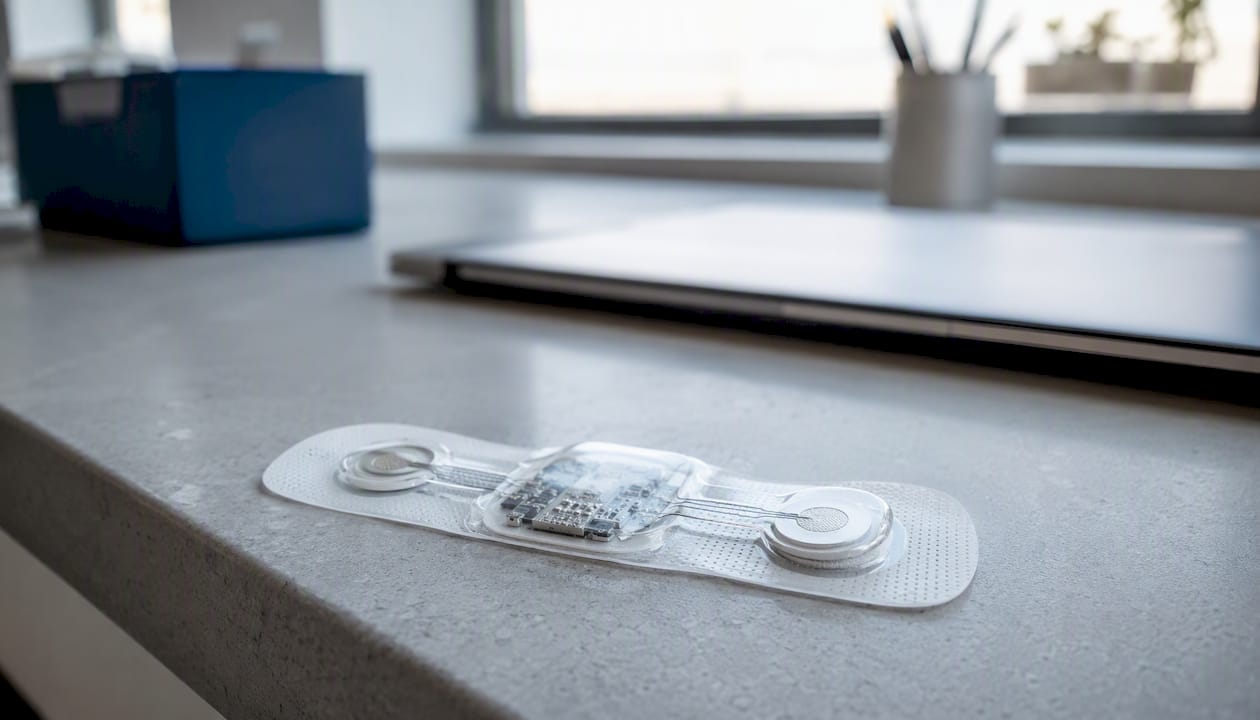
iRhythm agreed to acquire VitalConnect for approximately $287.5 million to add mobile cardiac telemetry capability and expand into a larger cardiac monitoring market. iRhythm already owned the ambulatory cardiac monitoring category with its Zio patch. VitalConnect's MCT capability opened an adjacent market segment without requiring iRhythm to build a new FDA-cleared device from scratch. That regulatory clearance, already in hand, was a material part of the deal's value.
ChartSpan / Validic — June 2026
ChartSpan acquired Validic in June 2026 to combine clinical care management services with a personal health data platform. The combined company planned to offer RPM software, device logistics, and data API infrastructure to health systems and payers. Validic's data integration layer was the asset: it converted patient-generated health data into structured clinical inputs that ChartSpan's care managers could act on in real time.
Innovaccer / Story Health
Innovaccer's acquisition of Story Health is part of a broader pattern of AI-enabled platform companies executing multiple acquisitions in rapid succession. Reporting from STAT documented this "shopping spree" behavior among AI-oriented platforms attempting to become the default operating layer for health systems. Story Health added specialty care management capabilities to Innovaccer's data platform, extending its clinical reach without building a new care model from scratch.
Clearlake Capital / ModMed
Clearlake Capital's acquisition of ModMed represents the private equity angle on digital health consolidation. PE buyers are targeting ambulatory EHR and practice management platforms with sticky enterprise contracts and high switching costs. ModMed's specialty-specific workflow depth and recurring revenue profile made it a textbook PE platform acquisition.
3. What's actually driving digital health M&A in 2024–2026
The volume and pace of these deals are not coincidental. Several converging forces created the conditions for this wave of health tech industry acquisition activity.
- AI capability acquisition: Buyers without proprietary clinical AI are purchasing it. Qualtrics paid $6.75B for a dataset. GE HealthCare paid $2.3B for an AI-ready imaging platform. The underlying logic is that training data and clinical context are harder to build than the models themselves.
- Platform consolidation: Single-condition digital health tools are losing commercial ground to multi-condition platforms. Hinge Health's acquisition of Cylinder Health is the clearest example: employers and health plans want one vendor, one contract, one integration.
- Distribution as a premium asset: Samsung's acquisition of Xealth and Amazon's acquisition of One Medical both paid for existing clinical distribution. Getting into 500+ hospital workflows organically takes years. Buying that access is faster and often cheaper at scale.
- PE-driven roll-ups: Private equity is consolidating ambulatory software, specialty EHR, and care management platforms. Clearlake / ModMed fits this pattern. PE buyers look for high switching costs, recurring revenue, and fragmented markets where consolidation creates margin.
- Reimbursement clarity reducing friction: RPM reimbursement pathways and value-based care contracts have made clinical digital health tools more defensible commercially. ChartSpan's acquisition of Validic was partly enabled by the fact that RPM billing codes create a recurring revenue stream that buyers can underwrite.
AI firms and platform companies are accelerating outbound acquisitions to become default enterprise platforms for health systems, a dynamic that is compressing the window for founders who want to exit before consolidation narrows the buyer pool.
Buyers increasingly prefer clinically validated models and physician-monitored interventions over standalone consumer health tools, which is raising the premium for targets with documented clinical outcomes and physician engagement.
4. What acquirers actually pay for during diligence
Understanding the valuation drivers in these deals gives founders a practical checklist. These are the attributes that consistently appear in buyer rationale statements and analyst commentary across the deals above.
Recurring revenue composition. Buyers distinguish between ARR and total revenue. GE HealthCare's press release specifically called out ~90% recurring revenue for Intelerad. That figure matters because it signals predictability and low churn risk. Founders should track and present ARR, net dollar retention (NDR), and gross revenue retention separately.
Enterprise contracts and covered lives. Cylinder Health's 100 enterprise clients covering two million lives was cited explicitly in Hinge Health's deal rationale. Enterprise contracts reduce concentration risk and signal that the product has passed procurement scrutiny at large organizations. Covered lives is the metric health plan and employer buyers use to size market penetration.
Data assets and labeled clinical data. The Qualtrics / Press Ganey Forsta deal is the most explicit example: $6.75B for a dataset. Buyers treat proprietary, labeled clinical data as a durable competitive asset that is difficult to replicate. Founders should document what data they hold, how it is structured, and what consent and governance frameworks govern its use.
Clinical outcomes and peer-reviewed evidence. Interoperability and clinically validated models are differentiators that increase acquirability and premium pricing. A product with published outcomes data reduces the buyer's due diligence burden and accelerates procurement approval at health system customers post-acquisition.
EHR integration and interoperability. Xealth's value to Samsung was its existing integration across 500+ hospital EHR environments. Building those integrations takes years. Founders who invest in FHIR-compliant APIs and EHR partnerships are building a moat that shows up in acquisition conversations.
Regulatory clearance and reimbursement alignment. iRhythm paid ~$288M partly for VitalConnect's FDA-cleared MCT capability. Regulatory clearance removes a major integration risk for acquirers. Reimbursement alignment, particularly CPT codes or value-based contracts, makes the revenue model legible to finance teams during diligence.
Pro Tip: Package your clinical evidence and data access documentation before any buyer conversation. A one-page data asset summary (what data you hold, consent framework, labeling methodology, and access API) reduces integration friction and signals operational maturity. Buyers who can model your data's value independently will move faster and price higher.
5. How founders can position their startup for acquisition
Exit readiness is not a last-minute exercise. The founders who achieved the exits above spent years building the specific attributes buyers paid for. Here is a prioritized action checklist organized by time horizon.
Short-term priorities (0–6 months)
- Audit your recurring revenue composition. Calculate ARR, percentage recurring, and NDR. If you cannot produce these figures cleanly, buyers will discount for uncertainty.
- Document your enterprise contract terms. Multi-year contracts with auto-renewal clauses and expansion provisions are materially more valuable than month-to-month agreements.
- Map your data assets. Inventory what patient or clinical data you hold, under what consent framework, and how it is structured. Engage legal counsel on HIPAA compliance and data governance.
- Identify your EHR integration status. List every EHR you integrate with, the integration depth (read-only vs. bidirectional), and your FHIR compliance posture. See digital health market entry strategies for a framework on building integration depth before scale.
Medium-term priorities (6–18 months)
- Generate clinical outcomes evidence. Commission a retrospective outcomes study or partner with a health system on a prospective pilot. Published or peer-reviewed evidence materially reduces buyer diligence friction.
- Expand enterprise distribution. Target self-insured employers, health plans, or large health systems. Each enterprise contract adds covered lives, which is a direct valuation input for strategic buyers.
- Build physician engagement infrastructure. Physician-monitored interventions command higher premiums than consumer-only tools. A physician engagement strategy that embeds your product in clinical workflows increases stickiness and acquirability.
- Align with a reimbursement pathway. RPM billing codes, value-based care contracts, or payer coverage policies make your revenue model legible and defensible to acquirer finance teams.
Long-term priorities (18+ months)
- Pursue regulatory clearance where applicable. FDA clearance or De Novo authorization removes a major integration risk for device-adjacent digital health products.
- Avoid overly restrictive exclusivity contracts. Contracts that limit your ability to work with certain buyers or distribute through certain channels can reduce your acquirer pool. Preserve optionality.
- Build a clean cap table and data room. Acquirers move faster when diligence materials are organized. A well-maintained data room signals operational maturity and reduces deal friction.
For a deeper look at how to structure your healthtech exit strategy, The StartupMD has published a dedicated guide for founders at various stages of exit readiness.
| Metric | What it measures | Buyer signal |
|---|---|---|
| ARR | Annual recurring revenue | Revenue predictability |
| NDR (net dollar retention) | Expansion minus churn | Product stickiness and upsell potential |
| CAC payback period | Months to recover customer acquisition cost | Unit economics efficiency |
| Covered lives | Total lives under enterprise contracts | Market penetration and distribution scale |
| Clinical outcome effect size | Measured improvement in clinical endpoints | Evidence quality and procurement defensibility |
| Recurring revenue % | ARR as share of total revenue | Revenue quality for valuation multiples |
Pro Tip: Frame your diligence package around the buyer's thesis, not your own. If you are targeting a platform buyer consolidating multi-condition care, lead with covered lives and enterprise contract depth. If you are targeting a device company, lead with clinical outcomes and regulatory status. Buyer-fit framing shortens the diligence cycle.
6. Acquisitions that struggled or failed to deliver
Not every digital health deal creates value. Several high-profile transactions illustrate the risks that founders and buyers both need to understand.
Amazon's One Medical acquisition, while strategically logical, has faced significant integration challenges. Merging a consumer tech culture with a credentialed primary care organization proved more complex than the deal thesis anticipated. Operational losses continued post-acquisition, and Amazon has made multiple leadership and operational adjustments. The deal illustrates a recurring pattern: distribution assets are easier to buy than clinical operations are to integrate.
Larger PE-backed roll-ups in the EHR space have also encountered friction when acquired platforms had incompatible data architectures or deeply customized workflows. When two platforms each carry years of health system-specific customization, the integration timeline and cost routinely exceed initial projections.
The common thread in challenged acquisitions is integration complexity that was underestimated at the time of signing. Clinical workflow integration, regulatory compliance across combined product lines, and cultural alignment between tech-first and clinically-oriented teams are the three failure modes that appear most consistently in post-acquisition reviews.
7. What post-acquisition integration actually requires
The deal close is not the finish line. Integration is where acquisition value is either realized or destroyed.
Technical integration is the most visible challenge. EHR integrations, data pipeline consolidation, and API harmonization take longer than projected in nearly every digital health deal. Buyers who acquired Xealth-style orchestration platforms or Validic-style data APIs are managing integration across dozens of existing health system connections simultaneously.
Clinical workflow alignment is often underestimated. A product that worked inside a specific clinical workflow at the acquired company may need significant reconfiguration to fit the acquirer's existing customer base. Hinge Health's plan to integrate Cylinder Health into a unified app by 2027 reflects a realistic timeline for this kind of clinical product consolidation.
Regulatory continuity requires active management. FDA-cleared devices, HIPAA-compliant data flows, and state-level telehealth regulations all require review when two entities combine. Acquirers who skip this step face compliance gaps that surface during subsequent audits or customer procurement reviews.
Talent retention is the least discussed but often most consequential factor. The clinical and technical talent that built the acquired product is frequently the asset the buyer most needs. Retention packages, cultural integration, and clear role definition in the combined organization are not soft issues. They are deal-value preservation mechanisms.
8. How the regulatory environment shapes acquisition success
Regulatory clarity is a deal accelerator. Regulatory ambiguity is a deal killer, or at minimum a valuation discount.
FDA clearance, as the iRhythm / VitalConnect deal illustrates, removes a major risk from the buyer's integration model. A cleared device can be sold, billed, and integrated into clinical workflows without the uncertainty of a pending regulatory decision. Buyers price that certainty into the offer.
Reimbursement policy has a similar effect. The expansion of RPM billing codes created a commercially legible revenue model for remote monitoring companies. ChartSpan's acquisition of Validic was partly underwritten by the predictability of those reimbursement pathways. When CMS or commercial payers establish coverage for a digital health modality, it converts a speculative revenue model into a billable service, which is a fundamentally different asset for an acquirer to underwrite.
Conversely, acquisitions in areas with unsettled regulatory status, such as AI-driven diagnostic tools awaiting FDA guidance or telehealth prescribing models under DEA scrutiny, carry regulatory risk that buyers either price in as a discount or avoid entirely. Founders operating in these spaces should monitor regulatory developments closely and, where possible, engage proactively with FDA through pre-submission meetings or the Digital Health Center of Excellence.
9. How these acquisitions affected acquirer financial performance
The financial impact of digital health acquisitions varies significantly by deal type and integration execution.
GE HealthCare's acquisition of Intelerad was explicitly framed as accretive to top-line growth and adjusted margins, supported by projected revenues of approximately $270 million in the first full year at roughly 90% recurring. That recurring revenue profile is what makes the accretion case credible to analysts: predictable cash flows reduce the risk that the acquisition dilutes earnings in the near term.
Qualtrics' $6.75B acquisition of Press Ganey Forsta is a longer-horizon bet. The financial case rests on the AI dataset's ability to generate new recurring revenue streams across the combined 41,000+ healthcare measurement system customer base. Near-term, the deal adds significant revenue scale. The margin impact depends on integration cost and the pace of AI product monetization.
For PE buyers like Clearlake Capital, the financial thesis is different. PE-backed platform acquisitions are designed to generate returns through margin improvement, cross-sell revenue, and eventual exit at a higher multiple. The near-term financial impact is often dilutive before it becomes accretive, as integration costs and management restructuring run through the income statement.
Tuck-in acquisitions funded from free cash flow, like Hinge Health's $105M all-cash deal for Cylinder Health, tend to have the cleanest near-term financial profile. There is no equity dilution, the deal size is manageable relative to the buyer's cash position, and the revenue contribution from the acquired enterprise contracts is relatively immediate.
10. Key metrics buyers use to benchmark acquisition success
Acquirers do not evaluate digital health deals on a single metric. They use a layered framework that covers revenue quality, clinical defensibility, and integration risk.
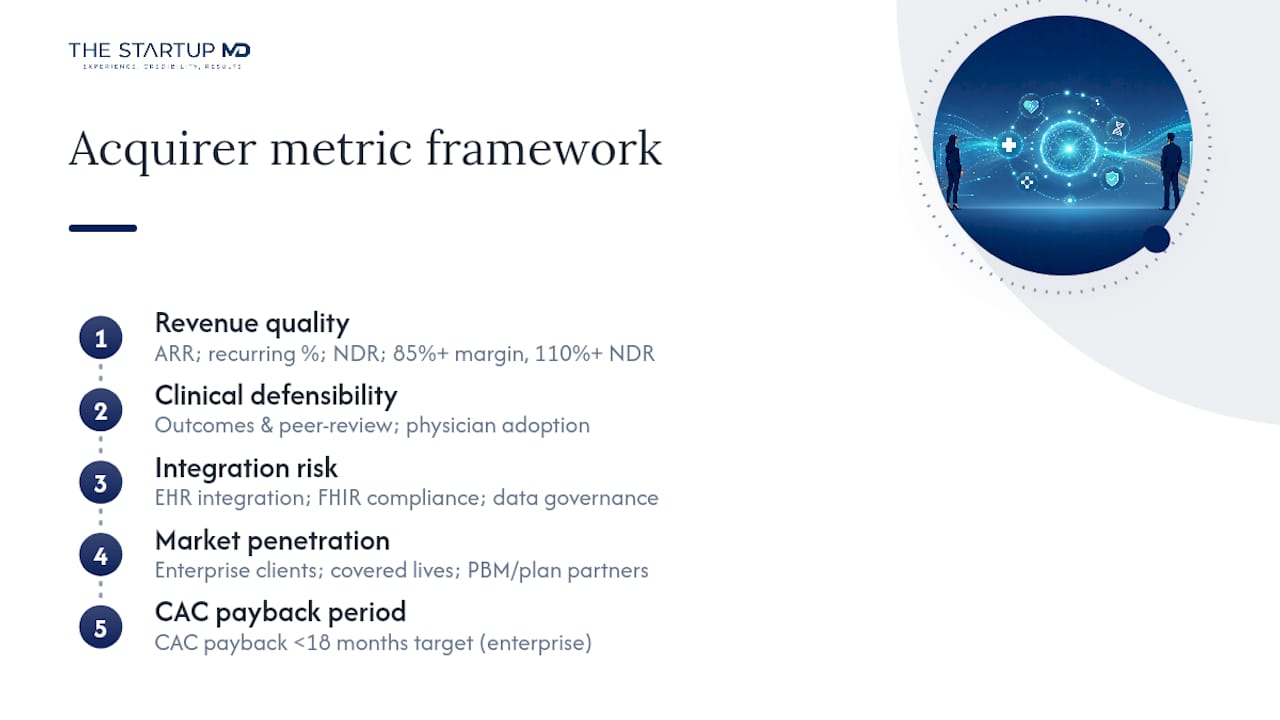
Revenue quality metrics: ARR, recurring revenue percentage, NDR, and gross margin composition. A target with 85%+ gross margins and 110%+ NDR is a fundamentally different asset than one with 60% margins and flat retention.
Clinical defensibility metrics: published outcome effect sizes, peer-reviewed evidence, physician adoption rates, and covered lives under enterprise contracts. These metrics answer the buyer's question: "Will health system procurement approve this product post-acquisition?"
Integration risk metrics: EHR integration depth, FHIR compliance, data governance documentation, and regulatory clearance status. Buyers use these to estimate the cost and timeline of technical integration.
Market penetration metrics: enterprise client count, covered lives, and distribution partnerships (PBMs, health plans, large employers). Cylinder Health's two million covered lives and PBM partnerships were cited directly in Hinge Health's deal rationale.
CAC payback period is increasingly scrutinized in a higher interest rate environment. Buyers want to see that customer acquisition costs are recovered within a reasonable timeframe, typically under 18 months for enterprise digital health.
11. Why AI capability and interoperability command acquisition premiums
AI and interoperability are not features. In the current acquisition market, they are valuation multipliers.
The Qualtrics / Press Ganey Forsta deal is the clearest evidence: $6.75B for a dataset that enables AI-driven decision-making at scale. The AI capability was not in the software. It was in the data. Buyers who understand this are acquiring data assets first and building models on top of them.
Interoperability commands a premium for a different reason. A digital health product that integrates with Epic, Oracle Health, and athenahealth through FHIR-compliant APIs is already inside the clinical workflow of the health systems that will become the acquirer's customers. That embedded position is worth paying for because the alternative, building those integrations post-acquisition, is expensive, slow, and disruptive to existing customers.
Samsung's acquisition of Xealth was fundamentally an interoperability acquisition. Xealth's value was its existing orchestration layer across 500+ hospitals. Samsung's wearable devices needed clinical context to become clinically relevant. Xealth provided the integration infrastructure that made that possible.
For founders, the implication is direct: invest in FHIR compliance, EHR partnerships, and data infrastructure early. These are not technical nice-to-haves. They are the attributes that show up in buyer rationale statements and drive premium pricing in acquisition conversations.
What the 2026 deal wave tells founders about exit strategy
The pattern across these acquisitions is consistent enough to be instructive. Buyers are not paying for features. They are paying for distribution, data, clinical validation, and the infrastructure that makes their existing products more defensible.
The Hinge Health / Cylinder Health deal is worth studying carefully. Hinge Health did not need Cylinder's technology. It needed Cylinder's enterprise contracts, its PBM partnerships, and its two million covered lives. The $105M price was for commercial traction and distribution access, not for the underlying software architecture.
The Qualtrics / Press Ganey Forsta deal makes a different point. At $6.75B, Qualtrics was not buying a competitor. It was buying the data infrastructure to build an AI platform that no competitor could replicate without spending decades collecting the same dataset. That is a different kind of acquisition thesis, and it reflects where the most sophisticated buyers are placing their bets.
For founders, the single most important reorientation is this: stop optimizing your product for end users and start optimizing your commercial model for acquirers. That means enterprise contracts over consumer subscriptions, documented clinical outcomes over user engagement metrics, and EHR integration over standalone app experiences. The buyers writing the largest checks in 2026 are paying for assets that reduce their integration risk and expand their existing customer relationships. Build those assets deliberately.
The StartupMD helps founders build acquisition-ready digital health companies
Preparing for a digital health acquisition requires more than a clean cap table. It requires clinical strategy, enterprise positioning, and the kind of regulatory and product readiness that buyers scrutinize during diligence.
The StartupMD works with healthcare SaaS founders and executives as a Fractional Chief Medical Officer and strategic advisor, helping teams build the clinical evidence, enterprise distribution, and product positioning that acquirers pay premiums for. From healthcare SaaS revenue model evaluation to diligence packaging and buyer-fit framing, The StartupMD brings the clinical and business depth that most founding teams need but rarely have in-house. If you are building toward an exit and want to close the gap between where your company is today and what strategic buyers are looking for, book a consultation with The StartupMD to start that conversation.
Primary sources and further reading
The deal facts in this article draw from the following primary announcements and authoritative trade reporting. Press release language such as "accretive to adjusted margins" typically signals that the buyer expects the acquisition to improve earnings per share within one to two fiscal years, though integration costs in year one often delay that outcome.
- GE HealthCare completes Intelerad acquisition — GE HealthCare Newsroom
- Qualtrics acquires Press Ganey Forsta for $6.75 billion — Press Ganey Resources
- iRhythm acquires VitalConnect for $288M — MedTech Dive
- Samsung acquires Xealth — Samsung Newsroom
- Hinge Health to acquire Cylinder Health for $105M — HIT Consultant
- ChartSpan acquires Validic — PR Newswire / Morningstar
- Digital health M&A: AI firms and platforms accelerating acquisitions — STAT
- The largest digital health acquisitions ever — Massively Better Healthcare
Sources
- Qualtrics acquires healthcare experience leader Press Ganey Forsta for $6.75 billion — Press Ganey resources
- GE HealthCare completes Intelerad acquisition – accelerating shift to cloud-first enterprise solutions to deliver precision care | GE HealthCare (United States)
- Samsung Electronics Acquires Xealth, Bridging the Gap Between Wellness and Medical Care — Samsung Newsroom