

Health data analytics is the systematic use of clinical, operational, and financial health data to generate insights that improve patient outcomes, reduce costs, and support evidence-based decisions. It is not an IT project. It is a clinical strategy, and the organizations that treat it as one consistently outperform those that do not.
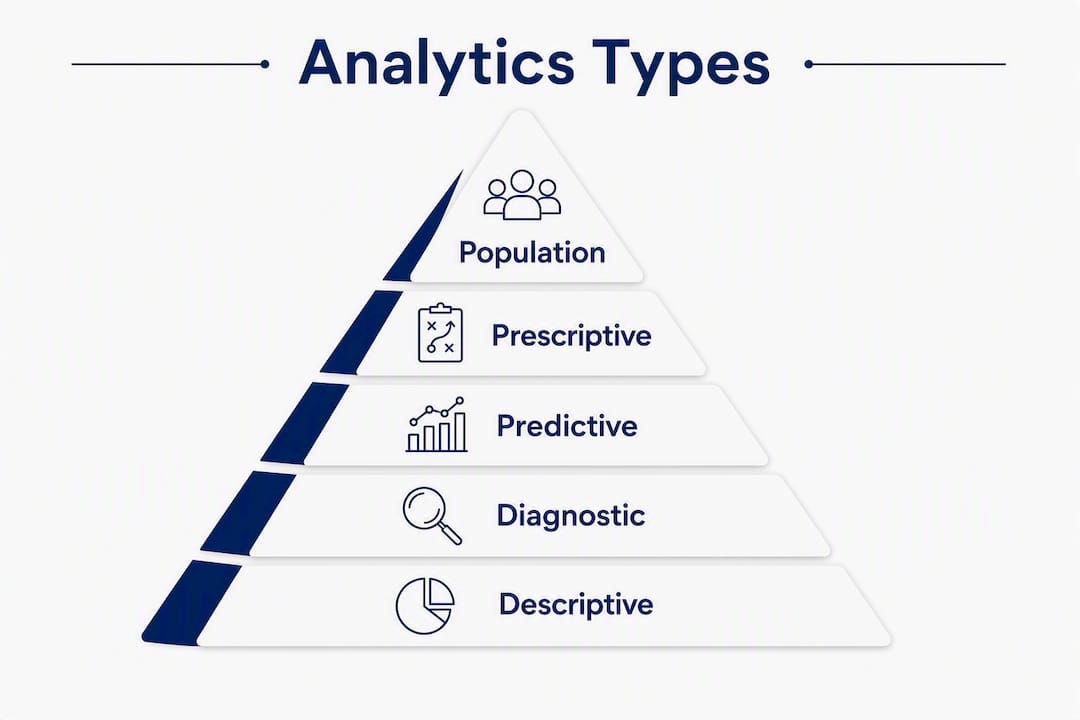
Healthcare analytics delivers three core outcomes: improved clinical outcomes through earlier identification of high-risk patients, enhanced operational efficiency through smarter resource allocation, and evidence-based administrative decisions that replace gut instinct with measurable data. Every analytics program, regardless of size or setting, builds on four analytic types:
- Descriptive: What happened?
- Diagnostic: Why did it happen?
- Predictive: What is likely to happen next?
- Prescriptive: What should we do about it?
Understanding where your program sits on that spectrum determines which tools you need, which data you must clean first, and which clinical questions you can realistically answer.
Table of Contents
- What does health data analytics actually include?
- What are the four types of healthcare analytics?
- Where does health analytics data come from?
- What are the real benefits of health data analytics?
- What tools and techniques power health data analytics?
- What are the biggest challenges in healthcare analytics?
- What standards and governance frameworks apply?
- How do you implement health analytics that actually works?
- How do you measure the impact of an analytics program?
- What trends are shaping health analytics in the next few years?
- Strategic guidance for healthtech startups building analytics products
- Key Takeaways
- The gap most analytics programs never close
- How The StartupMD helps healthcare SaaS teams build analytics that sticks
- Useful sources for further reading
What does health data analytics actually include?
The formal industry term is healthcare data analytics, though "health data analytics" is used interchangeably across clinical, research, and commercial settings. According to StatPearls on NCBI, it encompasses quantitative and qualitative methods applied across diverse data sources, including electronic health records (EHRs), medical imaging, claims data, wearables, and genomics, all in service of evidence-based decision-making.
The scope breaks into three distinct domains:
Clinical analytics focuses on individual patient care. A hospitalist team using sepsis prediction scores, a cardiologist reviewing risk-stratified patient panels, or a pharmacist flagging dangerous drug interactions are all working within this domain.
Operational analytics addresses how a health system or SaaS platform runs. Bed utilization, staff scheduling, supply chain forecasting, and revenue cycle performance all fall here. The questions are business questions answered with clinical data.
Population health analytics zooms out to cohorts, communities, or payer-defined panels. Chronic disease surveillance, preventive care gap identification, and social determinants of health mapping are typical use cases. Public health agencies, ACOs, and value-based care organizations rely on this layer most heavily.
Who uses analytics day-to-day? Clinicians interact with decision-support alerts embedded in their EHR workflow. Data analysts and informaticists build and maintain the pipelines. Administrators and executives consume dashboards and KPI reports. Payers use claims analytics to manage risk and utilization. Researchers use registry and genomic data to generate evidence. Each group needs different outputs from the same underlying data, which is why analytics architecture decisions made early have long-lasting consequences.
What are the four types of healthcare analytics?
The four core analytic categories are descriptive, diagnostic, predictive, and prescriptive. A fifth, discovery analytics, is common in research settings. Each answers a different question and requires a different level of data maturity.
- Descriptive analytics summarizes historical data. It answers "what happened?" A monthly readmission rate report, a dashboard showing average length of stay by service line, or a case-mix index summary are all descriptive. This is where most organizations start, and where many stop.
- Diagnostic analytics investigates causation. It answers "why did it happen?" Root-cause analysis of a spike in surgical site infections, or a drill-down into which patient segments are driving ED overcrowding, are diagnostic exercises.
- Predictive analytics uses statistical models and machine learning to forecast future events. It answers "what is likely to happen?" Readmission risk scores, deterioration alerts, and chronic disease progression models are the most common clinical applications. Predictive models can identify high-risk patient populations before clinical deterioration occurs, giving care teams a window to intervene.
- Prescriptive analytics recommends specific actions. It answers "what should we do?" Automated care pathway suggestions, optimized staffing schedules, and dynamic formulary recommendations are prescriptive outputs.
- Discovery analytics generates new hypotheses from large datasets. Genomic association studies, drug repurposing research, and novel biomarker identification fall here.
How the types stack in practice
A real-world example shows how these layers build on each other:
- Descriptive: A hospital notices its heart failure readmission rate is above the national benchmark.
- Diagnostic: Analysis reveals that patients discharged on Friday afternoons with no scheduled follow-up within seven days account for a disproportionate share of readmissions.
- Predictive: A model scores each heart failure patient at discharge for readmission risk based on social factors, medication adherence history, and prior utilization.
- Prescriptive: High-risk patients automatically receive a care coordinator call within 48 hours and a telehealth follow-up within five days, triggered by the model score.
Each layer is only as good as the one beneath it. Skipping descriptive and diagnostic work to jump straight to predictive modeling is one of the most common and costly mistakes in health analytics.
Where does health analytics data come from?
Data sourcing is where analytics programs succeed or fail before a single model is trained. The primary sources each carry distinct strengths and persistent limitations.
- Electronic health records (EHRs): The richest source of longitudinal clinical data. Structured fields (diagnoses, medications, labs, vitals) are relatively clean. Unstructured physician notes, however, are noisy, inconsistent, and require natural language processing (NLP) to extract usable signal. Mismatched coding across ICD-10 and CPT systems makes raw EHR data unusable for predictive modeling without significant preparation.
- Claims data: Administratively coded, complete for billed encounters, and excellent for population-level utilization analysis. The limitation is latency: claims often arrive 30–90 days after the encounter, making them unsuitable for real-time clinical decisions.
- Laboratory and pathology data: Highly structured and reliable for quantitative analysis. The challenge is result normalization across reference labs with different units and reference ranges.
- Medical imaging: Rich diagnostic data, but computationally intensive. Computer vision models require large, labeled training sets and significant infrastructure.
- Device and wearable data: Continuous, high-frequency streams from remote patient monitoring devices, implantables, and consumer wearables. Volume is high; signal-to-noise ratio is often low without preprocessing.
- Genomic and molecular data: Enables precision medicine and pharmacogenomics. Integration with clinical data remains technically complex and is still maturing in most health systems.
- Public health and registry data: CDC surveillance data, state immunization registries, cancer registries, and social determinants datasets add population context that EHRs alone cannot provide.
Linking data across these sources requires identity resolution, matching patients across systems using probabilistic or deterministic algorithms. A patient in the EHR, the claims system, and the device platform may have three different identifiers. Without a master patient index or a reliable matching strategy, your analytics will double-count, miss records, or corrupt cohort definitions.
What are the real benefits of health data analytics?
The benefits of health data analytics are most visible when analytics is embedded in clinical and operational workflows rather than confined to a reporting dashboard. Health systems that integrate analytics into clinician workflows achieve higher adoption and measurable impact.
Clinical applications and outcomes:
- Early warning and deterioration detection: Sepsis and rapid response algorithms reduce time-to-treatment and mortality when embedded in nursing workflows.
- Chronic disease management: Risk-stratified patient panels allow primary care teams to proactively outreach patients with diabetes, heart failure, or COPD before acute episodes occur.
- Clinical decision support: Drug interaction alerts, evidence-based order sets, and diagnostic support tools reduce preventable errors.
- Precision medicine: Analytics supports grouping patients by biological and disease characteristics to guide targeted therapies, particularly in oncology and rare disease.
Operational applications:
- Resource and staffing optimization: Predictive census models allow nurse managers to adjust staffing 24–48 hours in advance, reducing overtime and agency costs.
- Supply chain management: Consumption analytics and demand forecasting reduce stockouts and expired inventory.
- Revenue cycle optimization: Claim denial pattern analysis identifies coding gaps and documentation deficiencies before submission.
Population health applications:
- Chronic disease surveillance and gap closure across attributed patient panels.
- Social determinants screening and referral tracking to community resources.
- Preventive care compliance monitoring at the practice and payer level.
The competitive advantage now lies in translating analytics into workflows that demonstrably lower costs and improve safety, not in building more dashboards. Executives increasingly prioritize predictive and prescriptive analytics that produce measurable improvements over visualization tools that report on the past.
What tools and techniques power health data analytics?
How health data analytics works technically depends on a layered stack. Each layer has a distinct function, and gaps in any layer propagate errors upward.
- Visualization and decision support: — Tableau, Power BI, and Looker are common for operational dashboards. Clinical decision support is typically embedded directly in the EHR via SMART on FHIR apps or native CDS Hooks integrations.
Big data analytics in healthcare relies on AI/ML, cloud computing, NLP, and sensor integration, but adoption is slowed by privacy requirements, technical complexity, and resource constraints that most organizations underestimate at the outset.
Pro Tip: For healthcare SaaS teams, the most defensible technical choice is building your analytics layer on FHIR R4 APIs from the start. Retrofitting interoperability onto a proprietary data model after launch is significantly more expensive and creates regulatory risk as CMS interoperability rules tighten.

What are the biggest challenges in healthcare analytics?
The barriers are well-documented, and most programs encounter several simultaneously. Knowing them in advance is the only way to design around them.
Data quality and completeness:
- Missing values, duplicate records, and inconsistent coding degrade model performance. A model trained on clean academic medical center data often fails when deployed in a community hospital with different documentation practices.
- Unstructured notes require NLP pipelines that must be validated for each clinical domain.
Algorithmic bias:
- Training datasets that underrepresent certain racial, ethnic, or socioeconomic groups produce models that perform worse for those populations. Bias audits before deployment are not optional; they are a patient safety requirement.
Privacy and HIPAA compliance:
- Protected health information (PHI) in analytics pipelines requires de-identification under the HIPAA Safe Harbor or Expert Determination standards, business associate agreements with all vendors, and audit trails for data access. A breach is not just a regulatory event; it is a reputational one.
Interoperability:
- Integrating real-time data across clinical, financial, and administrative systems is consistently underestimated by startups and health systems alike. Legacy EHRs create persistent data silos that standards alone cannot resolve.
Clinician adoption and alert fatigue:
- Model adoption frequently fails when clinicians perceive analytics outputs as black-box AI without clinical context. An alert that fires too often, or whose logic cannot be explained, gets dismissed or disabled. Engaging clinical leaders in model design and validation is not a nice-to-have; it is the difference between a deployed tool and an abandoned one.
Mitigations worth building in from day one:
- Establish a data governance committee with clinical, technical, and compliance representation.
- Run bias audits on every model before production deployment.
- Use privacy-preserving techniques (differential privacy, federated learning) where PHI cannot be fully de-identified.
- Invest in change management: train clinicians on what the model does and does not do, and give them a feedback mechanism.
What standards and governance frameworks apply?
The U.S. regulatory and standards environment for health analytics is specific, and compliance is not optional.
Key standards and regulations:
- HL7 (Health Level Seven): The foundational messaging standard for clinical data exchange. HL7 v2 messages are still the dominant format in legacy EHR integrations.
- FHIR (Fast Healthcare Interoperability Resources): The modern API-based standard for health data exchange, now mandated by CMS and ONC for certified EHR technology. FHIR R4 is the current production standard.
- HIPAA (Health Insurance Portability and Accountability Act): Governs the use and disclosure of PHI. Analytics programs that use identifiable patient data must comply with the Privacy Rule, Security Rule, and Breach Notification Rule.
- ISO standards: ISO/TR 14639 and related standards address health informatics and population health data quality, relevant for organizations pursuing international interoperability.
A governance checklist for analytics programs:
- Define data ownership and stewardship roles for each source system.
- Establish data quality rules (completeness thresholds, validation checks) before ingestion.
- Implement role-based access controls and audit trails for all PHI.
- Document model development, training data, and validation results in a model registry.
- Conduct vendor risk assessments and execute BAAs with all third-party analytics vendors.
- Establish a model monitoring protocol to detect performance drift after deployment.
- Create a patient consent framework for research and secondary use of clinical data.
Even with FHIR and HL7 standards, integrating real-time data across legacy EHRs, financial systems, and device streams into a single source of truth is technically complex and often underbudgeted. Governance is not a one-time setup; it is an ongoing operational function.
How do you implement health analytics that actually works?
Implementation is where most analytics programs stall. The technical work is tractable; the organizational work is not. A structured sequence reduces the failure rate.
- Define the clinical or operational question first. Not "we want to use AI" but "we want to reduce 30-day readmissions in our heart failure population by identifying high-risk patients at discharge." The question determines the data, the model type, and the success metric.
- Confirm data availability and quality. Before building anything, audit whether the data needed to answer the question actually exists, is accessible, and is clean enough to use. This step alone eliminates roughly half of proposed analytics projects.
- Clean and normalize the data. Map diagnoses to ICD-10, medications to RxNorm, and procedures to CPT. Run NLP on relevant note fields. Resolve patient identities across systems.
- Prototype with a small, validated cohort. Build a minimum viable model on a well-defined patient subset. Validate performance metrics (AUC, sensitivity, specificity, PPV) against a held-out test set.
- Validate with clinicians before deployment. Show the model's outputs to the physicians and nurses who will use them. Ask whether the predictions make clinical sense. Adjust thresholds based on their feedback. Engaging clinical leaders in model design and validation is essential to ensure clinical relevance and ethical application.
- Deploy within the existing workflow. The output should appear where clinicians already work, inside the EHR, in the nursing handoff tool, or in the care coordinator's dashboard, not in a separate application that requires an extra login. Health systems that embed analytics into clinician workflows achieve higher adoption and impact.
- Monitor, measure, and iterate. Track model performance, alert response rates, and clinical outcomes monthly. Retrain models when performance drifts. Treat deployment as the beginning of the work, not the end.
For a practical framework on developing a clinical use case for SaaS, the sequence above maps directly to what investors and health system partners expect to see before committing to a pilot.
Pro Tip: Clinician buy-in is not secured at go-live. It is secured six months earlier, when you invite a respected physician champion to co-design the alert logic and define the threshold for action. That physician becomes your internal advocate when skeptics push back.
How do you measure the impact of an analytics program?
Proving value requires metrics chosen before deployment, not after. KPIs split cleanly by domain.
Clinical KPIs:
- 30-day readmission rate (condition-specific and all-cause)
- In-hospital mortality and complication rates
- Time-to-diagnosis and time-to-treatment for time-sensitive conditions
- Preventable adverse event rates
Operational KPIs:
- Average length of stay (LOS) by service line
- Bed occupancy and throughput
- Staffing efficiency (overtime hours, agency utilization)
- OR and procedure suite utilization rates
Financial KPIs:
- Cost per case by DRG
- Avoided spend from reduced readmissions and complications
- Claim denial rate and days in accounts receivable
- Revenue cycle yield
Adoption KPIs:
- Alert response rate (accepted, overridden, ignored)
- Clinician satisfaction scores with decision support tools
- Model utilization rate by department
Evaluation methods:
- Pre/post analysis is the most common and the weakest design; confounders are difficult to control.
- Stepped-wedge cluster randomized designs offer stronger causal inference when rolling out across multiple units.
- Prospective validation against a concurrent control group is the gold standard for clinical impact claims.
For analytics features embedded in a SaaS product, adoption KPIs directly influence healthcare SaaS customer success and retention. A feature that clinicians ignore does not reduce churn; it accelerates it.
What trends are shaping health analytics in the next few years?
The field is moving fast. The near-term and medium-term shifts are distinct enough to plan around separately.
Near-term (1–2 years):
- Federated learning: Models trained across multiple health systems without centralizing PHI. This approach is gaining traction as a privacy-preserving alternative to data pooling, particularly for rare disease research and multi-site clinical trials.
- Real-world evidence (RWE): FDA's increasing acceptance of RWE for regulatory submissions is accelerating investment in EHR-derived and claims-derived evidence generation. Health systems and SaaS companies that can produce publication-quality RWE have a significant commercial advantage.
- SMART on FHIR and CDS Hooks maturation: More EHR vendors are opening their platforms to third-party analytics apps via standardized APIs, reducing the integration burden that has historically slowed SaaS adoption.
Medium-term (3–5 years):
- Clinical-grade AI regulation: The FDA's evolving framework for AI/ML-based software as a medical device (SaMD) will require more rigorous pre-market validation and post-market surveillance for analytics tools that influence clinical decisions.
- Edge analytics and IoT integration: Processing data at the device level, in wearables, implantables, and point-of-care sensors, will enable real-time interventions without cloud latency. This is particularly relevant for remote patient monitoring and chronic disease management.
- Multimodal AI: Models that integrate genomic, imaging, clinical notes, and wearable data simultaneously are moving from research settings toward clinical deployment, particularly in oncology and cardiology.
A systematic review of peer-reviewed studies maps current practices and persistent barriers, consistently finding that standardized data policies and staff training are prerequisites for capturing the benefits of these emerging technologies. The organizations that invest in governance infrastructure now will be positioned to deploy these capabilities faster.
Strategic guidance for healthtech startups building analytics products
Most healthtech startups approach analytics backward. They build a feature-rich dashboard, then try to convince health systems it is useful. The ones that succeed do the opposite: they identify one high-value clinical or operational problem, prove measurable impact on that problem, and use that evidence to expand.
Where to focus first:
- Pick a single use case where your data advantage is clearest and the clinical question is well-defined. A readmission risk tool for a specific condition is more fundable and more deployable than a "population health platform."
- Confirm that the data required for your use case is actually available in your target customer's EHR, at the completeness and latency you need. Many pilots fail because the data assumed to exist does not.
- Build for the clinician's existing workflow. An analytics output that requires a separate login, a new screen, or a new habit will not be used. The best analytics features are nearly invisible: they surface the right information at the right moment in the workflow the clinician is already in.
What investors and boards want to see:
- Clinical validation data from a real deployment, even a small pilot. A peer-reviewed publication or a conference abstract carries more weight than a case study.
- Uptake and retention metrics: what percentage of eligible clinicians use the feature, and how often?
- A clear pathway to a clinical milestone, such as a reduction in a specific adverse event rate, that can be attributed to your product.
For startups building their first analytics feature, developing a defensible clinical use case is the prerequisite to a credible go-to-market strategy. Without it, you are selling a capability, not a solution.
Pro Tip: Package your analytics output as a workflow-integrated recommendation, not a score. A readmission risk score of 0.73 means nothing to a busy hospitalist. "This patient meets criteria for the high-risk discharge protocol" is a decision, not a number. That framing reduces cognitive load and drives action.
Key Takeaways
Health data analytics delivers clinical, operational, and financial value only when it is treated as a clinical strategy, built on fit-for-purpose data, and embedded directly in the workflows where clinicians make decisions.
| Point | Details |
|---|---|
| Four analytic types build on each other | Descriptive, diagnostic, predictive, and prescriptive analytics must be layered sequentially; skipping early stages undermines model quality. |
| Data quality precedes model building | Mismatched ICD-10/CPT coding and unstructured notes require normalization before any predictive work can begin. |
| Workflow integration drives adoption | Analytics embedded in existing EHR workflows achieves higher clinician uptake than standalone dashboards or separate applications. |
| Governance is an ongoing function | HIPAA compliance, bias audits, model registries, and access controls must be maintained continuously, not set up once at launch. |
| The StartupMD advisory approach | The StartupMD helps healthcare SaaS teams define high-value use cases, validate clinical evidence, and integrate analytics into fundable, deployable products. |
The gap most analytics programs never close
The honest observation, after watching dozens of analytics initiatives across health systems and SaaS companies, is that the technical problem is rarely what kills them. The data pipelines get built. The models get trained. What fails is the last 10 feet: getting the output into the hands of a clinician in a form they will actually use, at the moment it matters.
Most analytics programs are designed by data scientists and approved by executives. The clinician is consulted late, if at all. The result is a tool that is technically correct and clinically irrelevant. Alert thresholds are set too low. Recommendations are framed in statistical language. The workflow integration is an afterthought. And then the team is surprised when adoption is poor.
The fix is not a better model. It is earlier and deeper clinical co-design. The physician champion who helped define the alert logic will defend it when colleagues push back. The nurse who tested the deterioration workflow in simulation will train her unit on it at go-live. That human infrastructure is what separates a deployed analytics program from an archived one.
For startups, this has a direct commercial implication. A product that clinicians actively use generates the retention and outcome data that justifies expansion contracts and supports fundraising. A product that sits unused generates churn. The analytics feature is not the product. The clinical behavior change it produces is the product.
If your analytics strategy feels misaligned with your clinical or commercial goals, that is a conversation worth having.
How The StartupMD helps healthcare SaaS teams build analytics that sticks
Healthcare SaaS founders often have strong technical teams and weak clinical translation. The StartupMD fills that gap directly, as a fractional Chief Medical Officer and strategic advisory partner who has sat on both sides of the table.
The StartupMD works with analytics-driven SaaS companies at the inflection points that matter most: defining the clinical use case that will survive investor scrutiny, designing the pilot that generates publishable evidence, and packaging analytics outputs as workflow-integrated features that clinicians actually adopt. Services include clinical strategy development, product validation, regulatory guidance for AI/ML-based tools, and investor readiness support tied to clinical milestones.
If your analytics product is built but not yet adopted, or funded but not yet validated, the next step is a direct conversation about where the gap is and how to close it. Reach out through The StartupMD services page to explore a fractional CMO engagement or advisory project scoped to your current stage.
Useful sources for further reading
The sources below are the primary references used in this article. They are organized by role to help you go deeper in the area most relevant to your work.
For clinicians and clinical informaticists:
| Title | Publisher | Year |
|---|---|---|
| Healthcare Analytics | StatPearls, NCBI Bookshelf | — |
| Benefits of Data Analytics in Healthcare | Alliant International University | — |
| The Growing Importance of Data Analytics in Health Informatics | HIMSS | — |
For data scientists and engineers:
| Title | Publisher | Year |
|---|---|---|
| Introduction to Health Care Data Analytics | Springer | — |
| Big Data Analytics in Healthcare: Current Practices, Innovations, and Future Prospects | Journal of Big Data, Springer | — |
For executives and healthtech founders:
| Title | Publisher | Year |
|---|---|---|
| Data Trends: Healthcare Analytics | ThoughtSpot | — |
| An Easy Guide to Understanding Healthcare Data Analytics | ISO | — |
| Data Analytics in Healthcare: Transforming Patient Care Delivery | Park University | — |
This article provides general educational information about healthcare data analytics. It is not legal, regulatory, or clinical advice. Confirm compliance requirements with qualified legal counsel and your organization's compliance officer before implementing any analytics program involving protected health information.