

Healthcare SaaS onboarding is the full operational process that moves a provider from signup to their first moment of genuine clinical or administrative value, before they lose momentum or abandon the platform. It covers far more than a welcome email or a product tour. The process includes HIPAA-compliant data provisioning, role-based access configuration, EHR integration sequencing, workflow customization, and the behavioral triggers that push providers toward activation. Healthcare SaaS onboarding differs from generic SaaS onboarding in one critical way: compliance constraints are not optional add-ons. They are structural requirements baked into every touchpoint.
Key elements that make healthcare SaaS onboarding distinct:
- HIPAA compliance at every stage, including session timeout handling, audit logging, and Business Associate Agreements (BAAs) with any third-party tool that touches Protected Health Information (PHI)
- Role-based access and workflow configuration tailored to physicians, nurses, billing staff, care coordinators, and administrators
- EHR and EMR integration sequencing as a prerequisite to activation, not an afterthought
- Activation milestones tied to clinical or billing outcomes, not just account creation
- Ongoing lifecycle support that builds habit formation across 30–90 days post-activation
## 1. What does health SaaS onboarding actually require before you start?
Preparation is the stage most healthcare SaaS teams underinvest in, and it is where the most expensive delays originate. Before a single provider logs in, your team needs documented workflows, provisioned tenant environments, and compliance infrastructure already in place.
Start by mapping the workflows your platform will touch for each provider type. A physician's onboarding path looks nothing like a billing coordinator's. Defining those paths in advance prevents the "one-size-fits-all" trap that drives activation rates down in healthcare SaaS to 23.8%, compared to a 37.5% cross-industry average.
Concrete preparation actions before onboarding begins:
- Execute BAAs with every third-party tool that will process PHI during onboarding
- Configure tenant environments with role-based access controls (RBAC) per provider segment
- Document the activation milestone for each role (first clinical note entered, first claim submitted)
- Align technical, operations, and compliance teams on a shared onboarding playbook
- Prepare synthetic patient data for sandbox and training environments
- Confirm HIPAA session timeout settings and test tour progress persistence after re-authentication
Pro Tip: Reduce your signup form to email, password, and one routing question. Each extra field drops conversion 3–8%. Collect company size, billing details, and role specifics after the provider has seen the product.
## 2. How do you structure the onboarding process to reduce complexity?
The SaaS onboarding process is a seven-stage operational workflow: pre-signup intent capture, signup and data capture, email verification and welcome, first session and the "aha moment," activation sprint, conversion to paid, and handoff to customer success. In healthcare, each stage carries compliance requirements that generic SaaS teams never face.
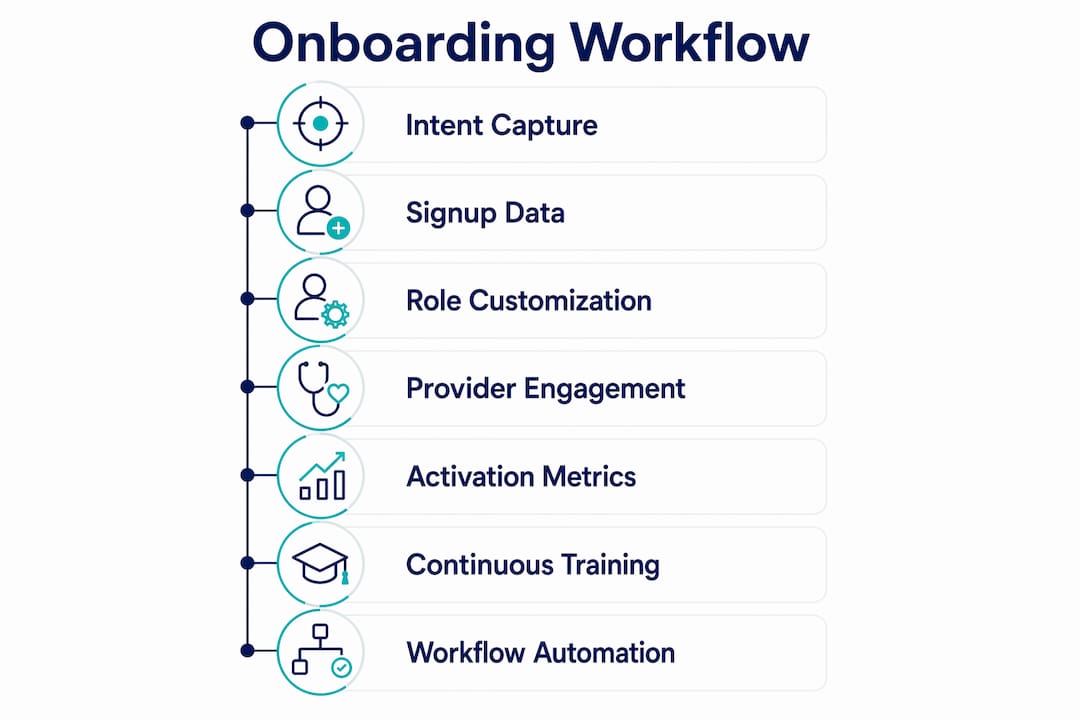
Role-based path customization is the single highest-leverage structural decision you can make. A physician needs charting and order entry workflows front and center. A billing coordinator needs claims submission. Showing either role the wrong path is not just a poor user experience; it violates HIPAA's Minimum Necessary principle.

Automation removes the manual friction that slows healthcare onboarding. AI-driven automation reclaims 10–20 hours of manual work per week and can reduce processing time by up to 50%. That capacity goes directly toward higher-touch accounts that need human support.
Simplification strategies that work in healthcare SaaS:
- Build separate onboarding checklists for clinical, administrative, and IT roles
- Use behavioral triggers to surface the next relevant action, not a fixed calendar sequence
- Design tours as skippable conversations with progress persistence across sessions
- Set activation milestones around genuine value delivery: first clinical data entered, not account creation
- Automate tenant provisioning, role assignment, and integration alerts as repeatable platform operations
Statistic: Healthy healthcare SaaS products see 40–60% activation within 14 days, and providers who adopt multiple features churn at half the rate of single-feature users.
## 3. How do you keep providers engaged after initial onboarding?
Activation is not the finish line. Providers who hit their first activation milestone still need to build a habit around the platform, discover adjacent features, and integrate it deeply enough into their workflow that switching becomes costly. Lifecycle onboarding runs 30–90 days post-activation and is where long-term retention is actually won or lost.
Elite healthcare SaaS companies connect patient intake, clinical communication, and staff readiness within onboarding to build those habits. Multi-channel support makes that possible at scale.
Key support tactics for post-activation engagement:
- In-app contextual guidance triggered by specific user behaviors, not a fixed schedule
- Behavioral email sequences that re-engage providers who stall at a particular workflow step
- Human touchpoints (customer success calls) for accounts above a defined ARR threshold
- Compliance-aware communication that avoids transmitting PHI through unsecured channels
- Monitoring dashboards that flag stalled adoption before it becomes churn risk
For teams scaling across regional clinics or multi-site health systems, workflow automation tools can standardize these touchpoints without adding headcount.
## 4. Which metrics actually tell you if onboarding is working?

Tracking login counts or email open rates tells you almost nothing about whether onboarding is succeeding. Behavior-based progress metrics are what matter. They show whether providers are moving toward the outcomes that predict retention.
The metrics worth tracking:
- Time-to-value: Days from signup to the first activation milestone. Long time-to-value means more providers abandon before seeing the product's worth.
- Activation rate: Percentage of new providers who complete the actions that predict retention. Define this narrowly. A soft activation milestone inflates the number without predicting anything.
- Step completion drop-off: Where providers stall or abandon the onboarding flow. This identifies whether friction is concentrated in one step or distributed across the journey.
- Return rate after first session: Whether providers come back after the initial visit, a critical signal in healthcare where first-session completion is rarely realistic.
- 90-day retention post-activation: The downstream proof that onboarding produced durable adoption, not isolated trial behavior.
Activation milestones must represent genuine value delivery, such as first clinical data entered, not just account creation. Build your KPIs around that standard and you will identify bottlenecks faster.
## 5. How do onboarding needs differ across healthcare provider types?
A single onboarding flow cannot serve physicians, nurses, billing staff, and administrators well. Each role has distinct workflows, compliance exposure, and tolerance for learning curves. Role-specific onboarding is not a nice customization feature; it is a HIPAA access control requirement.
Provider segment onboarding approaches:
- Physicians: Prioritize charting, order entry, and clinical decision support. Tours should use synthetic patient data and highlight the fastest path to a completed clinical note.
- Nurses: Focus on medication administration records, patient status updates, and care coordination tools. Skippable, resumable tours work best given shift interruptions.
- Billing staff: Lead with claims submission, eligibility verification, and revenue cycle workflows. Compliance training on PHI handling in billing contexts is mandatory.
- Administrators: Cover user provisioning, reporting dashboards, and system configuration. These providers often need the broadest platform view and the most structured onboarding checklist.
- IT stakeholders: Require integration documentation, security configuration guides, and audit trail access before any clinical staff onboarding begins.
Product tours in healthcare SaaS must be skippable at any point, with progress persisting across sessions, given HIPAA-mandated session timeouts. Dismissed tours should offer a "resume later" option, not disappear permanently.
## 6. Why does understanding your healthcare buyer persona change everything?
Healthcare SaaS onboarding fails when it is designed for a generic "user" rather than the specific buyer who signed the contract and the clinical staff who will actually use the platform daily. These are often different people with different priorities, and your onboarding needs to serve both.
Healthcare buyer personas worth mapping:
- Clinical decision-makers (CMOs, Medical Directors): Care about outcomes data, workflow disruption risk, and compliance posture. Onboarding messaging should address clinical governance and patient safety.
- Administrative and operational leaders (COOs, Practice Managers): Focus on implementation timelines, staff training burden, and billing continuity. They need clear go-live milestones and escalation paths.
- IT and security stakeholders (CIOs, IT Directors): Require integration documentation, BAA confirmation, and security architecture review before approving deployment.
- End users (physicians, nurses, billing staff): Need fast time-to-value, minimal workflow disruption, and role-specific guidance.
Qualitative research methods that sharpen onboarding design include provider interviews during the sales cycle, post-activation surveys tied to specific workflow milestones, and feedback loops from customer success teams back to product. Pain points around interoperability, compliance overhead, and workflow disruption surface consistently in this research and should directly inform onboarding path design. A well-built healthcare SaaS go-to-market strategy treats buyer persona research as an input to onboarding architecture, not just to marketing copy.
## 7. Expert perspective: onboarding as an operational discipline
Paul Bergeron brings 25+ years across clinical practice, value-based care, and venture-backed healthcare startups. As former Regional Executive Medical Director at Steward Health Care Network, overseeing 3,000+ providers, he has seen firsthand what happens when onboarding is treated as a project task rather than a repeatable system.
Onboarding is an operational discipline distinct from what providers see as their experience. Lack of documented workflows produces inconsistent outcomes regardless of how polished the product tour looks.
Expert best practices and common pitfalls:
- Document every onboarding stage with a single owner, a defined trigger, and a measurable KPI
- Never treat BAA procurement as a post-launch task; it adds weeks and blocks deployment
- Build activation milestones around clinical or billing outcomes, not product interactions
- Avoid shared ownership across onboarding stages; it produces the slowest decisions and the most contradictory provider experiences
- Connect onboarding completion to subscription billing activation so revenue and adoption stay aligned
## 8. What makes EHR and EMR integration so difficult during onboarding?
EHR and EMR integration is the most common technical bottleneck in healthcare SaaS onboarding. Most health systems run Epic, Oracle Health (formerly Cerner), or athenahealth, each with distinct API standards, credentialing requirements, and data governance rules. Getting a new SaaS platform to exchange data reliably with an incumbent EHR is rarely a one-week task.
Standardizing integration sequencing as a repeatable platform operation reduces this friction significantly. Teams that treat each integration as a custom project create one-off exceptions that erode margin and delay go-live dates. A documented integration playbook covering HL7 FHIR endpoint configuration, data migration standards, and validation checkpoints turns a variable into a process.
HIPAA's Security Rule adds another layer. Every integration point that transmits PHI requires encryption in transit (TLS 1.3 as the 2026 baseline), audit logging, and access control validation. Testing these controls in a staging environment with synthetic data, generated by tools like Synthea, before touching a live clinical system is not optional. It is the difference between a clean go-live and a compliance incident on day one.
## 9. What training formats actually work for healthcare providers?
Healthcare providers are time-constrained, often mid-patient-care when they first encounter your platform, and deeply skeptical of training that feels like a chore. Long video walkthroughs and mandatory linear tours create resentment. Short, role-specific, outcome-focused training works.
Effective training formats for healthcare SaaS:
- Interactive, skippable tours with progress persistence across sessions, designed around specific role workflows rather than full feature catalogs
- Short video guides (under three minutes) covering one workflow at a time, accessible from an in-app resource center without leaving the platform
- Synthetic data sandboxes where providers can practice clinical workflows without PHI exposure, using tools like Synthea to populate realistic but de-identified records
- Contextual tooltips that appear when a provider attempts a specific action, not as a mandatory first-session sequence
- Structured onboarding checklists that separate essential setup tasks from optional advanced features, with each checklist item launching directly into the relevant workflow
The goal is to develop a clinical use case for every training module so providers understand why a workflow matters, not just how to complete it.
## 10. How do you overcome resistance to change among clinical staff?
Resistance to new technology among clinical staff is predictable and rational. Providers are accountable for patient safety, operate under time pressure, and have been burned by poorly implemented systems before. Dismissing that resistance as a change management problem misses the point.
The most effective adoption strategy starts before go-live. Involving a physician champion or clinical lead in the onboarding design process builds internal credibility that no vendor-produced training material can replicate. When a respected peer says "this workflow actually saves me time," adoption accelerates faster than any in-app prompt.
Practical adoption strategies:
- Identify and engage clinical champions early in the implementation process
- Frame onboarding around time savings and workflow improvement, not feature completeness
- Make the platform useful in the first session; providers who do not see value immediately rarely return
- Provide a visible "resume later" option for interrupted onboarding rather than forcing restart
- Use behavioral data to identify stalled providers and trigger a personal outreach before they churn
Healthcare SaaS churn often traces back to onboarding failures that were visible in the data weeks before the cancellation. Monitoring step completion drop-off by role and acting on it quickly is the most direct way to protect retention.
## 11. How do you customize onboarding configuration for different healthcare roles?
Configuration customization is where onboarding moves from a generic process to a platform that feels purpose-built for each provider's actual job. Role-based configuration covers access scope, feature visibility, default workflows, and the sequence of onboarding steps each provider encounters.
Role-specific configuration checklist:
- Access scope: Restrict feature visibility to what each role can legally and operationally access under HIPAA's Minimum Necessary standard
- Default workflows: Pre-configure the most common tasks for each role so providers start from a relevant baseline rather than a blank slate
- Onboarding step sequence: Route each role through the steps most likely to produce their specific activation milestone first
- Notification and alert settings: Configure defaults that match each role's clinical or administrative responsibilities
- Reporting and dashboard views: Surface the metrics each role actually uses; a physician's dashboard should not look like a billing coordinator's
Healthcare platform governance requires that configuration changes go through approval workflows with audit trails. This is not bureaucratic overhead. It is the operational control that prevents a misconfigured role from accessing PHI it should not see, and it protects your platform from the compliance exposure that follows.
Key Takeaways
Effective healthcare SaaS onboarding requires documented operational workflows, role-based configuration, HIPAA compliance at every touchpoint, and activation milestones tied to real clinical or billing outcomes.
| Point | Details |
|---|---|
| Activation benchmark | Healthcare SaaS activation rates average 23.8% versus a 37.5% cross-industry average; structured onboarding closes that gap. |
| Compliance is structural | HIPAA session timeouts, BAAs, and RBAC are not optional add-ons; they must be built into every onboarding stage before launch. |
| Role-based paths drive adoption | Physicians, nurses, billing staff, and administrators each need separate onboarding flows scoped to their access and workflows. |
| Automation reclaims capacity | AI-driven onboarding automation reclaims 10–20 hours of manual work per week, freeing teams for high-touch accounts. |
| Onboarding is a production operation | Treating onboarding as a repeatable platform operation with documented playbooks produces consistent, scalable activation outcomes. |
Is your onboarding strategy costing you retention?
Healthcare SaaS onboarding is where retention is won or lost, and most teams do not find out until the churn data arrives. Thestartupmd works with healthcare SaaS founders and product leaders to build onboarding operations that activate providers faster, stay compliant, and scale without breaking. If your activation rates are below where they should be, or your go-lives are inconsistent, explore Thestartupmd's services and start building an onboarding system that actually holds.