

To close a health tech Series A in the U.S., you need five things investors can verify: product-market fit evidence (paid pilots or early ARR), a defensible clinical or regulatory step-up (a defined FDA pathway or clinical proof-of-concept), a repeatable commercial motion (named contracts or credible LOIs), technology and security readiness (HIPAA compliance, EHR integration, SOC 2 progress), and a scaled founding team with investor-ready financials. Miss any one of these, and the round stalls — not because your product is weak, but because the investor cannot decompose the risk.
Here is the prioritized checklist investors work from:
- Product-market fit: Paid pilots, early ARR, strong retention, and net revenue retention above 100% (digital health) or named LOIs with verifiable terms (MedTech)
- Clinical and regulatory step-up: FDA pathway defined, pre-submission meeting completed, IDE submitted, or human proof-of-concept data in hand
- Commercial traction: Named buyer contracts, signed LOIs with pricing and trigger conditions, or payer engagement conversations documented
- Technology and security readiness: HIPAA compliance evidence, SOC 2 Type I or II in progress, EHR integration (Epic, Cerner, or FHIR API plan)
- Team and governance: Head of sales, regulatory lead, clinical director, and a structured medical advisory board in place
- Financial readiness: 18-month runway post-close, documented unit economics, and a use-of-funds narrative tied to the next milestone
Paul Bergeron, MD, MBA, founder of Thestartupmd, works with health tech and biotech founders on exactly this sequence. The order above is not arbitrary. It reflects how institutional investors decompose risk, and getting the sequence wrong is one of the most common reasons a promising company raises at a discount or doesn't raise at all.
Table of Contents
- What investors are actually buying at Series A
- What product-market fit looks like in health tech and biotech
- Clinical evidence and regulatory progress that de-risk a Series A
- Technology, security, and integration milestones investors require
- Commercial milestones: pilots, contracts, revenue models, and reimbursement
- People and governance milestones investors expect at Series A
- The financial KPIs and cap table realities investors will interrogate
- What investors will ask for in diligence and how to prepare your data room
- Benchmarks for round sizes, timelines, and how much to raise
- Common risks and red flags that kill or delay Series A deals
- A concise pitch template: the investor narrative and slide map
- Clinically grounded priorities from a physician-executive
- How to prioritize milestones when you cannot do everything at once
- How successful health tech companies executed their Series A milestones
- How to communicate milestones to investors during the fundraise
- Key Takeaways
- What investors really seize on
- Thestartupmd helps founders prepare for health tech Series A
- Authoritative sources and further reading
What investors are actually buying at Series A
Series A is not a larger seed round. Institutional investors are buying execution confidence, not just product potential. They want evidence that you can acquire customers repeatedly, that your clinical or regulatory story holds up under scrutiny, and that the team around you can scale the business without you personally closing every deal.
The mindset shift founders often miss: seed investors bet on the founder and the idea. Series A investors bet on the system. They want a repeatable sales process, documented unit economics, and a clinical plan that survives a 45-minute diligence call with their medical advisor.
Different investor types prioritize different milestones, and pitching the wrong evidence to the wrong fund wastes months.
| Investor Type | Top Priority Milestones | Secondary Focus |
|---|---|---|
| Specialist MedTech fund | FDA pathway defined, IDE/510(k) progress, clinical evidence | Regulatory team, burn-to-milestone math |
| Digital health VC | ARR, NRR, CAC payback, retention | EHR integration, HIPAA compliance |
| Strategic / health system investor | Named pilot contracts, workflow integration | Clinical outcomes data, enterprise scalability |
| Corporate / pharma strategic | Regulatory clearance, IP, clinical data | Partnership terms, co-development potential |
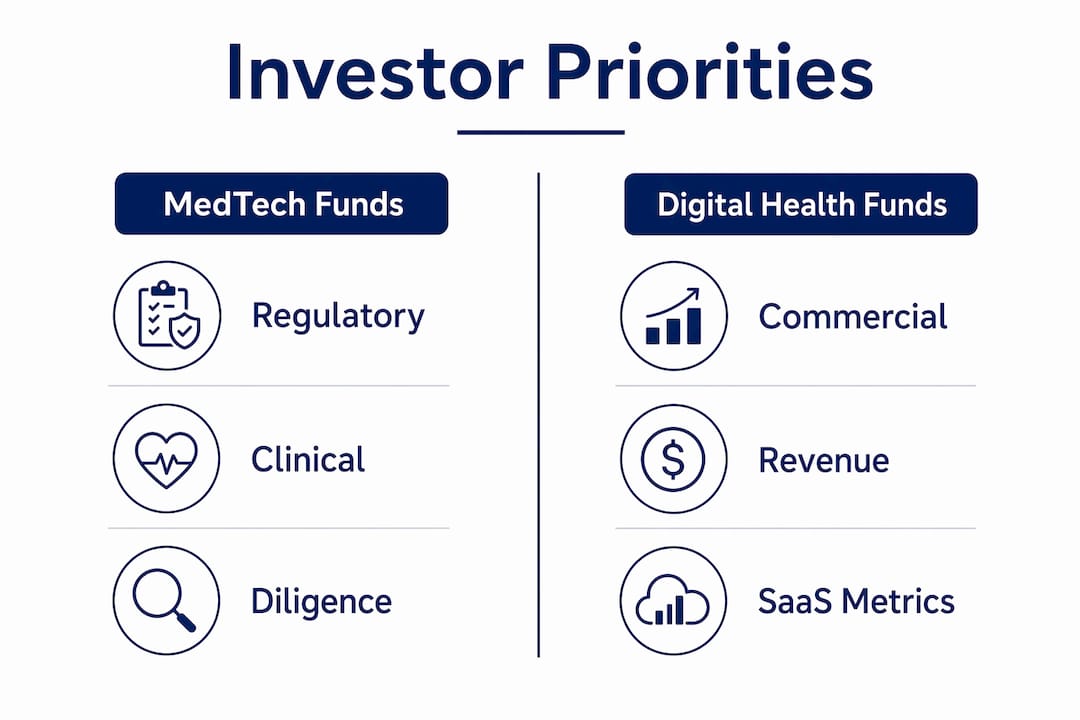
Pro Tip: Match your lead investor to your dominant milestone. If your step-up is regulatory (a pre-submission meeting or IDE acceptance), target MedTech-specialist funds first. If your step-up is commercial (ARR velocity and NRR above 110%), lead with digital health VCs who underwrite SaaS metrics. Pitching a SaaS deck to a MedTech fund is one of the fastest ways to get a polite pass.
What product-market fit looks like in health tech and biotech
Product-market fit in health tech is not a feeling. It is a set of verifiable artifacts investors will pull into a data room and stress-test.
For digital health companies, the accepted signals are SaaS metrics: annual recurring revenue, net revenue retention, CAC payback period, and monthly active usage rates. Investors want to see that customers are not just signing but expanding. An NRR above 100% tells the story better than any slide. For customer success benchmarks that translate into retention evidence, the bar is higher in healthcare than in most SaaS verticals because switching costs are real and procurement cycles are long.

For MedTech and biotech, the PMF signals look different. Paid pilots with named health systems, letters of intent with documented pricing and trigger conditions, cohort enrollment data, and KOL endorsements with verifiable engagement all substitute for ARR when revenue is pre-commercial. Investors accept these in lieu of revenue only when the documentation is airtight.
Directional benchmarks investors reference in digital health diligence:
- ARR in the range of $1M–$3M with a clear growth trajectory signals early commercial traction
- CAC payback under 18 months is generally expected for enterprise health SaaS
- Monthly retention above 85% for clinical workflow tools; higher for consumer-facing digital health
- Pilot-to-paid conversion rate above 50% is a credible signal; below 30% raises questions about fit
Pro Tip: Convert every pilot into a verifiable diligence artifact before you start investor conversations. That means a signed agreement with scope, pricing, and renewal terms, plus documented usage data. A verbal "they love it" from a hospital CMO is not diligence-ready. A signed contract with 90-day utilization data is.
Clinical evidence and regulatory progress that de-risk a Series A
For MedTech and biotech founders, the regulatory step-up milestone is often the single most important valuation anchor in the round. Investors will not fund a regulatory black box. They want to know exactly where you are on the FDA pathway, what the next gate is, and how much capital it takes to clear it.
The common regulatory milestones that anchor a U.S. MedTech Series A:
| Regulatory Milestone | Typical Duration | Investor Signal |
|---|---|---|
| Pre-submission (Q-Sub) meeting with FDA | 3–6 months to schedule and complete | Confirms pathway; reduces regulatory risk perception |
| IDE submission and acceptance | 6–12 months from pre-sub | Unlocks pivotal trial; major de-risking event |
| 510(k) submission | 12–18 months from IDE or direct path | Clearance path defined; commercial timeline visible |
| De Novo or PMA pathway defined | Varies; 18 months | Higher bar; requires stronger clinical data package |
| Human proof-of-concept (diagnostics/biotech) | Varies by modality | Signals biological plausibility; anchors next raise |
Clinical evidence documents to include in your pitch and data room:
- Clinical evaluation plan or clinical evidence summary (U.S. equivalent of MDR Article 61 framework)
- Interim analysis or feasibility study results with statistical methodology
- KOL letters with verifiable institutional affiliation and documented engagement
- FDA correspondence (pre-sub meeting minutes, Q-Sub responses)
- Post-market clinical follow-up plan (if applicable)
- IRB approval documentation for any human studies
Pro Tip: Present regulatory uncertainty honestly. Investors who specialize in MedTech have seen every version of "we expect clearance in Q3." What they respect is a founder who says: "Here is our pre-sub response, here is the FDA's feedback, here are the two open questions, and here is our mitigation plan if the pathway shifts." Transparency on regulatory risk, paired with a documented plan, keeps valuation credible. Overconfidence on timeline kills it.
Technology, security, and integration milestones investors require
HIPAA compliance is effectively non-negotiable by Series A. Investors expect documented evidence of your privacy and security posture, not a promise that you are working on it. The bar has risen sharply as health system procurement teams now run their own security reviews before signing any pilot agreement.
The security and compliance baseline investors verify:
- Business Associate Agreements (BAAs) in place with all vendors handling PHI
- Encryption at rest and in transit, with documented key management
- Access controls, audit logs, and role-based permissions documented
- SOC 2 Type I completed or Type II audit in progress
- Penetration testing results from a recognized third-party firm
- Incident response plan documented and tested
EHR integration is where many digital health companies separate themselves. Investors increasingly favor solutions embedded in clinical workflows over standalone apps, and for good reason: embedded tools have higher retention, shorter sales cycles, and lower churn. If you have a live Epic or Cerner integration, lead with it. If you have a FHIR R4 API plan with a named health system partner, document it clearly.
Operational scalability markers to show in diligence:
- Cloud architecture diagram (AWS, Azure, or GCP with multi-region failover)
- Uptime SLA documentation (99.9% or above for clinical tools)
- Deployment automation and CI/CD pipeline evidence
- Monitoring and alerting stack (Datadog, PagerDuty, or equivalent)
Pro Tip: SOC 2 Type I is achievable in 60–90 days with the right compliance platform (Vanta, Drata, or Secureframe are commonly used). Start it before your first investor meeting. Showing a SOC 2 report in progress signals operational maturity. Showing nothing signals that security is an afterthought, which is a deal-killer in health tech.
Commercial milestones: pilots, contracts, revenue models, and reimbursement
The commercial motion in health tech is rarely a clean SaaS sale. It moves through hospital pilots, payer engagement, and enterprise procurement cycles that can run 9–18 months. Investors know this. What they want to see is that you understand the motion and have already started it.
A credible LOI is not a letter of enthusiasm. It names the buyer, defines the scope, states the pricing, and documents the trigger conditions for conversion to a paid contract. Anything less is a relationship memo, not a commercial milestone. Specialist investors will call the signatory and ask about volume commitments and budget allocation. If the signatory is surprised by the call, the LOI is worthless.
Vanity LOIs are one of the most common deal-killers in health tech diligence. Founders collect letters from friendly hospital CMOs or health system executives who are genuinely interested but have no budget authority or procurement timeline. When investors call to verify, the conversation reveals that the "commitment" is aspirational. The round either stalls or reprices.
What constitutes a credible commercial artifact:
- Signed pilot agreement with named buyer, defined scope, and payment terms
- LOI with pricing, volume commitments, and a conversion trigger (e.g., 90-day pilot completion)
- Executed contract with at least one renewal or expansion clause
- Documented payer engagement: named payer, meeting dates, coverage discussion summary
Reimbursement strategy is chronically underbudgeted. For digital health tools seeking CPT code coverage or value-based care reimbursement, early payer conversations matter more than most founders realize. A documented payer engagement strategy, even at the "we have had three exploratory meetings with two regional payers" stage, signals commercial sophistication. For MedTech, a clear CPT pathway or a CMS coverage analysis in the data room meaningfully reduces investor concern about long-term unit economics.
Pro Tip: Avoid the common go-to-market mistakes of treating all pilots as equivalent. Tier your pilots: a paid pilot with a named academic medical center that has a defined conversion path is worth ten times a free pilot with a community clinic that has no procurement budget. Investors count the former; they discount the latter.
People and governance milestones investors expect at Series A
The team question at Series A is not "do you have smart people?" It is "do you have the right people in the right seats to execute the next 18 months?" Investors are looking for evidence that the founding team has filled the gaps that seed-stage companies typically run with.
Key hires investors expect to see in place or actively recruiting:
- Head of Sales or VP of Commercial: Someone who has sold into health systems or payers before, with a verifiable track record and an existing network.
- Regulatory Lead or VP of Regulatory Affairs: For MedTech/biotech, this hire is non-negotiable. For digital health, a regulatory consultant with documented FDA experience is acceptable at Series A.
- Clinical Director or Chief Medical Officer: A board-certified physician with relevant specialty experience who can engage KOLs, validate clinical claims, and open enterprise doors. A fractional CMO is a credible and cost-effective option for companies not yet ready for a full-time hire.
- VP of Engineering or CTO: Someone who has built and scaled HIPAA-compliant infrastructure, not just a strong individual contributor.
- Finance Lead or VP of FP&A: Capable of owning the financial model, managing investor reporting, and running the cap table.
The medical advisory board is often treated as a checkbox. Investors see through it immediately. What they want is documented engagement: advisory agreements with defined time commitments, evidence that advisors have reviewed clinical protocols or opened doors to named health systems, and KOL letters that reference specific interactions with the product.
Governance items to resolve before Series A:
- Cap table cleaned up: no missing founder agreements, no informal equity promises, all option grants documented
- Founder vesting on a standard 4-year schedule with a 1-year cliff
- Board composition plan: typically two founders, two investors, one independent director post-Series A
- IP assignment agreements signed by all founders and early employees
The financial KPIs and cap table realities investors will interrogate
Investors will build their own financial model from your data. The question is whether your model and theirs converge. If they diverge by more than 20% on key assumptions, you have a credibility problem.
Core KPIs digital health VCs examine:
- ARR and MRR: Growth rate matters more than absolute size at Series A
- Net Revenue Retention: Above 100% signals expansion; below 90% signals churn risk
- CAC payback period: Under 18 months for enterprise health SaaS is the general expectation
- Gross margin: Above 60% for SaaS; lower for services-heavy models, which investors will discount
- Monthly churn: Below 2% for enterprise; SaaS churn benchmarks in healthcare are stricter than general SaaS
For MedTech VCs, the financial interrogation shifts to burn rate per regulatory milestone, runway to the next FDA gate, and the cost model for the pivotal trial or 510(k) submission. A milestone-costing model that shows exactly how much capital each regulatory step requires is more persuasive than a 5-year revenue projection.
Raise size and runway guidance: the standard ask for a health tech Series A is sized to provide 18 months of runway post-close, with a buffer for the fundraising process itself. MedTech raises are typically structured against a specific regulatory milestone, so the ask should match the capital needed to reach that gate plus a 20–30% contingency.
Pro Tip: Build three scenarios: base, conservative, and upside. Walk investors through the conservative case first. It signals that you understand your risks and have planned for them. Founders who only present the upside case make investors nervous, because it suggests they have not stress-tested their assumptions.
What investors will ask for in diligence and how to prepare your data room
A health tech Series A diligence process typically runs 4–9 months. The founders who survive it intact are the ones who organized their data room before the first investor meeting, not after the term sheet.
Structure your data room in three tiers:
Tier 1 (open at first meeting):
- Executive summary and pitch deck
- Cap table (current and post-money scenarios)
- Financial model with assumptions documented
- Customer list with ARR by account (redacted names acceptable initially)
- One-page regulatory summary (pathway, current status, next milestone)
Tier 2 (provided on NDA):
- Full customer contracts and LOIs
- Clinical study protocols and interim results
- FDA correspondence and pre-submission meeting minutes
- HIPAA compliance documentation and SOC 2 report
- IP assignments and patent filings
Tier 3 (on request, late-stage diligence):
- Individual employment agreements and option grants
- Full financial statements (audited if available)
- Detailed technical architecture documentation
- Reference contacts for KOLs and named customers
Common diligence pitfalls and how to fix them:
- Unverifiable LOIs: Replace with signed agreements or add named signatory contact information and a summary of the conversation history
- Missing regulatory artifacts: Commission a regulatory consultant to produce a written FDA pathway analysis before investor meetings start
- Unvetted KOL letters: Ensure every KOL letter references specific product interactions and is signed by someone with verifiable institutional affiliation
- Cap table discrepancies: Run a full cap table audit with your attorney 90 days before you start outreach
For a comprehensive guide to assembling due diligence documents and structuring your data room, the BabyLoveRaise guide is a practical starting point for first-time founders.
Pro Tip: Use a secure virtual data room platform (Carta, Docsend, or Intralinks) from day one. Tracking who views which documents gives you real-time signal on investor interest and lets you sequence follow-up conversations intelligently. A shared Google Drive folder signals that you have not done this before.
Benchmarks for round sizes, timelines, and how much to raise
Digital health Series A rounds in the U.S. typically fall within a moderate range, while MedTech and biotech Series A rounds tend to be larger, reflecting the capital intensity of regulatory and clinical programs. These are directional ranges, not guarantees. The right ask size is the one that funds your next milestone with 18 months of runway and a 20–30% contingency.
Timeline reality: digital health seed rounds typically close in 8–12 weeks under SaaS-style diligence, while MedTech seed and Series A rounds can take 6–9 months due to regulatory and clinical review. Plan your fundraising calendar accordingly. If you are a MedTech company starting investor outreach in January, do not plan to close before September.
Running parallel conversations with 20–40 investors simultaneously is the standard approach for health tech Series A. Sequential outreach, where you wait for a no before approaching the next fund, is a timeline killer in a market where a single diligence process can take three months.
Use-of-funds buckets investors expect to see:
- Growth hires: Head of sales, regulatory lead, clinical director (typically 35–45% of raise)
- GTM and commercial: Pilot expansion, marketing, payer engagement (typically 20–30%)
- Regulatory and clinical: FDA submissions, trial costs, clinical operations (MedTech: 30–50%)
- Technology and infrastructure: EHR integrations, SOC 2, platform scaling (typically 10–20%)
The milestone-driven ask is more persuasive than the runway-driven ask for MedTech. "This $18M gets us to 510(k) clearance and three signed health system contracts" is a cleaner story than "this $18M gives us 18 months of runway." Both are true; one tells investors exactly what they are buying.
Common risks and red flags that kill or delay Series A deals
Most deals that fall apart in health tech diligence do not fail because the product is bad. They fail because the documentation does not match the story the founder told in the pitch meeting.
The top red flags investors flag in health tech Series A diligence:
- Uncorroborated LOIs: Investors call signatories. If the signatory does not recall the commitment or cannot confirm pricing, the round reprices or dies.
- Missing HIPAA or SOC 2 evidence: A verbal "we are HIPAA compliant" with no documentation is a red flag, not a milestone.
- Weak or absent clinical plan: For MedTech, no written FDA pathway analysis signals that the regulatory strategy is aspirational, not operational.
- Sloppy cap table: Undocumented equity promises, missing founder agreements, or informal grants discovered in diligence create legal risk that investors will not absorb.
- Unrealistic runway math: A financial model that assumes zero customer churn and 100% pilot conversion rates tells investors that the founder has not stress-tested their assumptions.
- Single-customer concentration: More than 40% of ARR from one customer is a risk flag that requires an explicit mitigation narrative.
Run this checklist internally 60–90 days before your first investor meeting:
- Pull every LOI and verify that the signatory can confirm scope, pricing, and timeline
- Commission a SOC 2 audit or produce a written HIPAA compliance summary with supporting documentation
- Engage a regulatory consultant to produce a written FDA pathway analysis
- Run a full cap table audit with your attorney
- Stress-test your financial model with a 30% revenue miss scenario and confirm you still have 12 months of runway
Pro Tip: The 60-day pre-outreach window is your best opportunity to fix problems quietly. Once you are in active diligence, every gap you discover becomes a negotiating point for the investor. Fix it before they find it.
A concise pitch template: the investor narrative and slide map
The most effective Series A pitch in health tech answers the investor's core question in the first three slides: what is the problem, what have you proven, and what does this round buy? Everything else is supporting evidence.
A ten-slide narrative that works:
- Problem: One slide, one number, one clear statement of the clinical or operational gap. No more than three bullet points.
- Solution: What you built, how it works in a clinical workflow, and why it is defensible. Include a screenshot or workflow diagram.
- Traction: Your step-up milestone front and center. ARR growth chart, pilot conversion rate, or FDA milestone achieved. This is the slide investors will photograph.
- Clinical and regulatory: Pathway defined, current status, next gate, and timeline. One clean table.
- Market: Total addressable market with a bottom-up build, not a top-down percentage. Name the buyer segments.
- Go-to-market: Sales motion, channel strategy, and the first three named customers or prospects in the pipeline.
- Team: Photos, titles, and the two or three credentials that matter most. Include advisors with named institutional affiliations.
- Financials: ARR, growth rate, gross margin, burn rate, and runway. Three-year model with base and conservative scenarios.
- Use of funds: Four buckets, specific dollar amounts, and the milestone each bucket funds.
- The ask: Round size, pre-money valuation range, and the single sentence that describes what investors are buying.
Evidence to put behind each slide in the data room:
- Behind Traction: signed customer contracts, usage data, NRR calculation
- Behind Clinical/Regulatory: FDA pre-submission meeting minutes, clinical protocol, KOL letters
- Behind Financials: full financial model with assumptions, cap table, audited statements if available
Pro Tip: When an investor asks about valuation, anchor to the milestone, not the multiple. "We are pricing this round to fund us to 510(k) clearance and $3M ARR, which we believe positions us for a Series B at a materially higher valuation" is a more defensible answer than citing a revenue multiple. It shows you understand what the capital is buying.
Clinically grounded priorities from a physician-executive
Paul Bergeron, MD, MBA, is a board-certified Internal Medicine physician, Fellow of the American College of Physicians (FACP), and Certified Physician Executive (CPE) with an MD from the University of Vermont College of Medicine, residency training at Stanford University Medical Center, and an MBA from UMass Isenberg School of Management. He has served as CMO at Prospect Medical Holdings, Regional Executive Medical Director at Steward Health Care Network overseeing 3,000+ providers and 500,000+ covered lives, and has advised companies including CareGem Health, which was acquired by Althea.AI within three months of engagement.
The milestone sequencing that matters most depends on your product type and capital position:
| Product Type | First Milestone | Second Milestone | Third Milestone |
|---|---|---|---|
| Digital health SaaS | ARR and NRR evidence | EHR integration + HIPAA/SOC 2 | Named enterprise contracts |
| MedTech / device | FDA pathway defined (pre-sub) | Clinical evidence package | Named health system pilot |
| Biotech / diagnostics | Human proof-of-concept | KOL endorsements + IRB | Payer engagement initiated |
For founders in the next 30/90/180 days:
- 30 days: Assemble your Tier 1 data room, run a cap table audit, and commission a written FDA pathway analysis or HIPAA compliance summary.
- 90 days: Lock at least one verifiable paid pilot or signed LOI with named buyer and pricing. Begin SOC 2 audit. Identify and engage two KOLs with documented advisory agreements.
- 180 days: Reach your step-up milestone (regulatory gate, ARR target, or named enterprise contract). Begin parallel investor outreach with 20–40 funds. Have your financial model stress-tested by an independent advisor.
The founders who close health tech Series A rounds on their own terms are not always the ones with the best product. They are the ones who treated the fundraise as a clinical trial: hypothesis defined, evidence collected, documentation airtight, and timeline managed. Investors are not buying your vision. They are buying your ability to execute against a plan.
Pro Tip: A physician engagement strategy is not just a clinical credibility play. It is a commercial accelerator. Founders who can put a board-certified physician in front of a hospital CMO close pilots faster, get better LOI terms, and move through procurement with fewer objections. Build clinical leadership into your team before you start investor conversations, not after.
How to prioritize milestones when you cannot do everything at once
Milestone prioritization is not a philosophical exercise. It is a capital allocation decision. Every dollar and every week you spend on a milestone that does not move your valuation or reduce investor risk is a dollar and a week you did not spend on the one that does.
The prioritization framework works on three variables: product type, time-to-revenue, and capital intensity. A digital health SaaS company with $800K ARR and 90% retention should prioritize commercial traction and EHR integration over regulatory work. A MedTech company with a novel device and no revenue should prioritize the FDA pre-submission meeting and clinical evidence over hiring a sales team.
The sequencing error most founders make is pursuing milestones in parallel when they should be pursuing them in series. SOC 2, EHR integration, payer engagement, and a pivotal trial cannot all be the top priority simultaneously. Rank them by investor impact: which single milestone, if achieved, most materially reduces the risk an investor is pricing into your valuation? Start there.
For digital health market entry companies, the answer is almost always commercial traction. For MedTech, it is almost always the regulatory step-up. For diagnostics and biotech, it is almost always the clinical proof-of-concept. Build your 90-day sprint around that one milestone, then sequence the next.
How successful health tech companies executed their Series A milestones
The companies that have closed strong health tech Series A rounds share a pattern: they identified their single most de-risking milestone early, built their entire 12-month plan around reaching it, and entered investor conversations with that milestone either achieved or visibly in progress.
CarePredict, an AI-powered senior care platform, demonstrated measurable clinical outcomes before its Series A, including documented reductions in hospitalizations and falls. That outcomes data became the centerpiece of its investor narrative and directly supported its raise. The lesson: quantified clinical impact, not just product functionality, is what moves institutional investors.
Companies in the value-based care and population health space have consistently used named health system contracts and documented HEDIS performance improvements as their commercial step-up milestone. Investors in this segment respond to evidence that the product changes payer economics, not just clinical workflows. A documented $1M+ in savings through a home-based care program, for example, is a more persuasive commercial milestone than a pilot agreement with no outcome data attached.
The pattern across successful raises is consistent: the step-up milestone is defined before the fundraise starts, the evidence is assembled before the first investor meeting, and the narrative ties the milestone directly to the use of funds. Founders who enter investor conversations still working toward their step-up milestone raise at a discount. Founders who enter with it achieved or clearly in sight raise on their own terms.
How to communicate milestones to investors during the fundraise
Investor communication during a health tech Series A is not a single pitch meeting. It is a 4–9 month relationship-building process where every interaction either builds or erodes confidence. The founders who manage this well treat investor communication as a product: structured, consistent, and evidence-driven.

Before the first meeting, send a one-page executive summary that leads with your step-up milestone and your ask. Do not make investors read a 40-slide deck to find the number. Lead with the answer.
During the process, send monthly investor updates to every fund in your pipeline, whether or not they have signed an NDA. A concise update covering ARR or regulatory progress, a key customer win, and a team hire keeps you top of mind and signals operational discipline. Investors who receive regular updates are more likely to move quickly when they are ready to commit.
When presenting milestones, use the "achieved, in progress, planned" framework for every major item. Investors respect founders who are clear about what is done, what is underway, and what the capital will fund. Ambiguity about milestone status is interpreted as either confusion or concealment.
For your investor pitch checklist and documentation sequence, having a structured framework before outreach begins saves weeks of reactive document assembly during diligence. Prepare the materials before you need them.
Pro Tip: After every investor meeting, send a follow-up email within 24 hours that summarizes the three key points you made, addresses any open questions, and states the next step. Investors meet dozens of founders. The ones who follow up with precision and speed stand out. It is also a signal of how you will run the company post-close.
Key Takeaways
To close a U.S. health tech Series A, your step-up milestone must be achieved or visibly in progress before your first investor meeting, your data room must be organized in three tiers, and your financial model must survive a 30% revenue miss scenario with 12 months of runway intact.
| Point | Details |
|---|---|
| Step-up milestone first | Identify and achieve your single most de-risking milestone (regulatory gate, ARR target, or named contract) before investor outreach begins. |
| Data room in three tiers | Organize documents into Tier 1 (first meeting), Tier 2 (post-NDA), and Tier 3 (late diligence) to control information flow and signal operational maturity. |
| Parallel investor outreach | Run conversations with 20–40 investors simultaneously; sequential outreach adds months to a process that already runs 4–9 months. |
| Verify every LOI | Ensure every letter of intent names the buyer, states pricing, and documents trigger conditions — investors will call the signatory. |
| Financial model stress-tested | Build base and conservative scenarios; show 18 months of runway post-close with a 20–30% contingency built in. |
| Thestartupmd for Series A prep | Paul Bergeron, MD, MBA, provides fractional CMO, clinical strategy, and pitch readiness support to help founders execute milestones and enter investor conversations with credible documentation. |
What investors really seize on
Most founders walk into a Series A pitch thinking the deck is the product. It is not. The deck is the menu. The data room is the kitchen. Investors who are serious about a deal will spend more time in your data room than in any pitch meeting, and what they find there either confirms the story you told or unravels it.
The two checkpoints that consistently determine whether a health tech round closes on the founder's terms: the quality of the commercial evidence (specifically, whether the LOIs and pilot agreements hold up to a phone call) and the clarity of the regulatory plan (specifically, whether the founder can answer "what happens if the FDA comes back with a major deficiency?" without hesitating).
Founders who prepare for those two questions before they start investor conversations close faster, negotiate from a stronger position, and spend less time in diligence. Founders who discover the gaps during diligence spend months patching documentation under investor scrutiny, which is the worst possible negotiating environment.
The posture that works in investor meetings is transparent confidence: here is what we have achieved, here is what we are still working on, here is the plan, and here is what the capital buys. Investors are not looking for perfection. They are looking for founders who know exactly where they are and have a credible plan to get where they need to be.
Thestartupmd helps founders prepare for health tech Series A
Closing a health tech Series A requires more than a strong product. It requires clinical credibility, a defensible regulatory story, and commercial evidence that holds up under institutional scrutiny. That is the gap Thestartupmd is built to close.
Paul Bergeron, MD, MBA, works directly with health tech and biotech founders as a fractional CMO and clinical strategy advisor, helping them sequence milestones, build investor-ready documentation, and enter fundraising conversations with the clinical authority that opens enterprise doors. From pitch deck review and data room organization to KOL engagement and payer strategy, the work is hands-on and tied to your specific raise timeline.
Founders who have worked with Thestartupmd have moved through diligence faster, presented clearer regulatory narratives, and closed pilots with named health systems that became the centerpiece of their Series A story. If your round is 6–12 months out and you want to enter investor conversations with your milestones documented and your clinical story airtight, explore the services at Thestartupmd or schedule a conversation to discuss where you are in the process.
Authoritative sources and further reading
- FDA Pre-Submission Program (Q-Sub): The FDA's official guidance on requesting feedback before submission — essential reading for any MedTech founder defining their regulatory pathway.
- HIPAA for Professionals (HHS.gov): The primary source for HIPAA compliance requirements; use this to verify your privacy and security posture before investor diligence.
- Rock Health: The leading source for digital health funding data and market intelligence in the U.S.; useful for benchmarking raise sizes and tracking sector trends.
- JMIR (Journal of Medical Internet Research): Peer-reviewed digital health research; useful for sourcing clinical evidence citations and understanding what published outcomes data looks like.
- Secure data rooms for startups: Practical guidance on selecting and organizing a secure data room platform for Series A diligence.
- Thestartupmd Services: Overview of fractional CMO, clinical strategy, and go-to-market advisory services for health tech and biotech founders.
- Healthcare Startup Investor Pitch Checklist: A structured checklist for founders preparing investor materials and data room documentation.