

Prioritize regulatory readiness, data governance evidence, and commercial health first when evaluating a healthcare SaaS target. Those three domains decide whether a deal closes cleanly, closes with conditions, or should not close at all. A target that cannot produce HIPAA documentation, a current SOC 2 Type II report, and a reconciled ARR schedule in the first week of diligence is signaling operational immaturity, not just administrative lag. Per Nixon Peabody's health-tech M&A guidance, health-tech deals require more stringent scrutiny across management, regulatory compliance, and data governance than traditional healthcare M&A checklists, and that scrutiny starts at the top of the funnel.
Three immediate priorities:
- Regulatory and compliance readiness: Confirm HIPAA Privacy and Security Rule evidence, executed Business Associate Agreements (BAAs), and no unreported breaches. Cross-reference with HHS OCR's public breach database and check for FDA applicability if the product touches clinical decision support or diagnostics.
- Data governance and technical evidence: Request SOC 2 Type II, HITRUST certification (if claimed), penetration test summaries with remediation tickets, and architecture diagrams showing PHI data flows.
- Commercial and financial health: Require a reconciled ARR/MRR schedule, cohort retention data, and top-10 customer contracts before committing deeper diligence resources.
Quick decision rule: If HIPAA evidence, a current SOC 2 or pen-test with remediation confirmation, and an ARR reconciliation are all missing, pause and require a remediation plan before proceeding to full diligence.
Key Takeaways
Effective healthcare SaaS due diligence requires regulatory and data governance evidence first, commercial validation second, and specialist clinical expertise present from day one to prevent post-close surprises.
| Point | Details |
|---|---|
| Regulatory evidence gates the deal | Missing HIPAA documentation, BAAs, or an unreported breach are deal-killers, not negotiating points. |
| Operational proof beats policy PDFs | Require SOC 2 Type II, pen-test remediation tickets, and incident logs, not just written policies. |
| Leadership composition signals risk early | A dedicated CISO, clinical lead, and compliance officer with documented tenure reduces post-close remediation burden. |
| Financial health requires reconciliation | ARR/MRR must be reconciled line-by-line to contracts and invoices; customer concentration above 20% is a structural valuation risk. |
| The StartupMD accelerates clinical validation | Fractional CMO and advisory services from The StartupMD deliver clinical risk memos and regulatory scope assessments within your deal timeline. |
Table of Contents
- What should you request first in healthcare SaaS due diligence?
- Does leadership composition predict regulatory and operational risk?
- How do HIPAA, FDA, and CMS shape your regulatory diligence?
- What technical evidence do you need to validate security posture?
- Which financial metrics reveal hidden risk in a healthcare SaaS target?
- What IP and contract risks can impair the product post-close?
- How do you assess vendor and subprocessor risk before close?
- What documents should you request for the diligence data room?
- How do you grade risk findings and identify deal-killers?
- When should you bring in clinical, regulatory, and security experts?
- Does the target have a credible business continuity plan?
- How do you assess regulatory change risk going forward?
- What data migration challenges should you plan for post-close?
- What cyber and data breach insurance coverage should you require?
- What experienced healthcare SaaS advisors know that checklists miss
- The StartupMD brings clinical and regulatory depth to your diligence process
- Sources
What should you request first in healthcare SaaS due diligence?
A structured intake cadence prevents the most common diligence failure: receiving documents out of sequence and spending week two chasing items that should have arrived on day one. The following order surfaces time-sensitive, deal-gating items before your team invests in deeper commercial analysis.
Day 1 requests (gate items):
- Executed BAAs with all covered-entity customers and cloud subprocessors
- Most recent SOC 2 Type II report (or HITRUST assessment letter)
- HIPAA Security Risk Assessment (SRA) completed within the last 12 months
- Breach notification history and any HHS OCR correspondence
- ARR/MRR schedule reconciled to invoices for the trailing 12 months
Day 3 requests (risk-triage items):
- Penetration test summary with remediation ticket evidence and re-test confirmation
- FDA regulatory correspondence, 510(k) or PMA filings, and any warning letters
- Organizational chart with tenure dates for CISO, CMO/Chief Medical Officer, and compliance lead
- Top-10 customer contracts, including custom pricing addenda and termination clauses
- Cyber insurance policy declarations page and claims history
Week 2 requests (validation and depth):
- Architecture diagrams and PHI data flow maps (de-identified or synthetic; no live PHI in the data room)
- Incident response runbooks and postmortem logs for the past couple of years
- Open-source license inventory and IP assignment agreements for all founders and key engineers
- Subprocessor list with BAA status, data residency, and SLA terms
- Cohort retention analysis and customer concentration breakdown
14-day intake cadence by validation owner:
- Legal team: BAAs, customer contracts, IP assignments, litigation disclosures, insurance
- Security lead: SOC 2, pen-test evidence, incident logs, architecture diagrams, access control documentation
- Clinical/regulatory advisor: FDA correspondence, SRA, breach history, telehealth licensure records
- Finance team: ARR reconciliation, deferred revenue schedules, revenue recognition policy, invoice samples
Pro Tip: Never allow identifiable PHI into the data room. Request de-identified summaries, synthetic datasets, or aggregated metrics instead. If a seller insists on sharing live patient records to demonstrate product capability, that itself is a HIPAA red flag worth documenting.
Does leadership composition predict regulatory and operational risk?
Yes, and it does so faster than most other signals. The presence of a dedicated CISO, a clinically credentialed CMO or Chief Medical Officer, and a compliance lead with documented tenure tells you whether the organization has built compliance into its operating model or bolted it on for the sale. Nixon Peabody's health-tech diligence framework identifies leadership composition as an early risk signal that shapes the entire diligence scope.
What to check in leadership bios and tenure:
- CISO: confirm they hold a recognized credential (CISSP, CISM, or equivalent), have been in role for at least 12 months, and own the incident response program, not just the title
- CMO or clinical lead: verify clinical credentials, active licensure, and whether they have direct input into product safety decisions or are primarily a marketing function
- Compliance lead: check whether the role is full-time or shared, and whether they report to legal, the CEO, or a board committee (reporting line matters for independence)
- Turnover: request HR turnover reports for the past couple of years; high turnover in any of these three roles in the 12 months before a sale is a material signal
Red flags tied to management:
- Concentrated institutional knowledge in one founder who is departing post-close
- Undisclosed officer litigation or regulatory sanctions
- Compliance function that exists only on paper, with no documented training records or audit trail
- Board composition with no independent healthcare or regulatory expertise
Practical validation steps: Request org charts with reporting lines, leadership CVs with dates, HR turnover reports, and escalation runbook ownership documentation. Ask who owns each runbook by name, not by title.
Pro Tip: Ask the seller to identify who would own a HIPAA breach response at 2 AM on a Saturday. If the answer is unclear or points to a single person who is leaving, that is a governance gap, not a staffing inconvenience.
How do HIPAA, FDA, and CMS shape your regulatory diligence?
Regulatory exposure in healthcare SaaS is not uniform. A practice management tool carries different risk than a clinical decision support platform or a telehealth prescribing application. Map each regulatory domain to its deal impact before requesting evidence, so your legal and clinical teams know where to spend time.
| What to check | Risk impact | Evidence to request | Remediation estimate | Who validates |
|---|---|---|---|---|
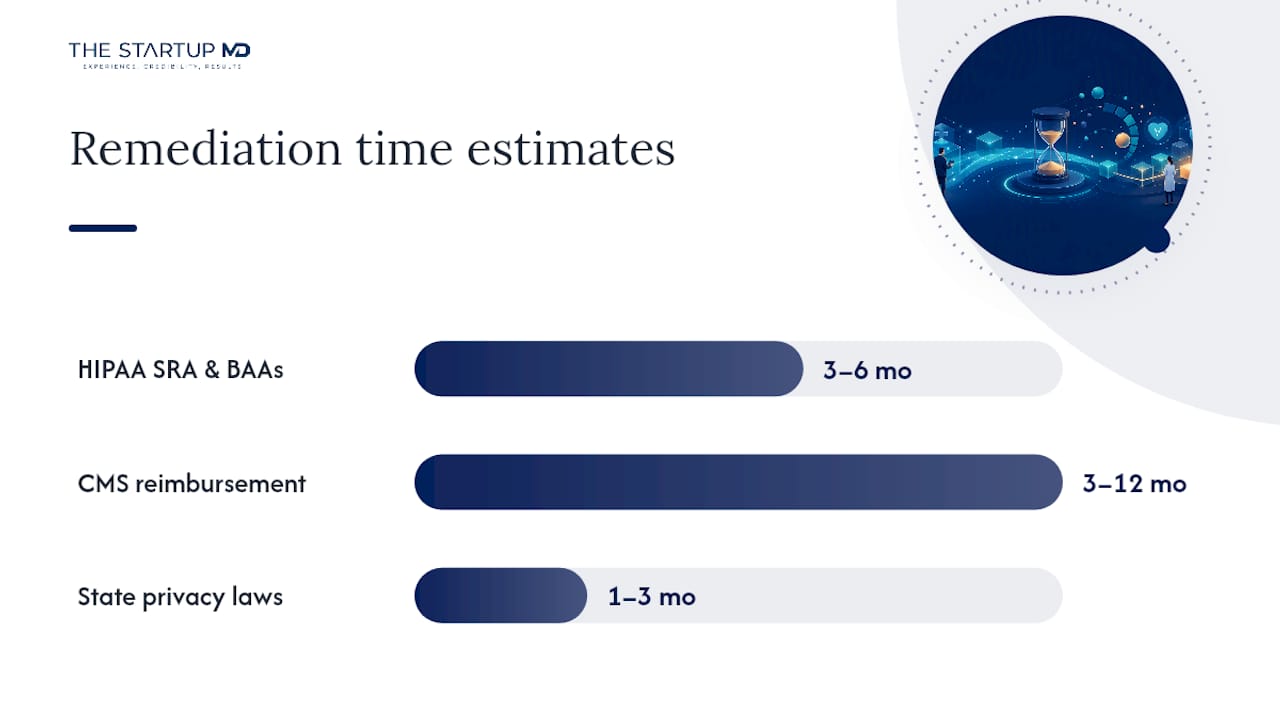
| HIPAA Privacy and Security Rule compliance | High | SRA, BAAs, training records, policy set | 3–6 months for gaps | Legal, security |
| HHS OCR breach history | High | OCR correspondence, breach log, notification letters | Depends on severity | Legal |
| FDA SaMD classification (510(k)/PMA) | High | Regulatory correspondence, classification memos, warning letters | several months if unresolved | Regulatory counsel, clinical |
| Telehealth state licensure and prescribing rules | High | Licensure matrix, prescriber credentials, state-by-state analysis | a few months | Regulatory counsel, clinical |
| CMS reimbursement model and federal payor exposure | Medium–High | Billing records, payor contracts, Anti-Kickback/Stark review | 3–12 months | Reimbursement counsel, legal |
| State privacy laws (CCPA, state HIPAA analogs) | Medium | Privacy policy, state-specific BAAs, data residency documentation | 1–3 months | Legal |
HIPAA: The Privacy and Security Rules require documented policies, a completed SRA, executed BAAs with every business associate, and a breach notification program. Cross-reference the seller's breach disclosures against HHS OCR's public breach portal to confirm nothing was underreported. An unreported breach is a deal-killer, not a negotiating point.
FDA: When the product touches clinical decision support, diagnostic algorithms, or patient-facing therapeutic guidance, FDA rules and regulations determine whether it qualifies as Software as a Medical Device (SaMD). Review all regulatory correspondence and any 510(k) or PMA filings. A warning letter in the file changes the risk profile materially.
CMS: If the target receives federal payor payments or supports Medicare/Medicaid workflows, CMS guidance is the reference point for evaluating Anti-Kickback Statute, Stark Law, and False Claims Act exposure. Government enforcement actions in this space have resulted in nine-figure penalties, as illustrated by a hospital chain's $260 million settlement for false billing and kickback violations. Buyers inherit legacy liability if reimbursement arrangements are not reviewed before close.
Telehealth: Treat telehealth as a separate diligence track. Telehealth workflows create distinct threat surfaces and require targeted checks on transmission security, encryption, vulnerability testing, and state-by-state prescribing rules. A telehealth product operating across many states without a current licensure matrix is a commercial risk, not just a compliance gap. See The StartupMD's overview of healthcare startup regulatory basics for a founder-facing primer on these frameworks.
What technical evidence do you need to validate security posture?
Policy documents are not evidence. HIPAA readiness that exists only on paper is insufficient; buyers must demand proof that controls have operated over time, not just that they were written down. This is the distinction between a compliant-looking target and one that is actually defensible.
Core technical evidence to request:
- SOC 2 Type II report (not Type I) covering the trailing 12 months, with bridge letter if the period has lapsed
- HITRUST CSF assessment letter or certification, if claimed
- Penetration test summary from a named third-party firm, with remediation tickets and re-test confirmation
- Architecture diagrams showing all system components, data flows, and PHI boundaries
- Encryption-at-rest and in-transit documentation (key management, algorithm standards, rotation schedules)
- Access control and identity management documentation: SSO/MFA enforcement on privileged accounts, role-based access controls, secrets management practices
- CI/CD pipeline controls: code review gates, dependency scanning, supply-chain security posture
- Patch SLA policy and evidence of recent patch cycles
Data lineage: Trace PHI from ingestion through processing, storage, and deletion. Ask for documentation and then test it against a production example. Gaps between documented flows and actual system behavior indicate either poor documentation discipline or undisclosed data handling practices, both of which carry regulatory exposure.
Incident response: Request incident logs for the last the past couple of years, containment timelines, lessons-learned documents, and cyber insurance coverage details. IC3 cybercrime reporting confirms that healthcare remains a high-frequency target for ransomware and data theft, which makes a clean incident history a genuine differentiator, not a baseline expectation.
| What to validate | Risk impact | Evidence to request | Remediation estimate | Who validates |
|---|---|---|---|---|
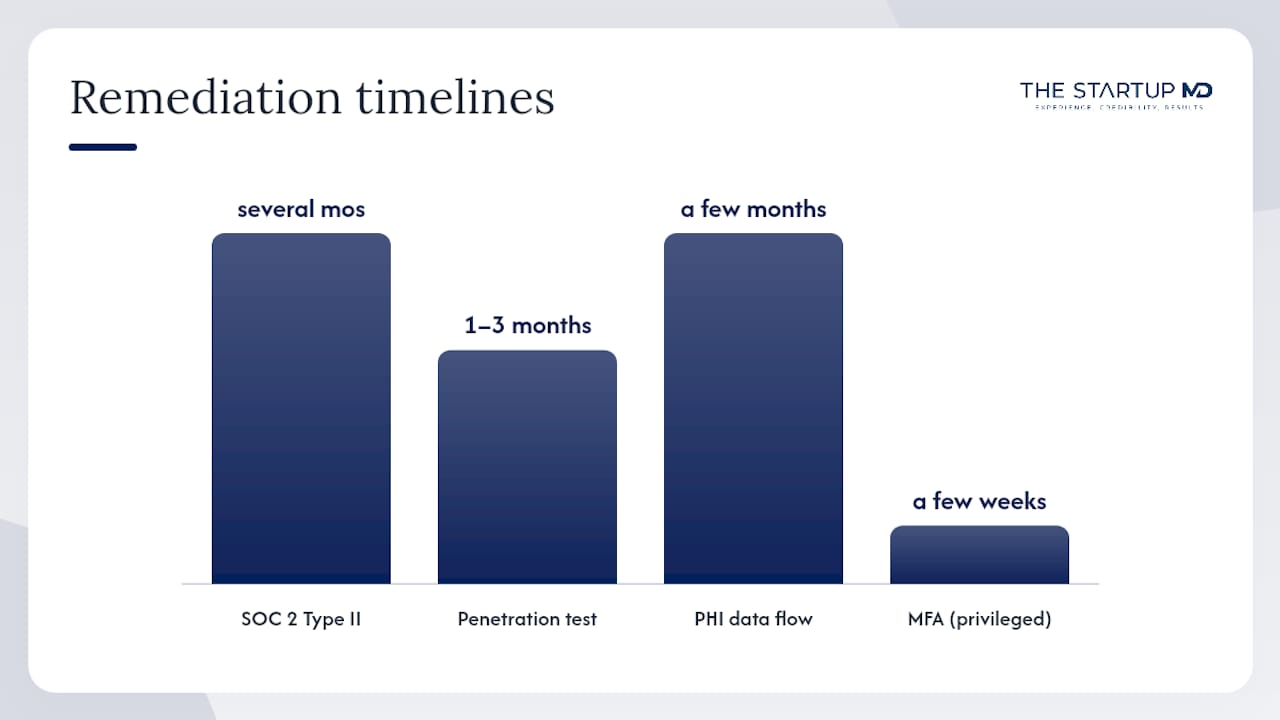
| SOC 2 Type II (current) | High | Audit report, bridge letter | several months to achieve | Security lead |
| Pen test with remediation evidence | High | Test report, ticket trail, re-test confirmation | 1–3 months per finding | Security lead |
| PHI data flow accuracy | High | Architecture diagrams, production comparison | a few months | Security, legal |
| MFA on privileged accounts | Medium | Access control logs, SSO configuration | a few weeks | Security lead |
| Incident response logs (the past couple of years) | High | Postmortems, containment records | N/A (historical) | Security, legal |
| Dependency and supply-chain posture | Medium | SBOM or equivalent scan output | a few weeks to a couple months | Security lead |
Pro Tip: A penetration test PDF without remediation tickets is marketing material, not evidence. Require remediation-ticket evidence and re-test confirmation for every critical and high finding before accepting the test as satisfactory. A seller who cannot produce this has either not remediated the findings or has not tracked the work.
Which financial metrics reveal hidden risk in a healthcare SaaS target?
Revenue figures in a data room tell you what the seller wants you to see. The reconciliation work tells you what is actually there. Start with ARR/MRR and work outward to the metrics that reveal customer quality, revenue durability, and hidden integration cost.
What to reconcile first:
- ARR/MRR schedule reconciled line-by-line to executed contracts and invoices
- Deferred revenue balance and revenue recognition policy (ASC 606 compliance)
- Refund and chargeback history for the trailing the past couple of years
- Customer concentration: what percentage of ARR comes from the top 3 and top 10 customers
- Contract term lengths and auto-renewal provisions
SaaS health metrics to evaluate:
- Logo churn and net revenue retention (NRR) by cohort, not just blended averages
- Customer acquisition cost (CAC) versus lifetime value (LTV) by segment
- Expansion revenue as a share of total growth (a high expansion ratio signals product stickiness)
- Onboarding customization burden: how many customers required non-standard implementation work
| Financial artifact | Risk impact | Evidence to request | Remediation estimate |
|---|---|---|---|
| ARR/MRR reconciliation | High | Contract list, invoices, billing system export | a short period to verify |
| Deferred revenue schedule | High | Balance sheet detail, ASC 606 memo | a few weeks with auditor |
| Customer concentration (top 3 > 40% ARR) | High | Customer revenue breakdown | Structural; affects valuation |
| Logo churn > 15% annually | High | Cohort retention analysis | several months to address |
| CAC/LTV ratio below 3:1 | Medium | Sales and marketing spend, cohort data | 3–6 months |
| Custom SOWs with non-standard pricing | Medium | Contract redlines, SOW library | 1–3 months post-close |
High customer concentration, where a single customer represents more than 20% of ARR, is a structural risk that affects both valuation and post-close stability. Review the SaaS churn dynamics specific to healthcare before finalizing retention assumptions, since healthcare SaaS churn drivers differ from general enterprise SaaS. For a deeper look at revenue model evaluation, The StartupMD's healthcare SaaS revenue model guide covers ARR/MRR considerations in detail.
What IP and contract risks can impair the product post-close?
IP ownership gaps are among the most expensive post-close surprises in healthcare SaaS deals. They are also among the most preventable, because the evidence is either in the data room or it is not.
IP checks to run:
- Confirm all founders, contractors, and early employees signed invention assignment agreements before contributing code
- Run an open-source license inventory (tools like FOSSA or Black Duck can automate this) and flag any GPL or AGPL components in the core product, since these can trigger copyleft obligations
- Verify registered copyrights, patents, and trademarks, and confirm no third-party claims are pending
- Check whether any IP was developed under a prior employer's time or resources
Contract priorities:
- BAAs: confirm executed agreements with every covered entity customer and every cloud subprocessor handling PHI
- Customer master services agreements: review termination-for-convenience clauses, data portability obligations, and SLA penalties
- Subcontractor and subprocessor terms: confirm data residency, breach notification timelines, and audit rights
- Reseller and channel agreements: check change-of-control provisions that could allow termination or price renegotiation at close
- Employment and contractor agreements: confirm non-compete, non-solicit, and IP assignment terms for key personnel
Red flags that should trigger price adjustments or walk-away consideration:
- Missing invention assignment agreements for any founder or early engineer who contributed to the core product
- GPL-licensed components embedded in proprietary features with no remediation plan
- Customer contracts with change-of-control termination rights covering more than 20% of ARR
- BAAs that are expired, unsigned, or missing for active covered-entity customers
- Undisclosed litigation, regulatory investigations, or demand letters from former employees or competitors
A change-of-control clause that lets a customer terminate without penalty is not just a legal technicality. If that customer represents 15% of ARR, it is a valuation event. Review every top-10 customer contract for this provision before signing a letter of intent.
How do you assess vendor and subprocessor risk before close?
Every third-party vendor that touches PHI is a potential liability the buyer inherits. The goal is not to eliminate vendor relationships but to understand their terms, their security posture, and what happens to those relationships at close.
Vendor matrix columns to collect for each vendor:
- Vendor name and service category (cloud infrastructure, analytics, communications, etc.)
- BAA or subprocessor agreement status (executed, expired, missing)
- Data residency (US-only, EU, or unspecified)
- SLA terms and uptime commitments
- Termination terms and notice periods
- Change-of-control clauses
What to request:
- Full subprocessor list with BAA status for each
- Vendor SOC 2 or HITRUST reports where available
- Evidence of vendor testing or attestation reviews conducted by the target
- Cloud provider agreements (AWS, Azure, GCP) with data processing addenda
Vendor concentration risk: A target that runs entirely on a single cloud provider with no multi-region failover and no documented exit strategy carries meaningful integration risk. Single-vendor failure scenarios can add both integration cost and regulatory exposure if the vendor's own security posture is not verified.
Pro Tip: Validate audit rights and breach notification clauses in every vendor agreement before close. A vendor contract that gives the target no right to audit and requires 72-hour breach notification internally but only 30-day notification to the target creates a gap that becomes your gap post-close.
When critical third-party dependencies cannot be replaced within 90 days, insist on transitional services agreements or escrow arrangements as a condition of close. This is especially relevant for specialty data vendors and clinical content providers where alternatives are limited.
What documents should you request for the diligence data room?
Organize requests by discipline so each validation team can work in parallel. Flag high-priority items that are deal-gating versus items that are negotiable.
Regulatory domain:
- Executed BAAs with all covered entities and subprocessors (deal-gating)
- HIPAA SRA completed within 12 months (deal-gating)
- HHS OCR correspondence and breach notification history (deal-gating)
- State privacy law compliance documentation
- FDA regulatory correspondence and classification memos (deal-gating if SaMD applicable)
- Telehealth licensure matrix and prescriber credential records
Security domain:
- SOC 2 Type II report with bridge letter (deal-gating)
- HITRUST assessment letter (if claimed)
- Penetration test report with remediation tickets and re-test confirmation (deal-gating)
- Incident response plan and postmortem logs (the past couple of years)
- Cyber insurance declarations page and claims history
Technical domain:
- System architecture diagrams and PHI data flow maps
- Runbooks for all critical operational processes
- Dependency list and open-source inventory
- CI/CD pipeline documentation
- Backup and disaster recovery procedures and test results
Financial domain:
- ARR/MRR schedule reconciled to contracts and invoices (deal-gating)
- Deferred revenue schedule and ASC 606 revenue recognition memo
- Cohort retention analysis and churn data
- CAC/LTV analysis by customer segment
- Refund and chargeback history
Legal domain:
- Customer master services agreements (top 20 customers)
- Founder and employee invention assignment agreements (deal-gating)
- Open-source license inventory
- Litigation disclosures and demand letters
- Insurance certificates (cyber, E&O, D&O)
Clinical domain:
- Clinical safety incident logs
- Clinician credential records (for telehealth or prescribing products)
- Any IRB approvals or clinical study documentation
Data room handling rules: No identifiable PHI belongs in a diligence data room. Request de-identified summaries, aggregated metrics, or synthetic datasets. If a seller cannot demonstrate product capability without sharing live patient records, document that as a compliance concern. For secure review workflows, require that all reviewers sign NDAs before data room access is granted and that access is logged and time-limited.
How do you grade risk findings and identify deal-killers?
Not every finding is equal. The goal of a risk grading framework is to separate deal-killers from remediable items quickly, so your team can focus negotiation leverage where it matters.
Risk matrix framework:
| Finding | Impact | Evidence strength | Remediation effort | Who validates |
|---|---|---|---|---|
| Unreported HIPAA breach | High | OCR records vs. seller disclosure | Not remediable pre-close | Legal, regulatory counsel |
| Missing IP assignment (core feature) | High | Contract review | 3–6 months post-close | Legal |
| No SOC 2 Type II (never achieved) | High | Absence of report | 6–12 months | Security lead |
| Systemic MFA gaps on privileged accounts | High | Access control logs | a few weeks | Security lead |
| Outdated HIPAA policies (no SRA update) | Medium | Policy dates, SRA timestamp | 1–3 months | Legal, security |
| Single unpatched CVE (non-critical) | Low | Vulnerability scan | 1–2 weeks | Security lead |
| Customer concentration (top 3 > 40% ARR) | High | Revenue breakdown | Structural; valuation impact | Finance |
| GPL component in proprietary code | Medium | OSS inventory | 1–3 months | Legal, engineering |
Deal-killer red flags:
- An unreported HIPAA breach discovered through HHS OCR records that the seller did not disclose
- Missing invention assignment agreements for the engineer who wrote the core algorithm
- Systemic identity and privilege failures (no MFA, shared admin credentials, no access logging)
- Active FDA warning letter with no remediation plan
- Customer contracts covering more than 30% of ARR with change-of-control termination rights
Remediable findings (with appropriate deal terms):
- Outdated policies with no operational gaps: price adjustment or escrow holdback
- Single unpatched CVE with a documented remediation timeline: conditional close with milestone
- Missing vendor BAA for a non-PHI-touching vendor: cure period post-close
Pro Tip: Fold technical risk scores into the valuation model directly. A finding that requires 6 months of remediation work at $200,000 in engineering and legal cost is a $200,000 valuation adjustment, not a footnote in the diligence memo. Build a remediation cost estimate for every high-impact finding before the final offer.
When should you bring in clinical, regulatory, and security experts?
The answer is earlier than most buyers think. Waiting until week three to engage a fractional CMO or regulatory counsel means the deal timeline compresses exactly when the most complex findings need the most careful analysis.
Specialist roles and timing:
- Fractional CMO (engage by day 3): Validates clinical safety posture, reviews clinician credential records, assesses whether the product's clinical claims are defensible, and produces a clinical risk memo. For telehealth or SaMD products, the fractional CMO should also evaluate whether the product's intended use aligns with its regulatory classification.
- Security lead or CISO consultant (engage by day 1): Validates SOC 2 and pen-test evidence, reviews architecture diagrams, assesses identity management posture, and produces a technical risk report with remediation cost estimates.
- Healthcare regulatory counsel (engage by day 1): Reviews HIPAA documentation, BAAs, FDA correspondence, and state telehealth rules. Produces a regulatory scope memo that maps each finding to its deal impact and remediation timeline.
- Reimbursement counsel (engage by day 5 if CMS exposure is possible): Reviews billing records, payor contracts, and referral arrangements for Anti-Kickback, Stark, and False Claims Act exposure. Produces a reimbursement risk memo.
Expected deliverables from each expert:
- Fractional CMO: clinical risk memo, clinician credential verification summary, SaMD classification opinion
- Security lead: technical risk report, pen-test validation assessment, remediation cost estimate
- Regulatory counsel: regulatory scope memo, HIPAA gap analysis, FDA applicability opinion
- Reimbursement counsel: payor exposure memo, referral arrangement review
The most expensive diligence mistake is treating expert engagement as a cost to minimize. A fractional CMO who identifies a SaMD classification issue in week one saves months of post-close regulatory remediation. The cost of the engagement is a fraction of the cost of the finding.
Pro Tip: Ask each expert to deliver a one-page executive summary alongside their full memo. The deal team needs to act on findings quickly, and a 40-page technical report without a summary creates decision latency at exactly the wrong moment.
The StartupMD's clinical advisory scope guide explains how fractional CMO engagements are structured for pre-close and post-close work, including what deliverables to expect and how to scope the engagement against your diligence timeline.
Does the target have a credible business continuity plan?
Business continuity and disaster recovery (BC/DR) planning is where operational maturity becomes visible. A healthcare SaaS target that cannot demonstrate tested recovery procedures is a post-close integration risk, not just a theoretical concern.
Request the BC/DR plan document and then test it against evidence. Ask for the most recent tabletop exercise or live failover test results, including the date, participants, and outcomes. A plan that has never been tested is a draft, not a program.
Key items to validate: recovery time objective (RTO) and recovery point objective (RPO) commitments and whether they are contractually promised to customers; backup frequency, storage location, and restoration test results; geographic redundancy and failover architecture; and escalation procedures that name specific individuals, not just roles. Runbooks that reference departed employees or outdated system names indicate the plan has not been maintained.
How do you assess regulatory change risk going forward?
Regulatory change in healthcare SaaS is not a background risk. It is an operating condition. The FDA's evolving SaMD framework, CMS reimbursement rule updates, and state-level telehealth prescribing restrictions have all shifted materially in recent years, and they will continue to shift.
During diligence, assess whether the target has a process for monitoring regulatory change, not just a snapshot of current compliance. Ask who owns regulatory horizon scanning, how often it is reviewed, and whether the product roadmap has ever been adjusted in response to a regulatory change. A target with no answer to that question has no regulatory change management function.
Post-close, build a regulatory monitoring cadence into the integration plan. Assign ownership to a named individual, whether that is an internal compliance lead or a retained regulatory counsel, and set a review frequency tied to the product's regulatory risk profile. For SaMD products, that cadence should be quarterly at minimum.
What data migration challenges should you plan for post-close?
Data migration in healthcare SaaS is more complex than in general enterprise software because PHI carries legal obligations at every stage of movement. A migration that would take two months in a standard SaaS deal can take six months when HIPAA, BAA updates, and state privacy laws govern every step.
The first challenge is data mapping. Before any migration begins, document every data store, its classification (PHI, PII, de-identified), its current access controls, and its downstream dependencies. Gaps in this map become compliance gaps during migration.
The second challenge is BAA continuity. When PHI moves from one environment to another, every business associate in the chain needs an updated or new BAA. Failing to update BAAs during a migration is a HIPAA violation, not a technicality.
The third challenge is data quality. Healthcare data accumulated over years often contains duplicates, inconsistent formats, and legacy identifiers that do not map cleanly to a new system. Budget for a data quality assessment before migration begins, not after the first failed import.
Plan for a parallel-run period where both the legacy and new systems operate simultaneously, with reconciliation checks at defined intervals. This is operationally expensive but far less expensive than a failed migration that requires rollback under regulatory scrutiny.
What cyber and data breach insurance coverage should you require?
Cyber insurance in healthcare SaaS is not optional, and the policy details matter as much as the coverage limit. A $5 million cyber policy with a $1 million sublimit for regulatory defense costs and a 30-day waiting period for business interruption coverage is a materially different asset than one without those restrictions.
Request the full policy declarations page and the policy itself, not just a certificate of insurance. Review coverage for: first-party breach response costs (forensics, notification, credit monitoring); regulatory defense and fines coverage, including HIPAA enforcement actions; business interruption and dependent business interruption; ransomware and extortion; and third-party liability for customer data breaches.
Check the claims history. A target that has filed multiple cyber claims in the last three years may face coverage restrictions, higher premiums, or non-renewal at close. That affects post-close operating costs and should factor into the valuation model.
Confirm that the policy does not exclude coverage for incidents that predate the acquisition. Retroactive coverage, sometimes called prior acts coverage, is negotiable and worth requiring as a condition of close for any target with a complex incident history.
What experienced healthcare SaaS advisors know that checklists miss
The checklist is necessary. It is not sufficient.
The most common mistake in healthcare SaaS diligence is treating HIPAA compliance as a binary: either the target has it or it does not. The reality is that most targets have documentation. What they often lack is evidence that those controls have operated consistently over time. A policy binder and a one-time SRA do not tell you whether access controls were actually enforced last quarter or whether the incident response plan has ever been activated. That gap, between documented compliance and operational compliance, is where post-close surprises live.
The second common mistake is sequencing commercial diligence before regulatory diligence. Buyers who fall in love with the ARR trajectory and then discover a material HIPAA gap in week three have already spent political capital on a deal that may need to be restructured. Regulatory and data governance evidence should gate commercial analysis, not follow it.
The third mistake is underestimating the value of clinical expertise at the table. A security consultant can validate a SOC 2 report. Only a clinically credentialed advisor can assess whether the product's clinical claims are defensible, whether its intended use aligns with its regulatory classification, and whether the clinical workflow it supports creates patient safety risk. That assessment changes the deal plan more often than buyers expect.
Use the checklist in this guide as a pre-screen. If the target cannot produce the day-one items within 48 hours of a signed NDA, that is itself a finding worth documenting before committing deeper resources.
The StartupMD brings clinical and regulatory depth to your diligence process
Healthcare SaaS M&A moves fast, and the gap between a clean close and a costly post-close remediation often comes down to whether clinical and regulatory expertise was at the table early enough.
The StartupMD provides fractional CMO and advisory services specifically designed for healthcare SaaS diligence engagements. That means clinical risk memos, SaMD classification opinions, clinician credential reviews, and regulatory scope assessments delivered within your deal timeline, not after it. For buyers who need financial and commercial validation alongside clinical review, The StartupMD's healthcare SaaS revenue model evaluation guide is a practical starting point for structuring ARR and retention analysis. Post-close, the same advisory relationship extends into integration planning, go-to-market readiness, and customer success operations to protect the value you acquired.
If you are entering diligence on a healthcare SaaS target and want clinical and regulatory expertise scoped to your timeline, connect with The StartupMD to discuss a pre-close advisory engagement.
Sources
Use these authoritative U.S. sources to back evidence requests and verify seller disclosures.
- Due diligence for health tech M&A | Nixon Peabody LLP
- Hhs
- FDA rules and regulations | FDA
- Regulations & guidance | CMS
- Checking the pulse: an approach to telehealth privacy and cybersecurity due diligence | Troutman Pepper
This article is general information, not a substitute for advice from a qualified lawyer. Consult a qualified legal professional about your own circumstances before acting on anything here.