

Evaluating a healthcare SaaS company's revenue model is one of the most consequential decisions an investor makes. The gap between a pure subscription platform and a fully embedded Revenue Cycle Management model translates directly into valuation multiples of 7x–9x versus 13x–16x, respectively. Firms that add native EHR integration on top of embedded fintech see an additional +90% valuation premium. These are not marginal differences.
Key investor considerations at a glance:
- Dominant revenue models: Pure SaaS subscriptions, blended SaaS with partial RCM, and AI-driven Services-as-Software with outcome-based pricing
- Valuation anchors: Embedded fintech and native EHR integration drive the highest multiples in 2026
- ARR discipline: Recurring revenue must be separated from one-time implementation and professional services fees to avoid inflated metrics
- Compliance floors: HIPAA and FDA clearance costs set a structurally higher pricing floor than general software
- Financial health signals: ARR quality, churn rate, CAC payback, and LTV are the primary indicators analysts should prioritize
How revenue model choices drive healthcare SaaS valuation
The revenue model a healthcare SaaS company chooses is not just a pricing decision. It determines valuation multiples, investor confidence, and long-term durability.
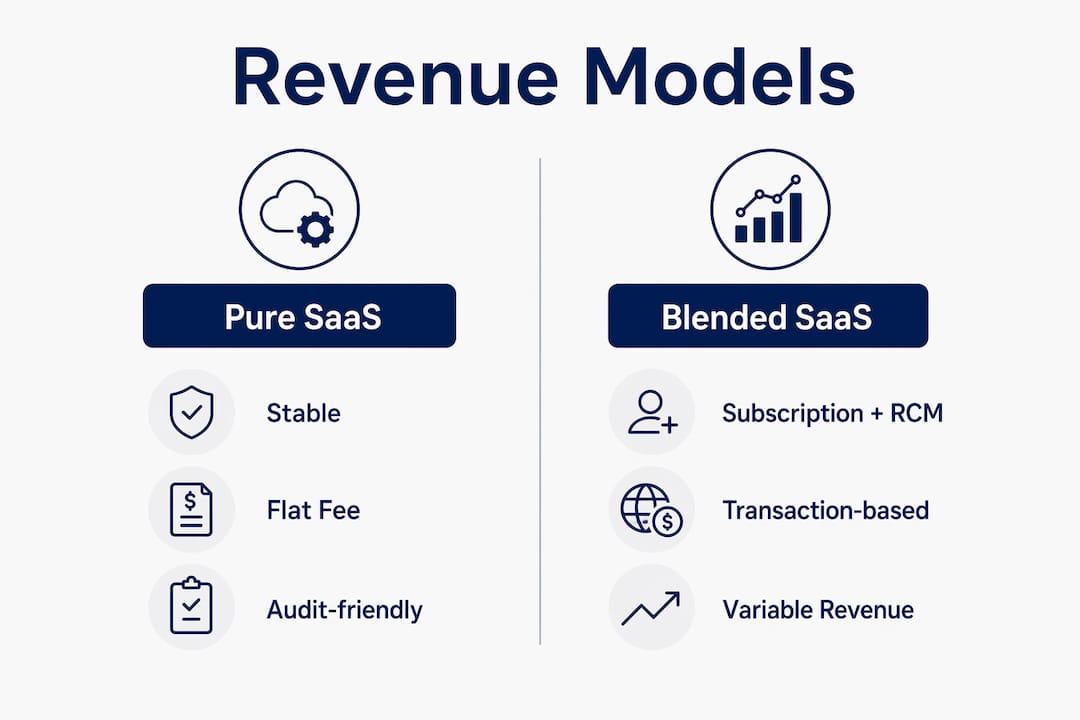
Pure SaaS subscriptions charge a flat per-seat or per-module fee. Predictable, clean, and easy to audit. But they trade at the lowest multiples, typically 7.0x–9.0x revenue, because revenue scales only with new customer acquisition.
Blended SaaS with partial RCM layers transaction-based revenue on top of the subscription base. As providers process more claims, vendor revenue compounds without proportional increases in customer acquisition costs. This model trades at 10.0x–12.0x, a 40% premium over pure SaaS.
End-to-end RCM embedded fintech is where the real valuation gap opens. Platforms capturing 70–80% of revenue from payment flows command 13.0x–16.0x multiples, an 80% premium over pure software. The U.S. healthcare system processes over $1.5 trillion in annual claims volume, and a 3–5% take rate on that flow creates a revenue engine that scales automatically with provider growth.
Beyond RCM, two additional drivers matter:
- Native EHR integration commands a +90% valuation premium over standalone applications. Workflow friction elimination is the primary value driver, not feature count.
- Value-based care alignment: Platforms that demonstrably improve HEDIS or MIPS scores earn 15–35% valuation premiums because they transform from a cost center into a direct revenue generator for providers. With 65% of healthcare payments projected to be tied to outcomes by 2027, this alignment is becoming a baseline expectation.
Clinical ROI also increases pricing power and reduces churn. When a provider can correlate software usage with measurable financial upside, switching costs rise sharply.
Why pricing and revenue recognition are harder in healthcare SaaS
Healthcare SaaS pricing is structurally more complex than general software pricing. Generalist investors consistently underestimate this.

Regulatory cost floors are real and non-trivial. HIPAA compliance costs SMBs $4,000–$12,000 annually and enterprises upward of $250,000. For software qualifying as a Software as a Medical Device, FDA clearance averages $500,000 with a 6–18 month timeline. These costs must be baked into pricing, which is why healthcare SaaS cannot compete on price with general-purpose software. For a deeper look at how these requirements shape go-to-market decisions, Thestartupmd covers healthcare startup regulatory basics in detail.
Recurring revenue ambiguity is the most common analytical trap. Many healthcare platforms blend usage-based fees, capitation payments, professional services, and implementation charges. Only the pure platform subscription fee represents true ARR; everything else is variable or one-time. Misclassifying these streams inflates ARR and misleads investors about financial predictability.
Investors must also distinguish between two related but distinct metrics:
- Committed ARR (CARR): Contractually signed recurring revenue not yet live
- Realized ARR: Revenue currently being collected from active users
The gap between CARR and realized ARR can be substantial in healthcare, where phased rollouts and long implementation cycles are standard. Healthtech companies that mix professional services and software fees must apply strict delineation to avoid overstating financial health.
Payer mix and reimbursement uncertainty add another layer. Revenue tied to CPT code reimbursement can shift overnight when payer policies change or prior authorizations are denied. Only 43% of digital health solutions had clear reimbursement pathways as of 2023, creating persistent pricing pressure for companies without established billing codes.
Sales and implementation cycles are long. Healthcare SaaS top performers take roughly 5.5 years to reach $10 million ARR, compared to three years for tech-enabled services businesses. That timeline affects cash flow forecasting and revenue recognition timing in ways that standard SaaS models do not anticipate.
How to evaluate revenue models for investment potential
Identifying a viable healthcare SaaS investment requires looking past headline ARR to the quality and durability of the underlying revenue.
Core metrics to assess:
- ARR quality: What percentage is truly recurring subscription revenue versus variable or one-time fees?
- Churn rate: Healthcare SaaS customers are sticky when deeply integrated, but SaaS churn in healthcare has its own dynamics worth understanding before modeling retention
- CAC payback period: Healthcare SaaS companies maintain consistent CAC payback as they scale, driven by operating leverage from stickier customers and expansion within existing accounts
- LTV: A 3–5% take rate on payment volume can effectively double LTV without increasing CAC
- ARR per FTE: For healthcare SaaS, this rises from $110,000 at the $1M–$10M ARR stage to $280,000 at $100M ARR and beyond
Operational visibility is the difference between a clean investment thesis and a blind spot. Integrating subscription reporting with ERP and service delivery data into a unified system predicts churn more accurately than generic SaaS metrics. Proactive signals like deployment status, active user penetration, and support intensity by account reveal whether revenue is durable or fragile.
Market segmentation shapes deal economics. The mid-market sweet spot for healthcare SaaS sits at $50,000–$100,000 ACV with 9–18 month sales cycles. This band balances deal size against velocity in a way that enterprise and SMB segments rarely achieve. Revenue model advisors like Solano Advisory Group specialize in helping analysts structure this kind of segmented revenue categorization for healthcare SaaS portfolios.
Compliance as a filter: Platforms with established regulatory moats, meaning HIPAA-compliant infrastructure, FDA clearance where applicable, and audit-ready governance, are harder to displace and command premium pricing. Treat compliance depth as a durability signal, not just a cost line.
Pro Tip: Prioritize platforms that combine native EHR integration, embedded fintech monetization, and proven clinical ROI. Per Q1 2026 valuation data, this trifecta consistently trades above 12x revenue regardless of broader market conditions.
What AI-enabled services-as-software means for your investment thesis
AI is not just changing how healthcare SaaS products work. It is changing the revenue model itself.
AI Services-as-Software companies charge based on outcomes rather than licenses. Think surgeries scheduled, clinical notes generated, or claims reviewed. This aligns with operational expense budgets rather than IT capital budgets, which shortens procurement cycles and expands the addressable buyer pool. Sales cycles for AI-enabled models run under six months, compared to 12–18 months for traditional healthcare SaaS.
The valuation implications are significant. AI-enabled Services-as-Software companies command 2x–5x higher valuations than non-AI healthcare SaaS peers, driven by ROI alignment with operational budgets and faster ARR ramp. AI-enabled healthcare solutions represented 38% of new health tech funding in 2024.
Gross margins for these models average 60–65%, close to traditional SaaS, but vary widely. "Copilot" models that assist human workflows carry higher margins because they require less labor. AI-first models with heavy human-in-the-loop review compress margins due to quality assurance costs. Understanding where a company sits on that spectrum is critical for accurate margin modeling.
The risk shift also matters. Outcome-based pricing transfers some performance risk from the buyer to the vendor, which accelerates adoption but requires vendors to maintain operational discipline at scale.
Glossary of healthcare SaaS revenue model terms
Investors evaluating this sector encounter terminology that does not map cleanly onto general SaaS frameworks. These definitions reflect how the terms are used in practice.
- ARR (Annual Recurring Revenue): The annualized value of active subscription contracts. Excludes one-time fees, implementation charges, and variable service revenue.
- CARR (Committed ARR): Contractually signed recurring revenue not yet live. Signals pipeline health but overstates current cash flow.
- RCM (Revenue Cycle Management): The process of managing claims, payments, and reimbursements from patient encounter to final payment. Embedded RCM in SaaS platforms creates transaction-based revenue that scales with provider volume.
- SaaS-plus-payments: A model where a software platform also captures a percentage of payment flows, generating 45–55% gross margins and superior unit economics versus pure software.
- AI-enabled Services-as-Software: Outcome-based pricing where vendors charge per completed unit of work (a scheduled surgery, a reviewed claim) rather than per seat or module.
- Value-based care (VBC): Reimbursement tied to patient outcomes rather than service volume. Platforms that improve HEDIS, MIPS, or Star Ratings scores directly increase provider reimbursement, making them revenue generators rather than cost centers.
- Native EHR integration: Deep, workflow-level connection to an electronic health record system, as opposed to API-level data exchange. Commands a +90% valuation premium in 2026.
- CPT codes: Current Procedural Terminology codes that determine provider reimbursement from payers. Software without a corresponding CPT code faces adoption friction regardless of clinical value.
- CAC payback: The number of months required to recover customer acquisition cost from gross margin. Healthcare SaaS companies maintain consistent payback periods as they scale due to customer stickiness.
- LTV (Lifetime Value): Total gross margin generated from a customer over the relationship. Embedded payment monetization can double LTV without increasing CAC.
- Compliance costs: Direct costs of maintaining HIPAA, FDA, and payer-specific regulatory requirements. These set the pricing floor for healthcare SaaS and create regulatory moats for established platforms.
Key Takeaways
Platforms combining native EHR integration, embedded fintech monetization, and proven clinical ROI consistently trade at 13x–16x revenue in 2026, making revenue model structure the single most important valuation driver in healthcare SaaS.
| Point | Details |
|---|---|
| Valuation range by model | Pure SaaS trades at 7x–9x; end-to-end RCM embedded models reach 13x–16x revenue multiples. |
| ARR discipline | Separate true subscription ARR from implementation fees and variable service revenue to avoid inflated metrics. |
| Compliance as a pricing floor | HIPAA costs $4,000–$250,000+ annually; FDA clearance averages $500,000, setting a structural pricing floor. |
| AI model premium | AI Services-as-Software commands 2x–5x higher valuations than traditional healthcare SaaS peers. |
| Growth timeline | Healthcare SaaS top performers take 5.5 years to reach $10M ARR, longer than general SaaS counterparts. |
How Thestartupmd helps investors and founders align on revenue model clarity
Revenue model misalignment is one of the fastest ways a healthcare SaaS company loses investor confidence. Thestartupmd, led by Paul Bergeron, MD, MBA, brings 25+ years of clinical and executive experience to exactly this gap. As a board-certified physician-executive and Certified Physician Executive who has led ACOs serving 375,000+ covered lives and earned $17.2M in Medicare Shared Savings, Paul understands how clinical strategy and financial architecture intersect in ways most advisors do not.
If you are evaluating a healthcare SaaS company and need clarity on revenue model sustainability or clinical ROI positioning, Thestartupmd offers fractional CMO advisory built for exactly this work. Explore Thestartupmd's advisory services or connect directly to discuss what you are seeing in your current deal flow.