

Healthcare startup regulatory compliance is defined as the set of legal obligations governing how your product handles patient data, classifies its clinical function, and operates within federal and state law. Getting this wrong is not a recoverable mistake. The three frameworks every founder must understand from day one are HIPAA, FDA Software as a Medical Device (SaMD) classification, and the Office of Inspector General (OIG) compliance program standards. These are not bureaucratic formalities. They determine your product architecture, your vendor contracts, your fundraising narrative, and your timeline to market. This guide covers healthcare startup regulatory basics explained in plain terms, so you can build with clarity and move without costly surprises.
What are the primary healthcare regulations startups must know?
HIPAA, FDA SaMD classification, and OIG compliance standards form the regulatory foundation for virtually every healthcare startup. Each framework applies differently depending on your product type, your data flows, and your business model.
HIPAA: covered entities, business associates, and PHI
HIPAA applies to any organization that handles Protected Health Information (PHI). Startups fall into two categories: Covered Entities (health plans, providers, clearinghouses) and Business Associates (vendors who handle PHI on behalf of a Covered Entity). If your platform touches PHI in any way, you need a signed Business Associate Agreement (BAA) with every vendor in your data chain. BAA requirements for AI vendors are especially critical. Failure to execute a BAA triggers breach notification obligations and civil monetary penalties under HITECH.

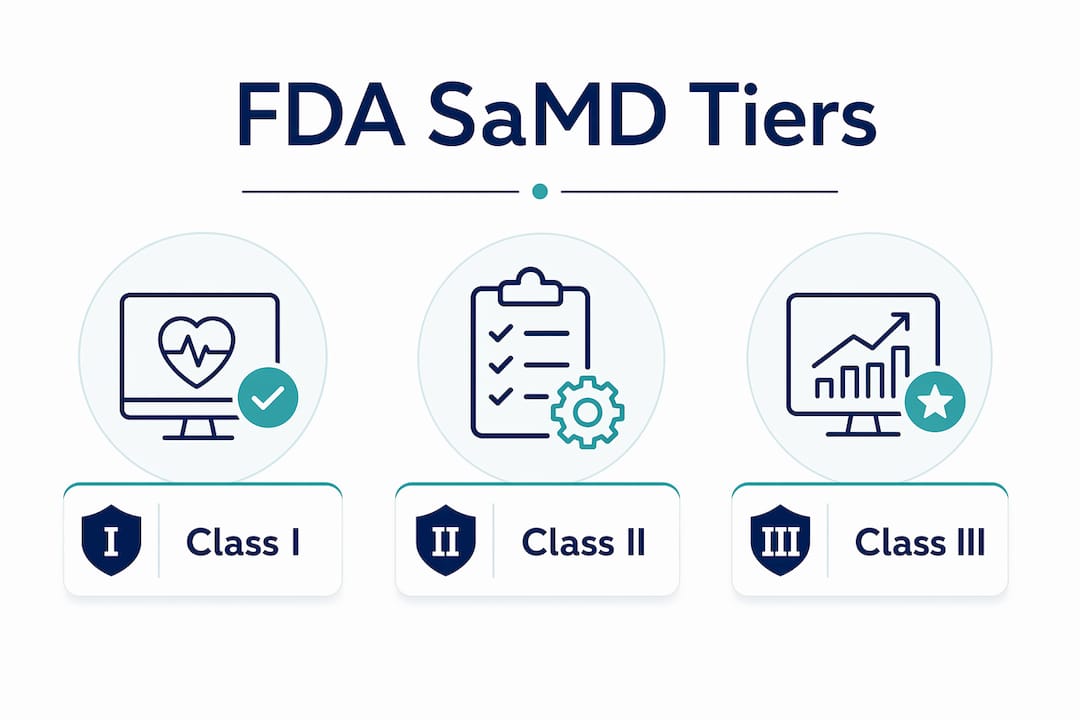
FDA SaMD classification tiers
The FDA classifies Software as a Medical Device into three risk tiers. Understanding which tier your product falls into determines your clearance pathway, your timeline, and your budget.
| Class | Risk Level | Pathway | Estimated Cost | Timeline |
|---|---|---|---|---|
| Class I | Low | Exempt or 510(k) | Minimal | Weeks to months |
| Class II | Moderate | 510(k) or De Novo | $500,000–$2,000,000 | 12–27 months total |
| Class III | High | PMA | $10M+ | 3–5 years |
FDA Class II SaMD clearance costs between $500,000 and $2,000,000 and requires 6–18 months of pre-submission work plus a 6–9 month median review period. That timeline has direct implications for your fundraising runway and go-to-market planning.
State-level laws and the Corporate Practice of Medicine
Federal law is only part of the picture. The Corporate Practice of Medicine (CPOM) doctrine, active in most states, prohibits non-physician entities from owning or controlling a medical practice. Non-physician healthcare startups operating clinics must structure ownership through licensed physicians and use Management Services Agreements to stay compliant. Ignoring CPOM is one of the most common and expensive structural mistakes founders make.
- HIPAA: Governs PHI handling, BAA execution, and breach notification
- FDA SaMD: Classifies software by risk and mandates clearance pathways
- OIG Compliance: Sets standards for billing, coding, and program integrity
- CPOM Doctrine: Restricts non-physician ownership of clinical operations
- EU AI Act: Imposes high-risk AI obligations with phased deadlines affecting US companies selling into European markets
How to design an effective compliance program for a startup
A compliance program is not a policy binder. OIG's 2026 update requires compliance programs to be operational, documented, and measurable. Auditors now look for live evidence of corrective actions, not just written policies.
The OIG's seven-element framework gives founders a clear structure to build from:
- Written policies and procedures tailored to your specific risks, including billing, coding, privacy, and vendor management
- Compliance officer designation with real authority to investigate and escalate issues, not a title assigned to the CFO as an afterthought
- Training and education designed to change behavior, not just satisfy an annual checkbox
- Open lines of communication including anonymous reporting channels so staff can flag concerns without fear
- Internal monitoring and auditing on a scheduled cycle with documented findings
- Disciplinary standards applied consistently when violations occur
- Corrective action protocols with documented follow-through and outcome tracking
The compliance officer role deserves special attention in a startup context. Many early-stage companies assign compliance duties to a legal or operations generalist. That works only if the person has genuine authority to pause a product release or reject a vendor contract. Without that authority, the role is decorative.
Pro Tip: Build your compliance program around your actual risk profile, not a generic template. A telehealth startup faces different billing and privacy risks than a clinical AI company. Map your risks first, then write your policies.
Operational compliance programs require ongoing audit trails, documented follow-ups, and evidence of measurable improvement. Annual checklists no longer satisfy regulators. This shift changes how founders should budget for compliance from the start.
What are the regulatory considerations for software and AI products?
Software and AI products face a specific regulatory question before anything else: does your product qualify as a medical device? The FDA's four-prong test for Clinical Decision Support (CDS) software exemption under 21 U.S.C. §520(o) determines the answer.
To qualify for the CDS exemption, your software must meet all four criteria:
- It does not acquire, process, or analyze medical images or signals
- It supports, rather than replaces, clinician judgment
- It displays the basis for its recommendations so the clinician can independently review them
- Its intended use is not for a serious or immediately life-threatening condition
Missing even one prong of this test means your software is classified as a medical device and must follow a clearance pathway. AI tools that automate clinical decisions typically fail the second and third criteria and must pursue the De Novo pathway, which carries a median review time of approximately 338 days.
AI governance and HIPAA intersect here
AI vendors handling PHI are Business Associates under HIPAA. PHI boundaries must be established from day one. Using an AI tool without a BAA even once creates HITECH liability that cannot be undone retroactively. This applies to large language models, ambient documentation tools, and any third-party AI service that touches patient data.
The FDA's clearance of UpDoc's patient-facing LLM-based SaMD via the 510(k) pathway demonstrates that a viable route exists for clinical AI products. The clearance also confirms that human-in-the-loop design is not optional for safety and regulatory reasons. Clinical AI supports clinicians. It does not replace their judgment, and regulators will hold that line.
The EU AI Act adds another layer for any startup with European market ambitions. High-risk AI systems in healthcare face mandatory conformity assessments, transparency requirements, and phased compliance deadlines. Founders building AI products should map EU AI Act obligations alongside FDA pathways from the beginning, not after product launch.
What are common pitfalls when navigating healthcare regulations?
The most expensive regulatory mistake founders make is treating compliance as a post-product problem. Regulatory strategy before product design prevents costly pivots. Changing your regulatory classification after architecture decisions are locked is exponentially more expensive than getting it right at the design stage.
- Marketing claims drive classification. A wellness app that claims to diagnose or treat a condition becomes a regulated medical device the moment that claim appears in marketing copy. Review every word in your app store listing, your website, and your sales deck before launch.
- Budget for compliance from day one. Healthcare startups budget 15–25% of operating expenses on regulatory and compliance activities through Series B. That includes HIPAA infrastructure, legal counsel, clinical evidence generation, and FDA submission costs.
- Define your payer pathway early. FDA clearance does not equal reimbursement. CMS and commercial payers require separate clinical evidence. Founders who conflate regulatory clearance with payer coverage lose 12–18 months of market time.
- Avoid the BAA gap. Many startups use productivity tools, AI writing assistants, or cloud services that touch PHI without executing BAAs. Each instance is a potential HITECH violation.
- Engage regulatory counsel before your first investor pitch. Investors in healthcare SaaS ask about regulatory classification in early diligence. A clear, credible answer accelerates funding. A vague one stalls it.
Pro Tip: Define your regulatory classification in writing before your first sprint. Share it with your engineering lead, your legal counsel, and your lead investor. Alignment at that stage saves months of rework later.
Founders who treat digital health market entry as a regulatory exercise from the start close funding rounds faster and reach enterprise customers sooner. The compliance work is not a tax on innovation. It is the foundation that makes enterprise sales possible.
Key Takeaways
Healthcare startup regulatory compliance requires HIPAA, FDA SaMD classification, and OIG program standards to be addressed before product development begins, not after.
| Point | Details |
|---|---|
| HIPAA applies broadly | Any product touching PHI requires BAAs with every vendor, including AI tools, from day one. |
| FDA classification drives cost and timeline | Class II SaMD clearance costs $500,000–$2,000,000 and takes 12–27 months total. |
| Compliance programs must be operational | OIG's 2026 standards require live audit evidence and corrective actions, not just written policies. |
| AI products face dual regulation | Clinical AI must satisfy the FDA's four-prong CDS test and HIPAA BAA requirements simultaneously. |
| Regulatory strategy precedes product design | Changing classification after architecture is locked costs exponentially more than early planning. |
What I've learned about compliance after 25 years in healthcare
Most founders I work with arrive with a product idea and a compliance question they haven't asked yet. The question is usually: "Do we need FDA clearance?" The real question is: "What does our product claim to do, and who bears the clinical risk if it's wrong?"
I've seen well-funded teams lose 18 months because they built a product, then discovered their marketing language triggered SaMD classification. I've seen startups lose enterprise deals because their BAA documentation was incomplete. These are not edge cases. They are the norm for founders who treat regulatory work as a legal formality rather than a clinical and operational discipline.
The shift I'm watching in 2026 is significant. Regulators are no longer satisfied with a compliance binder on a shelf. The OIG now expects operational evidence: audit logs, corrective action records, training completion rates with behavioral outcomes. That is a fundamentally different standard than what most early-stage teams are prepared for.
My advice is direct. Hire or retain a compliance officer with real authority before you close your Series A. Build your BAA inventory before you write your first line of code. And if you are building clinical AI, read the UpDoc 510(k) clearance carefully. It tells you exactly where the FDA's tolerance for autonomous decision-making ends.
Regulatory work done early is a competitive advantage. It shortens enterprise sales cycles, strengthens investor confidence, and protects the patients your product is meant to serve. That alignment between compliance and clinical mission is the gap most founders miss, and the one worth closing first.
— Paul
How Thestartupmd supports healthcare startups on regulatory strategy
Regulatory clarity is one of the first things healthcare investors and enterprise buyers look for. Founders who can articulate their compliance posture close deals faster and build more durable companies.
Thestartupmd works with healthcare SaaS startups and digital health companies to develop regulatory strategy, design compliance programs, and build the clinical credibility that opens enterprise doors. From FDA classification guidance to go-to-market positioning, the work connects regulatory foundations to commercial outcomes. Founders who want to avoid the common pitfalls covered in this article can explore the full range of startup advisory services at Thestartupmd, where regulatory strategy and clinical expertise work together from day one.
FAQ
What is a Business Associate Agreement in healthcare?
A Business Associate Agreement (BAA) is a required HIPAA contract between a Covered Entity and any vendor that handles Protected Health Information on its behalf. Every AI vendor, cloud provider, or third-party tool touching PHI must have a signed BAA before any data is shared.
When does a health app require FDA clearance?
A health app requires FDA clearance when it meets the definition of a Software as a Medical Device, meaning it is intended to diagnose, treat, cure, or prevent a disease or condition. Marketing claims trigger this classification, so founders must review all product language before launch.
What are the seven elements of an OIG compliance program?
The OIG's seven elements are written policies and procedures, a designated compliance officer, training and education, open communication channels, internal monitoring and auditing, disciplinary standards, and corrective action protocols. OIG's 2026 standards require all seven to be operational and documented with measurable outcomes.
How much should a healthcare startup budget for compliance?
Healthcare startups typically budget 15–25% of operating expenses on regulatory and compliance activities through Series B funding rounds. This covers HIPAA infrastructure, legal counsel, clinical evidence generation, and FDA submission costs.
What is the Corporate Practice of Medicine doctrine?
The Corporate Practice of Medicine doctrine prohibits non-physician entities from owning or controlling a medical practice in most US states. Startups operating clinical services must structure ownership through licensed physicians and use Management Services Agreements to comply.