

A healthtech exit strategy is a deliberate plan for transferring ownership or control of a healthcare startup to maximize value and achieve strategic alignment with buyers or public markets. Most founders treat exit planning as a late-stage event. That is the single most expensive mistake in digital health. M&A accounts for 95% of digital health exits, with a median time to exit of 9.5 years. That timeline means your exit strategy must be embedded in how you build the company from day one. Founders who wait until they receive an offer are already negotiating from a weaker position.
What are the primary types of digital health exit strategies?
Mergers and acquisitions represent the dominant exit path for healthtech founders by a wide margin. 268 of 282 digital health exits in 2025 and the first half of 2026 were M&A transactions. That concentration reflects both the complexity of healthcare regulation and the preference of strategic buyers to absorb proven clinical workflows rather than build them internally.
The four main exit types each carry distinct trade-offs:
- Strategic acquisition. A health system, payer, or large health IT company buys your startup to integrate your product into their existing platform. Valuations are driven by workflow fit, clinical evidence, and revenue predictability. This is the most common outcome for venture-backed healthtech.
- Private equity buyout. A PE firm acquires a controlling stake, typically to consolidate a fragmented market segment or scale a profitable platform. PE buyers focus heavily on EBITDA margins and recurring revenue. They are less interested in early-stage clinical validation.
- Initial Public Offering (IPO). Taking a company public remains possible but rare in 2026. Public markets now require IPO candidates to meet the "Rule of 40," combining revenue growth rate and free cash flow margin, plus stable gross margins of 60%–80%. Clinical validation through randomized controlled trials is also expected.
- Secondary sale and acqui-hire. A secondary sale transfers investor stakes to new private buyers without a full company sale. An acqui-hire targets your team's expertise rather than your product. Both are typically lower-value outcomes and work best when a full exit is not yet feasible.
| Exit type | Primary buyer | Valuation driver | Typical timing |
|---|---|---|---|
| Strategic acquisition | Health systems, payers, health IT | Clinical fit, workflow integration | Series B onward |
| Private equity buyout | PE firms | EBITDA, recurring revenue | Profitable stage |
| IPO | Public markets | Rule of 40, gross margins, RCT data | Late stage, rare |
| Secondary sale | New private investors | Investor returns, growth trajectory | Any stage |
| Acqui-hire | Tech or health companies | Team expertise | Early or distressed |
Understanding which path fits your company depends on your revenue model, clinical evidence base, and the strategic priorities of likely buyers. Founders who map exit options early avoid building products that are technically impressive but commercially unattractive to any specific buyer category.

When should you start planning your healthtech exit?
Healthcare CEOs should begin formal exit planning 3–5 years before their intended sale date. That window is not arbitrary. It reflects how long it takes to normalize financials, document systems, reduce founder dependency, and build the commercial infrastructure that buyers pay a premium for.
A phased approach makes the timeline manageable:
- Years 3–5 before exit. Define your likely buyer profile. Map two or three strategic acquirers and understand what they value. Begin building relationships through conferences, advisory boards, and partnership conversations. Align your product roadmap with acquirer needs, not just customer requests.
- Years 1–2 before exit. Normalize your financials. Remove one-time revenue items, clean up your cap table, and document all key processes. Reduce founder dependency by distributing clinical relationships and market access across your leadership team.
- 6–12 months before exit. Prepare your data room. Conduct a mock due diligence review. Address any HIPAA, data governance, or IP ownership gaps. Failure to address compliance and scalability at this stage leads to deal delays or valuation discounts of up to 20%.
Pro Tip: Work with a healthcare M&A advisor at least 18 months before your target exit date. They provide market timing intelligence, buyer mapping, and process management that founders cannot replicate independently. The cost of that advisory relationship is typically a fraction of the valuation uplift it produces.
The 90-day quick wins matter too. Cleaning up contracts, resolving outstanding litigation, and formalizing key opinion leader relationships can each move valuation meaningfully in a short window. Do not save these for the formal sale process.
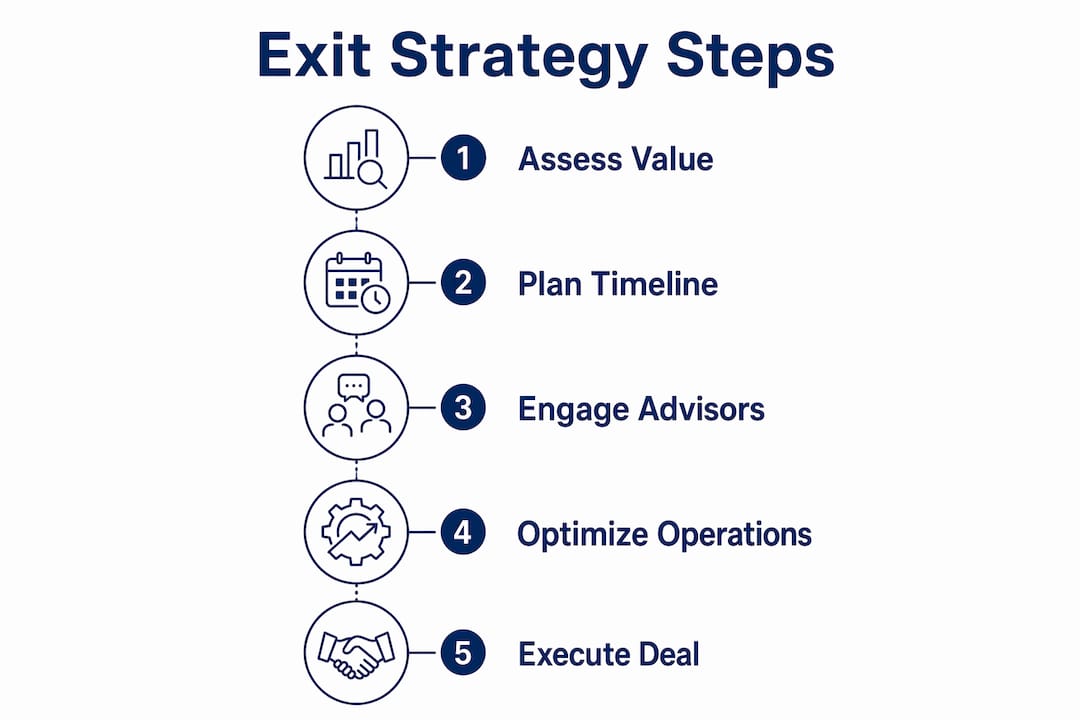
Key value drivers buyers examine in healthtech deals
Strategic buyers analyze your company through the lens of operational risk, not just product innovation. Financial discipline and clinical integration are the two factors that most consistently separate premium valuations from average ones. Founders who understand this shift their priorities accordingly.
The core value drivers fall into four categories:
- Financial discipline. Recurring revenue models, predictable gross margins, and clear paths to EBITDA improvement are non-negotiable for serious buyers. Premium healthtech platforms trade at 6x–8x revenue multiples versus 3x–4x for subscale or unprofitable firms. That gap is entirely within a founder's control to close.
- Regulatory and compliance readiness. HIPAA compliance, data governance documentation, and IP ownership clarity must be current and clean before any formal process begins. The EU AI Act adds a new layer of regulatory scrutiny for companies operating in European markets. Founders should treat regulatory compliance basics as a continuous discipline, not a pre-sale checklist.
- Clinical validation. Buyers in 2026 expect real-world evidence and, for AI-enabled products, validated algorithmic performance data. Randomized controlled trials remain the gold standard for clinical claims. Organizing and documenting this evidence early is a direct valuation lever. A well-structured clinical content strategy prevents scrambling during due diligence.
- Commercial infrastructure. Channel partnerships reduce sales cycle length by 25%, making companies significantly more attractive to strategic buyers. A plug-and-play commercial engine is worth more than a product that requires the acquirer to build new sales infrastructure from scratch.
Key person risk is one of the most common valuation discounts acquirers apply. If your clinical relationships, enterprise accounts, or regulatory knowledge live entirely in one or two people, buyers will price that risk into their offer. Distribute knowledge, document processes, and build a leadership team that can operate without you.
Pro Tip: Embed your reimbursement strategy early. In both US and EU markets, building a reimbursable product with documented payer pathways signals commercial maturity to acquirers and significantly expands your buyer pool.
How do market trends shape healthtech exit choices in 2026?
The IPO window for digital health remains largely closed in 2026. Public market investors now demand fundamentals that most venture-backed healthtech companies have not yet built. That reality pushes the vast majority of founders toward M&A as their primary exit path.
The market has also shifted away from growth-at-all-costs models. Buyers now prioritize companies deeply embedded in clinical workflows with measurable margin impact. A platform that saves a health system $3 million annually in care management costs is far more attractive than one with impressive user growth but no clear financial return. Founders who avoid common go-to-market mistakes and build workflow-embedded solutions position themselves in the preferred buyer category.
| Market trend | Impact on exit strategy |
|---|---|
| IPO stagnation | M&A becomes the primary exit path for most founders |
| Margin-first buyer priorities | Workflow-embedded, revenue-generating products command higher multiples |
| EU AI Act enforcement | Regulatory readiness becomes a valuation differentiator |
| Consolidation among strategic buyers | Fewer but larger acquirers with specific integration needs |
| Rule of 40 for public markets | IPO candidates must demonstrate both growth and profitability |
Consolidation among strategic buyers narrows the field of likely acquirers but also increases competition among them for the best assets. Founders who have mapped their buyer landscape early and built relationships before a formal process have a structural advantage. Timing your exit to align with a strategic buyer's acquisition cycle, rather than your own funding timeline, consistently produces better outcomes.
Key Takeaways
A healthtech exit strategy built into daily company operations, not bolted on at the end, is the single most reliable path to a premium acquisition outcome.
| Point | Details |
|---|---|
| M&A dominates exits | 95% of digital health exits are M&A; plan your company around strategic buyer needs from the start. |
| Start planning 3–5 years early | Early preparation normalizes financials and reduces founder dependency, directly improving valuation. |
| Clinical and regulatory assets matter | Clean HIPAA compliance, real-world evidence, and IP documentation are non-negotiable for premium deals. |
| Commercial infrastructure drives multiples | Channel partnerships and recurring revenue models separate 6x–8x valuations from 3x–4x outcomes. |
| Continuous data room discipline | Ongoing compliance verification prevents the 20% valuation discounts that last-minute gaps create. |
What I've learned about exit strategy after 25 years in healthcare
Most founders I work with think about exit strategy the wrong way. They treat it as a destination rather than a discipline. The companies that achieve the best outcomes are the ones where exit readiness is baked into every major decision, from product architecture to hiring to partnership structure.
I helped CareGem Health achieve acquisition by Althea.AI within three months. That speed was not luck. It reflected years of deliberate work on clinical validation, regulatory cleanliness, and commercial infrastructure. When the right buyer appeared, the company was ready to move fast. That readiness is what creates optionality.
The founders who struggle most are those who build for their customers but not for their acquirers. Those two audiences often want different things. Your customers want features. Your acquirers want margin, workflow integration, and a team that can operate without the founder in the room. Aligning those two sets of needs early is the real work of exit planning.
One more thing I see consistently: founders underestimate how much key person risk costs them at the negotiating table. If you are the only one who knows the clinical evidence, manages the enterprise accounts, and holds the regulatory relationships, a buyer will discount your company accordingly. Build a team. Document everything. Make yourself replaceable before you need to be.
— Paul
How Thestartupmd supports your exit readiness
Thestartupmd works with healthcare SaaS founders and digital health companies at every stage of exit preparation. From go-to-market positioning to clinical evidence strategy, regulatory readiness, and buyer engagement, the advisory model is built around the specific demands of healthcare M&A.
Paul Bergeron brings 25 years of clinical practice, C-suite leadership, and hands-on startup advisory experience to every engagement. That combination of medical credibility and commercial expertise opens enterprise doors that most advisors cannot. Whether you are 18 months from a transaction or just beginning to think about your exit path, a structured conversation about your current position and your target outcome is the right place to start. Explore the full advisory services to see how Thestartupmd can support your exit planning from strategy through execution.
FAQ
What is a healthtech exit strategy?
A healthtech exit strategy is a planned process for transferring ownership of a healthcare startup to maximize value for founders and investors. It typically involves M&A, IPO, or private equity, with M&A accounting for 95% of digital health exits.
When should a healthtech founder start exit planning?
Founders should begin formal exit planning 3–5 years before their intended sale date. Early preparation improves valuation by normalizing financials, reducing founder dependency, and building the commercial infrastructure buyers pay a premium for.
What do strategic buyers look for in a healthtech acquisition?
Strategic buyers prioritize recurring revenue, clinical validation, HIPAA compliance, and workflow integration. Companies with channel partnerships and documented reimbursement strategies consistently attract higher valuation multiples.
Are healthtech IPOs a realistic exit option in 2026?
IPOs remain rare in 2026. Public markets require candidates to meet the Rule of 40 and demonstrate stable gross margins of 60%–80%, along with clinical validation through randomized controlled trials.
How does key person risk affect a healthtech exit valuation?
Acquirers discount companies where clinical relationships, market access, or regulatory knowledge depend on one or two individuals. Distributing those relationships and documenting processes across the leadership team directly protects valuation.