

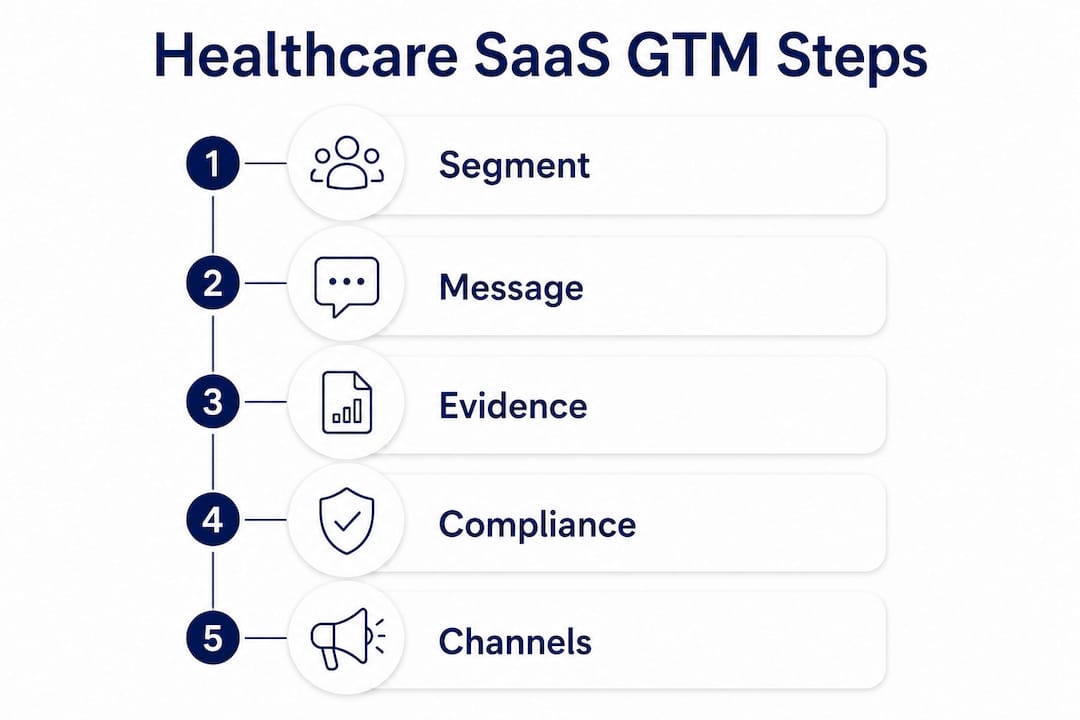
A healthcare SaaS go-to-market strategy is a structured plan that defines how your product reaches, engages, and converts healthcare buyers across a market shaped by long sales cycles, multi-stakeholder buying committees, and strict regulatory requirements. Generic SaaS playbooks fail here. Healthcare demands clinical credibility, HIPAA compliance, and evidence-based value propositions before most enterprise deals even reach a demo. To build a healthcare SaaS go-to-market strategy that actually closes revenue, you need to align market segmentation, clinical evidence, stakeholder messaging, and compliance readiness from day one. This article gives you the framework to do exactly that.
How to identify and segment your healthcare SaaS target market
Market segmentation is the first decision that determines everything else in your go-to-market plan. Healthcare is not one market. It is three distinct segments with very different economics, timelines, and buyer profiles.
Sales cycles vary sharply by segment: digital-native clinics close in 3–6 months, specialty groups in 6–12 months, and large health systems in 12–24 months. That difference is not just a timeline issue. It changes your cash flow, your hiring plan, and your investor story.

The annual contract values (ACVs) reflect that complexity. Large health systems carry ACVs of $350,000–$2.5M. Specialty groups average $60,000–$250,000. Digital-native clinics offer lower ACVs but faster decisions. Each segment requires a different sales motion, different proof points, and different channel strategies.
To assess your go-to-market readiness across segments, evaluate these criteria:
- Clinical fit: Does your product solve a documented workflow problem in this segment?
- Regulatory exposure: Does the segment require HIPAA Business Associate Agreements (BAAs), SOC 2, or EHR integrations?
- Budget authority: Who controls the budget, and what is the typical procurement cycle?
- Reference availability: Do you have any existing customers or pilots in this segment?
- Sales capacity: Can your current team support a 12–24 month enterprise cycle?
| Segment | Typical ACV | Sales cycle | Primary buyer |
|---|---|---|---|
| Large health systems | $350K–$2.5M | 12–24 months | C-suite, IT, Procurement |
| Specialty groups | $60K–$250K | 6–12 months | Practice administrator, CMO |
| Digital-native clinics | Under $60K | 3–6 months | Founder, clinical lead |
Pro Tip: Start with digital-native clinics. Building clinical credibility there gives you the reference accounts and outcome data you need to win larger health system contracts later.
What messaging do healthcare SaaS buyers actually need?
Healthcare buying committees include five distinct roles, and each one evaluates your product through a completely different lens. Generic single-narrative approaches fail early because they address one stakeholder while alienating the other four. You need five distinct value narratives, built before your first enterprise demo.
Here is how to map your messaging to each role:
-
Chief Medical Officer (CMO): Focus on clinical outcomes, patient safety, and workflow integration. The CMO wants to know your product improves care without disrupting clinical staff. Lead with peer-reviewed evidence or pilot data showing measurable outcome improvement.
-
Chief Financial Officer (CFO): Lead with ROI and payback period. Healthcare AI and SaaS companies typically price at 10–20% of documented value delivered, which supports payback periods under 12 months. That framing makes budget approval far easier.
-
IT Director: Address security architecture, EHR integration complexity, and uptime guarantees. IT reviewers will kill a deal over a missing SOC 2 Type II report or an undocumented API. Have your technical compliance documentation ready before the first IT call.
-
Procurement and Legal: Speak to contract risk, vendor stability, and indemnification. Procurement teams in health systems run formal RFP processes with mandatory compliance checklists. Your BAA, liability coverage, and data residency documentation must be ready to submit on day one of procurement.
-
C-suite Economic Buyer: Connect your product to organizational priorities: value-based care performance, HEDIS scores, CMS quality metrics, or cost reduction targets. The economic buyer approves the budget. They need a one-page business case, not a feature list.
Structured GTM playbooks that include role-playing, objection libraries, and clinical-persona messaging reduce sales rep ramp time by 30–50%. That is a direct revenue impact, not a training nicety.
Pro Tip: Build an objection library specific to each buyer role. The IT Director's objections about integration are completely different from the CFO's concerns about budget timing. Separate libraries, separate prep, separate outcomes. Review common positioning mistakes to sharpen each narrative.
Why clinical evidence and pilots accelerate healthcare SaaS adoption
Clinical evidence is not a marketing asset. It is a sales infrastructure investment. Peer-reviewed clinical evidence accelerates enterprise sales cycles by 2.7x compared to products without published data. Health system CMOs and medical directors require it before recommending adoption to their boards.
Publishing that evidence costs between $80,000–$350,000, including CRO fees, IRB review, and journal submission costs. That is a significant investment for an early-stage startup. The return is a compressed sales cycle and a credibility signal that no case study or testimonial can replicate.
Structured pilot programs serve a parallel function. A well-designed pilot does three things at once:
- It generates the outcome data you need for your clinical evidence pipeline.
- It builds a reference account relationship with a named health system or specialty group.
- It reduces perceived adoption risk for the next buyer in your pipeline.
The most effective pilots are paid, time-bound, and tied to pre-agreed success metrics. A free pilot signals low confidence in your own product. A paid pilot with a 90-day outcome review signals maturity and creates a natural conversion point to a full contract.
Design your pilot around two or three measurable outcomes that map directly to the buyer's existing quality metrics. If you are selling to a value-based care organization, tie pilot success to HEDIS measure improvement or avoidable admission reduction. That alignment makes the conversion conversation straightforward.
Healthcare AI and SaaS companies that price pilots at 10–20% of projected ROI create a low-friction entry point while still establishing commercial intent. A $30,000 pilot for a product with $300,000 annual value is easy to approve at the department level, without triggering a full procurement review.
How do you handle compliance and certification in healthcare SaaS sales?
Compliance is not a checkbox. It is a prerequisite for being considered. EHR marketplace certification fees for platforms like Epic Showroom and Oracle Cerner CODE range from $5,000–$150,000 annually. More critically, these certifications are mandatory to qualify for more than 70% of health system RFPs. Without them, your deal is disqualified before it starts.
The compliance stack for enterprise healthcare SaaS deals typically includes:
| Certification or requirement | Purpose | Deal impact |
|---|---|---|
| HIPAA BAA | Protects PHI under federal law | Required for any PHI-adjacent product |
| SOC 2 Type II | Validates security controls over time | Required by most health system IT teams |
| HITRUST CSF | Higher-assurance security framework | Required for large IDN and payer deals |
| Epic Showroom listing | EHR marketplace visibility | Qualifies for 70%+ of health system RFPs |
| Oracle Cerner CODE | Cerner ecosystem integration | Required for Cerner-based health systems |
HIPAA compliance means more than signing a BAA. It requires documented data handling policies, breach notification procedures, and employee training records. Procurement teams at large health systems will request your HIPAA compliance documentation as part of the vendor assessment, often before a demo is scheduled.
SOC 2 Type II takes 6–12 months to complete from the time you engage an auditor. HITRUST certification takes longer. Plan your compliance roadmap 12–18 months ahead of your target enterprise sales motion.
Pro Tip: Get your clinical use case documented and your compliance stack in place before pursuing health system deals. Trying to close a $500,000 contract while your SOC 2 audit is still in progress will stall the deal every time.
What sales channels work best for healthcare SaaS?
Direct sales is not the only path to healthcare revenue, and for most early-stage startups, it should not be the primary one. Channel partnerships give you access to existing buyer relationships, faster pipeline development, and lower customer acquisition costs.
The three most productive channel types for healthcare SaaS are:
-
Value-added resellers (VARs): VARs in healthcare earn 15–25% commission but can reduce your customer acquisition costs by 30–50% through existing trusted relationships with health system procurement teams. They already have the vendor approval, the compliance documentation on file, and the relationships with IT and procurement.
-
Health IT consultants: Independent consultants advising health systems on technology selection are powerful referral sources. They do not resell your product, but a recommendation from a trusted advisor can move a deal from cold to warm in a single conversation.
-
Strategic technology alliances: Partnering with EHR vendors, population health platforms, or revenue cycle management companies creates co-marketing opportunities and integration credibility. An Epic-integrated product listed in the Epic Showroom carries implied endorsement that accelerates IT approval.
Partner training is not optional. Your channel partners need to understand HIPAA requirements, your integration architecture, and your clinical use cases well enough to represent your product accurately in front of health system buyers. A VAR who misrepresents your compliance posture can kill a deal and damage your reputation in a market where word travels fast.
Align your channel strategy to your target segment. VARs work best for mid-market specialty groups and regional health systems. Strategic tech alliances are most valuable for large IDN and academic medical center deals. Digital health market entry frameworks can help you map the right channel to the right segment from the start.
Key Takeaways
A successful healthcare SaaS go-to-market strategy requires clinical evidence, multi-stakeholder messaging, compliance readiness, and segment-specific channel selection working together from the first sales conversation.
| Point | Details |
|---|---|
| Segment before you sell | Match your sales motion to the ACV and cycle length of each healthcare segment. |
| Build five value narratives | Address CMO, CFO, IT, Procurement, and C-suite with distinct, role-specific messaging. |
| Invest in clinical evidence | Peer-reviewed data accelerates enterprise sales cycles by 2.7x and is worth the $80K–$350K cost. |
| Complete compliance before enterprise outreach | SOC 2 Type II, HIPAA BAA, and EHR marketplace listings are prerequisites, not follow-ups. |
| Use channel partners to reduce CAC | VARs can cut customer acquisition costs by 30–50% through existing buyer relationships. |
What I have learned from watching healthcare SaaS GTM plans fail
The most common failure I see is single-threaded selling. A founder builds a strong relationship with one clinical champion, assumes that person will carry the deal internally, and then watches the opportunity stall when that champion changes roles or loses internal support. Healthcare deals require multi-threaded engagement across clinical, IT, financial, and executive stakeholders simultaneously. If you only have one contact at a prospect, you do not have a deal. You have a conversation.
The second pattern I see repeatedly is treating implementation as a post-sale problem. Implementation quality is part of customer acquisition. Health system buyers talk to each other. A difficult implementation at one regional health system will surface as an objection in your next enterprise conversation. Your implementation plan, your onboarding timeline, and your clinical support model need to be part of your sales presentation, not an afterthought.
The third mistake is trying to solve the "who pays, who adopts, and who benefits" question after the contract is signed. Digital health GTM success depends on aligning institutional logic across all three of those questions upfront. If the CFO pays, the clinical staff adopts, and the patients benefit, you need a narrative that connects all three in a single business case. That connection does not happen by accident.
Speed matters, but not more than credibility. I have seen startups rush to enterprise deals before their compliance stack was complete, before their pilot data was published, and before their messaging was differentiated. The result is a longer sales cycle, not a shorter one. Build the foundation first. The deals will close faster because of it.
— Paul
Thestartupmd works with healthcare SaaS startups on GTM execution
Healthcare SaaS founders rarely lack a good product. What stalls growth is the gap between a working solution and a market that trusts it enough to buy. Thestartupmd works directly with early-stage and growth-stage healthcare SaaS companies to close that gap through fractional CMO services that cover clinical messaging, go-to-market planning, enterprise sales support, and digital marketing execution.
Paul Bergeron, MD, MBA brings 25 years of clinical practice, C-suite leadership, and hands-on startup advisory experience to every engagement. That combination of medical credibility and commercial execution is what opens enterprise doors that generic marketing agencies cannot. If your pipeline is stalling, your messaging is not landing, or your compliance readiness is holding back deals, reach out to Thestartupmd to discuss where your go-to-market plan needs the most attention.
FAQ
What is a healthcare SaaS go-to-market strategy?
A healthcare SaaS go-to-market strategy is a structured plan for reaching and converting healthcare buyers by addressing their specific sales cycles, compliance requirements, and multi-stakeholder buying processes. It differs from generic SaaS GTM plans by requiring clinical evidence, HIPAA compliance, and role-specific value propositions.
How long does a healthcare SaaS sales cycle take?
Sales cycles range from 3–6 months for digital-native clinics to 12–24 months for large health systems, depending on deal size, compliance requirements, and the number of stakeholders involved in the buying decision.
Why do healthcare SaaS startups need clinical evidence?
Peer-reviewed clinical evidence accelerates enterprise sales cycles by 2.7x and is often required by health system CMOs and medical directors before they will recommend adoption. Publishing that evidence typically costs $80,000–$350,000 but compresses deal timelines significantly.
What compliance certifications do healthcare SaaS companies need?
Most enterprise healthcare deals require a HIPAA Business Associate Agreement, SOC 2 Type II certification, and EHR marketplace listings such as Epic Showroom or Oracle Cerner CODE. Missing these certifications disqualifies vendors from more than 70% of health system RFPs.
How do channel partners help healthcare SaaS companies grow?
Value-added resellers in healthcare earn 15–25% commission but reduce customer acquisition costs by 30–50% through existing buyer relationships. Strategic technology alliances with EHR vendors add integration credibility and co-marketing reach that accelerates pipeline development.