

A clinical use case for SaaS is defined as a focused description of a specific clinical decision or workflow that software will support to improve patient outcomes and operational efficiency. To develop a clinical use case for SaaS, you must identify one narrow clinical problem, select the right integration architecture, and validate the solution with real clinicians before scaling. Most healthcare SaaS projects fail not because of bad technology, but because the use case is too broad or disconnected from how clinicians actually work. Getting this right from the start determines whether your product gets adopted or ignored.
What do you need before developing a clinical use case for SaaS?
Preparation separates successful SaaS clinical applications from expensive shelf-ware. Before writing a single line of code, you need three things: a clear picture of the clinical workflow, access to the right data, and the right team in the room.
Clinical workflow analysis and stakeholder input
Start with direct observation and structured interviews. Sit with the clinicians who will use the tool. Map every step in the workflow you plan to support, from the clinical trigger that initiates action to the decision or documentation that closes the loop. Skipping this step produces software that technically works but practically fails.

Data sources and technical standards
Your use case depends entirely on what data you can access and how reliably you can access it. The most widely adopted integration standards in 2026 are SMART on FHIR and CDS Hooks. Workflow integration using SMART on FHIR or CDS Hooks is the defining factor in whether clinicians adopt or abandon a clinical decision support tool. EHR data, clinical guidelines from sources like the Agency for Healthcare Research and Quality (AHRQ), and validated research databases all feed the use case logic.
Team composition
No single discipline can build a trustworthy clinical SaaS use case alone. You need clinicians to define the problem and validate outputs, developers to build the integration layer, and compliance experts to address HIPAA, FDA software guidance, and institutional governance requirements. Missing any one of these roles creates gaps that surface during pilot testing at the worst possible time.
Prerequisites at a glance:
| Prerequisite | Why it matters |
|---|---|
| Clinical workflow map | Defines the trigger, decision point, and output format |
| EHR integration access | Enables real-time or batch data retrieval via FHIR APIs |
| SMART on FHIR / CDS Hooks | Embeds the tool inside existing clinical workflows |
| HIPAA compliance plan | Required before any patient data touches the system |
| Cross-functional team | Clinicians, developers, and compliance experts working together |
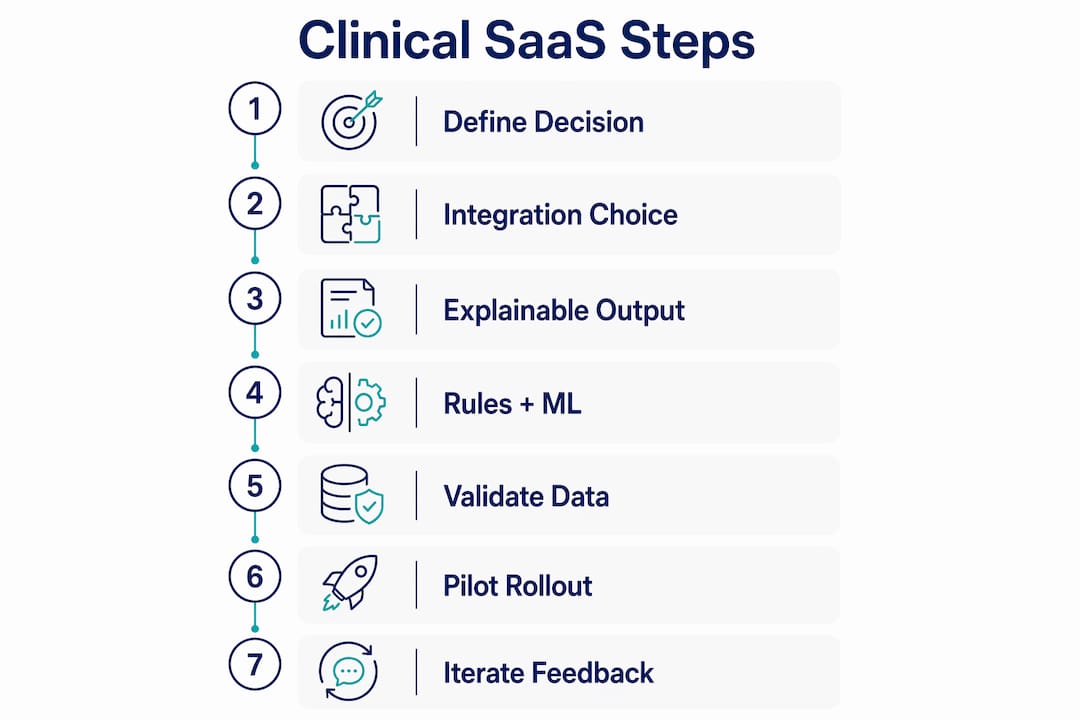
Step-by-step process to develop a clinical SaaS use case
Building a compliant healthcare SaaS MVP typically costs between $40,000 and $120,000 and takes 2–12 weeks from concept to pilot. That range reflects how much scope decisions drive both cost and timeline. A tightly scoped use case lands at the low end. A sprawling one bleeds budget and trust.
Step 1: Define one clinical decision
Pick one clinical trigger and one decision it should support. Not five. Not a "platform." One. A sepsis early-warning alert, a medication reconciliation flag, or a care gap notification for patients with uncontrolled diabetes each represent a single, testable use case. Narrow-scoped MVPs build clinician trust faster and generate fewer false positives than broad tools trying to do everything at once.
Step 2: Choose your integration architecture
The urgency of the clinical trigger determines your integration pattern. Real-time integration suits sepsis detection; batch processing suits patient portal updates or population health reports. CDS Hooks delivers alerts inside the EHR at the point of care. SMART on FHIR launches a full app within the EHR session. Choose based on latency needs, not technical preference.
Step 3: Design explainable outputs
Clinicians do not trust black boxes. Explainability and human override are the two features clinicians cite most when evaluating whether to trust a clinical software output. Every alert or recommendation must cite the specific clinical guideline or literature it draws from. Every output must allow the clinician to override it and document why. This is not optional. It is a governance requirement at most health systems.
Step 4: Start with rules-based logic, add ML where necessary
Build your first version on transparent, rules-based logic. Add machine learning only where the clinical evidence supports it and where you can explain the model's reasoning to a clinician. MVP clinical decision support tools that focus on a single risk score with transparent rules reduce false positives and earn faster institutional approval than complex models with opaque outputs.
Step 5: Validate with synthetic data first
Before any real patient data enters the system, run your use case against synthetic datasets that mirror your target population. Test sensitivity, specificity, and alert frequency. High alert volume is a red flag. Clinicians who receive too many alerts start ignoring all of them, a phenomenon called alert fatigue that kills adoption before the pilot even starts.
Pro Tip: Set a target alert rate before you build. If your use case fires more than 5–10 alerts per clinician per shift, redesign the trigger logic before moving to real patient data.
Step 6: Run a graduated pilot rollout
Start with a small cohort of clinicians who volunteered to participate. Expand only after you have clean performance data. Graduated rollouts from synthetic to real patient data and from limited to broader clinician groups validate safety and build the institutional trust needed for enterprise adoption. One well-run pilot with 10 clinicians is worth more than a rushed launch to 200.
Step 7: Iterate on clinician feedback
Collect structured feedback after every pilot phase. Track override rates, alert dismissal rates, and time-to-decision. These metrics tell you whether clinicians find the output useful or just disruptive. Adjust trigger thresholds, output formatting, and alert language based on what you learn. The use case you launch will not be the use case that scales. Plan for iteration from day one.
What are the most common pitfalls in clinical SaaS use case development?
Most clinical SaaS projects fail at the same predictable points. Knowing where the traps are lets you avoid them.
- Scope creep at MVP. Teams add features to impress stakeholders. Each addition increases complexity, raises false positive rates, and delays the pilot. Protect the narrow scope aggressively.
- HIPAA compliance as an afterthought. Security architecture must be built in from the first line of code. Retrofitting HIPAA controls after development is expensive and often incomplete.
- Standalone apps that disrupt workflow. Clinicians will not leave the EHR to use a separate tool. Forced context switching is the single biggest driver of poor adoption in clinical decision support. Embed your tool inside the existing workflow using CDS Hooks or SMART on FHIR.
- Opaque model outputs. A recommendation without a cited source or an override option will not pass clinical governance review. Clinicians require outputs that cite guidelines and permit human override to meet institutional safety standards.
- Untiered alerting. Not every alert carries the same urgency. Build a tiered system: critical alerts interrupt workflow, advisory alerts appear passively. Flat alerting trains clinicians to ignore everything.
"The tools that earn clinician trust are not the most sophisticated ones. They are the ones that show their work, stay out of the way, and make the right call at the right moment in the workflow."
Pro Tip: Assign a clinical champion from the target department before development begins. That person becomes your real-world quality filter and your internal advocate during the pilot.
How do you measure and validate the impact of your clinical SaaS use case?
Measurement starts before the pilot launches. Define your success metrics during the use case design phase, not after the fact.
Core metrics to track:
- Clinician satisfaction rate: Collect structured surveys at 30, 60, and 90 days post-launch. A diagnostic support platform pilot achieved 94% clinician satisfaction and over 50,000 patient interactions with zero HIPAA incidents. That is the benchmark to aim for.
- Override rate: High override rates signal that the tool's recommendations do not align with clinical judgment. Investigate the cause before expanding the pilot.
- Alert dismissal rate: Tracks how often clinicians close alerts without acting. Dismissal above 30% suggests the trigger logic needs recalibration.
- Time-to-decision: Measures whether the tool actually speeds up clinical decisions or adds friction.
- Operational savings: Boston Children's Hospital documented 60,000 labor hours saved and $7 million in redeployed labor through clinical and operational automations. Operational impact data is your strongest argument for enterprise expansion.
| Metric | What it tells you |
|---|---|
| Clinician satisfaction rate | Whether the tool fits real clinical needs |
| Override rate | Whether recommendations align with clinical judgment |
| Alert dismissal rate | Whether trigger logic is calibrated correctly |
| Time-to-decision | Whether the tool reduces or adds workflow friction |
| HIPAA incident count | Whether security controls are holding under real conditions |
Addressing care gaps outside the hospital is one of the highest-value use cases available. Multilingual AI patient support reduces missed treatment windows and prevents patients from relying on unsafe internet searches. Measure patient-facing use cases with treatment adherence rates and patient-reported outcomes alongside clinician metrics.
Key Takeaways
A well-scoped, workflow-integrated clinical use case is the single most reliable predictor of healthcare SaaS adoption and clinical impact.
| Point | Details |
|---|---|
| Start narrow | Define one clinical decision or trigger before writing any code. |
| Embed in workflow | Use SMART on FHIR or CDS Hooks to avoid disruptive context switching. |
| Build explainable outputs | Cite guidelines and allow human override in every clinical recommendation. |
| Pilot with a graduated rollout | Move from synthetic data to real patients in controlled, expanding phases. |
| Measure from day one | Track satisfaction, override rates, and operational savings before scaling. |
What I've learned from building clinical use cases that actually get used
I have worked with enough healthcare SaaS teams to know where the real failure points live. They are almost never technical. The teams that struggle are the ones that build in isolation, present a finished product to clinicians, and then wonder why adoption is flat.
The teams that succeed do the opposite. They bring a clinician into the room on day one, not as a reviewer, but as a co-designer. They pick one problem that genuinely frustrates that clinician and build the simplest possible solution that addresses it. They show their work at every step. That approach builds the kind of trust that no marketing budget can manufacture.
Workflow integration is not a feature. It is the product. If your tool requires a clinician to leave the EHR, open a browser, log in separately, and then return to document, you have not built a clinical tool. You have built an obstacle. I have seen technically excellent products fail for exactly this reason, and I have seen simpler tools with clean EHR integration become indispensable within weeks of launch.
The other thing I tell every team I work with: explainability is not a nice-to-have. Health systems have governance committees. Those committees will ask what guideline your alert is based on and what happens when a clinician disagrees. If you cannot answer both questions clearly, your product will not clear institutional review. Build the answer into the product from the start. You can read more about go-to-market mistakes that clinical SaaS teams make when they skip this step.
The clinical use cases that scale are the ones that earn trust one alert, one clinician, and one correct recommendation at a time.
— Paul
How Thestartupmd helps you build clinical SaaS use cases that work
Clinical SaaS development requires more than good engineering. It requires a medical voice that health systems trust and a go-to-market strategy built for clinical buyers.
Thestartupmd brings 25+ years of clinical practice, C-suite leadership, and hands-on startup advisory experience to every engagement. From scoping your first clinical use case to structuring your pilot rollout and supporting enterprise sales conversations, the work is grounded in what actually moves clinical decision-makers. If you are building a healthcare SaaS product and need a physician-executive who has done this before, explore the full range of clinical SaaS services at Thestartupmd. You can also review the clinical content strategy guide to align your product messaging with clinical buyer expectations.
FAQ
What is a clinical use case in healthcare SaaS?
A clinical use case defines a specific clinical decision or workflow that a SaaS product will support, such as sepsis detection or medication reconciliation. It serves as the functional blueprint for product development and validation.
How long does it take to develop a clinical SaaS use case?
A compliant healthcare SaaS MVP typically takes 2–12 weeks from concept to pilot, depending on scope and integration complexity. Narrowly scoped use cases consistently reach pilot faster and at lower cost.
What integration standards should I use for clinical SaaS?
SMART on FHIR and CDS Hooks are the two primary standards for embedding clinical SaaS tools inside EHR workflows. The choice depends on whether your use case requires real-time alerts or app-level interaction at the point of care.
How do I get clinicians to trust and adopt my SaaS tool?
Clinicians adopt tools that cite clinical guidelines, allow human override, and fit inside their existing workflow without requiring context switching. Explainability and workflow integration are the two strongest predictors of clinician acceptance.
What metrics prove a clinical use case is working?
Track clinician satisfaction rates, override rates, alert dismissal rates, and operational savings. A well-run pilot should target above 90% clinician satisfaction with zero HIPAA incidents before expanding to a broader rollout.