

Physician engagement strategy is defined as the structured process of involving physicians in product development, clinical validation, and go-to-market execution to drive adoption and trust. For healthcare startups, getting this wrong is not just a missed opportunity. It is a direct threat to product viability. 72% of successful medtech launches used early physician input, and those that did saw 40% improvement in initial engagement. The industry term for this discipline is physician alignment, which goes deeper than satisfaction surveys or token advisory roles. Startups that treat it as a core function, not an afterthought, close deals faster and build products physicians actually use.
How to develop a physician engagement strategy for your startup
The most common mistake founders make is treating physician engagement as a sales problem. It is a product and trust problem first. Engagement requires participatory governance, not just job satisfaction programs or burnout workshops. Physicians want to shape decisions, not rubber-stamp them after the fact.

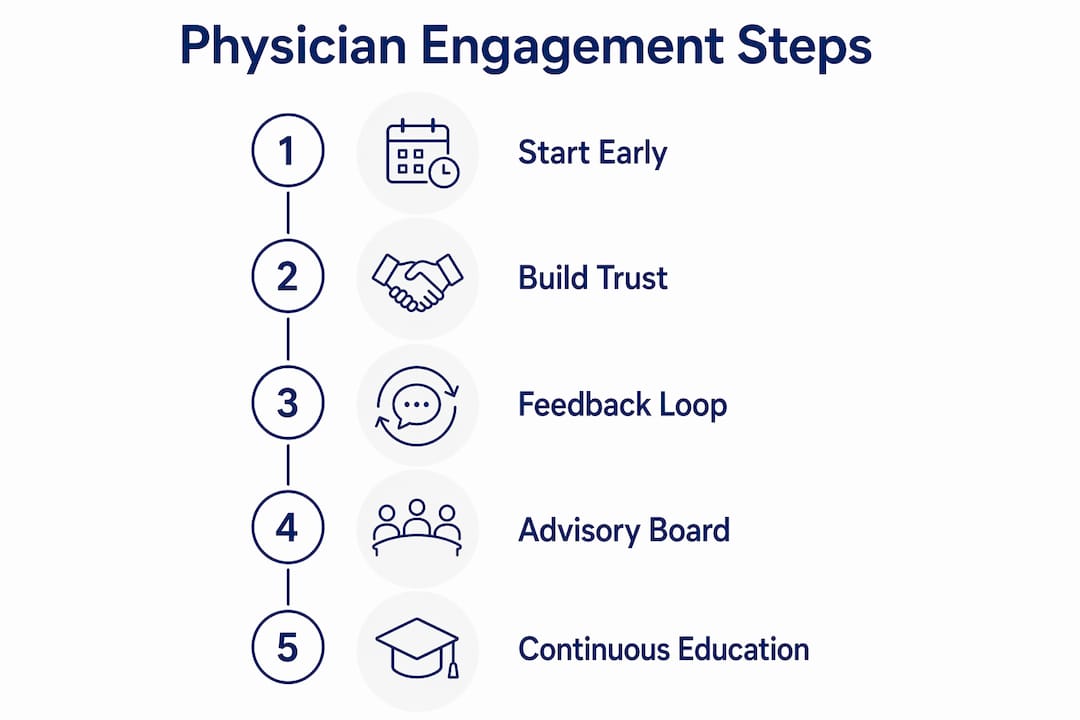
Early involvement means bringing physicians in before your product roadmap is locked. That means user interviews during discovery, structured feedback sessions during beta, and clinical advisory input before you write your first sales deck. Startups that do this reduce time-to-market by 30% and see 50% faster ROI on marketing spend.
The four areas where early physician input matters most:
- Clinical workflow fit. Physicians flag friction points that engineers miss entirely.
- Regulatory language. Physician reviewers catch claims that create compliance risk.
- Reimbursement logic. Clinicians understand billing context that shapes product positioning.
- Peer credibility. A physician co-designer carries more weight than a founder's testimonial.
Closing the feedback loop is non-negotiable. When a physician raises a concern and never hears back, trust erodes immediately. Transparency maintains credibility even when you cannot act on every request. Acknowledge the input, explain the decision, and document it. That single habit separates startups that retain physician advisors from those that burn through them.
Pro Tip: Build a simple feedback tracker shared with your physician advisors. Show them what you changed based on their input and what you did not, with a brief explanation. This one practice builds more trust than any advisory fee.
Why fractional CMOs accelerate physician acquisition
A fractional Chief Medical Officer with healthcare startup experience compresses your go-to-market timeline in ways a general marketing hire cannot. Fractional CMOs knowledgeable in healthcare accelerate physician acquisition by 60–90 days. That acceleration comes from existing relationships with Key Opinion Leaders, conference selection expertise, and clinical positioning knowledge that takes years to build from scratch.
The specific advantages a fractional CMO brings to physician engagement include:
- KOL relationships. They know which physicians move markets in your specialty and how to approach them without burning goodwill.
- Conference strategy. They know which medical society meetings generate pipeline and which ones drain budget.
- Clinical messaging. They translate your product's value into language that resonates with physicians, not investors.
- Regulatory awareness. They keep your marketing claims defensible under FDA and FTC scrutiny.
The right way to start is with a short, focused engagement. Successful fractional CMO engagements often begin with a 3-month test project tied to specific deliverables. This lets you evaluate quality before committing to a longer arrangement. Think of it as a paid pilot, the same model you would use when asking a physician to evaluate your product.
Understanding CMO equity compensation structures before you negotiate matters. Fractional CMOs in healthcare typically work on a retainer plus equity model, and knowing market norms protects both sides.
Pro Tip: Give your fractional CMO one clear deliverable for the first 90 days: a physician acquisition playbook with named KOLs, target conferences, and a clinical messaging framework. If they cannot produce that, the engagement is not working.
How does trust-based alignment differ from standard engagement?
Physician alignment is not the same as physician engagement. Engagement measures activity. Alignment measures commitment. Only 26% of healthcare organizations have formal retention plans, which means most startups and health systems are improvising. Trust-based alignment is more durable and more effective than perks, stipends, or advisory fees alone.
The three pillars of physician autonomy that drive long-term commitment are:
- Clinical autonomy. Physicians must retain control over patient care decisions. Any product that constrains clinical judgment without clear evidence will face resistance.
- Scheduling autonomy. Flexibility in how and when physicians engage with your program signals respect for their time.
- Strategic autonomy. Physicians want a real voice in decisions that affect their practice, not a seat at the table after the vote is taken.
Physician autonomy in clinical, scheduling, and strategic decisions drives long-term commitment and productivity. Startups that protect these three dimensions do not just retain physician advisors. They turn them into advocates who recruit peers.
Physician-to-physician communication is the preferred channel for decision-making and operational collaboration. The dyad model, pairing an administrative leader with a physician champion, improves trust and communication across the organization. For startups, this means your physician advisor should be the one presenting to clinical audiences, not your sales team.
Explaining the "why" behind every major decision is the most underused physician communication technique in startup culture. When you deny a physician's request, say why. When you change the product roadmap, explain the clinical rationale. This practice does not require extra budget. It requires discipline.
What scalable physician engagement programs look like
Scalable physician engagement programs share four structural elements: educational programming, clinical advisory boards, pilot programs, and transparent workflow communication.
Educational programming and CME. Continuing Medical Education credits give physicians a reason to engage with your content beyond commercial interest. Partnering with an accredited CME provider to develop educational modules around your clinical area builds credibility and creates a non-promotional entry point into physician networks.
Clinical advisory boards. A well-structured advisory board is not a vanity list of names on your website. It is a working group that meets quarterly, reviews clinical evidence, and shapes product direction. Structuring a medical advisory board correctly from the start prevents the common failure of advisory boards that exist only on paper.
The four-pillar trust framework that healthtech startups use to accelerate sales with medical practices covers regulatory, clinical, implementation, and financial credibility. Startups that address all four pillars close deals 3–4 times faster than those that lead with product features alone.
| Engagement model | Best for | Key requirement |
|---|---|---|
| Clinical advisory board | Early-stage validation | Quarterly meetings with real deliverables |
| Pilot program | Pre-scale adoption | Risk-sharing terms and clear success metrics |
| CME partnership | Broad physician education | Accredited content with no promotional language |
| KOL ambassador program | Market expansion | Peer-to-peer outreach with physician champions |
- Define success metrics before the pilot starts. Physicians lose confidence when goalposts shift mid-engagement.
- Use risk-sharing financial models. Offer performance-based compensation tied to outcomes, not just participation.
- Communicate workflow impact honestly. If your product adds 10 minutes to a physician's day initially, say so upfront and show the timeline to efficiency.
- Build peer endorsement into the program. Physician champions who recruit peers are more effective than any marketing channel.
Common pitfalls in physician engagement for startups
The most damaging mistake is late-stage consultation. When 80–90% of product decisions are already made before physicians are asked for input, the engagement is performative. Physicians recognize tokenism immediately, and it actively reduces their willingness to collaborate long-term.
Other frequent failures include:
- Ignoring clinical input after collecting it. Asking for feedback and then not acting on it, or not explaining why you did not, destroys credibility faster than not asking at all.
- Over-relying on financial perks. Advisory fees and speaking honoraria attract physicians but do not retain them. Mission alignment and genuine influence do.
- Scaling outreach before the foundation is solid. Recruiting 50 physician advisors before your engagement model works with 5 creates chaos, not momentum.
- Skipping the feedback loop. Closing the feedback loop transparently is the single most cited trust-building behavior in physician engagement research.
Pro Tip: Before you recruit your next physician advisor, audit your current engagement. Can you name one specific product change made because of physician input in the last 90 days? If not, fix the process before you add more people to it.
Key Takeaways
A physician engagement strategy built on early involvement, trust-based alignment, and transparent communication is the fastest path from product concept to clinical adoption for healthcare startups.
| Point | Details |
|---|---|
| Start early | Involve physicians in product design before the roadmap is locked to reduce time-to-market. |
| Hire strategic leadership | A fractional CMO with healthcare experience compresses physician acquisition by 60–90 days. |
| Protect physician autonomy | Clinical, scheduling, and strategic autonomy are the three pillars of long-term physician commitment. |
| Close every feedback loop | Explain decisions transparently, even when you cannot act on physician input. |
| Build before you scale | Validate your engagement model with a small cohort before expanding outreach. |
What I have learned about physician engagement after 25 years
Founders ask me all the time whether they should hire a full-time CMO or outsource physician outreach to a sales agency. My honest answer is neither, at least not first. Founders must lead early-stage sales to build authentic trust and capture the feedback that actually shapes product-market fit. Outsourcing that too early is one of the most common and costly mistakes I see in healthcare startups.
What I have observed across 25 years in clinical practice, health system leadership, and startup advisory work is this: physicians do not engage with products. They engage with people they trust. The startup that wins physician loyalty is the one where a founder or a credible clinical leader shows up, listens without a sales agenda, and follows through on what they heard.
The startups I have worked with that struggled most with physician engagement shared one trait. They treated physicians as a distribution channel rather than as clinical partners. The ones that succeeded treated physician input as a product development asset. That shift in mindset changes everything from your advisory board structure to your go-to-market timeline.
If you are building a physician-led startup or a digital health product that needs clinical validation, the engagement strategy is not a marketing function. It is a leadership function. Build it into your culture from day one, not as a campaign you run when adoption stalls.
— Paul
How Thestartupmd helps startups build physician engagement programs
Healthcare startups that work with Thestartupmd get more than consulting advice. They get a physician-executive with 25 years of clinical and C-suite experience who has sat on both sides of the table.
Paul Bergeron, MD, MBA, offers fractional CMO services built specifically for healthcare SaaS and digital health companies that need to accelerate physician acquisition, build clinical advisory boards, and create go-to-market strategies that resonate with medical audiences. From KOL identification to CME-aligned content programs, Thestartupmd brings the clinical credibility and startup execution experience that generic marketing agencies cannot replicate. If your physician engagement program needs a reset or a foundation, a focused 90-day engagement is the right place to start.
FAQ
What is physician engagement strategy for startups?
Physician engagement strategy is the structured process of involving physicians in product development, validation, and adoption to build trust and accelerate market entry. For startups, it functions as both a clinical and a commercial function.
How early should startups involve physicians in product development?
Startups should involve physicians during the discovery phase, before the product roadmap is finalized. Research shows that early physician input reduces time-to-market by 30% and improves initial engagement by 40%.
What does a fractional CMO do for physician engagement?
A fractional CMO with healthcare experience accelerates physician acquisition by 60–90 days through existing KOL relationships, conference strategy, and clinical messaging expertise. The engagement typically starts with a focused 3-month project.
Why do physician engagement programs fail?
The most common failure is late-stage consultation, where physicians are asked for input after 80–90% of decisions are already made. This tokenism actively reduces long-term physician collaboration and trust.
How do startups build long-term physician loyalty?
Long-term physician loyalty comes from protecting clinical, scheduling, and strategic autonomy, closing feedback loops transparently, and treating physicians as clinical partners rather than a sales channel.