

A modern KOL strategy is a goal-driven, audit-ready stakeholder engagement system that surfaces clinical insight on a predictable schedule rather than whenever a conference happens to line up. Getting there starts with three moves: define the business objective the engagement serves, identify and tier the right experts against that objective, and assign one owner and one operating model before the first outreach email goes out. Everything else, lifecycle design, digital formats, compliance, measurement, follows from those three decisions.
TL;DR:
- Focusing only on national-tier experts limits insight; including regional and digital opinion leaders provides a more comprehensive view of clinical practice.
- Digital engagement formats, like structured surveys and micro-surveys, can increase participation by fitting into clinicians' busy schedules and providing quick feedback.
- Maintaining detailed, auditable documentation for every interaction and contract reduces compliance risks and preserves institutional memory, especially for audit readiness.
- Launching a pilot program within 90 days is achievable by clearly defining objectives, shortlisting 8 to 12 experts, and running a small synchronous and asynchronous engagement.
- Using a centralized platform with structured taxonomy and integrated CRM prevents fragmentation and supports scalable, repeatable KOL management processes.
Table of Contents
- What Is the KOL Management Lifecycle in Healthcare?
- How Do You Identify and Tier Key Opinion Leaders?
- Which Engagement Formats Actually Work in 2026?
- What Compliance and Documentation Does a KOL Program Need?
- How Do You Measure KOL Program ROI?
- What Operating Model Keeps KOL Programs From Fragmenting?
- How Do You Launch a KOL Program in 90 Days?
- Why This Matters: Practitioner Experience Behind the Framework
- Future Perspective: From KOLs to Stakeholder Ecosystems
- How The StartupMD Helps You Build a Defensible KOL Program
- Sources
- FAQ
What Is the KOL Management Lifecycle in Healthcare?
Key opinion leader engagement runs on a lifecycle, not a calendar of one off events. Each phase feeds the next, and skipping one is usually why programs stall after a strong launch.
- Goal setting. Define whether the engagement supports clinical evidence generation, product development feedback, or commercial readiness. The goal decides everything downstream.
- Identification and profiling. Build a shortlist against that specific goal, not a generic "top doctors" list.
- Contracting and segmentation. Assign tier, engagement type, and fair-market-value rate before any conversation happens.
- Engagement. Run the actual advisory board, panel, or one-on-one consultation.
- Insights analysis. Convert transcripts and survey responses into structured findings tied to a decision.
- Follow-up. Report back to the expert on what changed because of their input, and log the interaction for the next cycle.
Objectives determine almost every choice that follows. A program built to inform a clinical evidence plan needs deep, synchronous access to a small group of national-tier physicians. A program built to gauge market readiness across a broader population needs breadth: more voices, shorter formats, faster turnaround.
Medical affairs, usually through medical science liaisons, owns identification, scientific exchange, and insight capture. Commercial teams can participate once a scientific relationship exists, a sequencing, TechTarget and industry recruitment guidance both flag as critical for preserving trust. Blur that order, and the relationship reads as promotional from the first meeting.
How Do You Identify and Tier Key Opinion Leaders?
Identification starts with data, not instinct. Reliable sources include publication and citation records, congress speaker and moderator lists, CRM interaction history, and digital signals like guideline authorship or clinical community activity. Cross-referencing these sources catches people your team already knows and people your team has never contacted, which matters more than it sounds.
Here's why that second group deserves attention: Veeva's field trends analysis found that roughly 30% of global experts tracked in its systems had no recorded MSL interaction at all. That is not a rounding error. It is a third of the field going untouched while teams focus on the same familiar names.
A profiling template should capture, at minimum:
- Institutional role and clinical practice setting (academic, community, hybrid).
- Publication and trial-participation history relevant to the therapeutic area.
- Prior engagement history with your organization and competitors.
- Digital reach, including guideline work, podcast or webinar presence, and peer community standing.
- Specific topics of influence, since broad reputation rarely maps to your exact clinical question.
From there, a three-tier deployment model keeps resources proportional to reach. Regional-tier experts, commonly the largest group, drive most ongoing insight capture. Local and digital opinion leaders round out the base, offering frontline practice reality that national figures sometimes lose touch with. A 2025 Sermo poll found that clinicians weigh professional credentials and years of practice far more heavily than social following when judging a peer's credibility, a useful check against over-indexing on follower counts when building any tier.
Which Engagement Formats Actually Work in 2026?
Format choice should follow the objective, not the calendar. Depth work, like refining a clinical evidence plan, calls for synchronous formats: a live virtual advisory board or a structured one-on-one interview where follow-up questions can happen in real time. Breadth work, like validating a product feature across 40 physicians, calls for asynchronous formats: structured surveys, discussion boards, or short video responses collected over a week.
- Use live virtual advisory boards when you need real-time debate among experts who may disagree.
- Use asynchronous panels when you need input from a geographically dispersed or time-constrained group.
- Use micro-surveys for quick directional checks between larger engagements.
- Reserve in-person sessions for relationship-building moments or complex multi-stakeholder discussions that benefit from a shared room.
Digital-first programs that combine secure platforms with asynchronous options tend to see stronger participation, largely because clinicians can contribute between patients instead of blocking out an evening, a pattern industry guidance on digital engagement has documented consistently. Design details matter as much as format choice. Send pre-reads at least 72 hours ahead. Use a trained moderator who keeps the session on the stated objective. Produce a one-page recap and send it to participants within a week, closing the loop instead of letting the conversation disappear into a slide deck nobody revisits.
Pro Tip: Offer a fixed 20-minute asynchronous window instead of an open ended one. Clinicians respond better to a bounded task than a vague invitation to "share thoughts when you get a chance."
What Compliance and Documentation Does a KOL Program Need?
Every engagement needs a contract that specifies scope of work, deliverable, and a fair-market-value rate set against defensible benchmarks, not a round number someone picked because it sounded reasonable. FMV should account for specialty, years of experience, and the specific task, whether that's a one-hour advisory call or a multi-day steering committee.
Open Payments readiness is not optional paperwork. Every honorarium, meal, and travel reimbursement tied to a physician interaction needs a timestamped record that can withstand an audit years after the engagement happened.
- Log every interaction, digital or in-person, in a single system rather than scattered emails and spreadsheets.
- Route every contract through a documented FMV approval step before signature.
- Retain agendas, attendee lists, and recap documents for the full retention period your compliance team requires.
- Tag each record with objective, topic, and outcome so a reviewer can reconstruct the business rationale months later.
Practitioner-level research on KOL dynamics points to fragmented, undocumented engagement as a direct driver of compliance exposure. The fix is procedural, not heroic: build the audit trail into the workflow so nobody has to reconstruct it later.
How Do You Measure KOL Program ROI?
Participation rate is the easiest KPI to track and the least interesting on its own. What matters more is insight utilization: what percentage of captured feedback actually reached a product, regulatory, or evidence-generation decision. Track an advisory-to-action ratio, the share of advisory board recommendations that resulted in a documented change, alongside re-engagement rates, since experts who return for a second or third session are voting with their calendar.
- Participation rate across invited versus engaged experts.
- Insight utilization rate, insights that reached a decision owner versus insights that sat in a report.
- Advisory-to-action ratio, recommendations acted on versus recommendations logged.
- Re-engagement rate across consecutive program cycles.
- Where clinically and legally appropriate, prescribing pattern shifts tracked through approved, compliant channels only.
IQVIA's analysis of KOL program economics makes a direct case that centralized, well-documented programs convert scattered interactions into measurable enterprise value, while fragmented ones lose both the compliance trail and the strategic upside. Report these metrics to leadership on a quarterly cadence, tied explicitly to the go-to-market or evidence milestones they were meant to inform.
What Operating Model Keeps KOL Programs From Fragmenting?
Every program eventually hits the same failure mode: three people run three parallel spreadsheets, none of them talk to each other, and six months later nobody can say what a given advisory board actually produced. A single source of truth, one platform integrated with your CRM, prevents that entirely.
The platform itself needs specific capabilities, not generic "engagement software" marketing language:
- Secure messaging channels that meet data privacy requirements for clinical communication.
- Asynchronous board functionality with built-in moderation and reminder sequencing.
- Automatic transcript capture and searchable taxonomies (objective, topic, output, action).
- FMV rate benchmarking and one-click audit export for compliance review.
That taxonomy point deserves emphasis. IQVIA's operational guidance recommends mapping every single interaction into a structured objective-topic-output-action framework, which is what actually lets a small team retrieve "what did our diabetes advisory board tell us about dosing concerns eight months ago" without digging through someone's old inbox. Route each finding to a named decision owner immediately after analysis, and log the outcome even when the answer is "no action taken." That negative result is still institutional memory worth keeping.
How Do You Launch a KOL Program in 90 Days?
Startups and lean medical affairs teams do not need a 12 month rollout plan. They need a sequence that produces a working pilot fast enough to show value before budget conversations happen again.
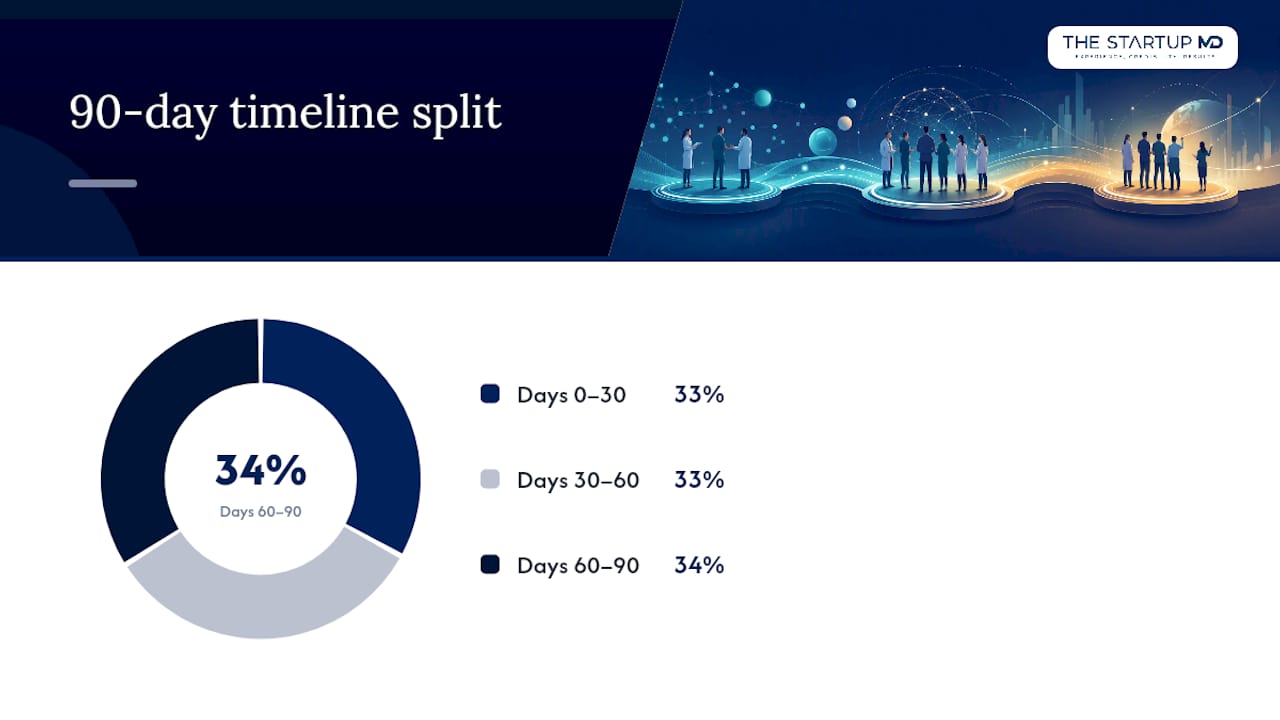
- Days 0 to 30: Define the single business objective the program serves. Run a quick identification sweep using publication data, congress lists, and CRM history. Shortlist 8 to 12 experts across national, regional, and local tiers. Build the compliance checklist, FMV benchmarks, contract template, Open Payments logging process, in parallel.
- Days 30 to 60: Recruit the pilot group and run one asynchronous panel plus one short synchronous advisory session. Capture every output in a structured format, not free-form notes.
- Days 60 to 90: Analyze what came out of the pilot, route findings to the relevant decision owner, formalize contracts and FMV documentation for anyone moving into an ongoing relationship, and draft the scale plan for the next 12 months.
Pro Tip: Resist the urge to shortlist 30 experts for a first pilot. A tight group of 8 to 12 produces cleaner signal and is far easier to manage without dedicated program staff.
A physician engagement strategy built for startups and a structured medical advisory board framework both give small teams a head start on steps one and three without reinventing the contracting process from scratch.
Why This Matters: Practitioner Experience Behind the Framework
This framework reflects more than theory. Paul Bergeron, MD, MBA, brings over 25 years of combined clinical and business experience to healthcare SaaS advisory work, including hands-on fractional Chief Medical Officer engagements where KOL program design is a recurring priority for early-stage teams.
Fractional CMO and advisory work help startups access physician-level engagement expertise without requiring a full-time executive hire. A fractional CMO can build the identification framework, set the compliance guardrails, and run the first pilot advisory board, then hand off a documented, repeatable process to an internal team as the company scales.
Future Perspective: From KOLs to Stakeholder Ecosystems
Academic KOLs alone no longer capture how clinical opinion actually forms. Digital opinion leaders, patient advocates, and frontline clinicians shape prescribing behavior in ways a purely credential-based roster misses entirely. Programs that combine traditional academic authority with these newer digital voices consistently surface richer, more current insight than either group alone. My recommendation for 2026: audit your current roster for digital and community voices before you build another national advisory board. That gap is usually larger than teams expect.
— Paul Bergeron MD, MBA
How The StartupMD Helps You Build a Defensible KOL Program
Building the identification framework, compliance checklist, and pilot advisory board described above takes physician-level judgment most early-stage teams have not yet hired in house. This gap can be addressed through fractional Chief Medical Officer engagements and project-based advisory work led by an experienced physician executive.
If your team needs a compliance-ready program design, a pilot advisory board run correctly the first time, or a second opinion on your current KOL roster, The StartupMD's advisory and fractional CMO services map directly to each phase covered here: goal-setting, tiering, engagement design, and audit-ready documentation. Book a scoping conversation to review your current stakeholder engagement approach and identify where a fractional CMO can move your program from ad hoc to defensible within a single quarter.
Sources
- Veeva Pulse field trends report
- The impact of key opinion leaders in healthcare (Sermo poll)
- The ROI of KOL engagement (IQVIA)
FAQ
What Does KOL Mean in Healthcare?
KOL stands for key opinion leader, a physician or clinical expert whose research, practice experience, or professional standing gives their perspective outsized influence on peers. Credibility typically rests on credentials and clinical experience rather than public visibility, according to a 2025 Sermo poll.
What Is a KOL Strategy?
A KOL strategy is a structured plan for identifying, engaging, and learning from key opinion leaders and related stakeholders to inform clinical, regulatory, and commercial decisions. Effective programs run on a full lifecycle, goal-setting through follow-up, and stay audit-ready throughout, as IQVIA's ROI research emphasizes.
What Skills Do You Need to Be a KOL?
Clinical credentials, sustained practice experience, and a track record of publication or guideline contribution matter most to peers judging credibility. A 2025 Sermo poll found clinicians weigh those factors well above social media reach when deciding whose opinion to trust.
What Does KOL Management Mean?
KOL management refers to the ongoing operational work of tracking engagements, documenting compliance details, and routing insights to decision owners across a program's full roster. Centralized platforms with CRM integration turn that work from scattered notes into an auditable, repeatable system.
How Does The StartupMD Support KOL Program Design?
The StartupMD offers fractional Chief Medical Officer and advisory engagements that help healthcare startups design compliant, objective-driven KOL programs from the ground up. Current pricing and scope details are available directly on the services page.