

What is a patient stratification model and why does it matter?
A patient stratification model is a systematic framework that groups patients by clinical and demographic characteristics to guide targeted care and smarter resource allocation. For healthcare startups, it is the operational backbone of any serious population health or value-based care strategy. You are not just sorting patients for clinical tidiness. You are creating the data infrastructure that tells your platform who needs what, when, and at what intensity.
The core purpose is deceptively simple: match the right intervention to the right patient at the right time. In practice, that requires pulling together multiple data streams and applying a classification logic that clinicians trust and operators can act on. A well-built model does both.
Primary components of a patient stratification model include:
- Clinical criteria: diagnosis codes (ICD-10), lab values, vital signs, and comorbidity burden
- Demographic data: age, sex, socioeconomic status, and geographic location
- Utilization patterns: emergency department visits, hospitalizations, and care gaps
- Risk scores: composite indices such as the Hierarchical Condition Category (HCC) score used in Medicare Advantage
- Behavioral and social determinants: health literacy, housing stability, and substance use history
- Functional status: Activities of Daily Living (ADL) scores and mobility assessments
- Engagement signals: appointment adherence, medication refill rates, and patient-reported outcomes
Each component feeds the model's classification logic. Strip any one of them out prematurely and you risk misclassifying patients who need intensive support or over-allocating resources to patients who do not. For a startup pitching to ACOs, health systems, or payers, the credibility of your stratification logic is often the first thing a clinical buyer scrutinizes.
Why risk stratification gives healthcare startups a real competitive edge
Risk stratification is the most clinically focused subset of patient stratification. Where general stratification may group patients by care pathway or service need, risk stratification specifically categorizes patients by their likelihood of developing adverse health outcomes, such as hospitalization, disease progression, or preventable death. The American Academy of Family Physicians describes it as a two-step process: identify the population, then rank patients by risk level to guide clinical intervention.
For startups, the distinction matters commercially. Risk stratification outputs map directly onto value-based care contracts, where payers reward providers for keeping high-risk patients out of the hospital. If your platform can demonstrate that it identifies rising-risk patients before a crisis occurs, you have a quantifiable ROI story.
Clinical and operational benefits your startup can point to:
- Prioritization: care managers focus time on the top 5–10% of patients driving the majority of costs
- Intervention targeting: high-risk patients receive proactive outreach; low-risk patients receive self-service digital tools
- Cost containment: avoiding one preventable hospitalization can offset months of platform subscription fees
- Scalability: a tiered model lets a small care team manage a large attributed population without burning out
- Investor appeal: risk stratification outputs align with HEDIS measures and Star Ratings, metrics investors and health system buyers already understand
- Regulatory incentives: CMS programs including the Medicare Shared Savings Program (MSSP) and the Primary Care First model reward practices that demonstrate systematic risk identification
A startup population health strategy built around risk stratification also signals clinical maturity to enterprise buyers. Health systems and ACOs have seen too many digital health tools that cannot explain their clinical logic. A defensible risk model changes that conversation.
Common types of patient stratification models and how they work
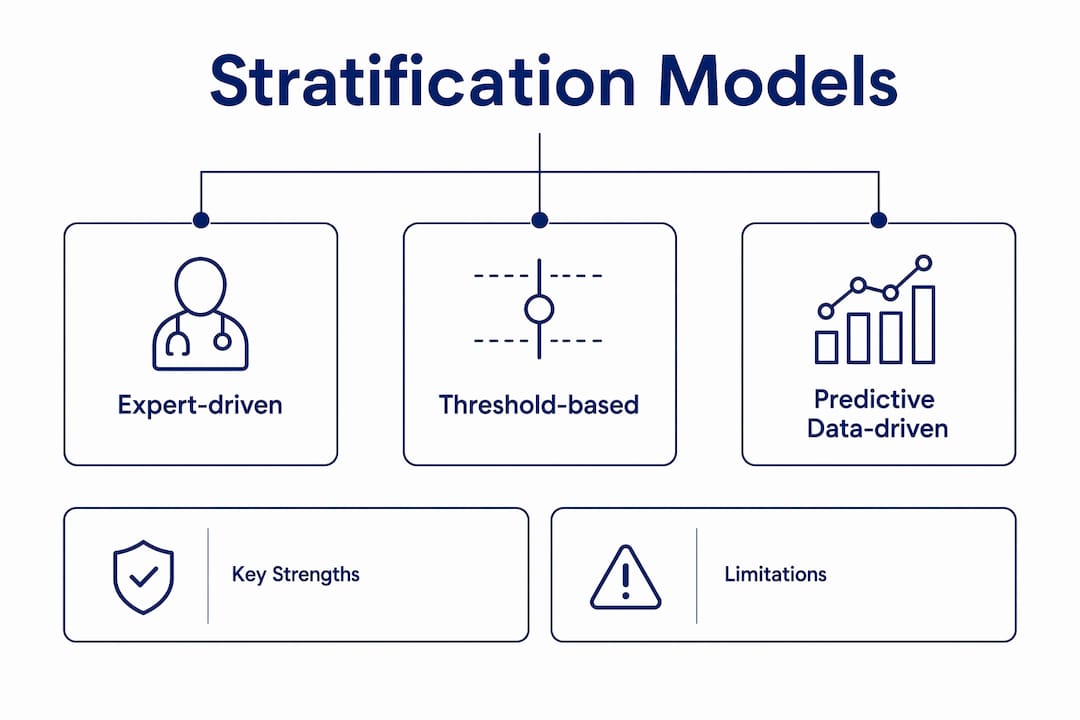
Three broad model categories dominate clinical practice and health tech product design. Understanding the differences helps you choose the right architecture for your startup's use case.
Expert-driven models
These rely on clinician-defined criteria established through literature review and consensus. The 3M Clinical Risk Group (CRG) system, for example, classifies patients into more than 200 mutually exclusive risk groups using a hierarchical logic that weights the highest-morbidity conditions most heavily. Kaiser Permanente's Senior Segmentation Algorithm divides elderly populations into four tiers: robust seniors without chronic conditions, seniors with one or more chronic conditions, seniors with advanced illness and end-organ failure, and seniors with advanced frailty or at end of life. Expert-driven models are transparent and clinician-friendly, but they require ongoing manual updates as clinical evidence evolves.

Threshold-based models
These apply fixed cutoff values to a small set of variables, such as an HCC score above a defined threshold or three or more emergency department visits in the past 12 months, to assign patients to risk tiers. They are fast to implement and easy to explain to non-technical stakeholders. The tradeoff is rigidity: a patient who falls just below the threshold may still carry substantial unmet need.
Data-driven predictive models
Statistical methods like K-means clustering and latent class analysis segment populations based on patterns in empirical data rather than predefined rules. Latent class analysis assigns patients to clusters based on the maximum posterior probability of membership, which makes it well-suited for identifying subgroups with distinct care utilization patterns. K-means works efficiently at scale when the patient population is large. These methods generate richer, more granular segments but require clean data and statistical expertise to validate.

| Model type | Best for | Key strength | Key limitation |
|---|---|---|---|
| Expert-driven | Established care programs, payer contracts | Clinician trust, regulatory alignment | Manual updates required |
| Threshold-based | Early-stage startups, lean data environments | Speed, interpretability | Misses near-threshold patients |
| Data-driven predictive | Mature data pipelines, population health platforms | Granularity, pattern discovery | Requires data quality and expertise |
The pyramid model is the most widely recognized visual framework in population health. It places the general healthy population at the base, rising through patients with chronic conditions, complex multimorbidity, and high-risk or high-cost patients at the apex. Your startup's product roadmap should map interventions to each tier, not just the top.
Data quality is the constraint that most startups underestimate. Incomplete EHR data, inconsistent coding practices across provider sites, and gaps in social determinants data all degrade model accuracy before the first algorithm runs.
How AI changes patient stratification for startups
AI does not replace the clinical logic in a stratification model. It amplifies it, particularly when you are working with multimodal data at scale. Combining molecular, imaging, and clinical data refines subgroup identification in ways that threshold-based or even traditional statistical models cannot match. For startups building clinical trial support tools or precision medicine platforms, that capability is the product.
A typical AI-enabled stratification workflow
- Data ingestion: Pull structured and unstructured data from EHR systems (Epic, Oracle Health), claims feeds, lab interfaces, and patient-reported outcome tools
- Feature engineering: Transform raw data into clinically meaningful variables, such as care gap counts, medication adherence rates, and comorbidity indices
- Model training: Apply supervised or unsupervised learning. Unsupervised methods like Doc2Vec and clustering on EHR data have uncovered patient clusters with distinct clinical characteristics that traditional models missed
- Validation: Test model outputs against known outcomes using held-out data; measure sensitivity, specificity, and positive predictive value
- Clinical review: A clinician advisory board reviews cluster definitions and flags outputs that do not align with real-world care patterns
- Deployment: Push risk scores and segment assignments into the EHR workflow or care management platform where clinicians act on them
- Monitoring: Track model drift, demographic bias, and outcome changes on a defined cadence
Key advantages AI brings to patient classification:
- Identifies responder subgroups in clinical trials with greater precision than manual methods
- Processes thousands of variables simultaneously, including genomic and imaging data
- Scales across large attributed populations without proportional increases in analyst headcount
- Detects rising-risk patients earlier by recognizing subtle pattern shifts in longitudinal data
The challenges are just as real. 80% of AI tools lack prospective validation, and trust deficits block adoption in 65% of implementations, largely because clinicians cannot see inside the model's reasoning. Black-box opacity is not a technical inconvenience. It is a clinical adoption failure mode. Startups also face the commoditization problem: without unique data assets and strategic alliances, AI stratification solutions become easily replicable by any team with access to the same open-source tools.
Regulatory pressure compounds the challenge. US state laws like Colorado's Consumer Protections for Artificial Intelligence (CAIA) impose anti-discrimination mandates, and non-integration of compliance at the development stage increases costs by 20–30%. Building compliance in from day one is not optional.
How to build and evaluate a patient stratification model that actually gets adopted
Most stratification models fail not because the math is wrong but because the output does not fit how clinicians actually work. The seven core evaluation criteria for clinical utility go well beyond statistical accuracy.
Criteria your model must meet:
- Validity: Does the model accurately predict the outcome it claims to predict? Measure sensitivity, specificity, and area under the ROC curve against a gold-standard dataset.
- Interpretability: Can a clinician explain why a patient landed in a given tier? If not, adoption stalls at the point of care.
- Stability: Do segment assignments remain consistent over time when the underlying patient population has not meaningfully changed?
- Actionability: Does each segment map to a specific, executable clinical or operational decision? A segment with no corresponding intervention is a data artifact, not a clinical tool. Effective models must align with actionable decisions to have real value.
- Parsimony: Use the fewest variables that still produce clinically meaningful segments. Overfitted models with dozens of inputs are fragile and hard to maintain.
- Substantiality: Each segment must be large enough to justify a distinct care program. A cluster of three patients does not warrant a dedicated intervention pathway.
- Identifiability: Can you reliably assign new patients to the correct segment using data that is actually available in your target EHR environment?
Best practices for startup implementation:
- Align model outputs directly with the clinical workflow your buyers already use. The main competition for your tool is the status quo, and clinicians will default to what they know unless your output fits naturally into their existing process.
- Build your proprietary data pipeline early. General-purpose AI models commoditize basic stratification quickly, so your defensible moat comes from unique data partnerships and custom feature engineering, not the algorithm itself.
- Embed regulatory compliance from the start. Governance committees, bias audits, and documentation of model logic are not post-launch tasks.
- Use Explainable AI (XAI) techniques and human-in-the-loop (HITL) validation to make model outputs transparent. This directly addresses the black-box problem that blocks clinical trust.
- Conduct bias detection on every model version. Biased outputs do not just create clinical harm; they create liability exposure and regulatory risk.
Pro Tip: Build your clinician advisory board before you finalize your model architecture, not after. Clinicians who help define the segmentation criteria are far more likely to trust and act on the outputs. This is the single fastest way to close the gap between a technically sound model and one that actually gets used.
For startups preparing to pitch this capability to health system buyers or investors, the healthcare startup investor pitch checklist at Thestartupmd covers how to frame your stratification logic as a clinical and commercial differentiator. Aligning your model's outputs with clinical governance standards also strengthens enterprise sales conversations by demonstrating that your platform meets the compliance bar health system procurement teams require.
Key Takeaways
Patient stratification models succeed when clinical validity, workflow integration, and regulatory compliance are built in from the start, not retrofitted after launch.
| Point | Details |
|---|---|
| Model architecture choice | Expert-driven, threshold-based, and data-driven predictive models each fit different startup stages and data environments. |
| AI adoption barrier | 80% of AI tools lack prospective validation; transparent, explainable outputs are required for clinical trust. |
| Compliance cost risk | Skipping regulatory integration at the development stage increases compliance costs by 20–30%. |
| Seven evaluation criteria | Validity, interpretability, stability, actionability, parsimony, substantiality, and identifiability are required for clinical utility. |
| Clinician advisory boards | Involving clinicians in model design from day one is the most reliable path to adoption and enterprise sales. |
Working with Thestartupmd
Building a patient stratification model that earns clinical trust and closes enterprise deals requires more than a good algorithm. It requires a medical voice that health system buyers and investors recognize as credible.
Thestartupmd, led by Paul Bergeron, MD, MBA, brings 25+ years of clinical practice, C-suite executive leadership, and hands-on startup advisory experience to exactly this problem. Paul has led ACOs serving 375,000+ covered lives, earned $17.2M in Medicare Shared Savings, and helped CareGem Health reach acquisition within three months of engagement.
If your stratification model needs clinical validation, a go-to-market strategy, or a fractional CMO who can walk into a health system boardroom and speak the language, explore Thestartupmd's services to see where the fit is.