

To position a digital health product for ACOs, you must prove a direct, measurable path to shared savings through interoperable data, clinician workflow integration, and a pilot designed around CMS quality and cost metrics. That is the short answer. Everything below is how you execute it.
Your positioning checklist before the first ACO conversation:
- Tie value to shared savings. Map your product's primary outcome to total cost of care reduction, readmission rates, or a CMS ACO quality measure. If you cannot draw that line in one sentence, the ACO's medical director will draw it for you, and not in your favor.
- Confirm FHIR/API readiness. ACOs increasingly expect Bulk FHIR support for digital quality measure reporting. NAACOS warns that many vendors are not yet ready, and that gap is a procurement blocker.
- Identify your clinical billing partner. Technology vendors often cannot participate directly in CMS models. You likely need a Part B–billing clinical entity as your ACO-side partner.
- Validate workflow integration. Clinicians will not use a tool that adds steps. Confirm your product fits into existing EHR workflows before the pilot conversation.
- Design a pilot with defined KPIs. Population size, control group, timeline, and success thresholds must be specified before you ask for a signature.
- Draft your data agreement early. PHI handling, data ownership, and liability terms are deal-breakers when left to the final contracting stage.
Your immediate next step: identify one executive sponsor inside the ACO and propose a 90-day, single-population pilot with pre-agreed success metrics.
Pro Tip: Before any ACO meeting, pull the organization's most recent CMS quality scorecard. Walk in knowing their lowest-performing measures. That specificity signals clinical seriousness and shortens the trust-building phase considerably.
Key Takeaways
Winning ACO adoption requires aligning every layer of your product strategy, from technical architecture to contracting terms, with how ACOs earn shared savings and measure quality performance.
| Point | Details |
|---|---|
| Shared savings alignment | Map your product's primary outcome to total cost of care, readmissions, or a specific CMS quality measure before any ACO conversation. |
| FHIR and data transparency | Confirm Bulk FHIR readiness and prepare a data provenance document; NAACOS warns that vendor readiness gaps are a current procurement blocker. |
| Clinical billing partnership | Technology vendors typically cannot participate directly in CMS models; identify a Part B–billing clinical partner before approaching ACO contracting teams. |
| Pilot design with pre-agreed KPIs | Define population, control group, timeline, and success thresholds in writing before the pilot starts to prevent disputes at contract close. |
| The StartupMD advisory support | The StartupMD's fractional CMO services help digital health teams build clinical credibility, design defensible pilots, and navigate ACO contracting. |
Table of Contents
- Why ACOs are a distinct buyer for digital health products
- How to position your digital health product for ACOs: what they actually prioritize
- How to measure and model value for an ACO: KPIs, pilots, and ROI
- Legal, reimbursement, and contracting realities for ACO vendors
- Does your product meet the technical bar ACOs expect?
- Your step-by-step GTM playbook for ACO adoption
- What actually works when positioning for ACOs
- The StartupMD accelerates your ACO market entry
- Sources
Why ACOs are a distinct buyer for digital health products
Accountable Care Organizations are groups of physicians, hospitals, and other providers that accept collective accountability for the cost and quality of care for a defined patient population. Under value-based contracting, they share in savings when total spending falls below a CMS benchmark, and in two-sided risk models, they absorb losses when it does not. That financial structure shapes every vendor conversation.
Success for an ACO is not measured in patient satisfaction scores alone. It is measured in shared savings earned, quality measure performance, and avoided expenditures on preventable hospitalizations and specialist overuse. The ACO REACH Model from CMS extends this accountability further, with enhanced focus on health equity, prospective attribution, and direct contracting arrangements that give ACOs more flexibility and more financial exposure simultaneously.
What this means for your positioning:
- ACOs prioritize vendors who reduce total cost of care, not those who improve a single clinical metric in isolation.
- Procurement decisions involve the medical director, CFO, care management leadership, and often a contracting committee. No single champion closes the deal alone.
- Risk sensitivity is high. ACOs in two-sided models are especially cautious about tools that require large upfront investment without a clear ROI timeline.
The CMS ACO care transformation toolkit gives ACOs operational playbooks for telehealth, post-acute care, and care transitions. Vendors who align their pitch to these established frameworks signal that they understand how ACOs actually operate, not just how they are described in policy documents.
That sequencing reality is the single most underestimated obstacle in digital health product marketing to ACOs. If your product requires the ACO to have mature analytics infrastructure before it delivers value, say so upfront and position accordingly.
How to position your digital health product for ACOs: what they actually prioritize
ACOs do not buy features. They buy outcomes tied to financial performance. Your product's capabilities matter only insofar as they solve a problem the ACO is already accountable for.
High-priority use cases ACOs fund:
- Transitions of care. Post-discharge follow-up, medication reconciliation, and 30-day readmission prevention are perennial priorities because the financial penalty for avoidable readmissions is direct and measurable.
- Remote patient monitoring (RPM). Chronic disease management for high-risk attributed patients, particularly those with heart failure, COPD, and diabetes, where early signal detection reduces acute episodes.
- Telehealth. Clinic-hosted telehealth reduces patient-side access barriers and is easier to reimburse within existing ACO structures. Home-based technology scales access but requires more patient-side support and equity consideration.
- Behavioral health pathways. Depression and substance use disorders drive disproportionate total cost of care in ACO populations. Integrated behavioral health tools are increasingly fundable.
- Patient engagement and adherence. Medication adherence, appointment completion, and care plan activation all affect quality measure performance and downstream utilization.
- Care navigation. Tools that help care managers prioritize outreach by risk score and close gaps in preventive care directly affect HEDIS-aligned quality measures.
The Bipartisan Policy Center's letter to CMS identifies the four adoption barriers ACOs cite most often: high upfront cost, EHR integration difficulty, uncertain reimbursement, and unclear ROI. Your pitch must address all four, not just the clinical value proposition.
Feature-to-value mapping ACOs expect:
| Capability | ACO Value Driver | What to Demonstrate |
|---|---|---|
| Risk stratification | Prioritize high-cost patients | Claims + EHR-derived risk scores, not self-reported data |
| Closed-loop care alerts | Reduce avoidable utilization | Alert-to-action rate, not alert volume |
| Quality measure reporting | CMS performance scores | Alignment to specific ACO REACH or MSSP measures |
| Health equity data | REACH equity requirements | Stratified outcomes by race, language, zip code |
| Telehealth integration | Access and utilization | Visit completion rates, no-show reduction |
ACOs also look for vendors who can integrate claims data with clinical data. A product that analyzes only one stream is less credible than one that combines both. Health Catalyst's guidance frames this as building a central data repository that brings analytics to the point of care, a model ACOs recognize and trust.
Avoid common healthcare SaaS positioning mistakes like leading with technology architecture instead of clinical outcomes. ACO medical directors are not evaluating your stack. They are evaluating whether your product makes their attributed population healthier at lower cost.
How to measure and model value for an ACO: KPIs, pilots, and ROI
A credible business case for an ACO requires more than a slide deck with projected savings. It requires a pilot design that produces defensible numbers within a timeline the ACO's finance team can act on.
Priority KPIs aligned to ACO financial and quality goals:
- Total cost of care per attributed beneficiary — the headline metric for shared savings calculations.
- 30-day all-cause readmission rate — directly tied to CMS quality scoring and penalty avoidance.
- ED utilization rate — avoidable ED visits are a high-yield cost reduction target.
- ACO quality measure performance — specific measures vary by model (ACO REACH vs. MSSP), but preventive care and chronic disease management measures are consistent priorities.
- Patient engagement and activation rate — a process metric that predicts downstream utilization changes.
- Attribution retention — patients who disengage from primary care leave the ACO's attributed population, reducing the denominator for shared savings.
Pilot design template:
- Population selection. Choose a defined cohort: a single chronic condition, a single primary care practice, or a post-discharge population. Avoid broad populations in a first pilot; specificity produces cleaner signals.
- Control vs. intervention. Use a matched historical cohort or a concurrent control group from a comparable practice. Pre-specify the matching criteria before data collection begins.
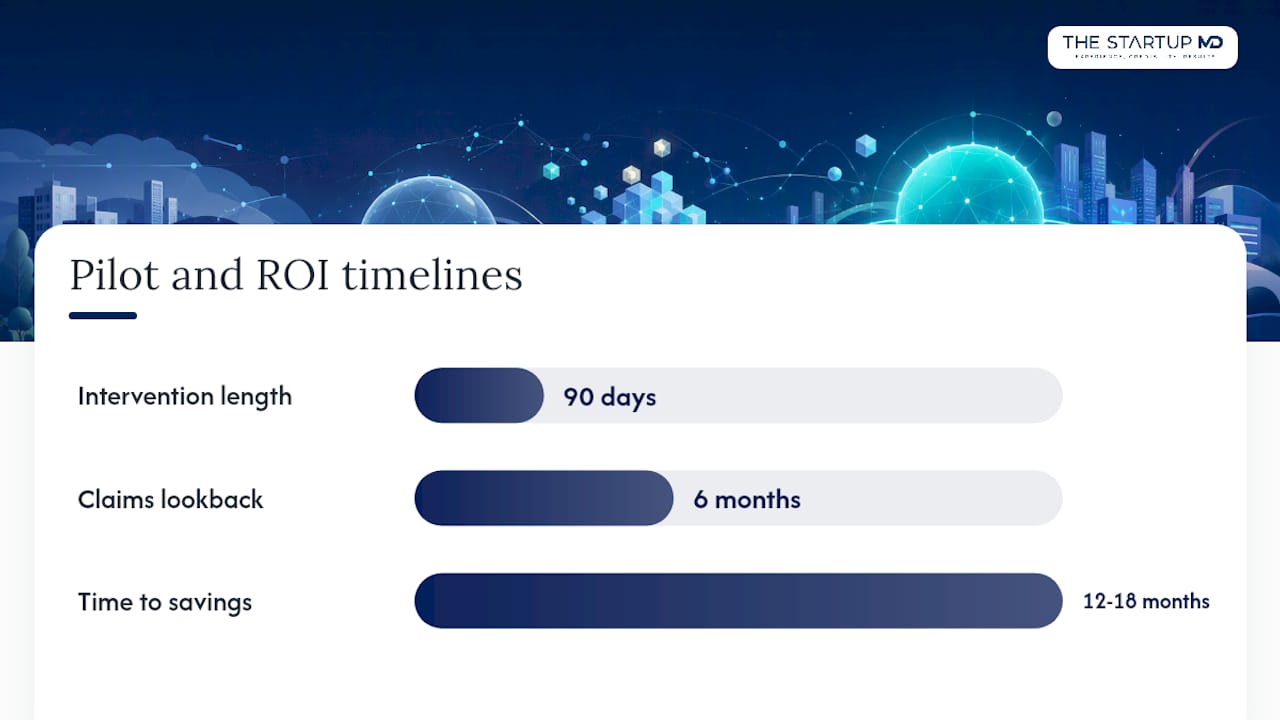
- Timeline. Plan for 90 days of intervention with a 6-month lookback on claims data. Shorter timelines produce process metrics only; cost signals require longer observation.
- Success thresholds. Define what "success" means before the pilot starts. A 10% reduction in 30-day readmissions for the intervention cohort, for example, is a concrete threshold that removes ambiguity at contract close.
- Data sources. Combine EHR-derived clinical data with claims data from the ACO's payer partners. Self-reported outcomes alone will not satisfy ACO finance teams.
ROI and shared-savings modeling:
Present conservative, mid-case, and optimistic scenarios. ACO CFOs are trained to discount vendor projections, so anchoring your base case to conservative assumptions builds more credibility than a single optimistic number. Show the timeline to savings explicitly: most ACOs will not see shared savings distributions until 12–18 months after the performance year closes, so your model must account for that lag.
Pro Tip: Combine a 12-month claims lookback with short-term process metrics (adherence rates, visit avoidance, alert-to-action rates) in your pilot design. The claims data provides financial credibility; the process metrics give the ACO early signals before the annual settlement cycle. This combination, described in Health Catalyst's ACO technology guidance, reduces disputes at contract close and accelerates executive buy-in.
Legal, reimbursement, and contracting realities for ACO vendors
The regulatory structure of CMS innovation models creates constraints that are not obvious from the outside. Getting these wrong delays deals by months.
Clinical accountability and billing partnerships:
Milliman's analysis of CMMI model design principles makes clear that clinical accountability in CMS models typically must remain with a Part B–billing clinical entity. Technology vendors cannot simply contract directly with an ACO and assume they are participating in the model. You need a clinical partner, a physician group or health system that holds the billing relationship, to serve as the accountable entity. Structure your partnership agreements accordingly before you approach the ACO's contracting team.
Telehealth and RPM reimbursement nuances:
CMS telehealth reimbursement flexibilities have evolved significantly since the COVID public health emergency. Within ACO structures, billing for telehealth and RPM services depends on the specific model, the originating site rules, and whether applicable waivers are in effect. Confirm current billing eligibility with your clinical partner before building reimbursement assumptions into your ROI model.
Contracting non-negotiables:
- Data ownership. Specify in writing who owns the data generated during the engagement, including derived analytics and population-level insights. ACOs will not accept ambiguity here.
- PHI and HIPAA responsibilities. Define Business Associate Agreement scope, breach notification timelines, and subcontractor obligations explicitly.
- Performance-based payment clauses. If you offer a shared-savings payment structure, define the calculation methodology, the audit rights, and the dispute resolution process before signing.
- Pilot exit criteria. Both parties need a clear, pre-agreed definition of what constitutes pilot failure and what happens to the data if the engagement ends.
- Indemnity and liability. ACOs carry significant regulatory exposure. Vendors who cannot clearly delineate their liability boundary create procurement risk.
Key regulatory signal: The Bipartisan Policy Center's CMS letter highlights that limited reimbursement clarity remains one of the top barriers to digital health adoption in ACOs, particularly for rural and low-income populations. If your product's reimbursement pathway is unclear, resolve that before the ACO's legal team does.
Does your product meet the technical bar ACOs expect?
ACO IT and data teams have become more sophisticated. A product that cannot pass a basic interoperability review will not reach the pilot stage.
Integration and interoperability checklist:
- FHIR API support. Confirm your product supports HL7 FHIR R4 at minimum. Bulk FHIR capability for population-level data exchange is increasingly expected for quality measure reporting.
- Claims data ingestion. Your product should be able to ingest claims feeds from the ACO's payer partners, not just EHR data. Risk stratification built on clinical data alone misses a significant portion of the utilization signal.
- Identity matching. Robust patient matching across data sources (EHR, claims, patient-reported) is a prerequisite for accurate attribution and outcome measurement.
- Quality measure alignment. Map your reporting outputs to specific CMS measure specifications. Generic outcome reports do not satisfy ACO quality reporting requirements.
- Data latency SLAs. Define how frequently data refreshes. ACOs need timely data to act on risk signals; weekly or monthly refreshes are often insufficient for high-risk patient management.
- Role-based access and audit logging. Care managers, physicians, and administrators need different data views. Audit logs are required for HIPAA compliance and ACO governance.
- Training and onboarding plan. Clinician adoption is the most common failure point in ACO digital health deployments. A structured onboarding plan with defined competency milestones is not optional.
The AMA, AHIP, and NAACOS joint guidance on data sharing is explicit: interoperable data ecosystems, timely and actionable data, and transparent data derivation methods are the foundation of trust in value-based care partnerships. If your methodology for deriving risk scores or quality metrics is opaque, ACO clinical leaders will not trust the outputs regardless of how accurate they are.
Pro Tip: Prepare a one-page data provenance document before your first technical review. It should describe exactly how each metric is calculated, which data sources feed it, and how you handle missing or conflicting data. This level of transparency, recommended by the AMA/NAACOS coalition, is rare among vendors and immediately differentiates you in a procurement process.
Your step-by-step GTM playbook for ACO adoption
Getting from initial outreach to a signed pilot agreement requires navigating a multi-stakeholder organization with competing priorities. Here is the sequence that works.
Step 1: Map the decision-making structure.
Every ACO has a different governance model, but the core decision-makers are consistent: the ACO executive director or CEO (budget authority), the medical director (clinical credibility gate), the care management director (operational champion), the IT director (integration approval), and the contracting or legal team (agreement execution). Identify all five before your first meeting. A structured medical advisory board that includes ACO-experienced physicians can accelerate your credibility with the medical director significantly.
Step 2: Secure an executive sponsor first.
Do not start with IT or care management. Start with the executive director or medical director. An executive sponsor who understands the shared-savings upside will pull the rest of the organization toward a pilot. Without one, your deal will stall in committee.
Step 3: Frame the first conversation around clinical ROI, not features.
Lead with the specific quality measures or cost drivers the ACO is underperforming on. Reference their CMS performance data. Then show how your product addresses that specific gap. This is digital health market entry strategy at its most practical: the ACO's problem first, your solution second.
Step 4: Propose a structured pilot.
Use the pilot template from the KPI section above. Specify population, timeline, success thresholds, and data requirements in a one-page pilot proposal. Offer two contracting options: a fixed-fee pilot or a shared-savings arrangement where your fee is partially contingent on measured outcomes.
Step 5: Address contracting and data terms in parallel.
Do not wait for pilot success to begin contracting conversations. Start the data agreement and BAA process during the pilot design phase. Delays in legal review are the most common reason signed pilots slip by a quarter or more.
Step 6: Define scale-up milestones before the pilot ends.
Agree in writing on what a successful pilot result means for expansion. If the pilot hits its thresholds, what is the timeline to full deployment? What additional contracting is required? Leaving this undefined means renegotiating from scratch after a successful pilot, which resets the sales cycle.
- Contracting options to offer: SaaS subscription, fee-for-service augmentation (per-patient-per-month), or shared-savings pilot with a performance floor.
- Scale-up triggers: Pre-define the metric thresholds that automatically trigger an expansion conversation.
- Resource allocation: Specify who from your team and the ACO's team is responsible for each implementation milestone.
Pro Tip: Fractional CMO involvement at the pilot design stage changes the procurement dynamic. A physician executive who can speak to clinical workflow, quality measure specifications, and shared-savings mechanics in the same conversation compresses the trust-building timeline. The clinical advisory scope that The StartupMD provides is specifically designed for this inflection point.
What actually works when positioning for ACOs
The most common failure pattern is not a bad product. It is a product positioned around a clinical outcome that the ACO cannot connect to its financial performance. A remote monitoring tool that reduces A1c levels is clinically valuable. But if the ACO cannot see a direct line from that A1c reduction to a shared-savings distribution, the procurement committee will table it.
The second failure pattern is data opacity. ACO medical directors are increasingly sophisticated about how risk scores are derived and how quality metrics are calculated. Vendors who cannot explain their methodology in plain clinical terms lose credibility fast, regardless of how accurate their models are. The AMA/NAACOS coalition's emphasis on transparent data derivation is not a compliance checkbox. It is a trust signal that separates vendors who understand value-based care from those who are selling into it without that understanding.
The third pattern is underestimating the clinical workflow barrier. Digital health adoption in ACOs stalls when tools require clinicians to leave their existing workflows. The product that wins is not always the most sophisticated one. It is the one that fits where clinicians already work and delivers a signal they can act on in the time they have.
Fractional CMO involvement changes all three dynamics. A physician executive embedded in your product and GTM strategy can validate clinical claims, translate product value into shared-savings language, and identify workflow integration gaps before they become pilot failures. That is the gap The StartupMD is built to close for digital health companies entering ACO markets.
The StartupMD accelerates your ACO market entry
Positioning a digital health product for ACOs requires clinical credibility, financial fluency, and regulatory precision simultaneously. That is a rare combination for most product teams to hold internally.
The StartupMD provides fractional Chief Medical Officer services, pilot design support, and contracting strategy specifically for healthcare SaaS companies entering value-based care markets. Paul Bergeron, MD, MBA brings over 25 years of combined medical and business experience to the exact inflection points where ACO deals are won or lost: the first medical director conversation, the pilot KPI negotiation, and the data governance review.
If your product is ready for ACO pilots but your team lacks the clinical executive presence to move procurement forward, that is a solvable problem. Review The StartupMD's healthcare SaaS go-to-market strategy services and book a consultation to discuss your ACO positioning and pilot design.
Sources
The recommendations in this guide draw on official CMS program documentation, coalition guidance from major industry associations, and policy analysis from nonpartisan research organizations.
- ACO REACH Model | CMS
- Succeeding in value-based care: Best practices for data sharing | American Medical Association
- NAACOS Comments on CMS Draft FHIR dQMs