

Start onboarding the moment a provider signs their contract. Every day you wait is a day of lost billing capacity. The full provider onboarding process, from zero-day initiation through first paid claim, can take several weeks to several months under ideal conditions. Miss the starting gun and that window extends further.
Three immediate actions, in priority order:
- Collect all required documents at contract signing using a validated digital intake form.
- Create or claim the provider's CAQH ProView profile and begin attestation.
- Submit Medicare PECOS, applicable state Medicaid applications, and commercial payer packets in parallel, once CAQH is attested.
The build-vs-hire decision is straightforward: if your team has no dedicated credentialing or revenue cycle staff, hire fractional expertise before the first provider signs. The cost of a 60-day billing gap almost always exceeds the cost of outside help.
Table of Contents
- Why provider onboarding determines your startup's revenue trajectory
- Zero-day checklist: what to collect and submit at contract signing
- Onboarding governance: who owns what and when
- Why data cleanliness and sequencing predict onboarding success
- Payer enrollment and credentialing: steps, registries, and realistic timelines
- Technology and templates that cut cycle time
- KPIs to track and how to fix the most common failures
- Sample 0–90 day timeline from contract signature to first patient encounter
- Build, buy, or hire fractional: the executive decision guide
- Key Takeaways
- The operational gap most founders miss
- The StartupMD can accelerate your provider onboarding program
- Authoritative U.S. sources and further reading
Why provider onboarding determines your startup's revenue trajectory
Onboarding is not an HR task. It is the operational gate between a signed provider and a billable encounter. For a healthcare SaaS startup, that gate controls your go-to-market timeline, your pilot success metrics, and your cash flow.

The compliance exposure is equally real. Mishandled Medicare or Medicaid enrollment, missing NPI-to-TIN linkages, or billing before receiving written effective-date confirmation from a payer can trigger permanent claim denials. Those denials are not always recoverable.
Three outcomes you must protect:
- Revenue: Billing gaps of many weeks to several months can compress your runway and distort your unit economics.
- Compliance: Medicare and Medicaid rules require correct enrollment before any claim submission. Errors here carry financial and legal consequences.
- Provider experience: Clinicians who cannot see patients or access systems in their first weeks disengage fast, which slows product adoption and threatens pilot retention. This is one of the common healthtech go-to-market mistakes founders make when they underestimate operational readiness.
Zero-day checklist: what to collect and submit at contract signing
The most common cause of onboarding delay is incomplete documentation discovered weeks after the process starts. Collect everything on day zero.
Required documents:
- Curriculum vitae with no unexplained employment gaps
- Current state medical license(s) for every state of practice
- DEA registration and any applicable state Controlled Dangerous Substance (CDS) certificates
- Malpractice insurance declarations page (current policy, with retroactive date)
- W-9 with Tax Identification Number (TIN) matching payroll records exactly
- NPI confirmation (Type 1 individual NPI from NPPES)
- Government-issued photo ID
- CAQH ProView authorization and login credentials
Immediate submissions:
- Create or claim the CAQH ProView profile; begin attestation before any commercial payer application
- Submit Medicare PECOS (Form 855I) as early as possible
- File state Medicaid applications for each relevant state simultaneously
- Batch commercial payer applications once CAQH attestation is complete
Pro Tip: Use a digital intake form with built-in validation rules and e-signature via DocuSign. This prevents the most common CAQH and NPPES mismatches (address formatting, middle initials, suite numbers) before they reach a payer's desk. A standardized digital onboarding packet with validation rules reduces rework and gives every team member real-time visibility.
Onboarding governance: who owns what and when
Founders frequently mislabel onboarding as a credentialing task. The real failure point is misaligned administrative tracks across HR, IT, legal, and revenue cycle management. Formalizing a governance body with a written charter and RACI prevents handoff failures.
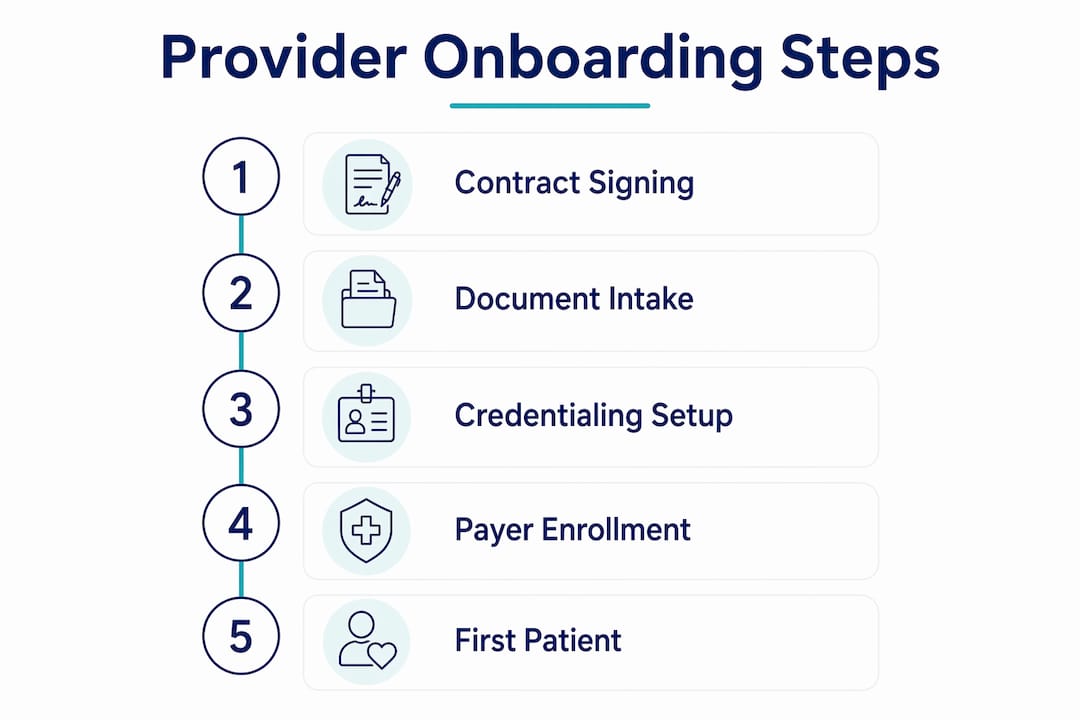
Recommended governance body: Medical leadership, credentialing coordinator, payer enrollment specialist, HR, IT/security, RCM lead, and legal/compliance.
| Phase | Responsible | Accountable | Consulted | Informed |
|---|---|---|---|---|
| NPI/data setup | Credentialing | CMO/Medical Director | IT, RCM | HR, Legal |
| Payer enrollment | Enrollment Specialist | RCM Lead | Legal | CMO, HR |
| Credentialing | Credentialing Coordinator | CMO | Medical Staff | HR, IT |
| Contracting | Legal | CEO/COO | RCM | Credentialing |
| Payer activation | RCM Lead | CFO | Enrollment | All teams |
Meet weekly during active onboarding. Set SLAs for internal handoffs within a few days and a clear escalation path when a payer goes silent beyond about two weeks. For startups building out their clinical governance structure, structuring a medical advisory board early gives you the credentialing oversight capacity this model requires.
Why data cleanliness and sequencing predict onboarding success
Clean data sequencing, not tools alone, is the variable that separates a 45-day activation from a 6-month stall. Consistent NPI, taxonomy, and W-9 information across every system prevents application rejections and clock resets.
Non-negotiable data alignment rules:
- NPI (Type 1) in NPPES must match exactly what appears in CAQH ProView, PECOS, and your practice management or EMR system.
- Taxonomy code must reflect the provider's primary specialty and match across all submissions.
- W-9 TIN must match payroll records and the group NPI (Type 2) billing entity.
- Legal name, date of birth, and SSN must be identical across CAQH, PECOS, and state Medicaid portals. A single character mismatch can cause an application to be withdrawn and require full resubmission.
Sequencing constraint: CAQH ProView must be fully attested before you submit any commercial payer application. Submitting before attestation causes immediate rejection or stalling and restarts the review clock.
Pro Tip: Before any submission, run a reconciliation audit: compare the provider's legal name, address (including suite formatting), middle initial, and TIN across NPPES, CAQH, your payroll system, and your PM/EMR. Specialty practices can also benefit from reviewing lab testing and data workflow alignment as part of their broader data hygiene process.
Payer enrollment and credentialing: steps, registries, and realistic timelines
The onboarding lifecycle runs through five dependent phases: NPI/data setup, enrollment, credentialing, contracting, and payer activation. Credentialing is the binding constraint. Everything else must synchronize to that milestone.
Operational flow:
- Confirm NPPES NPI registration is active and taxonomy is correct.
- Complete and attest CAQH ProView.
- Submit Medicare PECOS (Form 855I) with all supporting documentation.
- File state Medicaid applications for each applicable state.
- Submit commercial payer applications in parallel, using CAQH as the data source.
- Track all applications weekly; respond to deficiency notices within 24 hours.
| Payer Type | Typical Timeline | Key Registry |
|---|---|---|
| Medicare | 30–90 days | CMS PECOS |
| Commercial payers | 45–120 days | CAQH ProView |
| Medicaid (state-dependent) | 60–120+ days | State Medicaid portals / NPPES |
Contact each payer every 7–10 business days to confirm application status and document every interaction. Billing before receiving written effective-date confirmation from each payer risks permanent denial, even if credentialing is approved.
Technology and templates that cut cycle time
A digital-first approach to the provider enrollment process reduces manual rework and gives your team real-time visibility across all active applications.
Priority tool categories:
- Centralized intake portal with SSO: one submission point for all provider documents, with role-based access for credentialing, HR, and RCM.
- E-signature platform (DocuSign): speeds policy acknowledgments, HIPAA agreements, and payer authorization forms without printing or scanning.
- CAQH and NPPES API integrations: where available, pull verified data directly into your PM/EMR to eliminate re-keying errors.
- Robotic process automation (RPA) for status checks: automates weekly payer follow-up logging and flags applications approaching SLA deadlines.
- Standardized onboarding packet templates: pre-built per provider type (physician, Advanced Practice Provider, locum) with built-in validation rules and a defined workflow SLA.
Invest in integrations only after your manual process is documented and repeatable. Automating a broken workflow accelerates the errors. For broader health SaaS customer success outcomes, onboarding technology choices should align with your product's provider-facing workflows from day one.
KPIs to track and how to fix the most common failures
Track these five metrics from day one:
- Days to CAQH attestation (target: within 5 business days of contract signing)
- Days to first payer effective date (benchmark against your payer mix's typical windows)
- Time to first paid claim (the single most important revenue metric)
- Application rejection rate (anything above 10% signals a data or sequencing problem)
- Denial rate attributable to onboarding errors (tracks downstream billing impact)
Common failure modes and remediation:
- CAQH/NPPES mismatch: Run a data reconciliation audit immediately; correct at the source before resubmitting.
- Incomplete CV or work-history gaps: Return to the provider for a written explanation before any submission; payers will flag this.
- Submitting commercial applications before CAQH attestation: Withdraw and resubmit after attestation is confirmed.
- Delayed payer follow-up: Assign a single owner per payer relationship; document every contact in a shared tracker.
When a failure occurs, update your RACI to close the gap. The remediation is only complete when the process change is documented and the responsible owner is reassigned.
Sample 0–90 day timeline from contract signature to first patient encounter
| Milestone | Timing | Owner |
|---|---|---|
| Document intake complete; CAQH created/claimed | Day 0 | Credentialing |
| PECOS and state Medicaid applications submitted | Days 1–3 | Enrollment Specialist |
| CAQH ProView fully attested | Days 3–5 | Credentialing |
| Commercial payer applications submitted (parallel) | Days 5–7 | Enrollment Specialist |
| PM/EMR provider profile configured; scheduling templates live | Week 2 | IT/RCM |
| Active payer follow-up cadence begins (every 7–10 business days) | Week 2 | Enrollment Specialist |
| Deficiency responses submitted within 24 hours | Ongoing | Enrollment Specialist |
| Medicare effective date confirmed (target range: days 30–90) | Weeks 4–8 | RCM Lead |
| Commercial effective dates confirmed (target range: days 45–120) | Weeks 6–12 | RCM Lead |
| First patient encounter scheduled | Upon first payer activation | Scheduling/RCM |
| First paid claim received | Following first encounter | RCM |
Align your GTM strategy and pilot launch dates to this timeline. Promising a provider go-live in 30 days when payer enrollment takes 90 is one of the most damaging commitments a health SaaS founder can make.
Build, buy, or hire fractional: the executive decision guide
The right operational model depends on four variables: provider volume, internal bandwidth, risk tolerance for billing gaps, and your need for payer-relations escalation capability.
Keep it in-house when:
- You are onboarding a small, stable roster (fewer than five providers per quarter).
- You have a dedicated credentialing coordinator and an RCM lead already in place.
- Your payer mix is limited to a few commercial plans and Medicare, with no complex multi-state Medicaid enrollment.
Outsource or hire fractional expertise when:
- You are scaling quickly across multiple states or specialties.
- Your team lacks credentialing or payer enrollment experience and the learning curve will cost you billing days.
- Time-to-revenue is a fundraising or pilot-success constraint. A fractional clinical advisory engagement can stand up governance, sequencing, and payer-relations protocols in weeks rather than months.
- You need payer escalation capability, meaning direct relationships with provider relations contacts at major payers, that an internal hire cannot build quickly.
The decision is not permanent. Many startups begin with fractional support to build the playbook, then transition to an internal hire once the process is documented and repeatable.
Key Takeaways
A well-executed provider onboarding process requires zero-day initiation, CAQH-first sequencing, cross-functional governance, and relentless payer follow-up to convert a signed contract into a billable provider within 60–120 days.
| Point | Details |
|---|---|
| Start on day zero | Initiate document intake, CAQH creation, and PECOS submission at contract signing to avoid 90–120 day billing gaps. |
| CAQH attestation gates everything | Commercial payer applications submitted before CAQH attestation are rejected; attest within 5 business days. |
| Governance prevents handoff failures | Assign a RACI across HR, IT, credentialing, RCM, and legal with weekly cadence and 48-hour handoff SLAs. |
| Track five KPIs from day one | Monitor days-to-CAQH, days-to-first-effective-date, time-to-first-paid-claim, rejection rate, and onboarding-related denial rate. |
| The StartupMD accelerates the process | Fractional CMO advisory from The StartupMD builds onboarding governance and payer-enrollment playbooks for health SaaS startups where internal bandwidth is the constraint. |
The operational gap most founders miss
Provider onboarding is treated as a checklist when it should be treated as a program. The difference matters enormously in practice. A checklist gets completed once. A program has an owner, a governance structure, defined SLAs, and a feedback loop that improves with every new provider.
The most consistent failure pattern is not missing a document or choosing the wrong tool. It is the absence of a single accountable owner who sits across HR, credentialing, IT, and RCM simultaneously. When no one owns the full lifecycle, each team completes its piece and assumes someone else is managing the handoff. That assumption is where 60-day billing gaps are born.
Data sequencing is the other underestimated variable. Founders invest in credentialing software and still stall for months because the NPI in NPPES does not match the taxonomy in CAQH, or the W-9 TIN differs by one digit from the payroll record. No tool fixes a data problem that was never caught at intake. The governance model and the zero-day data audit are the controls that matter most, and they cost nothing but discipline.
Treat onboarding as a revenue-critical operational program from the first provider conversation. Assign an owner before the contract is signed.
The StartupMD can accelerate your provider onboarding program
Most health SaaS startups do not have a credentialing lead, a payer enrollment specialist, and an RCM strategist on staff when they sign their first provider. That gap costs real revenue.
The StartupMD provides fractional CMO and clinical advisory services specifically designed for healthcare SaaS founders navigating exactly this challenge. From designing your onboarding governance model and RACI to building your payer-enrollment playbook and sequencing your CAQH, PECOS, and NPPES workflows, the engagement is scoped to your stage and your payer mix. Clients get a documented, repeatable process they can hand off to an internal hire when the time is right. If your pilot timeline or fundraising milestone depends on getting providers billable fast, review The StartupMD's healthcare SaaS customer success services and book a consultation to assess where your onboarding program stands today.
Authoritative U.S. sources and further reading
Registries and payer resources:
- CAQH ProView — Universal provider data source for commercial payer enrollment
- CMS PECOS — Medicare enrollment for individuals and organizations
- NPPES NPI Registry — National Provider Identifier lookup and management
- DocuSign — E-signature for onboarding packets and payer authorization forms
Research sources used in this article:
- PractiSynergy: How to Onboard New Providers Without Billing Gaps
- Verisys: Provider Onboarding Best Practices
- VeracityEG: The Full Provider Onboarding Lifecycle
- ProEnrollment: Provider Onboarding and Credentialing Guide
Deeper reading from The StartupMD:
- Health SaaS onboarding for founders
- How to develop a physician engagement strategy
- Healthcare startup regulatory basics for founders