

Clinical advisory scope is defined as the specific roles, time commitments, and deliverables that clinical advisors provide to healthtech and medtech startups to guide clinical strategy, regulatory navigation, and product development. Most founders underestimate how structured this engagement needs to be. A vague handshake agreement with an impressive physician produces little. A well-scoped advisory relationship, by contrast, can improve product development efficiency by up to 30% and meaningfully accelerate your path to regulatory approval. Thestartupmd works with healthtech founders daily on exactly this problem: getting the scope right before the relationship starts.
What is the startup clinical advisory scope?
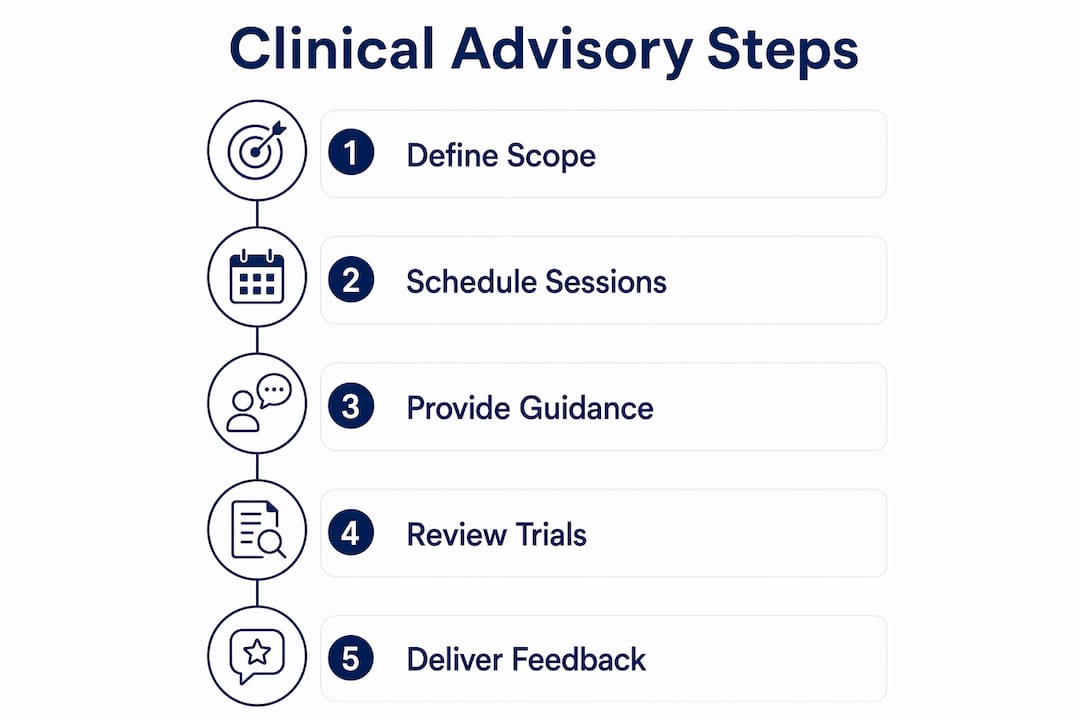
Clinical advisory scope, in the startup context, refers to the formal boundaries of what a clinical advisor is expected to do, how often, and with what accountability. The industry term most practitioners use is "clinical advisory engagement," and it covers everything from product strategy input to regulatory consulting to stakeholder introductions. Scope is not a soft concept. It is the contract between your startup and the physician or clinician you bring on board.
The scope of clinical advisory work typically falls into three categories. First, there is product strategy guidance, where the advisor reviews clinical workflows, identifies gaps in your solution, and helps you align the product with how care is actually delivered. Second, there is regulatory navigation, where the advisor helps you understand FDA pathways, clinical evidence requirements, and how to design studies that will hold up to scrutiny. Third, there is stakeholder engagement, where the advisor uses their institutional relationships to open doors with health systems, payers, and clinical networks.

Clinical advisors assist in designing feasible clinical trials aligned with practice standards. That alignment is what separates a trial that gets approved from one that gets redesigned at significant cost. Founders who skip this step often discover the gap only after spending months on a flawed protocol.
Pro Tip: Define the scope in writing before the first advisory session. A one-page scope memo prevents 90% of the misalignment that derails advisory relationships later.
What are the roles and responsibilities within clinical advisory services?
The roles inside a clinical advisory engagement are more specific than most founders expect. A physician advisor is not a generalist consultant who comments on everything. The most effective advisors operate within a defined specialty lane and contribute to a cross-functional advisory group that also includes regulatory, billing, and operational experts.
Core advisory roles include:
- Product strategy advisor. Reviews clinical workflows and validates that the product solves a real problem at the point of care.
- Trial design consultant. Provides input on study design, endpoints, and patient population criteria to align with FDA and payer expectations.
- Regulatory navigator. Guides the team through FDA 510(k), De Novo, or PMA pathways depending on device classification.
- Stakeholder connector. Introduces the startup to clinical department heads, ACO leaders, and health system procurement teams.
- Marketing validator. Reviews clinical claims in sales materials to protect the company from regulatory exposure.
Advisory boards differ from compliance consultants in one critical way: boards integrate clinical, regulatory, and billing perspectives into prioritized action plans for the CEO. A compliance consultant gives you a single-vertical opinion. An advisory board gives you a coordinated view across the functions that matter most to a healthtech startup.
Collaboration between clinical advisors and medical writers helps distill clinical feedback into executive summaries that drive decisions. This is a detail most founders overlook. The advisor's insight is only as useful as the team's ability to act on it.
How do time commitments and compensation structure advisory engagements?
Time and money are where most advisory relationships break down. Founders assume advisors are available on demand. Advisors assume the startup will respect their schedule. Neither assumption gets documented, and friction follows.
The standard commitment for a clinical advisor runs 2–8 hours per month, typically split between scheduled sessions and on-demand availability. Programs like the CHESS program (Clinicians for Healthcare Excellence and Startup Success) structure this as a 3-month engagement at $15,000, providing up to 8 hours of dedicated advisor access per month alongside weekly working sessions. That model works because it sets clear expectations from day one.
| Engagement type | Typical time commitment | Compensation model |
|---|---|---|
| Early-stage advisor | 2–4 hours/month | 0.25%–1.0% equity |
| Growth-stage advisor | 4–8 hours/month | 0.15%–0.60% equity or fee |
| Program-based (e.g., CHESS) | 8 hours/month + weekly sessions | $15,000 per 3-month term |
| Fractional CMO advisory | 10–20 hours/month | Monthly retainer fee |
Advisors typically receive between 0.2% and 1.0% equity, with idea-stage grants skewing toward 0.25%–1.0% and growth-stage grants closer to 0.15%–0.60%. Equity at the idea stage reflects higher risk and lower liquidity. Growth-stage grants reflect a more defined role with measurable deliverables.
Pro Tip: Specify in the advisor agreement whether availability is scheduled, on-demand, or both. Include expected response times for email and async requests. This single clause prevents most advisor relationship breakdowns.
What measurable impacts do clinical advisory services have on startup success?
The return on a well-structured clinical advisory engagement shows up in three places: product development speed, regulatory outcomes, and investor confidence.
Engaging clinical advisors with domain knowledge can improve product development efficiency by up to 30%. That figure reflects fewer redesign cycles, faster validation, and earlier identification of clinical workflow mismatches. A physician advisor who has spent 20 years in the specialty your product targets will spot a fatal flaw in your UX in the first session.
"Clinical advisors bring unique perspectives on patient care pathways that enable startups to tailor solutions closely to clinical realities. Without that perspective, founders build for an idealized workflow that does not exist in practice."
The regulatory impact is equally significant. Advisors who understand FDA expectations help founders choose the right submission pathway, design studies with appropriate endpoints, and avoid the common mistake of generating clinical evidence that does not meet the evidentiary standard for the intended claim. A failed submission costs months and significant capital.
Investor confidence is the third lever. Advisors with verifiable institutional affiliations signal to VCs that the clinical thesis has been stress-tested. Founders who can point to a named, credentialed advisor with a defined scope and documented outputs are far more credible in a pitch than those who list impressive names with no accountability structure. A strong investor pitch includes the advisory board as evidence of clinical validation, not decoration.
Key benefits of structured clinical advisory engagement:
- Faster identification of product-market fit within clinical workflows
- Reduced risk of costly protocol redesigns before FDA submission
- Stronger credibility with enterprise health system buyers
- More defensible clinical claims in marketing and sales materials
- Access to clinical networks that accelerate pilot site recruitment
How should startups structure and evolve their clinical advisory relationships?
Structure is what separates a productive advisory board from a list of names on a website. The structure starts with a written charter and evolves as the startup scales.
- Draft a formal advisory agreement. Include scope of work, time commitment, compensation, confidentiality terms, and IP ownership. Ambiguity in any of these areas creates legal and relational risk.
- Define deliverables, not just availability. Specify what the advisor will produce: a clinical evidence review, a regulatory pathway memo, a stakeholder introduction list. Deliverables create accountability.
- Build a cross-functional group. A single physician advisor is a starting point. A mature advisory structure integrates clinical, regulatory, billing, and operational perspectives. Successful advisory structures evolve from narrow memos to ongoing cross-functional groups as startups scale.
- Schedule regular touchpoints. Monthly or quarterly advisory meetings with documented outputs keep the relationship productive. Ad hoc availability alone produces inconsistent results.
- Track and document outputs. Meeting notes, recommendations, and decisions tied to advisory input create a verifiable output trail. This matters for investors, regulators, and future board members.
A high-impact advisory board requires verifiable clinical and academic credentials, a defined charter, and documented outputs like peer-reviewed publications or regulatory submissions. A board without these elements is a marketing asset at best and a liability at worst.
The distinction between advisory board types matters. A clinical advisory board provides evidence-based guidance on product, trials, and regulatory strategy. A marketing advisory board provides brand and messaging input. A compliance consultant provides single-vertical legal or regulatory opinions. Conflating these roles produces a board that does everything superficially and nothing well.
| Advisory type | Primary function | Key output |
|---|---|---|
| Clinical advisory board | Product, trial, and regulatory guidance | Evidence memos, protocol input |
| Marketing advisory board | Brand positioning and messaging | Campaign strategy, content review |
| Compliance consultant | Regulatory and legal opinions | Compliance reports, risk assessments |
Learning how to structure a medical advisory board before you recruit your first advisor saves significant time and prevents the most common structural mistakes.
Key Takeaways
A well-scoped clinical advisory engagement is the single most cost-effective investment a healthtech startup can make before its first regulatory submission or enterprise sales conversation.
| Point | Details |
|---|---|
| Define scope in writing | A formal agreement with deliverables, time commitments, and IP terms prevents most advisory failures. |
| Expect 2–8 hours per month | Standard advisory commitments run 2–8 hours monthly; programs like CHESS offer structured 8-hour access. |
| Equity ranges from 0.2% to 1.0% | Idea-stage advisors command higher equity; growth-stage advisors receive less as risk decreases. |
| Advisors improve development efficiency | Domain-matched clinical advisors can improve product development efficiency by up to 30%. |
| Evolve the structure as you scale | Start with a narrow scope memo and build toward a cross-functional advisory group over time. |
What I have learned about clinical advisory boards after 25 years
Most founders I work with make the same mistake. They recruit an impressive physician, give them a title, and assume the relationship will produce value on its own. It does not. The advisor gets busy. The founder stops reaching out. Six months later, the name is still on the website but the relationship is dormant.
The fix is not finding a better advisor. The fix is building a better structure before the first conversation. I have seen advisory boards with Nobel laureates produce nothing because there was no charter, no deliverables, and no accountability. I have also seen boards with community-based physicians produce clinical evidence that changed a company's regulatory trajectory, because the scope was clear and the relationship was managed.
Avoid marketing-only advisory boards. A legitimate board has a written charter, a defined scope, and a verifiable output trail. If your board cannot point to a specific recommendation that changed a product decision, it is not functioning as an advisory board. It is functioning as a logo.
The other pattern I see is founders who confuse clinical advisors with compliance consultants. They are not the same. A compliance consultant tells you what you cannot do. A clinical advisor tells you what you should do and why it will work clinically. You need both, but they serve different functions and should never be collapsed into a single role.
My honest recommendation: start with one well-scoped advisor in your core clinical domain. Get the agreement right. Document the outputs. Then expand the board as the startup's needs evolve. The physician-led startup success factors that actually move the needle are almost always structural, not relational.
— Paul
How Thestartupmd helps founders build effective clinical advisory structures
Healthtech founders who want to move faster on product development, regulatory strategy, and enterprise sales need more than a physician's name on a slide deck. They need a structured advisory engagement with clear scope, documented outputs, and a credible medical voice that opens doors.
Thestartupmd works with early-stage and growth-stage healthtech startups to design and manage clinical advisory engagements that produce measurable results. From drafting the initial scope agreement to recruiting domain-matched advisors and facilitating structured advisory sessions, the full service offering covers every stage of the advisory lifecycle. If your clinical advisory structure needs a reset, or if you are building one from scratch, this is the starting point.
FAQ
What is clinical advisory scope in a startup?
Clinical advisory scope defines the specific roles, time commitments, and deliverables a clinical advisor provides to a healthtech startup. It covers product strategy, regulatory navigation, trial design input, and stakeholder engagement.
How much equity do startup clinical advisors typically receive?
Advisors typically receive between 0.2% and 1.0% equity, with idea-stage grants ranging from 0.25%–1.0% and growth-stage grants closer to 0.15%–0.60%, depending on commitment and startup maturity.
How many hours per month does a clinical advisor commit?
Standard clinical advisory commitments run 2–8 hours per month, typically split between scheduled sessions and on-demand availability, with structured programs offering up to 8 hours of dedicated access monthly.
How do I set up a clinical advisory board for my healthtech startup?
Start with a written advisory agreement that defines scope, deliverables, time commitment, confidentiality, and IP terms. Recruit advisors with verifiable credentials in your core clinical domain, then expand to a cross-functional group as the startup scales.
What is the difference between a clinical advisory board and a compliance consultant?
A clinical advisory board integrates clinical, regulatory, and billing perspectives into prioritized recommendations for the CEO. A compliance consultant provides single-vertical legal or regulatory opinions. Both serve distinct functions and should not be conflated.
Recommended
- How to Structure a Healthcare Startup Medical Advisory Board
- Physician-Led Startup Success Factors: Real Examples
- Healthcare Startup Investor Pitch Checklist for Founders
- Start Up MD – The Startup MD specializes in elevating small to mid-size healthcare startups by offering a comprehensive suite of services, including an integrated digital marketing strategy with targeted lead generation, engaging content creation (long and short-form videos), and custom website design.