

Why clinical study design determines your startup's future
Clinical study design is the structured process of defining what you want to prove, how you will prove it, and what evidence will satisfy regulators, investors, and clinicians. For healthcare startups, getting this right is not optional. A poorly designed trial wastes capital, delays FDA clearance, and can permanently damage your scientific credibility.
The core elements every founder must understand:
- Primary research question: The single, measurable question your trial is built to answer
- Endpoints: Pre-specified outcomes that are clinically relevant, reproducible, and defensible
- Statistical planning: Power calculations, significance thresholds, and sample size rationale
- Regulatory alignment: FDA and IRB requirements woven in from day one, not retrofitted later
- Iterative design: Conceptual decisions made early, implementation details refined through collaboration
With 25+ years spanning clinical practice and venture-backed startups, the approach at Thestartupmd is grounded in NIH fundamentals and FDA guidance. A well-designed study does not just satisfy science. It opens enterprise doors and accelerates fundraising.
Table of Contents
- How do you turn a clinical concept into a testable research question?
- What are the two phases of clinical trial design every startup must complete?
- What does the FDA actually require from your trial design?
- Why your statistician needs to be in the room before you finalize anything
- How do you balance scientific ambition with startup resource constraints?
- Which study design fits your startup's stage and scientific question?
- How do you calculate sample size when your budget is the constraint?
- What do IRB approval and ethical compliance actually require from you?
- How should you budget for a clinical study when resources are limited?
- What recruitment strategies actually work in early-stage trials?
- What data management and quality control protocols protect your trial?
- Key Takeaways
- Ready to build a trial your investors and the FDA will both respect?
How do you turn a clinical concept into a testable research question?
Every trial starts with a vague idea. "Our device improves patient outcomes." That is not a research question. It is a hope.
A testable hypothesis requires specificity: the population, the intervention, the comparator, the outcome, and the timeframe. This is the PICO framework, and skipping it is where most early-stage protocols fall apart.
Key steps in this transition:
- Narrow the population: Specify age range, diagnosis, severity, and exclusion criteria
- Define the intervention precisely: Dose, frequency, delivery method, and duration
- Choose a comparator: Standard of care, placebo, or active control
- Select a primary endpoint: One measurable outcome that answers the question
- Frame the hypothesis: Null, alternative, or estimation-based, depending on your regulatory goal
Pro Tip: Framing your hypothesis as an estimation problem rather than a binary yes/no can give you more flexibility in adaptive designs, which matters when your sample size is constrained.
What are the two phases of clinical trial design every startup must complete?
Good clinical trial design moves through two distinct phases, and confusing them is expensive.

Conceptual planning covers background, scientific rationale, population selection, endpoint hierarchy, and overarching statistical parameters. This is where you decide what you are studying and why. Errors here are the hardest to fix. Changing your primary endpoint after enrollment begins is a regulatory red flag.
Implementation translates those decisions into operational specifics:
- Sample size calculation with documented assumptions
- Interim monitoring rules and data review schedules
- Stopping criteria for efficacy, futility, or safety signals
- Simulation studies to stress-test design assumptions
The critical insight: sample size calculations must account for effect size, statistical power, significance level, and expected dropout. Each assumption needs a citation from published literature. Reviewers will ask.
What does the FDA actually require from your trial design?
FDA guidance on clinical trial design is specific. Founders who treat it as a checklist to complete at the end of development consistently run into trouble.
The FDA expects:
- A clear, valid comparison with a control group
- Well-defined, reproducible endpoints established before enrollment
- Adequate participant selection criteria that reflect the intended use population
- Bias minimization through randomization and blinding where feasible
- Continuous safety monitoring with pre-specified stopping rules
Key regulatory principle: Randomization prevents selection bias. Blinding prevents performance and detection bias. Both are required for any trial seeking FDA market authorization, and both must be described in your protocol before the first participant is enrolled.
Randomized controlled trials use computer-generated allocation sequences. Blinding can be single, double, or triple, with double-blinded designs standard for drug efficacy trials. Good Clinical Practice compliance is not aspirational. It is the floor.
Why your statistician needs to be in the room before you finalize anything
Most startups bring in a statistician to run the numbers after the protocol is written. That is backwards.
Early statistician involvement means exploring multiple design options before committing, understanding the operating characteristics of each, and identifying risks that are invisible to clinical teams working alone. A design that looks scientifically sound may be statistically underpowered or operationally unworkable.
What integrated collaboration produces:
- Balanced feasibility: a design your sites can actually execute
- Interpretability: results that answer the question cleanly
- Regulatory defensibility: a statistical analysis plan reviewers cannot challenge
- Risk awareness: identified failure modes before enrollment, not after
The medical advisory board you build should include biostatistical expertise alongside clinical leadership. These two functions need to speak the same language from the start.
How do you balance scientific ambition with startup resource constraints?
This is where most founders make their most costly mistake. Scientific objectives should drive design choices. When design convenience drives objectives, you get a flawed protocol.
The "fundraising trial problem" is real. Startups design studies to impress investors rather than answer scientific questions. The result is over-engineered inclusion criteria that produce a pristine but unrepresentative sample, reducing external validity and making the next trial harder to run.
Practical principles for resource-constrained design:
- Use the smallest viable sample that achieves adequate power
- Limit sites to what you can monitor well, not what looks impressive
- Keep your endpoint set tight. Every outcome measure must map to a scientific conclusion you will actually act on
- Avoid secondary endpoints that generate noise without informing decisions
- Align your primary endpoint directly with your regulatory claim
For MedTech startups specifically, the optimal design often means a focused primary endpoint, few sites, and a sample size calculated to the minimum needed for regulatory support. Lean is not weak. Lean is defensible.
Which study design fits your startup's stage and scientific question?
Clinical study designs fall into two broad categories: observational and experimental. Choosing correctly depends on your question, your stage, and your regulatory pathway.
Randomized Controlled Trials (RCTs): The gold standard for demonstrating efficacy. Participants are randomized to intervention or control, eliminating selection bias. RCTs are resource-intensive and typically appropriate for later-stage startups with a defined product and a clear regulatory submission target.
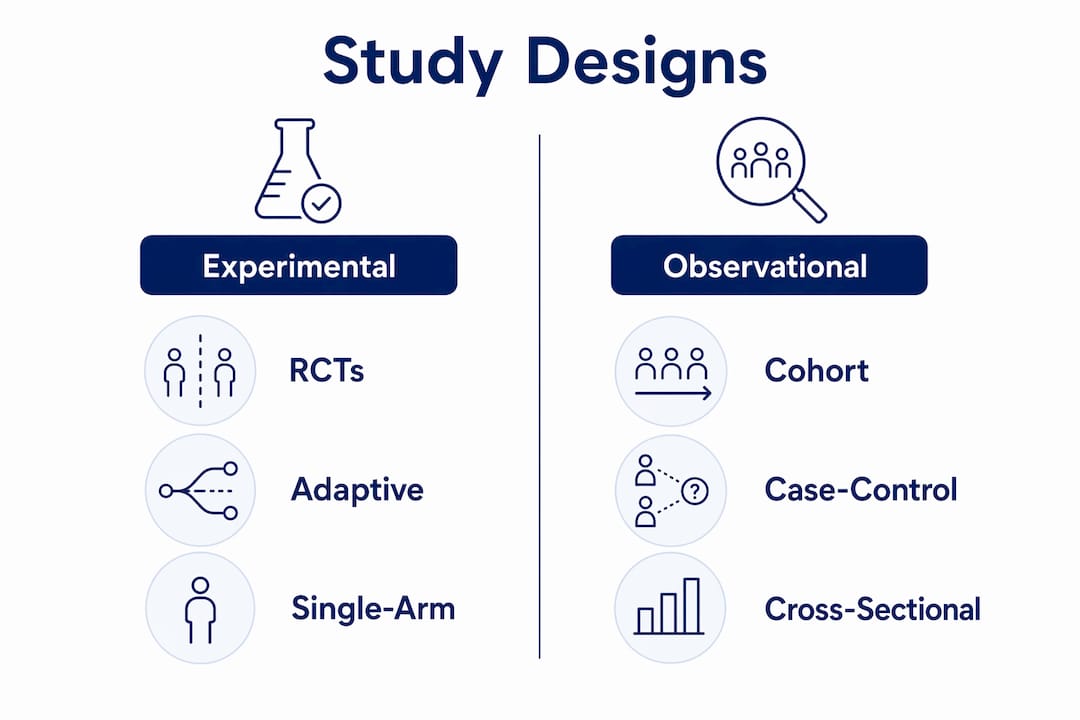
Observational studies: Hypothesis-generating rather than hypothesis-testing. Cohort, case-control, and cross-sectional designs are faster and cheaper. They are appropriate for early-stage startups building the evidence base before committing to a controlled trial. Use them to refine your hypothesis, not to prove efficacy.
Adaptive designs: Allow pre-specified modifications to the trial based on interim data, such as sample size re-estimation or dropping an arm. For startups with limited capital, adaptive designs can reduce the cost of a failed trial by building in decision points. They require more sophisticated statistical planning upfront, which reinforces the case for early statistician involvement.
Single-arm studies: Appropriate when a control group is ethically or practically impossible. Common in rare disease and device trials. The FDA accepts them under specific conditions, but the evidentiary bar for the primary endpoint is higher.
Understanding patient stratification within each design type helps you select the right population and avoid confounding that undermines your results.
How do you calculate sample size when your budget is the constraint?
Sample size is not a number you pick. It is a calculation with documented assumptions, and every assumption is a decision you will defend to the FDA, your IRB, and your investors.
The inputs:
- Effect size: The minimum clinically meaningful difference you expect to detect
- Statistical power: Conventionally 80% or 90%, meaning the probability of detecting a true effect
- Significance level: Typically alpha = 0.05
- Dropout rate: Add 10–15% to your calculated sample to account for attrition
For startups, the temptation is to inflate the expected effect size to reduce the required sample. Resist it. An underpowered trial that fails to reach significance is not a negative result. It is an uninformative result, and that is worse for your pipeline and your credibility.
Pro Tip: Run sensitivity analyses across a range of effect size assumptions. If your trial only works with an optimistic effect size, your design is fragile. Show investors the conservative scenario.
What do IRB approval and ethical compliance actually require from you?
Every clinical study involving human participants requires IRB review before enrollment begins. In the US, this is not negotiable under 21 CFR Part 56 and the Common Rule.
Your IRB submission must include:
- Full protocol with study design, endpoints, and statistical plan
- Informed consent documents written at an appropriate reading level
- Participant privacy and data confidentiality protections
- Risk-benefit analysis demonstrating that participant welfare is prioritized
- Investigator qualifications and site credentials
Research protocol development guidance consistently emphasizes that ethical considerations are not a separate workstream. They are embedded in every design decision, from inclusion criteria to stopping rules. IRB reviewers will scrutinize your consent process and your safety monitoring plan with the same rigor as your endpoints.
Central IRBs, such as WIRB-Copernicus Group or Advarra, can accelerate multi-site review timelines. For early-phase startup trials, a single-site IRB is often faster and sufficient.
How should you budget for a clinical study when resources are limited?
Clinical study budgets routinely exceed initial estimates. The categories founders most often underestimate:
- Site costs: Investigator fees, coordinator time, and facility overhead
- Regulatory affairs: FDA pre-submission meetings, IND preparation if required
- Data management: Electronic data capture (EDC) platform licensing and validation
- Monitoring: Clinical research associate visits, remote monitoring, and audit preparation
- Biostatistics: Statistical analysis plan development, interim analyses, and final report
- IRB fees: Initial review, amendments, and annual renewals
Build a 20–25% contingency into your total budget. Enrollment delays are the single most common driver of cost overruns, and they are almost universal in early-stage trials. A clinical advisory scope that includes budget modeling from the start prevents the painful mid-trial funding gap.
What recruitment strategies actually work in early-stage trials?
Recruitment is where well-designed trials fail operationally. The FDA estimates that a significant proportion of trials fail to meet enrollment targets on time, which extends timelines and burns capital.
Strategies that work for startups:
- Site selection based on patient volume: Choose sites with documented access to your target population, not sites that are geographically convenient
- Patient advocacy partnerships: Disease-specific foundations and advocacy groups can accelerate referrals and build trust
- Digital recruitment: Condition-specific online communities and social media targeting, compliant with IRB-approved recruitment materials
- Physician engagement: Referring clinicians need to understand the trial's value proposition. A physician engagement strategy built before enrollment opens shortens the ramp-up period
- Retention planning: Dropout is as damaging as slow enrollment. Minimize burden, maximize communication, and build follow-up visits into the protocol design
What data management and quality control protocols protect your trial?
Data integrity is what separates a publishable result from an FDA warning letter. Your data management plan must be in place before the first participant is enrolled.
Core requirements:
- Electronic Data Capture (EDC): Platforms such as REDCap, Medidata Rave, or Veeva Vault provide audit trails, access controls, and 21 CFR Part 11 compliance
- Data validation rules: Pre-programmed edit checks flag out-of-range values and missing data in real time
- Source data verification: Clinical research associates confirm that EDC entries match source documents at the site
- Data lock procedures: Defined process for freezing the database before unblinding and statistical analysis
- Quality management system: Standard operating procedures for protocol deviations, adverse event reporting, and corrective actions
Aidventure's data solutions offer startup-appropriate frameworks for integrating clinical trial data with broader analytics infrastructure. For startups running their first trial, the priority is a system that is auditable, not elaborate.
Key Takeaways
Sound startup clinical study design begins with a precise primary research question and builds every subsequent decision, from endpoints to budget, around that scientific anchor.
| Point | Details |
|---|---|
| Lead with the research question | Define your PICO framework before touching protocol structure or budget. |
| Separate conceptual from implementation | Errors in conceptual planning cannot be fixed after enrollment begins. |
| Involve statisticians early | Early collaboration prevents underpowered designs and costly redesigns. |
| Match design type to your stage | Observational studies build evidence; RCTs and adaptive designs prove it. |
| Budget for overruns | Build a 20–25% contingency; enrollment delays are nearly universal. |
Ready to build a trial your investors and the FDA will both respect?
Clinical study design is one of the highest-leverage decisions a healthcare startup makes. Get it right, and you have a fundable asset and a regulatory pathway. Get it wrong, and you are rebuilding from scratch after burning 18 months of runway.
Thestartupmd brings board-certified physician executive experience and C-suite startup leadership to this exact problem. Understanding what a CMO does in a healthcare startup is the first step toward knowing what kind of clinical leadership your trial actually needs. If your study design feels misaligned with your scientific goals or your fundraising timeline, that conversation is worth having.