

Startup CMO equity compensation is defined as the combination of base salary and a company ownership stake offered to a Chief Marketing Officer as part of their total pay package. The industry term for this structure is "equity compensation," and it applies across all startup stages, from pre-seed through pre-IPO. Getting this package right matters more in healthtech than in most sectors, because top marketing talent with clinical credibility is rare and expensive. A poorly structured offer loses candidates to better-capitalized competitors or pushes them toward pure cash roles. This article breaks down the components, benchmarks, valuation methods, and negotiation tactics you need to build a CMO package that actually works.
What components make up startup CMO equity compensation packages?
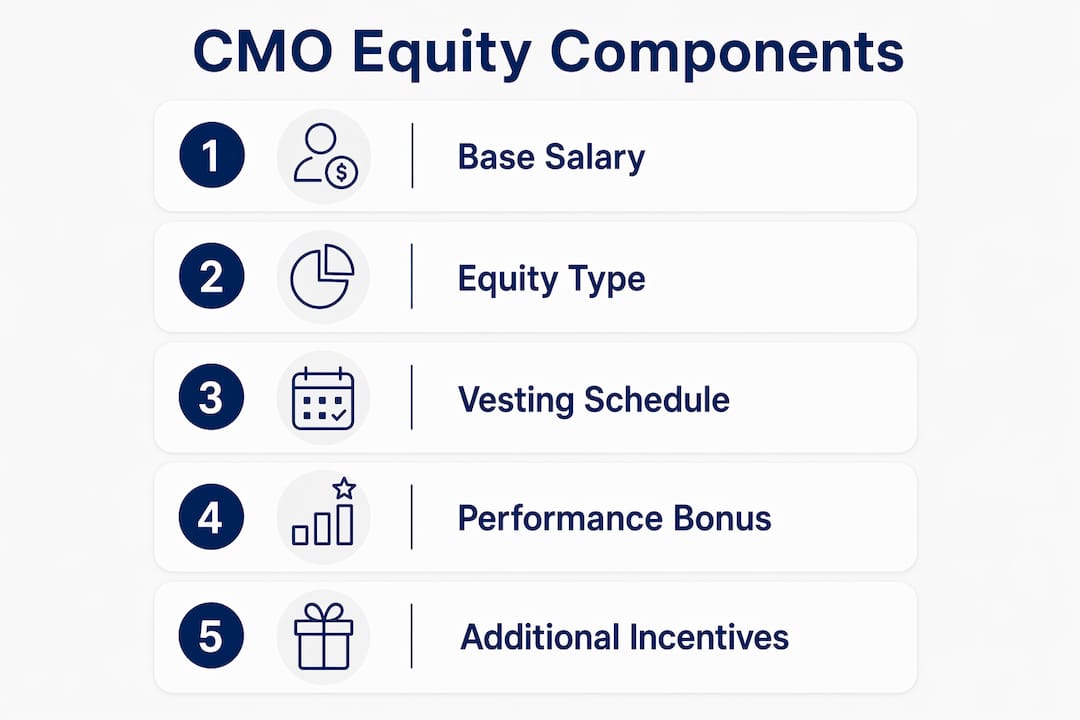
A CMO compensation package at a startup has five core elements: base salary, equity type, vesting schedule, performance bonus, and benefits. Each element carries weight, and founders who treat equity as an afterthought consistently lose candidates who know their market value.
Base salary by stage
CMO base salaries at startups under $5M ARR typically range from $140,000 to $180,000, paired with 1%–3% equity. As the company grows past $5M ARR and approaches Series B or C, cash compensation rises and equity grants shrink. That tradeoff reflects lower company risk at later stages, not lower CMO value.

Equity instrument types
Startup equity compensation takes four main forms, each with distinct tax treatment and risk:
- ISOs (Incentive Stock Options): Reserved for employees, taxed at capital gains rates if held correctly, and subject to Alternative Minimum Tax (AMT) on exercise.
- NSOs (Non-Qualified Stock Options): Available to employees, contractors, and advisors. Taxed as ordinary income at exercise, which creates an immediate cash obligation.
- RSUs (Restricted Stock Units): Shares granted outright upon vesting. Taxed as ordinary income when they vest. Common at later-stage startups with established valuations.
- RSAs (Restricted Stock Awards): Shares issued immediately but subject to forfeiture until vesting conditions are met. Often used at the earliest stages when share prices are near zero.
ISOs are the most tax-efficient option for full-time CMOs at early-stage healthtech startups. NSOs are more common for fractional or part-time arrangements.
Vesting schedules and cliffs
The standard vesting schedule in startups is four years with a one-year cliff. The CMO vests 25% of their grant at the one-year mark, then vests the remainder monthly over the following three years. This structure protects the company from a CMO who leaves in month six with a significant ownership stake. For fractional CMOs, compressed schedules of one to two years are more common and appropriate.
Bonus and additional incentives
Performance bonuses for startup CMOs typically range from 10% to 25% of base salary, tied to metrics like pipeline generation, brand awareness milestones, or ARR growth targets. Some founders also offer signing bonuses to close candidates who are leaving unvested equity at a prior employer. A signing bonus is immediate, liquid, and reduces the candidate's financial risk from joining a pre-revenue company.
How to benchmark and set equity percentages for CMOs
Equity percentages for CMOs shift significantly across funding stages. Founders who ignore stage-appropriate benchmarks either overpay in dilution or underpay in ownership, and both outcomes create problems.
| Startup stage | Typical CMO equity range | Typical base salary range |
|---|---|---|
| Pre-seed / Seed | 1%–3% | $100,000–$150,000 |
| Series A | 0.5%–1.5% | $150,000–$200,000 |
| Series B | 0.25%–0.75% | $180,000–$250,000 |
| Series C+ | 0.1%–0.3% | $220,000–$300,000+ |
| Fractional CMO (Seed) | 0.25%–0.5% | 50%–70% of market rate |
Fractional CMO equity at seed-stage startups is commonly structured as 0.25%–0.5% with a cash retainer at 50%–70% of market rate, vesting over one to two years. That compressed schedule reflects the shorter engagement and lower time commitment. Founders who try to apply a four-year vesting schedule to a fractional arrangement will lose the candidate immediately.
Company ARR and market valuation directly influence how much equity a CMO should receive. A startup with $2M ARR and a $20M valuation can offer 1% equity worth $200,000 on paper. That same 1% at a $200M valuation is worth $2M, but the grant percentage will be far smaller at that stage. The math matters more than the percentage.
Pro Tip: Before finalizing any equity offer, model three exit scenarios: a flat acquihire at 1x invested capital, a moderate exit at 5x, and a home-run exit at 20x. Weight each by realistic probability. The weighted average is your true offer value, not the optimistic number on the pitch deck.
For founders building a healthtech go-to-market team, the CMO equity decision also signals company culture. A founder who offers a below-market package and refuses to negotiate tells the candidate exactly how they will be treated as an executive.
How to realistically value CMO equity and negotiate effectively
Valuing startup equity requires more than multiplying shares by the current 409A valuation. That number is a floor, not a ceiling, and it ignores the probability that the company never reaches a meaningful exit.
Over 65%–75% of venture-backed startups never reach liquidity events that result in meaningful equity payouts. That statistic does not mean equity is worthless. It means every CMO and founder must price equity with realistic probability weights, not founder optimism.
The four-scenario model works as follows:
- Zero outcome (company fails or acquihires at cost): Assign this a 50%–60% probability at seed stage. Equity value is zero.
- Flat acquihire (1x–2x return): Assign 15%–20% probability. Preferred shareholders often absorb most of the proceeds, leaving common stock holders with little.
- Moderate exit (5x–10x return): Assign 15%–20% probability. Common stockholders see real value here, depending on liquidation preferences.
- Home-run exit (20x+ return): Assign 5%–10% probability. This is the scenario founders always pitch. It is real but rare.
Executives frequently overlook risk adjustment in equity offers. Founders present optimistic scenarios, but candidates must stress-test values across multiple exit outcomes before accepting any package. The expected value of your equity is the probability-weighted average across all scenarios, not the best-case number.
Knowing the fully diluted share count is non-negotiable before accepting any offer. Raw share counts mislead executives on actual ownership percentage. A grant of 100,000 options sounds meaningful until you learn the fully diluted share count is 50 million. Always ask for the cap table.
Tax considerations add another layer of complexity. ISOs trigger AMT at exercise, which can create a large tax bill before any liquidity event. Qualified Small Business Stock (QSBS) under IRC Section 1202 can exclude up to $10M in gains from federal tax if the company qualifies and shares are held for five years. Missing the 83(b) election window within 30 days of an RSA grant permanently forecloses a major tax advantage.
Sophisticated candidates negotiate extended post-termination exercise windows of up to 10 years, compared to the standard 90-day window. A 10-year window transforms optionality. It means a CMO who leaves after three years does not face a forced exercise decision with a large AMT bill and no liquidity.
Pro Tip: Always negotiate the post-termination exercise window alongside the equity percentage. A 10-year window on a 0.5% grant is often more valuable than a 1% grant with a 90-day window, especially at early-stage companies where liquidity is years away.
Cash compensation is inherently more liquid than startup equity. Negotiating a signing bonus or a higher base salary hedges the risk that equity never pays out. Founders who resist this logic are asking CMOs to absorb company risk without adequate compensation.
What are common pitfalls in CMO equity compensation?
Founders and CMOs both make predictable mistakes with equity packages. Recognizing them early prevents expensive corrections later.
- Overvaluing equity at face value. A 1% stake in a $10M valuation company is worth $100,000 on paper. After dilution from future funding rounds, liquidation preferences, and the probability of failure, the realistic expected value is far lower. Never anchor compensation decisions to the current 409A number alone.
- Ignoring dilution across rounds. A 1% grant at seed stage typically dilutes to 0.5%–0.6% by Series B after new investor shares are issued. Founders should model dilution transparently and CMOs should ask for it explicitly. Without this data, ownership projections are fiction.
- Withholding cap table details. Without full cap table disclosure, a CMO cannot accurately calculate their ownership percentage or model dilution impact. Founders who refuse to share this information signal a transparency problem that extends beyond compensation.
- Missing tax election windows. The 83(b) election must be filed within 30 days of an RSA grant. Missing it means paying ordinary income tax on the full value of shares as they vest, rather than on the much lower value at grant. This is an irreversible mistake.
- Assuming standard vesting fits every arrangement. A four-year cliff schedule makes no sense for a fractional CMO engaged for 18 months. Mismatched vesting structures create resentment and early departures.
Founders building physician-led startups face an additional challenge: clinical credibility commands a premium in healthtech CMO hiring. A compensation package that ignores that premium will consistently lose candidates to health systems or later-stage companies with more cash to deploy.
Key Takeaways
Structuring CMO equity compensation correctly requires stage-appropriate benchmarks, transparent cap table disclosure, and probability-weighted valuation, not optimistic projections.
| Point | Details |
|---|---|
| Stage-appropriate equity ranges | Seed-stage CMOs typically receive 1%–3% equity; this shrinks at each subsequent funding round. |
| Fractional CMO structure | Fractional CMOs at seed stage typically receive 0.25%–0.5% equity with a compressed 1–2 year vesting schedule. |
| Probability-weighted valuation | Model equity value across four exit scenarios to get a realistic expected value, not just the best-case number. |
| Cap table transparency | Always request the fully diluted share count before accepting any equity offer. |
| Negotiate exercise windows | A 10-year post-termination exercise window often adds more practical value than a higher equity percentage. |
What I've learned about CMO equity in healthtech startups
I have worked on both sides of this conversation, as a fractional CMO negotiating my own packages and as an advisor helping founders structure offers for marketing leadership. The most consistent mistake I see is founders treating equity as a substitute for cash rather than a complement to it. That framing backfires. Top CMOs with healthtech experience know their market value, and they will walk away from packages that ask them to absorb too much risk without adequate cash compensation.
The second mistake is opacity. Founders who hesitate to share cap table details during negotiations lose credibility fast. A CMO who cannot model their actual ownership percentage cannot make an informed decision. Transparency is not just ethical. It is a competitive advantage in recruiting.
Healthtech is a sector where the CMO role carries unusual weight. Clinical credibility, regulatory awareness, and enterprise sales experience are not interchangeable skills. The compensation package needs to reflect that. If your offer looks identical to what a SaaS company in a different vertical would make, you are probably underpricing the role.
My advice to founders: build the compensation model before you start recruiting. Know your fully diluted share count, your exit scenarios, and your cash constraints. Then make an offer you can defend with data. Candidates respect that, and it sets the tone for the working relationship.
— Paul
How Thestartupmd helps healthtech founders structure CMO compensation
Designing a CMO compensation package that attracts the right talent without overextending your cap table is one of the harder decisions early-stage healthtech founders face.
Thestartupmd works directly with healthcare SaaS startups and digital health companies to build compensation frameworks grounded in real market data. The consulting services include fractional CMO equity benchmarking, cash and equity package modeling by stage, and go-to-market leadership strategy. Whether you are structuring your first CMO offer or revisiting a package that is not closing candidates, Thestartupmd brings 25+ years of clinical and executive experience to the table. Reach out to discuss what a well-structured CMO compensation package looks like for your stage and market.
FAQ
What is a typical CMO equity percentage at a seed-stage startup?
Seed-stage CMOs typically receive 1%–3% equity, depending on the company's valuation and the CMO's experience. Fractional CMOs at the same stage typically receive 0.25%–0.5% with a compressed vesting schedule.
What is the standard vesting schedule for startup CMO equity?
The standard vesting schedule is four years with a one-year cliff, vesting 25% at year one and monthly thereafter. Fractional CMO arrangements typically use a compressed one-to-two-year schedule instead.
How should founders value CMO equity in a startup offer?
Founders and CMOs should model equity value across multiple exit scenarios, weighted by realistic probability. Over 65%–75% of venture-backed startups never reach a meaningful liquidity event, so optimistic single-scenario projections consistently overstate true equity value.
What equity instruments are most common for startup CMOs?
ISOs are the most tax-efficient option for full-time CMO employees at early-stage startups. NSOs are more common for fractional or advisory arrangements. RSUs appear more frequently at Series B and later stages with established 409A valuations.
What should a CMO always ask for before accepting an equity offer?
A CMO should always request the fully diluted share count and the full cap table before accepting any offer. Without that data, it is impossible to calculate actual ownership percentage or model how future funding rounds will dilute the grant.