

HEDIS performance is the single most consequential quality metric your startup will face in value-based care. The Healthcare Effectiveness Data and Information Set, maintained by the National Committee for Quality Assurance (NCQA), is the most widely used standardized quality measurement framework in U.S. healthcare, applied to a very large number of people every year. If your startup operates in Medicare Advantage, Medicaid managed care, or any commercial value-based contract, your reimbursement depends on HEDIS scores whether you have read the measure specifications or not.
The financial stakes are direct. HEDIS measures account for 26% of Medicare Advantage Star Ratings, making them the single largest driver of quality bonuses and rebate competitiveness in the entire Stars system. Miss a few screenings, let denominator logic run unchecked, or let documentation gaps accumulate, and you can lose a full star tier and the bonus dollars that come with it. For a startup trying to prove clinical value to payers and investors simultaneously, that is not an abstract risk.
Strong HEDIS performance delivers concrete advantages:
- Quality bonus payments tied directly to Star Ratings and value-based contract performance
- Payer contracting leverage because plans prefer high-performing provider partners
- Market differentiation when competing for ACO, Medicare Advantage, and Medicaid managed care contracts
- Investor credibility through measurable, auditable clinical quality data
- Reduced audit exposure from clean, structured documentation and coding practices
What startup HEDIS performance actually measures across six domains
HEDIS MY2026 includes over 90 measures organized across six domains. Understanding the domains tells you where your quality operations need to focus and which gaps carry the most financial weight.
- Effectiveness of Care: The largest and most operationally demanding domain. Covers prevention, chronic disease management, behavioral health, and medication adherence. For most startups, this is where the majority of quality work happens and where the most bonus dollars are won or lost.
- Access/Availability of Care: Tracks whether members can actually get appointments, including after-hours access and availability of primary care and mental health services. Gaps here often reflect scheduling and capacity problems, not clinical ones.
- Experience of Care: Captures member-reported satisfaction through CAHPS surveys. This domain moves slowly because it depends on survey cycles and perception lag, making it harder to influence quickly than clinical measures.
- Utilization and Risk Adjustment: Monitors how care is used across a population, including inpatient admissions, readmissions, and emergency department visits. Readmission measures in this domain carry significant weight in value-based contracts.
- Health Plan Descriptive Information: Collects operational and structural data about the health plan itself. Less directly tied to clinical workflows but still part of the full reporting picture.
- Measures Reported Using Electronic Clinical Data Systems (ECDS): A growing category that pulls data directly from EHRs and health information exchanges. NCQA is actively moving more measures into this domain as digital infrastructure matures.
Together, these domains create a complete picture of whether a health plan or provider organization delivers the right care, at the right time, with the right documentation to prove it.
Key HEDIS measures your startup should prioritize in 2026
The full measure set runs over 90 indicators, but most startups in value-based contracts will be evaluated on a focused subset. These 15 measures carry the most weight in primary care and specialty performance:
- Controlling High Blood Pressure (CBP): Percentage of patients ages 18–85 with hypertension whose BP is adequately controlled. A few missed readings can drop this measure by a full star tier.
- Hemoglobin A1c (HbA1c) Control for Patients with Diabetes: Tracks glycemic management. Unmappable lab LOINC codes are a common reason documented results don't count.
- Breast Cancer Screening (BCS): Mammography completion in eligible women. Missing screenings done at unaffiliated imaging centers is a frequent data gap.
- Colorectal Cancer Screening (COL): Colonoscopy, FIT, or stool DNA completion. Administrative data often misses community-based completions.
- Cervical Cancer Screening (CCS): Pap smear and HPV testing compliance in eligible women.
- Diabetes Care: Eye Exam (EED): Retinal exam completion by an optometrist or ophthalmologist. Coding errors at the specialist level frequently make completed exams invisible to the measure.
- Medication Adherence for Diabetes Medications (MAD): Proportion of days covered for oral diabetes medications. High-weight measure with direct influence on rebate levels.
- Medication Adherence for Hypertension (MAH): Same proportion-of-days-covered logic applied to RAS antagonists.
- Medication Adherence for Cholesterol (MAC): Statin adherence in eligible populations. Adherence measures as a group are typically high-weight and directly tied to bonus calculations.
- Antidepressant Medication Management (AMM): Tracks whether patients newly diagnosed with depression stay on medication for 12 weeks and 6 months.
- Follow-Up After Hospitalization for Mental Illness (FUH): Requires a follow-up visit within 7 and 30 days of discharge. Missing the 7-day window is a common failure point.
- Plan All-Cause Readmissions (PCR): Tracks 30-day readmissions across all conditions. Structured remote patient monitoring workflows have demonstrated meaningful reductions in this measure.
- Adult Immunization Status (AIS-E): Tracks completion of recommended vaccines including influenza, Tdap, zoster, pneumococcal, hepatitis B, and COVID-19.
- Avoidance of Antibiotic Treatment for Acute Bronchitis (AAB): Measures appropriate non-prescribing. A higher rate signals better clinical decision-making.
- Depression Screening and Follow-Up (DMS): Screens for depression and documents follow-up plans. Behavioral health integration gaps frequently undermine this measure.
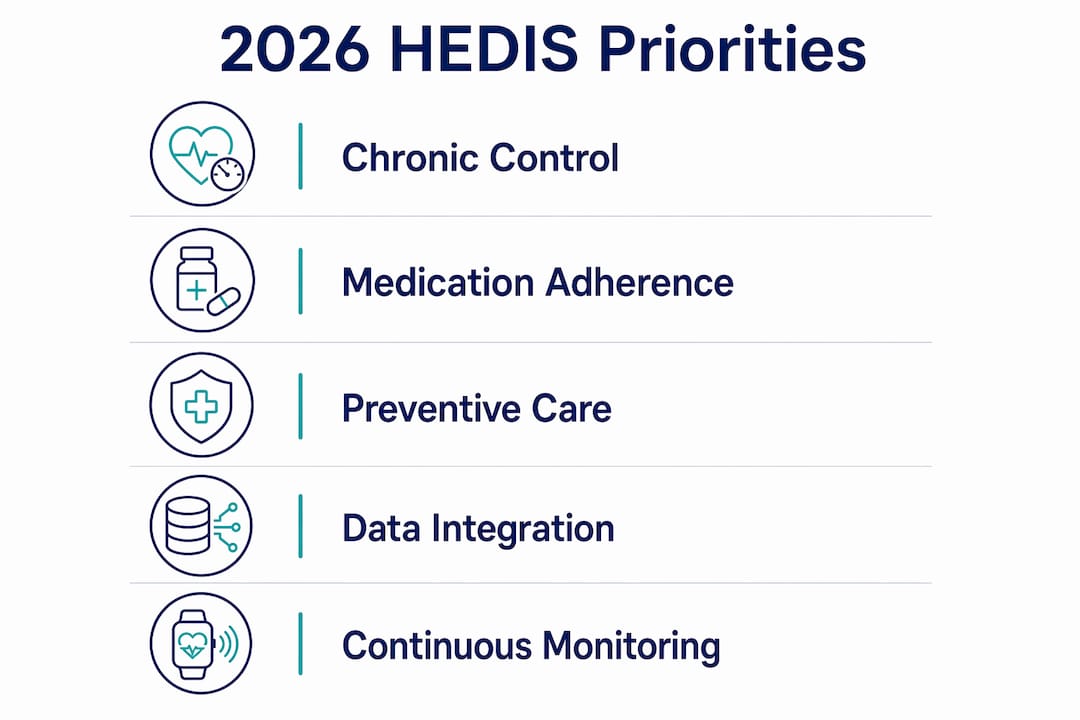
2026 updates from NCQA place increased weight on chronic disease control and medication adherence measures, reflecting CMS's emphasis on managing high-cost populations in Medicare Advantage.
How HEDIS scores are calculated and what that means for your data

HEDIS measures use three reporting methods, and the one your organization uses has a direct effect on your scores.

| Reporting Method | Data Source | Score Impact | Operational Cost |
|---|---|---|---|
| Administrative | Claims and encounter data only | Often underestimates true performance | Low |
| Hybrid | Claims plus manual chart abstraction | More accurate; improves scores 5–15 points | High |
| ECDS | Direct EHR and HIE data feeds | Most complete; growing category | Moderate with infrastructure |
Every measure has a denominator (the eligible population) and a numerator (the patients who received the service). Enrollment requirements, age bands, and clinical exclusions all affect denominator size. Getting the denominator wrong, specifically by miscalculating continuous enrollment, is one of the most common audit failures startups face. Building reusable denominator logic rather than embedding it separately in each measure is a structural fix that reduces this risk significantly.
Health plans must report errors above a 5% threshold to NCQA, which means your data accuracy is not just an internal quality concern. It is an auditable compliance obligation. Coding errors and unstructured clinical notes are the primary drivers of numerator undercounting. A diabetic eye exam completed by an out-of-network optometrist who uses incorrect CPT codes is invisible to the measure, even though the care happened.
Key calculation concepts to track:
- Denominator eligibility is determined by enrollment duration, age, and diagnosis codes
- Numerator events require specific CPT, HCPCS, and ICD-10 codes within defined service windows
- Exclusions must be applied correctly or denominator inflation tanks adherence scores
- Measure specifications change annually, so 2024 workflows may chase the wrong codes in 2026
What's changing in HEDIS measurement for 2026 and beyond
The shift happening right now is structural, not incremental. CMS mandates a transition from manual chart pulls to FHIR-based continuous data pipelines, with structured, auditable documentation required. Unstructured PDFs will not count after 2027. Year-round data management replaces the old seasonal chart-pull model entirely.
NCQA's digital quality measures (dQMs) use FHIR-based real-time data pipelines that allow HEDIS engines to read clinical data without human intervention. When data flows in FHIR format, gap identification happens continuously rather than at year-end. That changes the entire operational model for quality teams. NCQA requires one full measurement year of parallel testing before digital engine results are eligible for official reporting, so startups that have not started building FHIR infrastructure are already behind the timeline.
Key operational impacts for startups in 2026:
- FHIR infrastructure is now a prerequisite, not a future investment
- Real-time gap identification replaces quarterly or annual gap file reviews
- Structured lab data with correct LOINC codes is required for HbA1c and other clinical measures
- BP readings must appear in the correct EHR fields, not buried in narrative notes
- The phased path to fully digital HEDIS reporting by 2030 requires action now, not at the deadline
Pro Tip: Build your FHIR data pipeline before investing in automation engines. Accurate, continuous clinical data is the foundation. Automation layered on top of incomplete data accelerates the wrong results.
Why startups consistently underperform on HEDIS scores
The performance gap almost never comes from clinical care quality. Most practices deliver the services. The gap comes from operational and data failures that make delivered care invisible to the measure.
Data fragmentation is the most pervasive problem. Patients receive care across multiple settings: labs, imaging centers, pharmacies, and specialists outside your network. The mammogram happens at an affiliated imaging center. The flu shot happens at a retail pharmacy. None of those services automatically flow back to the attributed provider's quality reporting unless data exchange is functioning correctly, which it frequently is not for early-stage startups.
Patient outreach delays compound the problem. Most practices identify gaps in claims data 60–90 days after the missed service window. By the time outreach begins, the measurement year is half over. Getting a patient to act on a gap that is already months old requires significantly more effort than catching it early.
Common failure points that show up in audits:
- Coding errors that make completed services invisible to the numerator
- Unstructured PDF notes that will not count under 2027 NCQA requirements
- Denominator inflation from incorrect exclusion logic
- Missing LOINC codes on lab results that erase HbA1c control wins
- BP readings documented in narrative notes rather than structured EHR fields
- Outreach workflows that identify gaps but fail to convert patients to completed visits
The financial consequence of these failures is direct. Quality bonus payments depend on properly documented and coded care, not just care delivered. HEDIS does not reward care. It rewards documented, structured, auditable care.
Practical strategies to improve your startup's HEDIS scores
Improving HEDIS performance does not require a large quality team. It requires the right operational model applied consistently across four areas.
Continuous gap management. Pull payer gap files monthly, not quarterly. Cross-reference against EHR data to remove false positives before outreach begins. A patient flagged as having an open gap who already completed the service at an out-of-network provider wastes outreach resources and frustrates the patient. Maintaining a continuously refreshed gap list is the foundation of everything else. This connects directly to a broader population health strategy that keeps quality operations running year-round rather than in seasonal bursts.
Multi-channel outreach matched to patient preference. Letters have a low conversion rate. Outbound staff calls are volume-limited by your team's capacity. SMS, voice AI, and portal messaging can reach a majority of patients quickly when the channel matches the patient's communication preference. For Medicaid populations or non-English-speaking panels, multilingual outreach is not optional. Closing-call workflows that book the appointment during the same conversation outperform callback workflows by 2–3x.
Documentation and coding validation. Run a coding audit on a sample of attributed patients before year-end submission. A 30-minute review often uncovers a substantial proportion of "open" gaps that were already closed clinically but not coded correctly. This is the fastest, cheapest quality improvement move available to most startups. Strong physician engagement in documentation standards is what makes this stick across a provider panel.
FHIR integration and automation. Automation and AI-driven tools enable real-time HEDIS gap closure and reduce manual chart review time. But automation only works when the underlying data pipeline is clean. Prioritize EHR, lab, claims, and pharmacy data integration before deploying gap-closure automation. Remote patient monitoring workflows that feed structured vitals directly into HEDIS-compliant formats are particularly effective for CBP and HbA1c control measures.
Additional tactics that move scores:
- Book appointments at the moment of patient contact, not as a callback
- Validate LOINC codes on all lab interfaces before the measurement year closes
- Audit BP field mapping in your EHR to confirm readings land in structured, not narrative, fields
- Implement year-round denominator monitoring to catch enrollment errors before they become audit findings
- Use FHIR-based integrations to unify EHR, lab, claims, and device data into a single quality reporting view
How startups have improved HEDIS scores in practice
The operational model described above is not theoretical. Organizations that have applied structured, year-round quality workflows have produced measurable results across the measures that carry the most weight in value-based contracts.
One example from the research involves a chronic care organization that implemented a structured remote patient monitoring and care management workflow designed specifically to support both clinical outcomes and HEDIS documentation. The results included a significant reduction in 30-day readmissions across the chronic cohort, more consistent BP and diabetes control, and cleaner, audit-ready documentation. On the quality reporting side, the organization saw stronger performance on Plan All-Cause Readmissions, more stable CBP and HbA1c control numerators, better compliance with depression and chronic follow-up windows, and fewer denominator disputes during audit review.
Lee Health, a health system that implemented structured RPM workflows, achieved a large reduction in 30-day readmissions using continuous vitals data fed into HEDIS-compliant formats. That kind of result comes from building the data infrastructure first, then layering clinical workflows on top of it.
The pattern across successful organizations is consistent: year-round operations, clean denominators built early in the measurement year, structured documentation that auditors can verify without guesswork, and multi-channel outreach that converts patients rather than just contacting them. Startups that treat HEDIS as a year-end exercise consistently underperform against those that run it as a continuous operational discipline. Exploring care model innovation that embeds quality workflows into clinical delivery, rather than bolting them on at reporting time, is what separates the organizations that protect bonuses from those that lose them.
Regulatory and compliance implications of HEDIS performance in the US market
HEDIS performance is not just a quality metric. It carries direct regulatory and compliance weight across multiple federal and state programs.
CMS uses a subset of HEDIS measures to calculate Medicare Advantage Star Ratings, which determine bonus payments, rebate levels, and plan bid competitiveness. Plans rated 4 stars or above qualify for quality bonus payments that can represent hundreds of millions of dollars annually for large plans and meaningful revenue for startup-scale organizations. The CMS Star Ratings framework is updated annually, and HEDIS measure weights within that framework shift with each rule cycle.
State Medicaid programs use HEDIS for managed care organization quality reporting and bonus calculations. Commercial purchasers use HEDIS scores to evaluate plans during procurement. ACOs operating under CMS shared savings programs use HEDIS-aligned measures to determine whether they qualify for shared savings distributions. For a startup operating across multiple payer types, HEDIS performance affects revenue from every direction simultaneously.
The compliance dimension is specific. NCQA audits health plan HEDIS submissions, and the 5% error threshold for mandatory error reporting means data quality failures have direct regulatory consequences, not just financial ones. The transition to FHIR-based digital quality measures adds a technology compliance layer: organizations that cannot produce structured, auditable data in FHIR format will face increasing difficulty meeting reporting requirements as the 2027 and 2030 deadlines approach. The Office of the National Coordinator for Health Information Technology has been clear that interoperability requirements will tighten, not loosen, over this period.
For startups, the practical compliance checklist looks like this:
- Maintain audit-ready documentation for all HEDIS numerator events
- Track measure specification updates from NCQA annually and update workflows before the measurement year begins
- Build FHIR-compliant data pipelines now to meet 2027 unstructured data restrictions
- Validate denominator exclusion logic to avoid audit findings from enrollment miscalculations
- Understand which HEDIS measures apply under each payer contract, since Medicare Advantage, Medicaid, and commercial contracts may weight different measures
Working with Thestartupmd on HEDIS performance
I improved HEDIS performance 29% year-over-year at Steward Health Care Network while managing a network of 3,000+ providers and 500,000+ covered lives. That experience is directly applicable to the operational and data challenges your startup faces right now.
Thestartupmd works with healthcare startups and digital health companies to build the clinical strategy, data infrastructure, and quality workflows that drive HEDIS performance and protect value-based care revenue. If your team is navigating payer contracting, Star Ratings pressure, or the shift to digital quality measures, understanding what a CMO brings to that work is a practical starting point.
If something feels misaligned in your quality operations, I'd welcome a conversation.
Key Takeaways
HEDIS performance drives Medicare Advantage Star Ratings, payer contracts, and quality bonuses, making it the most financially consequential quality metric for healthcare startups in value-based care.
| Point | Details |
|---|---|
| HEDIS drives 26% of Star Ratings | HEDIS measures account for 26% of Medicare Advantage Star Ratings, making them the single largest driver of quality bonuses and rebate competitiveness in the entire Stars system. |
| Hybrid reporting improves scores | Switching from administrative-only to hybrid or ECDS reporting can improve scores 5–15 points without changing clinical care. |
| Documentation errors erase delivered care | Quality bonus payments hinge on care documented in the right fields with correct codes, not merely care that was delivered. |
| FHIR infrastructure is now required | CMS mandates a shift to FHIR-based continuous data pipelines; unstructured PDFs will not count after 2027. |
| Year-round operations outperform seasonal ones | Startups that run continuous gap management, outreach, and coding audits consistently outperform those treating HEDIS as a year-end exercise. |