

A startup population health strategy is defined as a data-driven, multi-pillar operational framework that healthcare organizations use to systematically improve health outcomes across a defined patient population while meeting value-based care performance targets. The industry term for this discipline is population health management, and understanding it is the first step toward building a program that actually generates revenue. Mature programs target 60–75% care gap closure by year-end, with that closure rate directly tied to performance bonus revenue. For healthcare startups, this is not a theoretical exercise. It is the operational engine that determines whether your value-based contracts pay out or fall short.
What are the five operational pillars of a startup population health strategy?
Five operational pillars define population health strategy: Identification, Stratification, Engagement, Interventions, and Measurement. Each pillar builds on the previous one, and skipping any of them creates gaps that erode both clinical outcomes and financial performance.
Here is what each pillar means in practice:
- Identification: Build your patient panel by aggregating data from claims, EHRs, labs, and social determinants of health. You cannot manage a population you cannot see.
- Stratification: Score and rank patients by clinical risk. This separates your high-acuity patients from your rising-risk cohort and your healthy population.
- Engagement: Design targeted outreach based on risk tier. A high-risk diabetic patient needs a care coordinator call. A rising-risk patient may need a text message and a preventive visit reminder.
- Interventions: Close care gaps and manage chronic conditions. This is where clinical work happens, from annual wellness visits to medication reconciliation to behavioral health referrals.
- Measurement: Track HEDIS metrics, care gap closure rates, total cost of care, and patient outcomes. HEDIS performance improves 3–8% annually under effective management. That improvement translates directly into quality bonus payments.
The most important shift in effective population health management is the move from reactive, diagnosis-focused care to primary and secondary prevention. Startups that build programs around prevention, not just disease management, outperform those that only respond to high-acuity events.
Pro Tip: Focus your first 90 days on risk stratification. Knowing which patients sit in your rising-risk cohort lets you direct limited resources where they generate the most measurable improvement.

How do startups use AI to improve population health management?
Artificial intelligence is changing what is possible in care model innovation for startups. The most impactful AI applications do not just analyze data. They generate clinical intelligence at the point of care, where providers can act on it immediately.
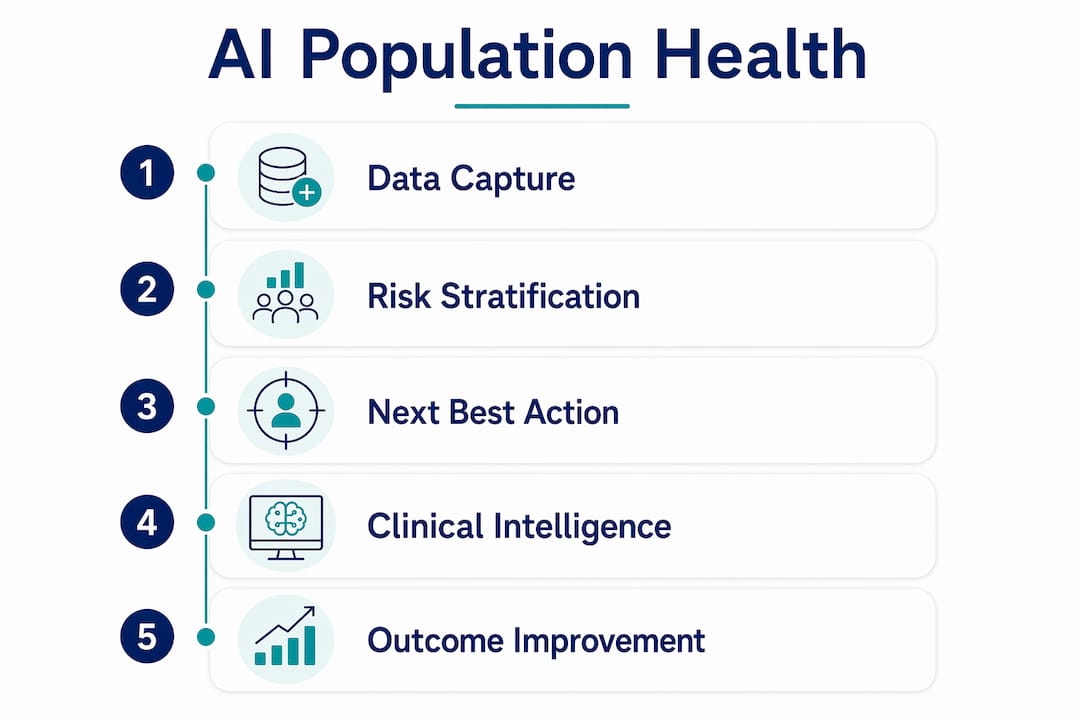
LLM-native AI platforms unlock unstructured clinical data, delivering next-best-action insights that support value-based care decisions. This moves the technology beyond simple risk reporting into real-time clinical guidance. The practical effect is that a provider sees a recommended intervention during a patient encounter, not three days later in a dashboard no one checks.
A concrete example of AI-enabled scale: platforms can now generate clinical meal plans aligned with WHO guidelines in 90 seconds. That kind of speed reduces audit costs and makes personalized care plans viable at population scale, not just for individual patients.
The key capabilities to look for in an AI platform for population health include:
- Next-best-action intelligence: Recommendations delivered at the point of care, not in retrospective reports
- Unstructured data processing: The ability to read clinical notes, not just structured claims fields
- Workflow integration: Embedded directly into the EHR or care coordinator tools your team already uses
- Outcome tracking: Closed-loop measurement that connects the AI recommendation to the clinical result
The shift from retrospective analytics to next-best-action clinical intelligence is not optional for startups that want to compete in 2026. Providers will not adopt a tool that only tells them what already happened.
Pro Tip: Before selecting an AI platform, ask the vendor to demonstrate how their tool fits into a provider's existing workflow. If the demo requires leaving the EHR, adoption will stall.
What are the best practices for aligning with state-led population health integrators?
State governments are positioning themselves as system integrators aligning Medicaid, public health, financing, delivery, partnerships, and technology to strengthen population health. This is a structural shift, not a policy trend. For startups, it represents a durable channel for scaling impact, particularly in rural and underserved communities where private market incentives alone are insufficient.
State-led models prioritize interoperable shared infrastructure and public-private collaborations. Startups that position themselves inside these frameworks gain access to Medicaid data, state contracts, and community health networks that are otherwise difficult to reach.
Five steps to align your startup with state system integrator frameworks:
- Map the state's population health priorities. Every state publishes a State Health Improvement Plan. Read it. Identify where your product solves a documented gap.
- Pursue interoperability certification. State systems require data exchange standards. Meeting those standards early removes a common barrier to partnership.
- Engage Medicaid managed care organizations. These plans sit at the intersection of state policy and clinical delivery. They are your fastest path to covered-lives contracts.
- Build public-private partnership credentials. Documented experience working with community health centers, FQHCs, or public health departments signals credibility to state procurement teams.
- Align your outcome metrics with state reporting requirements. If the state measures ED utilization and preventable readmissions, your platform should report on those same metrics.
State-level system integrator models represent a major opportunity for startups to scale population health impact through public-private partnerships. Startups that ignore this channel leave a significant growth path untouched.
How does risk stratification drive revenue in value-based care?
Risk stratification is the process of dividing a patient population into tiers based on clinical complexity, cost trajectory, and likelihood of near-term health deterioration. Most programs use three to four tiers: high acuity, rising risk, moderate risk, and healthy or low risk. The tier that generates the highest return on investment is not the top tier. It is the rising-risk cohort.
High-volume, lower-acuity care gap closure is the highest-ROI activity in value-based care. The reason is straightforward. High-acuity patients consume enormous care coordination resources and often have limited upside on quality metrics. Rising-risk patients, by contrast, respond well to proactive outreach, preventive visits, and chronic care management. Closing care gaps in this group drives HEDIS metric improvement and unlocks quality bonus revenue at scale.
| Risk segment | Primary intervention | Revenue potential |
|---|---|---|
| High acuity | Complex case management, specialist coordination | Moderate, high cost to serve |
| Rising risk | Preventive outreach, chronic care management, care gap closure | Highest ROI, quality bonus eligible |
| Moderate risk | Annual wellness visits, screening reminders | Moderate, lower cost to serve |
| Low risk / healthy | Population-level prevention, digital engagement | Low near-term, long-term retention value |
Targeted outreach to the rising-risk cohort yields the best improvement results across HEDIS measures. Startups that concentrate outreach resources on this segment, rather than spreading effort evenly across all tiers, see faster quality metric improvement and stronger contract performance.
Pro Tip: Build a separate work queue for your rising-risk patients. Treat it as a distinct program with its own outreach cadence, not as overflow from your high-acuity case management team.
For healthcare entrepreneurs building investor pitch materials, the rising-risk ROI story is one of the most compelling financial narratives you can present. It shows a clear path from clinical intervention to contract bonus revenue.
Key Takeaways
A startup population health strategy succeeds when it combines risk-stratified outreach, AI-enabled clinical intelligence, and alignment with state system integrator frameworks to close care gaps and generate quality bonus revenue.
| Point | Details |
|---|---|
| Five pillars are non-negotiable | Identification, Stratification, Engagement, Interventions, and Measurement must all function together. |
| Rising-risk patients drive the highest ROI | Focus outreach on this cohort to maximize HEDIS improvement and quality bonus payments. |
| AI must deliver point-of-care intelligence | Next-best-action tools embedded in provider workflows outperform retrospective dashboards. |
| State alignment opens Medicaid channels | Interoperability and public-private credentials unlock state contracts and covered-lives growth. |
| Care gap closure targets are measurable | Mature programs target 60–75% closure rates, directly linking clinical performance to revenue. |
What I have learned building population health programs from the ground up
Most startups I advise come in with the same blind spot. They have built a dashboard. It shows risk scores, utilization trends, and care gap rates. The data is clean. The visualizations are polished. And providers ignore it completely.
The problem is not the data. The problem is that the tool asks providers to change their workflow to use it. That never works. I learned this firsthand leading ACOs at Steward Health Care Network, where we covered more than 500,000 lives and earned $17.2M in Medicare Shared Savings. The programs that moved the needle were the ones where clinical intelligence arrived inside the provider's existing workflow, not in a separate portal that required a separate login.
Digital health startups fail due to poor strategic execution, not lack of innovation. That finding matches everything I have seen in 25 years of clinical and executive work. A good idea with poor workflow integration will lose to a simpler idea that fits naturally into how providers already work.
The other pitfall I see constantly is building only retrospective analytic tools. Retrospective data tells you what happened. It does not tell a provider what to do next, during the visit, when the patient is sitting in front of them. The startups that are winning right now are the ones building next-best-action clinical intelligence layers on top of their analytics. That is the gap worth closing.
My recommendation for startup leaders: pick one risk cohort, build one tight intervention workflow, measure one outcome metric, and prove it works before you scale. Sustainable population health programs are built on proof, not promises.
— Paul
How Thestartupmd helps healthcare startups execute population health strategy
Healthcare startups building population health programs face a specific challenge: clinical credibility opens doors that technology alone cannot. Thestartupmd brings 25 years of population health leadership, including ACOs covering 375,000 covered lives and a 29% year-over-year HEDIS improvement, directly into your startup's strategy and go-to-market execution.
Paul Bergeron, MD, MBA works with healthcare SaaS companies and digital health startups to build the clinical frameworks, provider workflows, and value-based care narratives that enterprise buyers require. From operational pillar design to AI integration guidance to state system alignment, Thestartupmd translates clinical expertise into commercial results. Explore the full range of startup consulting services or review common go-to-market mistakes that derail population health programs before they gain traction.
FAQ
What is a startup population health strategy?
A startup population health strategy is a data-driven framework that uses five operational pillars, Identification, Stratification, Engagement, Interventions, and Measurement, to improve health outcomes across a defined patient population while meeting value-based care performance targets.
What care gap closure rate should a startup target?
Mature population health programs target 60–75% care gap closure by year-end, with that rate directly linked to quality bonus revenue under value-based contracts.
Why is the rising-risk patient cohort the highest-ROI segment?
Rising-risk patients respond well to proactive outreach and preventive interventions, making care gap closure in this group the most cost-effective way to improve HEDIS metrics and earn quality bonus payments.
How does AI improve population health management for startups?
AI platforms that process unstructured clinical data and deliver next-best-action recommendations at the point of care improve provider adoption and drive better outcomes compared to retrospective reporting tools.
How can a startup align with state-led population health frameworks?
Startups should map state health improvement priorities, pursue interoperability certification, engage Medicaid managed care organizations, and align their outcome metrics with state reporting requirements to access public-private partnership channels.