

For U.S.-based healthcare SaaS startups seeking fractional CMO or advisory support, the strongest alternatives to Venturous.work are The StartupMD (MD-led specialist advisory), Toptal (vetted fractional executive network), and Upwork (broad marketplace access). Your choice depends on one variable more than any other: whether your next hire needs clinical credibility or just execution speed.
Shortlist at a glance:
- The StartupMD — Best for healthcare SaaS founders who need a fractional Chief Medical Officer with clinical strategy, investor support, and HIPAA-aware advisory built in.
- Toptal — Best for startups that need a vetted, senior fractional executive quickly and can handle their own healthcare onboarding.
- Upwork — Best for project-based tasks where speed and cost flexibility matter more than clinical specialization.
- Venturous.work — Best for early-stage founders exploring student-led, project-based startup connections; founded in 2023 with a small team and a community-first model rather than a clinical advisory firm.
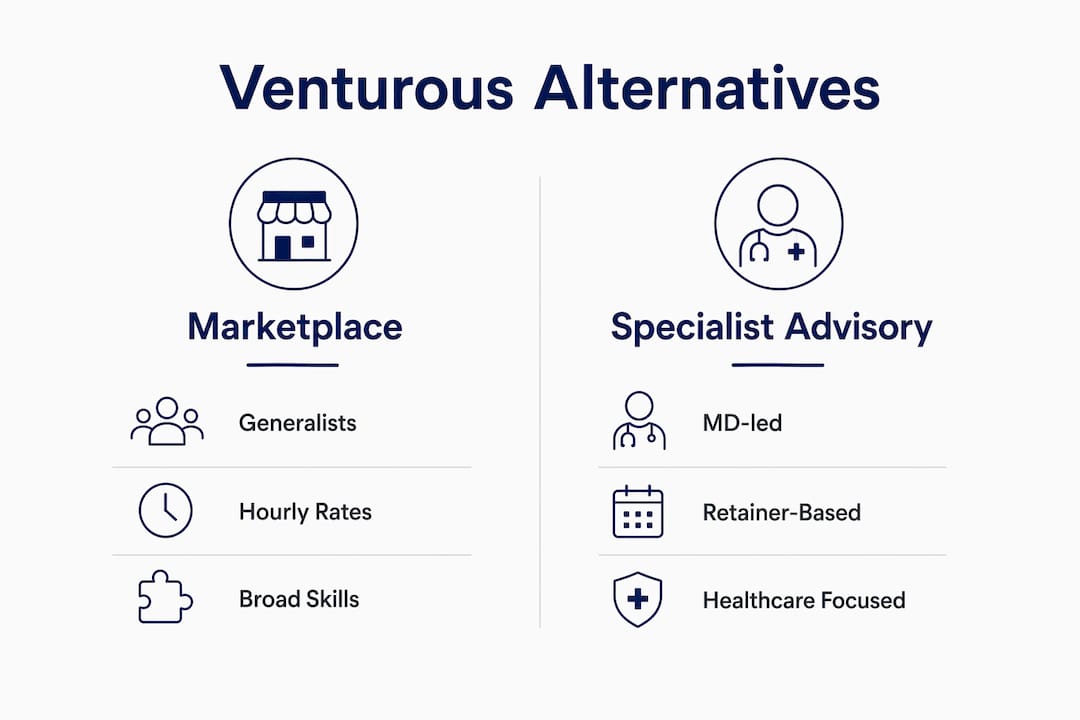
The core trade-off is straightforward: marketplaces give you speed and price flexibility; specialist advisory gives you clinical credibility and strategic depth. For a healthcare SaaS startup navigating physician adoption, payer conversations, or a Series A, the wrong hire in either direction costs months.
Table of Contents
- What do Venturous.work alternatives actually offer?
- How do you evaluate and choose the right partner?
- Which option fits your startup stage?
- What should you expect in the first 30–90 days?
- Why The StartupMD stands out as a healthcare-specialist option
- Key Takeaways
- What founders consistently get wrong when hiring advisory help
- The StartupMD: fractional CMO and advisory for healthcare SaaS
- Useful sources
What do Venturous.work alternatives actually offer?
| The StartupMD | Toptal | Upwork | Venturous.work | |
|---|---|---|---|---|
| Best for | Pre-seed to Series A healthcare SaaS needing fractional CMO/clinical strategy | Startups needing a vetted senior fractional executive fast | Project-based tasks; cost-flexible early-stage teams | Early-stage founders seeking student project support |
| Engagement model | Retainer-based fractional CMO; project advisory | Retainer or project; managed matching | Marketplace hire; hourly or fixed-price | Community/marketplace; project-based |
| Healthcare/clinical expertise | MD, MBA; HIPAA-aware; clinical strategy native | Varies by talent; no healthcare-specific vetting | Generalist marketplace; clinical vetting not built in | Listed specialties include healthcare; small team |
| Pricing shape | Retainer or scoped project; not publicly listed | Premium; not publicly listed | Hourly to fixed; wide range | Not publicly listed |
| Engagement length & onboarding | 3 months typical; onboarding accelerated by client readiness | 2–4 week matching; engagement length varies | Days to weeks to hire; onboarding on you | Project-based; timeline varies |
| Core deliverables | Clinical strategy, GTM, investor support, physician engagement, regulatory guidance | Executive deliverables per scope; general business | Task completion per contract | Project connections; community access |
| Flexibility/exit terms | Project or retainer; terms set per engagement | Varies; trial periods available | Cancel anytime; no long-term lock-in | Not publicly listed |
Decisive differences by category:
- Specialist advisory (The StartupMD): Clinical credibility is built in, not bolted on. An MD-led engagement means your investor deck, physician outreach, and regulatory narrative are shaped by someone who has practiced medicine and run a business.
- Vetted fractional networks (Toptal): Strong for general executive roles. Healthcare-specific competencies like HIPAA workflows or physician adoption pathways require additional onboarding you will need to manage yourself.
- Generalist marketplaces (Upwork, FlexJobs): Expert-vetted tiers screen for general excellence, not clinical readiness. Expect higher onboarding cost when the role touches healthcare operations.
A marketplace connects you to talent. A specialist advisory partner connects your product to the clinical world it has to operate in. Those are different jobs, and confusing them is one of the most expensive mistakes a healthcare SaaS founder can make.
How do you evaluate and choose the right partner?
Decision checklist before you start:
- What is your company stage? Pre-product, early revenue, or pre-Series A each demand different advisory depth.
- What outcome do you need in 90 days? Clinical validation, GTM strategy, fundraising narrative, or physician onboarding?
- Does your product touch PHI or require HIPAA-compliant workflows?
- What is your fundraising timeline? A Series A in six months requires a different engagement than a product pivot.
- What is your monthly advisory budget? Retainer engagements, project scopes, and marketplace hires carry very different cost structures.
Interview questions that reveal real healthcare SaaS experience:
- Can you walk me through a healthcare SaaS product you helped take from clinical validation to commercial launch?
- How have you handled physician adoption challenges, and what metrics did you use to track progress?
- What is your process for ensuring HIPAA compliance in advisory deliverables and communications?
- Have you supported a fundraising round for a digital health company? What was your specific contribution to the investor narrative?
- How do you define and measure product-market fit in a regulated healthcare environment?
Red flags to watch for:
- No clinical references or case studies specific to healthcare SaaS
- Deliverables described in vague terms ("strategic guidance," "advisory support") with no measurable outputs
- Unwillingness to sign basic data-handling or confidentiality terms before engagement
- No clear answer on HIPAA familiarity or regulatory experience
Pricing expectations (ranges, not fixed rates):
Retainer-based fractional CMO engagements in the U.S. typically run at a premium relative to marketplace hourly rates, reflecting strategic depth and clinical credibility. Project-based advisory scopes are scoped individually. Marketplace hires on platforms like Upwork vary widely by experience level. If you are also evaluating funding options during an engagement, understanding revenue-based financing mechanics can help you model runway implications alongside advisory costs.
Pro Tip: Ask every candidate for one specific, measurable outcome they delivered for a healthcare SaaS client. "Helped with strategy" is not an answer. "Reduced clinician onboarding time by X weeks" or "supported a $Y seed round" is.
Which option fits your startup stage?
| Stage / Problem | Best option category | Why it fits |
|---|---|---|
| Pre-product; clinical validation needed | MD-led specialist advisory | Clinical credibility shapes the product before it is built wrong |
| Early revenue; physician adoption lagging | Specialist fractional CMO | Physician engagement requires clinical peer authority, not just GTM tactics |
| Pre-Series A; investor narrative gap | Specialist advisory with fundraising experience | Investors in digital health ask clinical questions a generalist cannot answer |
| Regulatory readiness; HIPAA/compliance gaps | Specialist advisory | HIPAA-aware processes and clinical strategy must be integrated, not patched |
| Discrete project; limited budget | Vetted network or marketplace | Speed and cost flexibility outweigh clinical depth for bounded tasks |
Where clinical leadership materially changes the outcome:
- Fundraising prep: Investors in healthcare SaaS probe clinical evidence and physician adoption. An MD on your advisory team answers those questions with authority.
- Clinical validation: A fractional CMO with clinical trial familiarity can design validation frameworks that satisfy both clinical and commercial requirements.
- Physician adoption: Clinicians respond differently to peer-level outreach. An MD-led engagement changes the conversation from vendor pitch to clinical dialogue.
- Payer conversations: Payers ask outcomes questions. A clinician who understands reimbursement pathways accelerates those conversations significantly.
What should you expect in the first 30–90 days?
A well-structured fractional CMO engagement follows a clear arc. Here is what that looks like in practice:
- Days 1–14 (Discovery): The advisor reviews your product, clinical evidence, customer interviews, and competitive position. You should have these materials centralized before day one.
- Days 15–30 (Rapid audit): A structured gap analysis across clinical strategy, GTM, and regulatory readiness. Expect a written output, not just a verbal debrief.
- Days 31–60 (Strategy sprint): Prioritized recommendations with clear owners and timelines. This is where physician engagement plans, investor narrative work, or PMF frameworks take shape.
- Days 61–90 (Execution plan): A 90-day roadmap with defined KPIs, communication cadence, and accountability checkpoints.
What to prepare before the engagement starts:
- One-page product summary and clinical evidence brief
- Access to analytics dashboards and key customer success metrics
- List of key clinician and customer contacts for introductions
- Current investor materials or pitch deck (if fundraising is in scope)
- Any existing regulatory or compliance documentation
Early success in a fractional engagement looks like: a clear clinical positioning statement, a prioritized physician adoption plan, and at least one investor-ready narrative asset. Review healthcare SaaS customer success best practices before your engagement starts to align your internal team on what good looks like.
Pro Tip: Centralizing your product specs, clinical validation docs, and customer interview recordings in a single shared workspace before day one cuts ramp time significantly. A fractional executive's early impact is capped by the context you give them.
Why The StartupMD stands out as a healthcare-specialist option
Paul Bergeron, MD, MBA brings over 25 years of combined experience in medicine and business. The StartupMD's advisory model is built specifically for healthcare SaaS startups navigating the gap between clinical credibility and commercial growth.
The StartupMD's service scope covers the full range of what a healthcare SaaS startup needs from a fractional executive:
- Fractional Chief Medical Officer leadership
- Clinical strategy development and product evaluation
- Regulatory guidance and HIPAA-aware advisory processes
- Market readiness assessment and go-to-market support
- Investor support and fundraising narrative development
- Executive and board advising
What separates this model from a generalist marketplace hire is not just credentials. It is the integration of clinical judgment into every strategic decision. When a founder is preparing for a payer conversation or a Series A, having an MD who understands both the clinical evidence and the business case in the same room changes the quality of the output. Founders working with The StartupMD can expect measurable outcomes: improved physician activation metrics, stronger investor narratives, and clearer clinical positioning. For founders building out governance alongside advisory support, understanding how to structure a medical advisory board is a natural complement to a fractional CMO engagement.
Key Takeaways

For healthcare SaaS founders, the right Venturous.work alternative depends on whether your next engagement needs clinical leadership or just execution capacity.
| Point | Details |
|---|---|
| Specialist advisory beats marketplaces for clinical roles | MD-led advisory integrates clinical judgment into strategy; marketplaces require you to supply that context yourself. |
| Match the option to your stage | Pre-Series A and physician adoption challenges call for specialist advisory; discrete projects can use vetted networks or marketplaces. |
| Prepare before day one | Centralized docs, analytics access, and a clear 90-day outcome target cut fractional engagement ramp time materially. |
| Demand measurable deliverables | Define KPIs in the contract; vague deliverables are a red flag regardless of the provider's credentials. |
| The StartupMD | MD-led fractional CMO and advisory for healthcare SaaS; covers clinical strategy, GTM, investor support, and regulatory guidance. |
What founders consistently get wrong when hiring advisory help
Most founders I see come to this decision after a frustrating experience with a generalist hire. They found someone credentialed, articulate, and experienced in SaaS. Then they discovered that "SaaS experience" and "healthcare SaaS experience" are not the same thing.
The gap shows up fast. A generalist advisor will give you a GTM framework that works for a B2B software company. It will not account for the physician adoption cycle, the payer approval process, or the clinical evidence threshold your buyers actually require. You spend three months executing a strategy that was never calibrated for your market.
The corrective is not to hire the most expensive person on a marketplace. It is to hire someone whose clinical and business experience overlap precisely where your product operates. Before your next advisory search, write down the three clinical questions your product must answer to win a health system contract. If your candidate cannot answer those questions fluently, the engagement will cost you more than it saves.
The StartupMD: fractional CMO and advisory for healthcare SaaS
If you have read this far, you are likely past the "should I hire a fractional CMO" question and into the "who is the right fit" question. The StartupMD works with healthcare SaaS founders at the pre-seed through Series A stage on retainer-based fractional CMO engagements and scoped advisory projects.
Before a discovery call, prepare: a one-page product summary, your top three growth priorities, and your current key metrics. That context lets The StartupMD assess fit quickly and propose a scope that matches your actual stage. Whether you need clinical strategy, go-to-market advisory, or investor-ready positioning, the engagement is structured around your specific outcomes. Review The StartupMD's full service scope and reach out to schedule a discovery conversation.
Useful sources
- Venturous company profile (Tracxn) — Verify Venturous.work's founding year, team size, and stated focus before engaging.
- Venturous on SignalHire — Cross-reference stated specialties (fractional executives, healthcare, advisory board) against your requirements.
- Upwork — Review the Business Plus tier features and expert-vetted talent criteria to understand what marketplace vetting actually covers.
- Revenue-based financing guide (Othrfund) — Useful for founders modeling runway and funding options alongside advisory costs.
- The StartupMD services — Full scope of fractional CMO and advisory offerings; use this to evaluate fit against your stage and priorities.
- Healthcare SaaS customer success best practices — Prepare your internal team before an advisory engagement starts.
- Clinical advisory scope explained — Detailed breakdown of what a clinical advisory engagement covers and what deliverables to expect.
Recommended
- Top 3 hcir.io Alternatives Agencies 2026
- Top 5 Medicaladminadvisors.com Alternatives 2026
- Start Up MD – The Startup MD specializes in elevating small to mid-size healthcare startups by offering a comprehensive suite of services, including an integrated digital marketing strategy with targeted lead generation, engaging content creation (long and short-form videos), and custom website design.
- Top 3 loupesadvisory.com Alternatives 2026