

A Chief Marketing Officer (CMO) in a healthcare startup is the executive who owns market positioning, demand generation, and brand strategy to drive measurable growth. This role is distinct from a Chief Medical Officer, a confusion that causes real hiring errors in healthcare organizations. The CMO focuses on customer acquisition, funnel performance, and go-to-market execution. Understanding what is a cmo in healthcare startup means recognizing that this leader sits at the intersection of commercial ambition and clinical credibility. Approximately 50% of top fast-growing tech companies employ full-time CMOs, while others use VP-level or fractional models based on their growth stage.
What are the primary duties of a healthcare startup CMO?
The CMO's core job is to build a repeatable growth engine, not just run marketing campaigns. This distinction matters because founders often hire for execution when they actually need strategy. The role spans market positioning, demand generation, brand stewardship, and cross-functional leadership across sales, product, clinical, and compliance teams.
The day-to-day scope of a healthcare CMO covers a wide range of functions:
- Market positioning and category narrative. The CMO defines how the company is perceived relative to the problem it solves, not just relative to competitors.
- Demand generation. This includes digital channels, content marketing, SEO, paid media, and event-based outreach calibrated to healthcare buyers.
- Customer acquisition metrics. The CMO owns Customer Acquisition Cost (CAC), funnel conversion rates, and pipeline contribution as primary accountability measures.
- Brand stewardship. Every external communication, from pitch decks to patient-facing content, reflects the CMO's brand governance.
- Cross-functional collaboration. Healthcare CMOs work directly with clinical leadership, regulatory affairs, and medical advisory boards to keep messaging accurate and compliant.
- Marketing operations. Budget allocation, performance dashboards, and attribution modeling fall under the CMO's direct ownership.
Healthcare adds a layer of complexity that general startup CMOs rarely face. Translating clinical strategies into compelling marketing narratives requires regulatory sensitivity and the ability to earn trust from both clinicians and commercial buyers simultaneously. A CMO who cannot speak credibly to both audiences will lose ground on both fronts.
Pro Tip: In the first 90 days, a new CMO should run a full diagnostic before launching any new campaigns. That means validating the Ideal Customer Profile (ICP), auditing existing messaging, reviewing sales feedback, and analyzing funnel data. Campaigns built on unvalidated assumptions waste budget and delay growth.

When should you hire a full-time CMO versus a fractional one?
Timing the CMO hire is one of the most consequential decisions a healthcare founder makes. Hire too early and you carry an expensive executive without the revenue base to justify it. Hire too late and your growth stalls because no one owns the commercial strategy at the right level.
Here is a practical framework for thinking through the decision:
- Below $5M ARR. A VP of Marketing or a fractional CMO covers most needs. The company is still validating product-market fit, and full-time CMO costs are hard to justify.
- $5M to $30M ARR. A fractional CMO model provides C-level strategic input at a fraction of the cost, typically 2–10 hours monthly, while the company builds its marketing function.
- $30M to $50M ARR. This is the threshold where full-time CMO hires become standard. Multiple product lines, enterprise sales cycles, and complex go-to-market needs justify the investment.
- International expansion or major product launches. These scenarios require a full-time CMO regardless of revenue stage, because the strategic complexity demands dedicated leadership.
- When marketing and sales are misaligned. If your pipeline is inconsistent and no one owns the narrative connecting marketing activity to revenue, a CMO is the fix.
The VP of Marketing versus CMO distinction is not just about seniority. A VP executes campaigns and manages a team. A CMO sets the commercial vision, owns the board-level narrative, and aligns marketing with the company's three to five year growth trajectory. Confusing the two leads to misaligned expectations and early turnover.
Hiring a full-time CMO too early is a costly mistake that fractional arrangements can prevent. Fractional CMOs offer comparable strategic input at 30–50% of the cost, making them the right choice for most early-stage healthcare startups.
Pro Tip: Never optimize acquisition channels before you have validated brand messaging. Scaling paid media on a message that does not resonate accelerates spend without accelerating growth. Validate the message first, then scale the channel.
How does a CMO balance clinical insight with marketing strategy?
Healthcare CMOs face a challenge that CMOs in other industries do not. The buyers are often clinicians, administrators, or payers who demand clinical credibility. The patients are end users who need clear, accessible communication. Serving both audiences with the same brand requires deliberate structure.
Healthcare CMOs increasingly own the entire patient journey, connecting data, customer insights, and healthcare touchpoints into a unified experience. This is not a marketing function in the traditional sense. It requires the CMO to work directly with IT for data integration, with Finance for attribution modeling, and with clinical leadership for message validation.
Effective clinical-marketing integration depends on several structural elements:
- Medical advisory board engagement. The CMO should have a direct relationship with the medical advisory board to validate claims and align clinical narratives with commercial messaging.
- Regulatory review workflows. Every patient-facing or clinician-facing asset needs a compliance checkpoint before publication.
- Clinical content strategy. Content that educates clinicians on outcomes data builds trust faster than promotional content. A well-executed clinical content strategy is a competitive asset.
- Patient retention metrics. Acquisition without retention is a leaking funnel. The CMO tracks engagement and retention alongside acquisition costs.
- Cultural alignment. The CMO acts as the voice that connects the technical team's innovation with the patient-centered mission the market responds to.
"Healthcare CMOs must translate clinical strategies into compelling marketing narratives and build strong relationships with clinical and administrative leaders. Success requires clear messaging, cross-functional collaboration, and regulatory sensitivity."
This dual accountability, to both commercial outcomes and clinical integrity, is what separates a healthcare CMO from a general marketing executive. Founders who hire a CMO without clinical context often find that the messaging falls flat with hospital systems, ACOs, and payer networks.
What metrics should a healthcare startup CMO own?
A CMO without a measurement framework is a liability, not an asset. The board will ask for accountability, and the answer cannot be brand awareness scores or social media impressions. The metrics that matter connect marketing activity directly to revenue and patient outcomes.
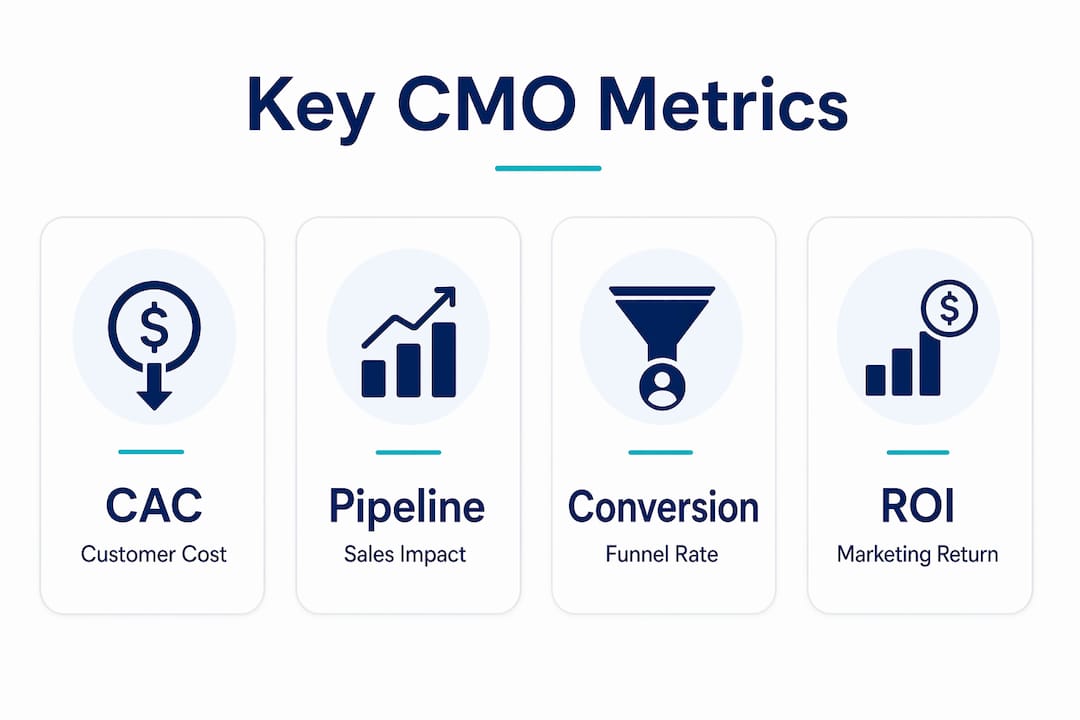
| Metric | Why it matters |
|---|---|
| Customer Acquisition Cost (CAC) | Shows the efficiency of spend across all acquisition channels |
| Pipeline contribution | Measures what percentage of the sales pipeline marketing directly sourced |
| Funnel conversion rates | Identifies where prospects drop off and where messaging needs improvement |
| Marketing ROI | Connects total marketing spend to closed revenue over a defined period |
| Patient engagement and retention | Tracks whether acquired patients or customers stay active and generate recurring value |
Data-driven measurement frameworks focused on CAC, pipeline contribution, and sales alignment are the standard for CMO accountability in high-growth environments. Vanity metrics like page views and follower counts do not belong in a board report.
Multi-channel attribution is particularly important in healthcare, where a buyer may engage with a webinar, a clinical white paper, a sales call, and a peer referral before converting. Call tracking tools and CRM-integrated attribution models connect those touchpoints to outcomes. Without this infrastructure, the CMO cannot defend the budget or justify increased spend to the board.
Pro Tip: Build your reporting dashboard before you need it. Founders often ask for marketing accountability after a missed quarter. The CMO who arrives with a pre-built framework earns credibility immediately and avoids the reactive scramble.
Key Takeaways
A healthcare startup CMO is the executive who connects clinical credibility with commercial growth, and hiring the right model at the right stage determines how fast the company scales.
| Point | Details |
|---|---|
| CMO vs. Chief Medical Officer | These are distinct roles; confusing them leads to costly hiring and strategic errors. |
| Fractional CMO timing | Early-stage startups below $30M ARR benefit most from fractional CMO arrangements. |
| First 90-day diagnostic | Validate ICP and messaging before scaling any acquisition channel or ad spend. |
| Clinical-marketing integration | The CMO must engage medical advisory boards and compliance teams to keep messaging credible. |
| Metrics that matter | CAC, pipeline contribution, and funnel conversion rates are the core CMO accountability measures. |
What I have learned about CMOs in healthcare startups
The CMO role in healthcare is harder than most founders expect. You are accountable to the board for revenue growth, accountable to clinical leadership for message accuracy, and accountable to the market for a brand that earns trust in a skeptical industry. That is a lot of pressure concentrated in one seat.
Healthcare CMOs face shorter tenures than their peers in other industries, often because the role absorbs blame for broader operational misalignment. I have seen this pattern repeatedly. A startup misses its growth targets, and the CMO becomes the visible fix. The real problem is usually that marketing was brought in too late to influence the product narrative or the go-to-market structure.
My advice to founders is direct: bring your CMO into the strategy conversation before the product launches, not after. The go-to-market mistakes that are hardest to fix are the ones baked into the product positioning from day one. A CMO who shapes that positioning early saves the company from expensive repositioning later.
If you are not ready for a full-time hire, a fractional CMO is not a compromise. It is the right structure for your stage. The goal is to get C-level marketing thinking into your company as early as possible, at a cost that matches your current revenue reality. That is the gap a fractional CMO is built to close.
— Paul
How Thestartupmd helps healthcare startups build marketing leadership
Healthcare founders building their first marketing function need more than a job description. They need a framework for what good looks like at each growth stage.
Thestartupmd works directly with healthcare SaaS startups and digital health companies to build that framework. Services include fractional CMO advisory, go-to-market strategy, CMO equity compensation structuring, clinical content development, and enterprise sales support. Paul Bergeron, MD, MBA brings 25+ years of clinical and executive experience to every engagement, giving your company a credible medical voice that opens enterprise doors. If you are ready to build a marketing function that connects clinical insight to commercial growth, explore the full range of healthcare startup services at Thestartupmd.
FAQ
What is a CMO in a healthcare startup?
A CMO in a healthcare startup is the Chief Marketing Officer, the executive responsible for market positioning, demand generation, and brand strategy. This role is distinct from a Chief Medical Officer, which focuses on clinical oversight and regulatory compliance.
When should a healthcare startup hire a CMO?
Most healthcare startups hire a full-time CMO at $30M–$50M ARR. Before that threshold, a fractional CMO provides C-level strategic guidance at a significantly lower cost.
What does a healthcare CMO do differently than a general CMO?
A healthcare CMO must translate complex clinical data into credible marketing narratives while navigating regulatory constraints. This requires direct collaboration with clinical leadership, medical advisory boards, and compliance teams.
How do you measure a healthcare CMO's performance?
The primary measures are Customer Acquisition Cost, pipeline contribution, funnel conversion rates, and marketing ROI. Vanity metrics like impressions and follower counts do not reflect CMO accountability in healthcare.
Is a fractional CMO right for an early-stage healthcare startup?
A fractional CMO is the right choice for most early-stage healthcare startups. It provides executive-level marketing strategy at 30–50% of a full-time hire's cost, with the flexibility to scale engagement as the company grows.