

A health IT vendor assessment is a structured review that validates your company's security controls, privacy compliance, interoperability capabilities, contracts, and operational maturity before an enterprise health system will sign a BAA and go live. The industry term for what you are building toward is "vendor readiness," and the output is a procurement-ready evidence shelf your buyers can review without chasing you for documents.
Your immediate TL;DR checklist — assemble these six artifacts first:
- SOC 2 Type II report (scoped to PHI-handling systems) [soc2 report]
- Signed BAA template with subprocessor flow-down clauses
- Subprocessor list reconciled line-by-line to the BAA
- Recent penetration test executive summary or bridge letter
- Data flow diagram showing where PHI enters, moves, and exits your system
- Application-level PHI audit logs (user identity, record ID, action, timestamp)
Reconciling your subprocessor list to the BAA is the single most common reason procurement stalls. Every tool that touches PHI must appear in the BAA's flow-down clauses — missing entries are not a paperwork technicality but a real HIPAA flow-down violation under 45 CFR §164.504(e).
Table of Contents
- What does a health IT vendor assessment actually cover?
- What documents do enterprise buyers actually request?
- How do you prove FHIR readiness to a procurement team?
- How do you run a vendor readiness assessment step by step?
- What mistakes cause deals to stall at the IT review stage?
- What should your procurement questionnaire answers look like?
- When should you hire a consultant instead of doing this in-house?
- Key Takeaways
- The gap most founders do not see until it costs them a deal
- The StartupMD helps healthcare SaaS founders pass enterprise vendor reviews
- Authoritative sources and further reading
What does a health IT vendor assessment actually cover?
Enterprise buyers divide their review into five domains, each owned by a different stakeholder.
Security controls fall to the CISO and security team. They map your environment against SOC 2 Trust Services Criteria, check encryption posture (in transit and at rest), verify MFA and RBAC evidence, and review your incident response plan. Their primary question: "Does this vendor's control environment match what their SOC 2 says?"
Privacy and BAA compliance is the privacy officer's territory. They compare every subprocessor in your stack against the BAA's flow-down clauses, confirm data residency, and check whether your DPA terms are consistent with HIPAA's minimum-necessary standard.
Interoperability goes to clinical informatics. They want to know which FHIR resources you support, which version (R4 is the current standard), and whether your integration is read-only or write-back. Vague EHR integration claims get flagged immediately.
Contracts and commercial terms sit with procurement and legal. They review indemnification, liability caps, breach notification timelines, and SLA commitments.
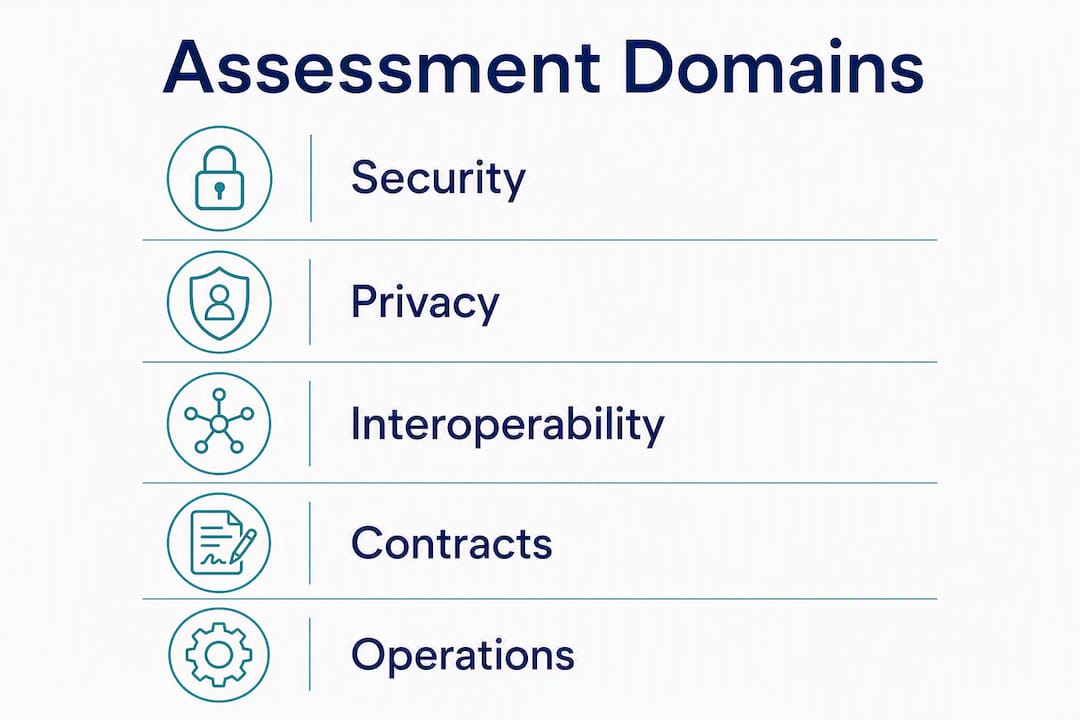
Operational maturity covers onboarding documentation, SLOs, and your incident response runbook. Buyers at 300-plus-bed health systems have seen too many vendors go dark after signing; they want evidence your team can actually operate at scale.
Scope your assessment to every system that touches PHI: your patient-facing app, any PHI-handling API, and your data pipeline. Leaving a component out of scope creates gaps that surface during the buyer's own review.
What documents do enterprise buyers actually request?
Buyers prioritize vendors who can hand over a complete documentation package on day one of procurement rather than assembling it mid-deal. Here is what they expect and what they check in each item.
| Artifact | What buyers verify |
|---|---|
| SOC 2 Type II | Scope covers PHI systems; 12-month observation window preferred; no critical observations unaddressed |
| BAA template | Flow-down clauses present; subprocessor list attached and current |
| Subprocessor list | Every PHI-touching tool listed; country of data processing noted |
| Pentest executive summary | Recent and with critical/high findings remediated or mitigated |
| Data flow diagram | PHI entry, transit, storage, and egress points all labeled |
| Application-level audit logs | User identity, record ID, action, timestamp captured at app layer |
| Encryption posture | encryption at rest and in transit; key management described |
| IR plan | Defined roles, notification timelines, breach escalation path |
| MFA/RBAC evidence | Screenshots or policy docs showing enforcement |
HITRUST r2 certification can reduce questionnaire volume for large health system buyers, but SOC 2 Type II is the common baseline most procurement teams require first. Treat HITRUST as an accelerant for later-stage deals, not a day-one requirement.
For pentest reports specifically: never share the full technical report publicly. Provide a redacted executive summary or a bridge letter for any gap between the report date and today. Procurement teams expect this practice and will ask for it by name.
Pro Tip: Build a Security Trust Center, a gated or NDA-protected portal where all artifacts live with direct links. Buyers who can self-serve documentation move faster through their internal approval queue, and a trust portal signals organizational maturity before a single meeting.
How do you prove FHIR readiness to a procurement team?
Vague answers here lose deals. Buyers expect one specific sentence per capability, not a marketing paragraph.
What to state explicitly:
- Supported FHIR resources (e.g., Patient, Observation, Condition, MedicationRequest)
- FHIR version (R4 is the current enterprise standard; note if you also support DSTU2 or STU3 for legacy systems)
- SMART-on-FHIR authorization support (OAuth 2.0 scopes, launch context)
- Read-only vs. write-back posture per resource
- USCDI v1/v3 data element coverage
Supporting evidence to attach:
- Conformance statement or CapabilityStatement resource
- Sandbox credentials and test endpoint URL
- Sample API call logs or test results
- Known limitations and your mitigation approach
Buyers treat ambiguous "we integrate with EHRs" answers as red flags and generate repeated follow-up questions that slow procurement by weeks. One precise sentence — "We support FHIR R4 read access for Patient, Observation, and Condition resources via SMART-on-FHIR OAuth 2.0" — closes the loop immediately.
How do you run a vendor readiness assessment step by step?
The process has five phases. Each builds on the last, and skipping one creates rework.
-
Intake and scoping (1–2 weeks). Define what is in scope: which systems touch PHI, which integrations exist, which third-party tools process patient data. Produce a scoping memo that maps to SOC 2 system boundaries.
-
Gap assessment (1–2 weeks). Compare your current controls and documentation against the artifact checklist above. Produce a gap report with findings ranked by procurement impact (subprocessor reconciliation and audit logging gaps rank highest).
-
Remediation sprints (4–12 weeks per tranche). Address gaps in priority order. Quick wins — reconciling subprocessors, enabling application-level logging, drafting a pentest bridge letter — can close in days. Policy and control gaps take longer.
-
SOC 2 Type II observation window (6–12 months if starting from scratch). This is the longest phase. Start scoping and selecting an auditor early; the observation clock does not start until controls are in place.
-
Final packaging and trust portal setup (1–2 weeks). Assemble all artifacts, publish your trust center, and prepare templated SIG/CAIQ answers.
| Phase | Timeline | Approximate cost range |
|---|---|---|
| Intake + scoping | 1–2 weeks | Consulting fees vary by engagement |
| Gap assessment | 1–2 weeks | Included in consulting scope |
| Remediation sprints | 4–12 weeks | Depends on gap depth |
| Pentest | 2–4 weeks | Costs vary based on scope |
| SOC 2 Type II audit | 6–12 months observation + audit | audit fees vary by engagement |
| HITRUST r2 (optional) | 6–12 months | certification costs vary widely |
Early investments compound. Scoped SOC 2 controls, subprocessor reconciliation, and application-level audit logging all map directly to HITRUST r2 requirements, so the work you do now reduces rework and audit cost later.

What mistakes cause deals to stall at the IT review stage?
Most procurement failures trace back to a short list of avoidable gaps.
- Subprocessor list not reconciled to the BAA. This is the top stall. Procurement teams compare every subprocessor against the BAA line by line; a missing entry triggers a legal hold that can push a deal back 2–3 months.
- Missing application-level PHI audit logs. Infrastructure logs do not satisfy this control. Buyers need to see who accessed which PHI record and when, at the application layer.
- SOC 2 scope gaps. A SOC 2 that excludes your primary PHI-handling system is worse than no SOC 2 because it signals the vendor organized for the audit rather than for security.
- Expired or absent pentest. A report older than 12 months raises questions. A missing pentest is a hard stop for most hospital security teams.
- Vague FHIR claims. "We support FHIR" without resource names and version numbers generates follow-up questions that slow procurement.
- Late BAA. Sending a BAA template only after the buyer requests it signals you have not done this before.
"The vendor's subprocessor list did not match the BAA. We cannot proceed until legal reviews the flow-down." That is the exact language procurement teams use to park a deal. The fix takes one afternoon: pull your BAA, list every tool that touches PHI, and reconcile them. Do it before the RFP arrives.
Fast fixes you can complete this week: reconcile subprocessors to the BAA, create a redacted pentest executive summary, and draft a one-page FHIR capability statement.
What should your procurement questionnaire answers look like?
A content library cuts SIG Core response time from 40–80 hours down to 6–10 hours. Build templated answers for these recurring questions:
- SOC 2 scope and date: "SOC 2 Type II scoped to our patient-facing application and PHI-handling API; observation period January 2025–December 2025. Report available under NDA via our trust portal."
- BAA availability: "We provide a standard BAA template. Custom redlines reviewed by legal within 5 business days."
- Subprocessor list: "Current subprocessor list available at [trust portal URL]. All subprocessors are US-based and contractually bound to HIPAA-equivalent terms."
- FHIR support: "FHIR R4; Patient, Observation, Condition, MedicationRequest resources; read-only via SMART-on-FHIR OAuth 2.0. Conformance statement available on request."
- Customer data and model training: "Customer PHI is not used to train models. Data use is limited to service delivery per the BAA."
- Pentest cadence: "Annual external penetration test; most recent completed [Month YYYY]. Redacted executive summary available under NDA."
Keep answers specific and free of marketing language. State exact limits. Point to the trust portal for documentation rather than attaching files to emails.
When should you hire a consultant instead of doing this in-house?
Three triggers make external help the faster path:
- No SOC 2 and a live RFP within 3 months. You need a gap report and a remediation plan immediately. A consultant who has done this before will cut weeks off your timeline.
- Subprocessor reconciliation plus legal redlines happening simultaneously. This requires both technical and legal expertise. A fractional CISO or healthcare-focused advisor handles both tracks without the context-switching cost.
- Clinical stakeholder questions you cannot answer. When a CMIO asks about clinical workflow impact or USCDI data element coverage, a fractional CMO with healthcare IT experience closes that gap in ways a security consultant alone cannot.
A well-scoped consultant engagement delivers in three milestones:
- 30 days: Gap report, scoping memo, prioritized remediation backlog.
- 60 days: Evidence shelf assembled, subprocessors reconciled, templated questionnaire answers drafted.
- 90 days: Trust portal live, pentest scheduled or bridge letter in place, SOC 2 auditor selected and observation window started.
When briefing a consultant, insist on a defined deliverable list before signing. Scope creep in vendor readiness engagements is common; a clear 30/60/90-day milestone structure keeps the engagement on track and gives you procurement-ready artifacts on a predictable timeline.
Key Takeaways
A health IT vendor assessment is a vendor readiness program: assemble your evidence shelf, reconcile subprocessors to the BAA, and enable application-level PHI audit logging before the first RFP arrives.
| Point | Details |
|---|---|
| Assemble the evidence shelf first | SOC 2 Type II, BAA template, subprocessor list, pentest summary, data flow diagram, and audit logs are the six non-negotiable artifacts. |
| Reconcile subprocessors to the BAA | Missing subprocessor entries are the top cause of procurement stalls and a real HIPAA flow-down violation. |
| State FHIR capabilities precisely | Name supported resources, version (R4), and read/write posture in one sentence; vague claims generate repeated follow-ups. |
| Start SOC 2 early | A 12-month observation window is preferred by hospital procurement teams; the clock starts only after controls are in place. |
| The StartupMD advisory engagement | A 30/60/90-day vendor readiness sprint delivers a gap report, evidence shelf, and trust portal on a defined timeline. |
The gap most founders do not see until it costs them a deal
Most founders treat vendor assessments as a compliance checkbox. That framing is expensive. The procurement review is actually a product review: buyers are evaluating whether your team can operate at enterprise scale, not just whether your paperwork is in order.
The founders who move through procurement fastest are the ones who built their evidence shelf before the first RFP arrived. They did not scramble to write a FHIR capability statement during a live deal. They did not discover a subprocessor gap when legal put a hold on the BAA. They treated readiness as a product milestone, the same way they treat a feature release.
The early investments that pay the largest return are application-level audit logging and a scoped SOC 2. Both close immediate procurement questions and map directly to HITRUST r2 controls, so the work compounds. A founder who waits until HITRUST is required pays for the same work twice.
A vendor readiness sprint structured around a gap report early and a live trust portal soon after is the most efficient path from "we're working on it" to "here is our trust center link." That is the framing The StartupMD brings to healthcare SaaS go-to-market strategy: readiness is not separate from growth, it is what makes growth possible.
The StartupMD helps healthcare SaaS founders pass enterprise vendor reviews
Healthcare SaaS founders who have a live deal and no SOC 2 need a specific kind of help: someone who understands both the clinical stakeholder questions and the security documentation requirements, and can move fast.
The StartupMD offers fractional advisory and vendor readiness assessments built specifically for healthcare SaaS companies. A typical engagement delivers a gap report and prioritized remediation plan within 30 days, a complete evidence shelf and templated procurement answers by day 60, and a live trust portal with SOC 2 scoping underway by day 90. Paul Bergeron, MD, MBA brings 25 years of combined medical and business experience, which means clinical informatics questions get answered alongside security ones, in the same engagement.
If you have an RFP in hand or an enterprise pilot on the horizon, the right first step is a readiness intake. Schedule an assessment with The StartupMD to get a clear picture of where you stand and what to fix first.
Authoritative sources and further reading
- Epic Vendor Security Review Guide (Nirmitee) — Covers subprocessor flow-down requirements and the Epic marketplace provisioning process; useful for BAA and SOC 2 scoping.
- Why Healthcare AI Startups Lose Enterprise Deals at the IT Review Stage (Aigilx Health) — Detailed breakdown of FHIR readiness expectations and application-level audit logging requirements.
- How Healthcare Innovators Can Prepare for Vendor Security Assessments (DashSDK) — Practical guidance on building a Security Trust Center and standardizing documentation.
- SOC 2 Type II for Healthtech Startups: The Hospital Procurement Checklist (Kleap Cybersecurity) — Explains observation window expectations and what procurement teams look for in a SOC 2 report.
- SaaS Security Questionnaire Prep: SIG, CAIQ, VSA Playbook (AxVeil) — Covers pentest report handling, bridge letters, and questionnaire response time benchmarks.
- SOC 2 vs. HITRUST for Healthcare SaaS Companies (All Star Tech) — Clear comparison of when SOC 2 is sufficient and when HITRUST r2 becomes necessary.
- Healthcare Compliance Priorities for Startups (Momentum) — Practical sequencing guidance for founders balancing HIPAA, SOC 2, and enterprise procurement demands.
- Healthcare Startup Regulatory Basics Explained for Founders (The StartupMD) — Covers regulatory stepping-stones and certification layering relevant to HITRUST planning.
- Startup Clinical Advisory Scope Explained for Founders (The StartupMD) — Describes fractional CMO scope and how clinical leadership supports vendor readiness reviews.