

A Medicare Accountable Care Organization (ACO) program is a coordinated care arrangement in which a group of doctors, hospitals, and other providers work together to manage the total cost and quality of care for an assigned group of Original Medicare beneficiaries, and you keep every right you have under Original Medicare, including the freedom to see any Medicare-accepting provider you choose.
The core promise of a Medicare ACO: Your providers share clinical information, coordinate your care, and may earn a portion of any savings they generate for Medicare — without restricting your access to any doctor or hospital that accepts Medicare.
For the 2026 performance year, CMS approved 134 new MSSP applications and reported the largest number of beneficiaries ever served by Medicare ACO initiatives, a signal that provider adoption of value-based care continues to grow. If your primary care doctor participates in an ACO, your care experience may feel more coordinated — but your coverage and your choices stay exactly the same.
Key Takeaways
Medicare ACO programs coordinate care for Original Medicare beneficiaries through provider groups accountable for cost and quality, without restricting beneficiary choice or changing Medicare coverage.
| Point | Details |
|---|---|
| ACO definition | A group of providers accountable for total cost and quality of care for assigned Medicare beneficiaries. |
| Your rights stay intact | You keep all Original Medicare rights and can see any Medicare-accepting provider at any time. |
| Assignment is automatic | Medicare assigns you based on where you receive most primary care; you do not enroll or sign anything. |
| Benefits vary by program | Care coordination and reduced duplicate tests are consistent; enhanced services like expanded telehealth depend on program type. |
| Evidence is mixed on savings | CMS reports meaningful savings in MSSP; CBO finds net budgetary savings vary by program design and provider behavior. |
Table of Contents
- How does a Medicare ACO program actually work?
- What are the main Medicare ACO programs?
- What does ACO participation mean for you as a Medicare patient?
- How does Medicare assign you to an ACO, and how can you find out?
- What are the risks and limits of Medicare ACO programs?
- What does the evidence say about ACO performance?
- How to explain ACOs to patients in plain language
- What actually makes ACOs succeed — a clinician's perspective
- Are you building for the ACO market? The StartupMD can help.
- Sources
How does a Medicare ACO program actually work?
The mechanics behind ACO programs are more specific than most patient-facing summaries suggest. Understanding them helps you know what your provider is accountable for and why that changes how your care is delivered.
Beneficiary assignment
Medicare does not ask you to enroll in an ACO. Instead, CMS assigns beneficiaries based on claims history — specifically, the plurality of primary care services you received from ACO-affiliated clinicians during a baseline period. Prospective assignment uses prior-year claims to predict who will be attributed before the performance year begins. Retrospective assignment finalizes the list after the year ends based on actual utilization. Both methods are used across different program tracks.
Payment mechanics and risk levels
Fee-for-service payments continue unchanged throughout the year. At year-end, CMS compares the ACO's actual spending against a risk-adjusted benchmark. If the ACO spends less than the benchmark and meets quality thresholds, it earns a share of those savings. This is the shared savings model.
Risk level is where program tracks diverge. One-sided risk (sometimes called "upside-only") means the ACO can earn savings but owes nothing if it exceeds the benchmark. Two-sided risk means the ACO shares in both savings and losses. MedPAC describes this spectrum clearly: newer ACOs typically start on one-sided tracks and graduate to two-sided arrangements over time, following a glide path built into the program rules.
Quality measurement
An ACO cannot collect shared savings on cost performance alone. CMS evaluates performance on a set of quality measures covering preventive care, chronic disease management, patient experience, and care coordination. Falling below quality thresholds disqualifies an ACO from shared savings even when it comes in under budget.
The annual cycle runs as follows:
- CMS sets a risk-adjusted spending benchmark for the ACO's assigned population.
- Providers deliver care throughout the performance year under standard fee-for-service billing.
- At year-end, CMS reconciles actual spending against the benchmark.
- ACOs that meet quality standards and beat the benchmark receive a shared savings payment.
- ACOs on two-sided tracks that exceed the benchmark owe a shared loss payment to CMS.
Pro Tip: If you are a primary care clinician in an ACO, ask your practice administrator which track your ACO is on and what quality measures are being tracked. That list directly shapes where your care coordination resources are focused.
What are the main Medicare ACO programs?
Three program types dominate the current landscape. Each carries different risk structures, eligibility rules, and patient-facing features.
| Program | Administered by | Risk model | Key focus |
|---|---|---|---|
| Medicare Shared Savings Program (MSSP) | CMS (permanent program) | One-sided and two-sided tracks | Broad provider participation; primary care-led |
| ACO REACH | CMMI (Innovation Center) | Professional or global risk | Health equity, access, new payment options |
| Historical pilots (Pioneer, NextGen, GPDC) | CMMI | Two-sided / full risk | Testing advanced risk models; now concluded or evolved |
Medicare Shared Savings Program (MSSP) is the permanent, large-scale program. CMS guidance establishes three-year agreement periods, defines eligible participants (physician groups, hospitals, critical access hospitals, and others), and sets the reconciliation timeline. Most ACOs a patient encounters will be MSSP participants.
ACO REACH (Realizing Equity, Access, and Community Health) is run by the Center for Medicare & Medicaid Innovation (CMMI). CMS describes ACO REACH as offering two risk options: a Professional model, where the ACO takes on 50% of financial risk, and a Global model, where the ACO assumes full risk for total cost of care. REACH also requires participating ACOs to submit health equity plans and allows model-specific enhanced benefits — such as expanded telehealth and post-discharge home visits — that go beyond what standard Original Medicare covers.
Historical models like Pioneer and NextGen ACOs tested higher-risk arrangements and informed the current program designs. They are no longer active, but their data shaped how MSSP tracks and REACH were structured.
For patients, the program type matters mainly because it determines which enhanced services your ACO can offer and how strongly your providers are financially motivated to manage total cost of care.
What does ACO participation mean for you as a Medicare patient?
The practical effects of your provider's ACO participation are real, but they operate quietly in the background of your care.
Coordinated care is the most tangible benefit. Medicare that ACO providers may use electronic health records (EHRs) to share your clinical information across the care team, reducing duplicate lab tests, imaging, and medication errors. When you are discharged from a hospital, an ACO-affiliated practice is more likely to have a structured follow-up protocol in place.
Possible enhanced services depend on the program. ACO REACH participants can offer benefits like expanded telehealth access and home-based care after a hospitalization — services not universally available under standard Original Medicare. These are model-specific, not guaranteed across all ACOs.
Your rights remain fully intact. This is the point most patients miss:
You are never locked into an ACO's provider network. As a Medicare beneficiary assigned to an ACO, you retain the right to see any doctor, specialist, or hospital that accepts Medicare — anywhere in the country. Assignment is an administrative classification, not an enrollment. You do not sign anything, and you cannot be penalized for going outside the ACO's affiliated providers.
From a practical standpoint, your primary care visits may feel slightly different. Expect more structured questions about your medications, recent specialist visits, and any emergency department use. Care coordinators may reach out between appointments. These are features of ACO-style care management, not restrictions.
A short patient checklist for ACO-affiliated primary care visits:
- Bring a complete medication list, including over-the-counter drugs and supplements.
- Mention any specialist visits or urgent care visits since your last appointment.
- Ask whether a care coordinator is available to help schedule follow-up appointments.
- Ask if telehealth visits are available for routine check-ins.
- Confirm that your preferred specialists are still accepting your Medicare coverage.
How does Medicare assign you to an ACO, and how can you find out?
Assignment is calculated from your claims data, not from a form you fill out. CMS looks at where you received the plurality of your primary care services — office visits, preventive care, and similar encounters — and attributes you to the ACO affiliated with those clinicians.
What assignment does not do: it does not restrict your provider choices, change your cost-sharing, or require your consent. You may receive a notice from your provider or from CMS informing you that your care is being coordinated through an ACO, but that notice is informational.
To find out whether your provider participates in an ACO, follow these steps:
- Call your primary care practice directly. Ask: "Is this practice part of a Medicare ACO or the Medicare Shared Savings Program?"
- Visit Medicare.gov. The coordinating your care page explains ACO participation and links to CMS resources.
- Ask your provider's billing office. They can confirm whether the practice has an active ACO agreement with CMS.
- Check your Medicare Summary Notice (MSN). Some ACO-related communications appear in your quarterly MSN.
- Contact 1-800-MEDICARE. Representatives can confirm whether your primary care clinician is affiliated with an ACO.
For family members or caregivers who manage appointments on behalf of a Medicare beneficiary: ask these questions at the first visit of the year, when care plans are typically reviewed. Knowing the ACO status of the primary care practice helps you understand why certain follow-up calls or care coordination outreach may occur.
What are the risks and limits of Medicare ACO programs?
ACOs are a genuine improvement over purely fee-for-service care in many settings, but they carry real trade-offs worth understanding.
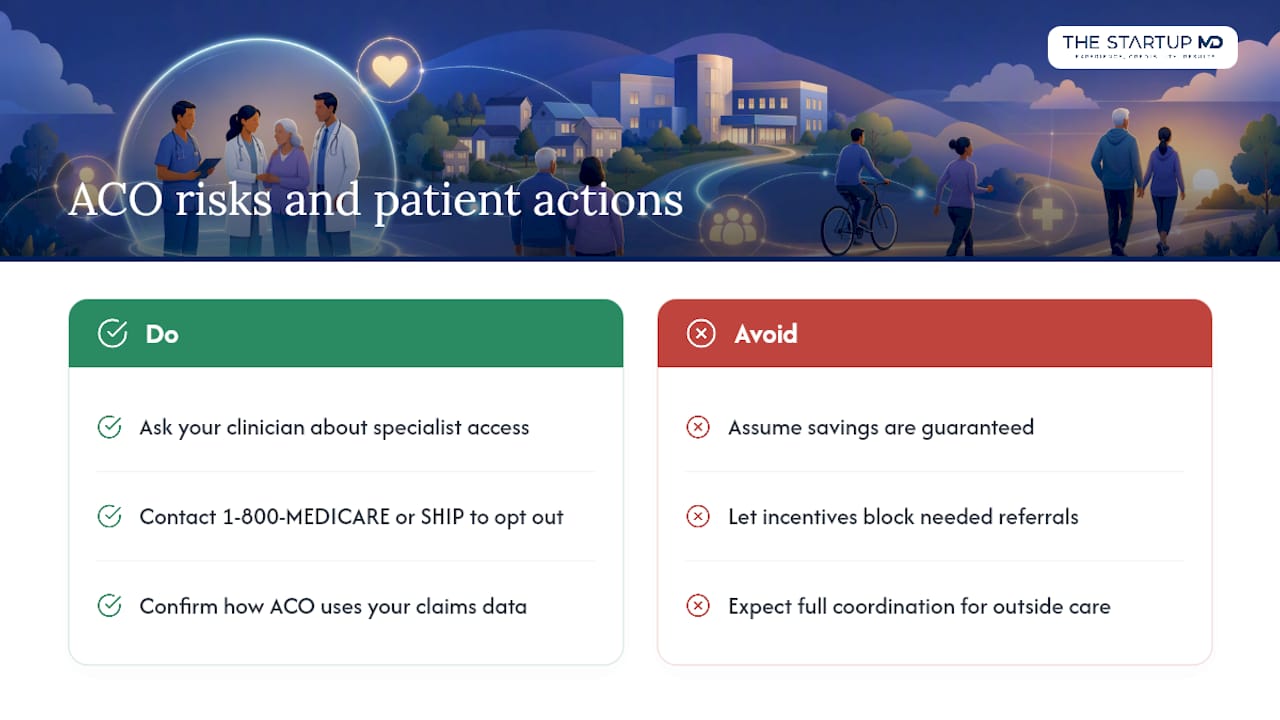
Provider incentive pressure. When an ACO operates under two-sided risk, clinicians and administrators face financial consequences for exceeding the spending benchmark. Academic reviews have noted that this creates a tension: the same financial incentive that encourages efficient care could, in poorly governed ACOs, discourage appropriate referrals or specialist use. This is not a universal outcome, but it is a documented concern in the literature.
Data sharing. ACOs request access to Medicare claims data for their attributed beneficiaries. CMS provides this data under strict privacy protections, and beneficiaries can opt out of having their identifiable data shared with the ACO. The data is used for care management, not marketing. Still, patients who prefer maximum data privacy should know this exchange occurs.
On data and privacy: CMS allows beneficiaries to request that their claims data not be shared with their ACO. If this matters to you, contact 1-800-MEDICARE or your State Health Insurance Assistance Program (SHIP) counselor to understand your options before the next performance year begins.
Mixed evidence on savings. The Congressional Budget Office found that ACOs' ability to produce net budgetary savings is mixed and depends heavily on program design and provider behavior. Some ACOs generate consistent savings; others do not. The aggregate effect on Medicare spending is more modest than early projections suggested.
Out-of-ACO utilization. Because you are free to see any Medicare provider, you may receive a significant portion of your care from clinicians outside the ACO. The ACO remains financially accountable for that spending anyway, which creates administrative complexity and can dilute the ACO's ability to coordinate your care effectively.
Pro Tip: If you are concerned that cost-saving incentives might affect your access to specialists or diagnostic tests, ask your primary care clinician directly: "Is there any reason I should not see a specialist for this?" A good ACO-affiliated clinician will refer appropriately regardless of financial incentives.
What does the evidence say about ACO performance?
The data on ACO performance is encouraging in some areas and more nuanced in others.
CMS has reported continuing meaningful savings and strong quality performance from the Medicare Shared Savings Program, with CMS reporting noting that ACOs led by primary care clinicians tend to achieve higher net per-capita savings. Primary care leadership appears to be one of the most consistent predictors of ACO success.
For the 2026 performance year, CMS approved 134 MSSP applications and reported the largest number of beneficiaries ever served by Medicare ACO initiatives, reflecting sustained and growing provider interest in value-based care arrangements.
MedPAC's analysis of ACO payment systems describes how benchmark-setting methodology, risk adjustment, and provider mix all influence whether an ACO generates net savings for Medicare. ACOs that start with lower baseline spending relative to their benchmark tend to find it harder to show savings over time, a structural challenge CMS has worked to address through benchmark rebasing rules.
The CBO's review of ACO research found that net budgetary savings depend on program design and provider behavior, and that aggregate savings across all ACOs have been more modest than initial projections. The most consistent outcome theme across the literature: reductions in unnecessary hospitalizations and emergency department use, particularly when ACOs invest in care management infrastructure.
For a patient deciding whether ACO-affiliated care is likely to improve their experience: the evidence suggests better care coordination and fewer redundant tests are the most reliable benefits, while large cost savings to Medicare as a whole remain variable.
| Evidence source | Key finding |
|---|---|
| CMS / MSSP performance reports | Continuing meaningful savings; primary care-led ACOs show stronger per-capita results |
| CMS 2026 participation data | 134 new MSSP applications approved; largest beneficiary count in program history |
| MedPAC Payment Basics | Benchmark methodology and provider mix significantly influence net savings |
| CBO review | Net budgetary savings are mixed; depend on program design and provider behavior |
How to explain ACOs to patients in plain language
Whether you are a clinician, a care coordinator, or a family member helping an older adult understand their care, these scripts and analogies help.
One-sentence scripts for different situations:
- For an older adult at a clinic visit: "Your doctor's practice is part of a Medicare program where your care team works together and shares your health information so you don't have to repeat your history at every appointment."
- For a caregiver on the phone: "The ACO is not a different insurance plan — your mom still has Original Medicare. It just means her doctors are coordinating with each other more formally."
- For a brief intake script: "We participate in a Medicare care coordination program. Your coverage doesn't change, but you may hear from a care coordinator between visits."
Simple analogies that work:
- Think of an ACO as a project manager for your healthcare. Your insurance (Medicare) is still paying the bills, but someone is now responsible for making sure the right people are talking to each other.
- It's like having a team captain for your care. Your specialists, primary care doctor, and hospital are still the same players — the ACO just makes sure they're running the same play.
Short FAQs for clinic intake or phone calls:
- "Do I have to sign up?" No. Medicare assigns you based on where you get most of your primary care. You don't enroll.
- "Can I still see my specialist?" Yes. You can see any doctor or hospital that accepts Medicare.
- "Will my costs change?" No. Your Medicare cost-sharing stays the same.
- "Why is someone calling me between appointments?" Care coordinators reach out to help manage chronic conditions, schedule follow-ups, and prevent unnecessary ER visits. It's a feature, not a problem.
What actually makes ACOs succeed — a clinician's perspective
The ACO model is structurally sound. The evidence on care coordination benefits is real, and the financial logic of shared savings gives providers a reason to invest in primary care infrastructure they previously had no incentive to build. But the gap between a well-functioning ACO and a struggling one almost always comes down to three things: the strength of primary care leadership, the quality of data infrastructure, and how seriously the organization invests in patient engagement.
ACOs that succeed tend to have physician leaders who understand both the clinical and financial dimensions of value-based care. They use data platforms that surface actionable signals — which patients are at risk of hospitalization, which chronic conditions are uncontrolled, which referrals are never completed. Without that infrastructure, the shared savings model is just a financial overlay on the same fragmented care delivery system it was designed to fix.
For healthtech founders and healthcare SaaS companies, this is where the opportunity is clearest. The ACOs that are generating consistent results are the ones investing in care coordination and patient engagement tools that close the gaps between visits. The clinical advisory work that informs those tools — understanding what a primary care team actually needs to manage a population — is the work that determines whether a product gets adopted or sits unused. Understanding clinical advisory scope is not optional for vendors building in this space.
Are you building for the ACO market? The StartupMD can help.
ACO-facing healthtech is one of the most complex and highest-stakes markets in digital health. The clinical workflows, CMS reporting requirements, and provider incentive structures require more than a good product — they require a team that understands how value-based care actually operates at the practice level.
The StartupMD provides fractional CMO and clinical advisory services for healthcare SaaS companies building tools for ACOs, primary care groups, and value-based care organizations. From product-market fit to investor readiness, the work is grounded in 25 years of combined clinical and business experience. If your product is designed to improve care coordination, population health management, or provider engagement in ACO settings, that is exactly the context The StartupMD works in every day.
Explore the healthcare SaaS revenue model evaluation guide to see how ACO-facing products are evaluated by investors and provider buyers.
Sources
The sources below are the primary references used in this article. Each is publicly available and free to access.
- Accountable Care Organization Payment Systems (MedPAC)
- Medicare Accountable Care Organizations: Past Performance and Future Directions | CBO
- 2026 Medicare accountable care organization initiatives participation highlights | CMS
- Coordinating your care | Medicare
- The New Accountable Care Organizations and Medicare Gain-Sharing Program | PMC
This article is general information, not a substitute for advice from a qualified lawyer. Consult a qualified legal professional about your own circumstances before acting on anything here.