

A narrow network is a health insurance plan that limits covered care to a select group of doctors, hospitals, and specialists in exchange for lower monthly premiums. The core trade-off is straightforward: you pay less each month, but you give up the freedom to see any provider you want. That trade-off works well for some people and creates real financial and clinical risk for others.
Three things to know before you read further:
- Emergency care is generally reimbursed at in-network rates even when the treating facility is out of network, under federal and most state rules.
- Narrow-network plans appear across ACA Marketplace plans, employer-sponsored coverage, and some Medicare Advantage and Medicaid products.
- Before you enroll, confirm that your current doctors and hospitals are in the plan's network — not just on the insurer's website, but by calling their offices directly.
Table of Contents
- How does a narrow network actually work?
- What are the real benefits of choosing a narrow-network plan?
- What are the main risks and downsides?
- Who should consider a narrow-network plan, and who should avoid it?
- How do you verify coverage and avoid enrollment mistakes?
- What does the research say about narrow networks, costs, and patient protections?
- Key Takeaways
- Why narrow networks are a signal, not just a cost lever
- Useful sources for further reading
How does a narrow network actually work?
An insurer building a narrow-network product starts by defining a cost and quality target, then selectively contracts with a subset of local providers willing to accept lower negotiated rates in exchange for a higher volume of referred patients. That selective contracting is what makes the network narrow. Fewer providers agree to the terms; the insurer passes the savings to enrollees as lower premiums.
Many narrow-network plans go a step further by applying value-based selection criteria, choosing providers based on measured performance, quality scores, and outcomes data rather than simply whoever accepts the lowest rate. The goal is a smaller panel of higher-performing clinicians, not just a cheaper one.
Once you enroll, the benefit mechanics work like this:
- Emergency care: Federal rules and most state frameworks require that emergency services be reimbursed at in-network cost-sharing levels, regardless of which facility treats you. HealthCare.gov outlines this protection for Marketplace enrollees.
Narrow-network structures are most common in Health Maintenance Organization (HMO) and Exclusive Provider Organization (EPO) plan designs on the ACA Marketplace, in employer-sponsored plans where the HR team has negotiated a lower-cost option, and in certain Medicare Advantage and Medicaid managed care products.
One important caveat: there is no standardized public rating for how narrow a network actually is. Consumer Reports notes that identifying true narrowness often requires manual validation rather than relying on a plan label.
Pro Tip: Call the provider's scheduling line and ask: "Are you currently in-network and accepting new patients under [plan name and ID]?" Then ask them to note your name and the date of that confirmation in your file. An insurer's online directory can lag weeks behind actual contract status.
What are the real benefits of choosing a narrow-network plan?
The most immediate benefit is cost. Lower premiums are the primary reason consumers choose narrow-network coverage, and the savings are measurable. A Health Affairs study found that plans with both narrow physician and hospital networks were associated with premiums substantially lower than comparable broad-network plans. Narrowing only one type of network — physician or hospital, but not both — was associated with a moderate decrease in premiums.
Statistic: Plans with both narrow physician and hospital networks carry premiums approximately 16% lower than broad-network equivalents, according to Health Affairs research on ACA Marketplace plans. Narrowing only one network type — physician or hospital — produces a moderate decrease in premiums of 6–9%. For a price-sensitive shopper, that gap can translate to hundreds of dollars per year in premium savings, especially when combined with ACA subsidies that are calculated against the second-lowest-cost silver plan in a given market.
Beyond cost, narrow networks can deliver better care coordination when the insurer has selected providers based on performance metrics. A tightly contracted panel of high-performing clinicians who share referral relationships and electronic health records can reduce duplicated testing and improve follow-through on care plans. That coordination benefit is most pronounced in plans that pair narrow networks with care management programs.
Key advantages at a glance:
- Lower monthly premiums, often significantly below broad-network alternatives in the same market
- Reduced out-of-pocket costs when you stay in-network, because negotiated rates are lower
- Potential for tighter care coordination among a curated provider panel
- Useful for healthy individuals with predictable, low-intensity healthcare needs
What are the main risks and downsides?
Limited provider choice is the most obvious drawback, but the financial exposure from going out of network is the one that catches people off guard. Some narrow plans offer zero out-of-network coverage outside of emergencies. If your preferred specialist is not in the network, you either switch providers or pay the full bill yourself.

Continuity of care is a serious concern for anyone managing a chronic condition. If your endocrinologist, rheumatologist, or oncologist is not in the plan's network, you face a disruptive transition mid-treatment. Provider panels also change during the year. A physician who was in-network when you enrolled can leave the network mid-year, leaving you scrambling for a replacement or absorbing out-of-network costs for ongoing care.
Access to specialists is where narrow networks create the most friction. Primary care physicians are usually well represented; specialist panels tend to be thinner. Finding an in-network cardiologist or neurologist in a rural or suburban market can require significant travel or a wait time that undermines the value of having coverage at all.
Common practical risks:
- Sudden network gaps when a provider retires, relocates, or drops a contract
- Prior authorization requirements that add delays for specialist referrals
- Out-of-area coverage gaps for enrollees who travel frequently or split time between locations
- Surprise bills when a facility is in-network but an individual provider (anesthesiologist, radiologist) is not
Warning: Out-of-network cost exposure in a narrow plan is not a minor inconvenience. Some plans provide no out-of-network benefit at all outside of emergencies. A single out-of-network specialist visit or an unplanned hospitalization at a non-participating facility can result in bills that dwarf an entire year of premium savings. Always confirm the out-of-network benefit structure before you sign up, and never assume a hospital being in-network means every provider in that hospital is covered.
Who should consider a narrow-network plan, and who should avoid it?
The answer depends almost entirely on your current health status, how often you use specialists, and whether your existing providers are in the network.
Profiles that tend to benefit:
Younger, generally healthy adults who see a primary care physician once or twice a year and rarely need specialists are the clearest fit. Price-sensitive shoppers who have confirmed their regular providers are in-network also do well. If you are enrolling through the ACA Marketplace and your subsidy makes the premium difference even larger, a narrow plan can be a genuinely smart financial choice.
Profiles that often should avoid narrow networks:
Anyone managing a complex chronic condition — diabetes with complications, autoimmune disease, cancer in active treatment, or serious mental health needs — faces real continuity risk. Patients who rely on a specific specialist or treatment center should verify that provider's participation before assuming the plan works for them. Caregivers who coordinate care for a family member with complex needs, or individuals who travel frequently for work, face similar access challenges.
Six-question decision checklist:
- Are my primary care physician and any specialists I see regularly in this plan's network?
- Are the hospitals I would use for surgery or emergency care in-network?
- How often do I need specialist care, and how far am I willing to travel for it?
- Do I have a chronic condition that requires consistent, ongoing specialist relationships?
- What is the plan's out-of-network benefit — partial coverage or none?
- If a provider leaves the network mid-year, what is my recourse?
If you answer "no" or "I'm not sure" to questions 1 or 2, stop and verify before enrolling. Consumer Reports identifies failing to verify frequently used providers as the single most common consumer mistake with narrow-network plans.
How do you verify coverage and avoid enrollment mistakes?
Verification is a process, not a single click. Online directories are useful starting points, but they are often outdated. The only reliable confirmation comes from a direct conversation with both the insurer and the provider's office.
Step-by-step verification checklist:
- Locate your plan ID. During open enrollment, find the exact plan name and ID number on the insurer's summary of benefits.
- Search the insurer's provider directory. Use the plan-specific directory on the insurer's website or on HealthCare.gov for Marketplace plans. Search for each provider by name and specialty.
- Call the provider's office. Ask the front desk: "Is Dr. [Name] currently in-network for [Plan Name, Plan ID]?" Confirm they are accepting new patients if you are not already established.
- Confirm hospital privileges. If a procedure is planned, verify that your surgeon has privileges at an in-network hospital and that the facility itself is in-network.
- Save documentation. Screenshot the directory result with a date stamp. Note the name of the staff member you spoke with and the date of the call.
Scripts that work:
When calling the insurer: "I am considering enrolling in [Plan Name]. Can you confirm that [Provider Name, NPI number if available] is currently contracted and in-network under this plan?"
When calling the provider: "I am planning to enroll in [Plan Name] from [Insurer]. Are you currently in-network under that plan, and are you accepting new patients?"
Special circumstances to address before enrolling:
- Ongoing specialty care: ask whether a continuity-of-care exception or transition period applies if your current specialist is out of network.
- Planned surgeries: confirm in-network status for the surgeon, the facility, and the anesthesiology group.
- Out-of-area care: ask whether the plan has any reciprocal agreements for care received outside your home region.
Pro Tip: Ask the provider's billing department, not just the front desk, to confirm network status. Billing staff interact with insurers daily and are more likely to catch a recent contract change that hasn't updated in the online directory yet.
What does the research say about narrow networks, costs, and patient protections?
The evidence on narrow networks is real, mixed, and worth understanding before you choose a plan.
On premiums, the data is consistent. The Health Affairs analysis of ACA Marketplace plans found that plans with both narrow physician and hospital networks were associated with premiums approximately 16% lower than broad-network plans. That same research notes a downstream policy effect: because ACA subsidies are pegged to the second-lowest-cost silver plan in each market, widespread narrow-network offerings can compress subsidy calculations across an entire region.
On access and quality, the picture is more complicated. A systematic review published in PMC found mixed evidence on how narrow and tiered networks affect access, quality, and patient steering. Some studies show that tightly managed panels with value-based selection improve care coordination; others document access barriers, particularly for specialist-dependent patients. KFF's analysis of physician network breadth across Marketplace plans shows substantial variation — some plans include a large share of local physicians while others cover a small fraction.
| Study / Source | Key Finding | Practical Implication |
|---|---|---|
| Health Affairs (Marketplace analysis) | Plans with narrow physician and hospital networks: ~16% lower premiums | Meaningful savings for healthy enrollees who stay in-network |
| PMC Systematic Review | Mixed evidence on access and quality outcomes | Chronic-condition patients face higher risk; healthy enrollees may see no quality difference |
| KFF Marketplace Analysis | Wide variation in physician network breadth across plans | Network size is not visible on plan labels; manual verification is required |
| Consumer Reports | No standardized narrowness rating exists | Consumers must validate directories manually before enrolling |
On regulatory protections, the Federal Register's HHS Notice of Benefit and Payment Parameters establishes Marketplace network reporting and adequacy requirements. Fair Health Consumer notes that network adequacy is defined by provider-type representation, geographic access, and panel size — but that the ACA set a general federal floor while states implement and enforce the specifics. Enforcement varies considerably. Some states have robust quantitative standards; others rely on complaint-driven review.
Emergency care protection is one area where the rules are relatively consistent: most regulatory frameworks require that emergency services be reimbursed at in-network cost-sharing levels regardless of facility participation. For non-emergency care, you are on your own if you go outside the network.
For healthcare SaaS founders and clinical product teams, the healthcare startup regulatory basics that govern Marketplace products directly affect how narrow-network plans are designed, reported, and audited. Understanding network adequacy standards is not optional for teams building payer-facing tools.
Pro Tip: If you are a clinician or product leader evaluating narrow-network design, track provider churn rates within contracted panels. A high churn rate signals contract instability and is a leading indicator of member access complaints and regulatory scrutiny — both of which affect plan performance scores and renewal negotiations.
Key Takeaways
Narrow-network plans deliver real premium savings, but those savings come with genuine access risk that only careful pre-enrollment verification can manage.
| Point | Details |
|---|---|
| Premium savings are real | Plans with both narrow physician and hospital networks carry premiums approximately 16% lower than broad-network alternatives, while narrowing only one network type (physician or hospital) produces premiums 6–9% lower than broad-network plans. |
| Verify providers before enrolling | Call each provider's office directly — online directories are frequently outdated and can show inactive contracts. |
| Out-of-network exposure is high | Some narrow plans offer zero out-of-network coverage outside emergencies; confirm the benefit structure before signing up. |
| Chronic-condition patients face the most risk | Continuity of care breaks down when specialists are excluded or leave the network mid-year. |
| Emergency care has federal protection | Emergency services are generally reimbursed at in-network rates under federal and most state rules, even at non-participating facilities. |
Why narrow networks are a signal, not just a cost lever
Narrow networks reveal something important about how a payer thinks about care delivery, highlighting the need for compliance-minded administration in healthcare operations. When a plan selects providers based on performance metrics and outcomes data rather than simply whoever accepts the lowest rate, it is making a clinical argument — not just a financial one. That distinction matters for anyone building products or partnerships in the payer space.
From where I sit, the consumer conversation about narrow networks tends to stop at premiums. That is understandable. A reduction in monthly cost is tangible. But the more interesting question for healthcare SaaS founders and clinical executives is what happens inside a narrow network once it is operational. Provider churn, directory accuracy, and continuity metrics for high-utilization cohorts are the variables that determine whether a narrow-network product succeeds or generates member complaints and regulatory exposure.
If you are building a tool that touches payer-provider contracting, care coordination, or member engagement, the narrow-network structure of your target customer's plan is a design constraint, not background context. A digital health market entry strategy that ignores network structure will misread the access patterns and referral flows your product needs to support.
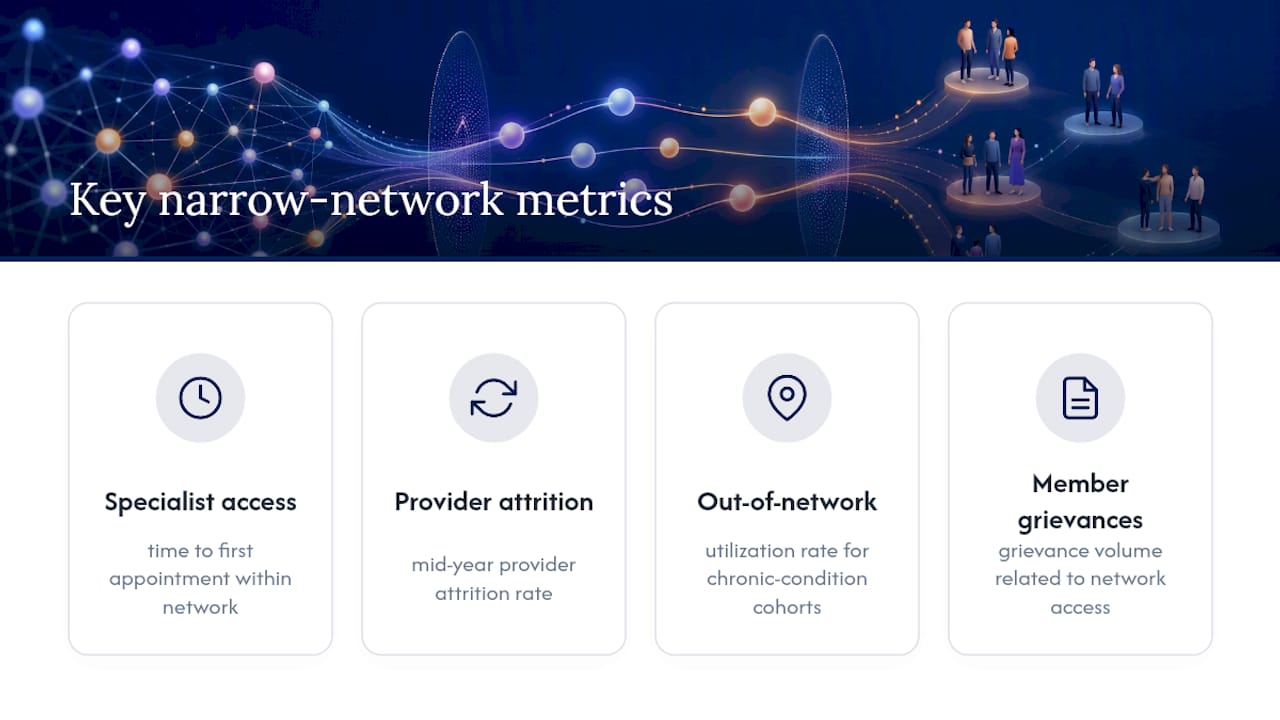
The metric set I recommend for any team monitoring narrow-network performance: specialist access rate (time to first appointment within network), mid-year provider attrition rate, out-of-network utilization rate for chronic-condition cohorts, and member grievance volume related to network access. Those four numbers tell you whether the network is functioning as designed or quietly failing the patients it was built to serve.
Narrow networks are not inherently good or bad for patients. They are a structural choice with predictable consequences. The teams that understand those consequences — and build products that account for them — are the ones that earn durable payer partnerships. If you are working through how this applies to your product or contracting strategy, The StartupMD's advisory services are built for exactly that conversation.
Useful sources for further reading
- Narrow Networks On The Health Insurance Marketplaces: Prevalence, Pricing, And The Cost Of Network Breadth (Health Affairs)
- Narrow Network Health Insurance Plans FAQ — Consumer Reports
- Patient Protection and Affordable Care Act; HHS Notice of Benefit and Payment Parameters for 2023 (Federal Register)
- HealthCare.gov
- Narrow networks — Fair Health Consumer
- How narrow or broad are ACA Marketplace physician networks? (KFF)
This article provides general information about narrow-network health insurance plans and is not a substitute for personalized insurance, legal, or medical advice. Verify current plan details, network status, and regulatory requirements directly with your insurer, a licensed broker, or the relevant state insurance authority.