

Episode-based payment, also called bundled payment, replaces the traditional fee-for-service (FFS) model with a single, predetermined payment covering all eligible services and supplies during a defined clinical episode. CMS describes it as a mechanism that holds providers accountable for both cost and quality across the full continuum of care, from the anchor event through a post-discharge window. The immediate operational takeaway: under this model, your organization bears financial risk for total episode spending, not just the services you directly bill.
Three authoritative sources frame the field. The CMS Innovation Center designs and administers the major federal models. The American Hospital Association (AHA) provides operational guidance for hospital systems navigating participation decisions. NEJM Catalyst offers peer-reviewed policy commentary on model design and evidence.
Key facts administrators and policymakers should hold before reading further:
- Episode-based payment (EBP) is distinct from capitation: it covers a defined clinical event, not a population over time.
- Providers typically continue billing FFS during the episode; reconciliation against a target price happens later.
- Risk arrangements range from upside-only (shared savings, no repayment) to two-sided (savings and repayment liability).
- Quality performance modifies the final settlement in every major CMS model.
- The four dominant federal models are CJR, BPCI, BPCI Advanced, and TEAM.
Key Takeaways
Episode-based payment holds providers accountable for total episode cost and quality, requiring parallel FFS operations and reconciliation analytics, strong PAC contracting, and robust risk adjustment to succeed.
| Point | Details |
|---|---|
| Core definition | A single target price covers all services in a defined clinical episode; providers share savings or owe repayment at reconciliation. |
| Operational requirement | Most models are retrospective, so FFS billing and episode analytics must run in parallel throughout the performance year. |
| Primary financial risk | PAC utilization drives most episode cost variation; conveners must contract PAC partners with shared financial and quality incentives. |
| Main policy levers | Mandatory vs. voluntary design, risk adjustment depth, and quality measure strength determine whether models reduce costs without harming equity. |
| First step | Complete a data readiness audit and model your episode cost distribution before committing to two-sided risk or convener status. |
For CMS model fact sheets and technical documentation, start at the CMS Innovation Center. For advisory support in evaluating whether your organization or product is ready to operate under an episode payment model, The StartupMD's healthcare SaaS revenue model evaluation and fractional CMO services are built for exactly this kind of strategic readiness work.
Table of Contents
- What is episode-based payment, and how are episodes defined?
- How does episode-based payment work operationally?
- What are the major U.S. episode-based payment models?
- What are the intended benefits of episode-based payment?
- What are the key risks and equity concerns?
- How do you implement an episode-based payment program?
- How do you measure performance under an episode payment model?
- What should policymakers consider when designing episode-based payment programs?
- The implementation gap most administrators underestimate
- Sources
What is episode-based payment, and how are episodes defined?
NEJM Catalyst defines bundled payment as a model in which participant providers assume risk and reconcile total allowable episode expenditures against a predetermined target price, then share in savings or are liable for excess costs depending on model design. That single sentence captures the core accountability shift.
Core terminology
Before evaluating a contract or model fact sheet, administrators need a shared vocabulary. The terms below appear in virtually every CMS technical document and payer agreement.
- Episode of care: The full set of services associated with a defined clinical event, bounded by a start date (the anchor event) and an end date (typically 30 or 90 days post-discharge).
- Anchor event: The triggering clinical event that opens the episode, usually an inpatient admission or an outpatient procedure with a qualifying diagnosis or procedure code.
- Target price: The prospectively set benchmark against which actual episode spending is compared at reconciliation. It typically reflects historical spending adjusted for a Medicare discount.
- Reconciliation: The periodic settlement process in which actual episode costs are compared to the target price and a payment or repayment is calculated.
- Risk adjustment: Modifications to the target price that account for patient acuity, comorbidities, or other factors that legitimately drive higher spending.
- Convener: An entity (often a hospital or health system) that accepts the episode payment from CMS and subcontracts financial and quality accountability to downstream providers.
- Retrospective payment: The provider bills FFS as usual; reconciliation happens after the episode closes.
- Prospective payment: A lump sum is paid at episode initiation; no separate FFS claims are submitted.
How an episode is triggered and bounded
Consider a straightforward example. A Medicare beneficiary undergoes a total knee replacement. The anchor event is the inpatient admission. The episode clock starts on the day of admission and runs 90 days post-discharge under BPCI Advanced. Every Medicare Part A and Part B service the patient receives during that window, including the surgery, inpatient stay, skilled nursing facility care, home health, outpatient physical therapy, and any readmissions, counts toward the episode's total cost. At reconciliation, that total is compared to the target price. If actual spending falls below the target, the convener retains a portion of the difference. If it exceeds the target, the convener owes the difference back to CMS.
Episodes can be as short as an inpatient stay or extend up to six months, depending on the model's clinical rationale and the post-acute utilization patterns typical for that condition.
How does episode-based payment work operationally?
The mechanics sit at the intersection of claims processing, actuarial modeling, and care management. Getting them wrong is expensive.
Target price calculation
Target prices are calculated prospectively, before the performance year begins. CMS typically uses one of three methodologies:
- Historical provider baseline: The participant's own prior spending on similar episodes, adjusted for trend and case mix.
- Regional benchmark: Average spending across a geographic region, which can disadvantage high-cost markets but rewards efficient ones.
- Blended approach: A weighted combination of provider-specific and regional data, phased in over time to smooth the transition.
Every methodology includes a Medicare discount, meaning the target price is set below historical average spending. That discount is the mechanism through which CMS captures savings even when providers perform at their historical average. Administrators should model this discount explicitly when projecting financial exposure.
Retrospective vs. prospective payment flows
CMS technical documentation confirms that most federal models are retrospective: participants continue to receive FFS payments during the episode, and reconciliation against the prospectively set target price occurs at a defined settlement date. The practical consequence is that your billing department runs two parallel workflows. FFS claims go out in real time. Reconciliation analytics run in the background, tracking cumulative episode spending against the target. A mismatch between those two data streams is one of the most common sources of financial surprise at settlement.
Prospective models pay a lump sum at episode initiation and require the convener to manage all downstream costs from that payment. They simplify reconciliation but demand strong actuarial reserves and tight PAC contracting from day one.
Pro Tip: If your organization is entering a retrospective model, build a shadow reconciliation report that runs weekly against your target price. Waiting for CMS's quarterly reconciliation report to learn you are over target is too late to change care patterns.
Risk-sharing arrangements
- One-sided (upside-only): The provider shares in savings if actual spending falls below the target but owes nothing if it exceeds it. Lower financial risk, but CMS typically offers a smaller savings share.
- Two-sided (upside and downside): The provider shares in savings and is liable for repayment if spending exceeds the target. Higher risk, but CMS generally offers a larger savings share and sometimes a higher target price.
Most organizations start with one-sided arrangements and transition to two-sided as their data and care management capabilities mature.
Quality adjustments and their role in settlement
Quality performance modifies the final reconciliation in every major CMS model. Poor performance on specified measures can reduce or eliminate shared savings. In some model designs, quality failures can convert a savings position into a repayment obligation. The measures typically include readmission rates, complication rates, and patient-reported outcomes. Administrators should treat quality reporting not as a compliance exercise but as a direct financial lever.
What goes into an episode's total cost
- Medicare Part A services: inpatient stay, skilled nursing facility, inpatient rehabilitation, home health
- Medicare Part B services: physician fees, outpatient therapy, durable medical equipment
- Post-acute care (PAC) costs: the largest driver of episode cost variation
- Readmissions within the episode window
- Complications requiring additional procedures or extended care
What are the major U.S. episode-based payment models?
The CMS Innovation Center has run several episode-based payment models since 2013. Four are most relevant to administrators and policymakers today.
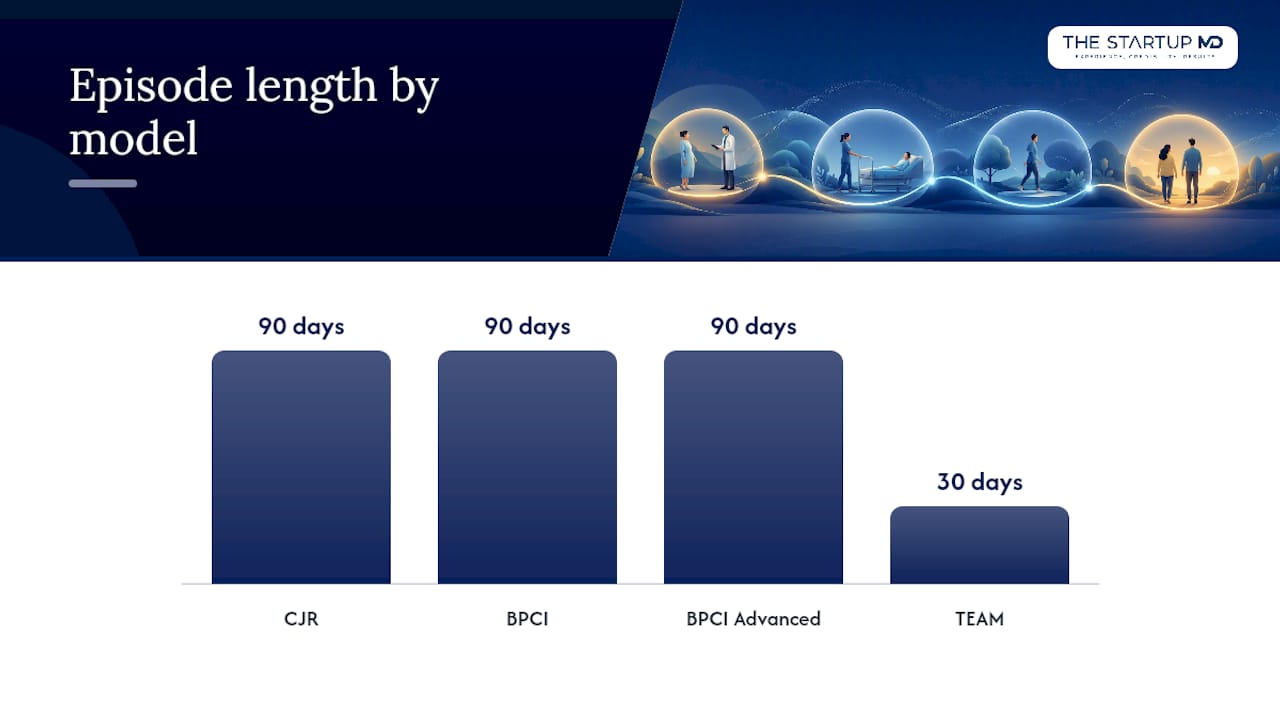
Comprehensive Care for Joint Replacement (CJR) was CMS's first mandatory bundled payment model for lower extremity joint replacement. It covers 90-day post-discharge episodes and uses a two-sided risk structure for most participants. Target prices blend provider-specific and regional data. CJR demonstrated that mandatory participation can drive broad adoption and produce measurable variation reduction in PAC utilization.
BPCI (Bundled Payments for Care Improvement) was a voluntary model that ran across dozens of clinical episode groups. It gave hospitals and physician groups flexibility to select the clinical conditions they felt most confident managing under a bundle. That voluntary, self-selection design produced strong results in some episode types but also allowed participants to exit when financial exposure grew.
BPCI Advanced built on BPCI's lessons. Reconciliation technical documents confirm that it uses 90-day episodes for joint replacements and a range of other clinical groups, with target prices set at the start of each performance year and reconciliation tied directly to quality performance. It is voluntary and covers both inpatient and outpatient anchor events.
TEAM (Transforming Episode Accountability Model) is the current mandatory model. CMS describes TEAM as covering five specified surgical episodes with 30-day post-discharge windows, running across a defined multi-year performance period. Participants bill FFS as usual, with reconciliation and quality adjustments applied at settlement. TEAM's mandatory design signals CMS's intent to drive systemic change rather than rely on voluntary adoption.
| Feature | CJR | BPCI | BPCI Advanced | TEAM |
|---|---|---|---|---|
| Episode length (post-discharge) | 90 days | 90 days | 90 days | 30 days |
| Payment timing | Retrospective | Retrospective | Retrospective | Retrospective |
| Risk structure | Two-sided | One- or two-sided | Two-sided | Two-sided |
| Clinical focus | Lower extremity joint replacement | Multiple medical and surgical | Multiple surgical and medical | Five specified surgical episodes |
| Participation | Mandatory (selected markets) | Voluntary | Voluntary | Mandatory |
| Target price methodology | Blended (provider + regional) | Provider historical | Provider + regional blend | Regional/blended |
| Quality measures | Yes, modifies payment | Yes | Yes, tied to reconciliation | Yes, modifies payment |
| Reconciliation cadence | Annual with interim reports | Annual | Annual with performance year targets | Annual with interim monitoring |
Administrators evaluating participation should also review CMS model fact sheets and technical documentation directly, as model rules are updated between performance years.
What are the intended benefits of episode-based payment?
CMS frames episode-based payment as a middle ground between FFS and full capitation. It preserves the FFS billing infrastructure providers depend on while layering value-based accountability on top. That positioning matters for policymakers designing transition pathways.
The intended benefits are well-documented:
- Care coordination: A single accountable entity has financial incentive to manage the full episode, reducing handoff failures between acute and post-acute settings.
- Reduced fragmentation: Providers who previously had no financial relationship are brought into a shared accountability structure.
- Lower cost variation: Bundled payment creates pressure to standardize care pathways, which tends to reduce the wide variation in PAC utilization that drives most episode cost differences.
- Incentive alignment: Physicians, hospitals, and PAC providers share a common financial goal rather than optimizing their individual FFS revenue.
- Predictable pricing: Payers gain cost predictability for high-volume procedures.
Peer-reviewed evaluations indicate that bundled payments can lower costs and reduce variation in some contexts, but results are heterogeneous and depend heavily on episode selection and implementation quality. The evidence is promising, not conclusive. Models covering surgical episodes with well-defined post-acute pathways, such as joint replacement, have shown more consistent results than those covering complex medical episodes with less predictable trajectories.
The strongest savings signal in evaluated models comes not from reducing acute care costs but from shifting PAC utilization toward lower-intensity settings, such as home health over skilled nursing facilities, when clinically appropriate.
What are the key risks and equity concerns?
Episode-based payment introduces financial accountability that can, if poorly designed, create perverse incentives. Administrators and policymakers need to anticipate these risks before signing contracts or designing models.
Operational and financial risks:
- Patient selection (cream skimming): Providers may avoid high-risk patients whose expected episode costs exceed the risk-adjusted target price, concentrating complex patients in safety-net settings.
- Inadequate risk adjustment: If the target price does not accurately reflect patient acuity, providers treating sicker populations will systematically lose money, regardless of care quality.
- Downside financial exposure: Two-sided models create real repayment liability. Organizations without actuarial reserves or stop-loss arrangements can face cash flow crises at settlement.
- Administrative burden: Running parallel FFS and reconciliation workflows requires dedicated analytics staff, data infrastructure, and contract management capacity that many smaller organizations lack.
- Data gaps: Reconciliation errors frequently trace back to missing PAC claims, delayed coding, or mismatched episode attribution logic between the provider's system and CMS's.
Equity concerns:
Providers serving high proportions of low-income, dual-eligible, or medically complex patients face structural disadvantages under episode-based models if risk adjustment is insufficient. The AMA warns that contract complexity and inadequate risk adjustment can unfairly penalize clinicians treating high-acuity populations. Weak quality measures compound the problem: if quality thresholds are easy to meet, there is no safeguard against care avoidance or under-provision for patients who generate financial losses.
Policy warning: Three contractual traps appear repeatedly in episode-based payment agreements. First, ambiguous service inclusion rules that leave PAC costs in a gray zone between "in episode" and "excluded." Second, risk-adjustment methodologies that are not disclosed in the contract, leaving providers unable to audit their own target prices. Third, aggressive discounting in the target price that makes the model financially unviable even with excellent care management. Review every contract against these three failure points before signing.
How do you implement an episode-based payment program?
Operational success depends on precise episode definitions, strong data interoperability, and recognition that most models run as retrospective reconciliations alongside FFS workflows. Organizations that treat EBP as a billing change rather than an operational transformation consistently underperform.
Prioritized implementation checklist
- Establish governance and convener accountability. Designate a convener entity and define its authority over PAC contracting, care pathway decisions, and financial settlement. Ambiguous governance is the single most common cause of implementation failure.
- Conduct actuarial and finance readiness assessment. Model your expected episode cost distribution, identify your stop-loss threshold, and confirm reserve capacity for two-sided risk before committing to downside exposure.
- Audit data interoperability. Map every data feed required to assemble complete episodes: inpatient claims, Part B claims, PAC claims, EHR discharge events, and readmission flags. Gaps here produce reconciliation errors.
- Design clinical pathways for target episodes. Work with clinical leads to define evidence-based care pathways that reduce PAC variation. Pathways should specify preferred PAC settings, discharge criteria, and follow-up protocols.
- Negotiate PAC partner agreements. Conveners who share financial and quality incentives with PAC partners consistently outperform those who do not. Contracts should include shared savings provisions and quality benchmarks.
- Build patient engagement and consent processes. Patients need to understand that their care team is coordinating across settings. Consent processes should explain the episode model without creating confusion about their coverage.
- Establish monitoring and escalation protocols. Define the metrics that trigger a clinical or financial escalation, and assign ownership to a named role.
Typical pilot timeline
A realistic pilot runs across three phases. The preparation phase (months 1–4) covers governance setup, data infrastructure build, and PAC contracting. The go-live phase (months 5–12) runs the first performance year with weekly shadow reconciliation. The evaluation phase (months 13–18) covers the first annual reconciliation, performance review, and pathway refinement before year two.
Internal roles and ownership
- Convener lead: Owns the CMS relationship, contract terms, and settlement mechanics.
- Care navigator: Manages patient transitions, PAC placement decisions, and readmission prevention.
- Finance lead: Runs shadow reconciliation, models financial exposure, and manages reserves.
- Analytics lead: Maintains episode assembly logic, monitors daily/weekly cost and utilization metrics, and flags reconciliation discrepancies.
Pro Tip: The most common reconciliation error is a PAC claim that arrives after the episode window closes in your internal system but before CMS's reconciliation cutoff. Build a 30-day claims lag buffer into your episode assembly logic to catch late-arriving claims before they become surprises at settlement.
How do you measure performance under an episode payment model?
Measurement under an episode payment system runs on two tracks: operational monitoring that drives daily care decisions, and financial reporting that drives settlement and strategy.
Core performance metrics
- Cost per episode vs. target price (variance, not just absolute cost)
- PAC utilization rate and setting mix (skilled nursing facility vs. home health vs. inpatient rehabilitation)
- 30-day and 90-day readmission rates
- Complication rates within the episode window
- Patient-reported outcomes (where collected)
- Patient experience scores
- Reconciliation adjustments paid or owed per performance period
Recommended reporting cadence
| Reporting level | Frequency | Primary audience | Key metrics |
|---|---|---|---|
| Operational monitoring | Daily / weekly | Care navigators, clinical leads | Readmissions, PAC placements, open episodes |
| Financial tracking | Monthly | Finance lead, convener | Cumulative episode cost vs. target, variance trend |
| Reconciliation report | Quarterly (interim) | Finance, executive team | Projected settlement position, quality measure status |
| Annual settlement | Annually | Executive team, board | Final reconciliation, savings or repayment, quality adjustments |
Minimum data feeds for a functional dashboard
- Real-time or near-real-time inpatient claims feed
- Part B professional claims (typically 2–4 week lag)
- PAC claims (skilled nursing facility, home health, inpatient rehabilitation)
- EHR discharge and readmission events
- Patient-reported outcome registry data (where applicable)
The EHR integration layer is not optional. Without it, care navigators are working from claims data alone, which runs 2–4 weeks behind clinical reality. That lag is long enough for a preventable readmission to occur and close before anyone flags it.
What should policymakers consider when designing episode-based payment programs?
Policy design choices made at the model level cascade into every provider's operational reality. Federal Register materials and CMS requests for information document ongoing stakeholder engagement on exactly these tradeoffs, reflecting that model design remains an active policy question.
Core tradeoffs:
- Mandatory vs. voluntary participation: Mandatory models achieve broader adoption and reduce selection bias but impose financial risk on organizations that may lack readiness. Voluntary models allow early adopters to lead but concentrate participation among already-efficient providers.
- Prospective vs. retrospective target prices: Prospective prices give providers certainty but require accurate forecasting. Retrospective reconciliation is more familiar but delays financial feedback.
- Depth of downside risk: Deeper downside risk accelerates behavior change but can destabilize safety-net providers. Phased risk introduction, starting with upside-only and transitioning to two-sided, is the most common mitigation.
- Scope of included services: Narrow episode definitions reduce administrative complexity but may shift costs to excluded services. Broad definitions capture the full continuum but increase attribution disputes.
- Transparency of pricing inputs: Providers who cannot audit their own target prices cannot manage to them. Transparent methodology is both a fairness requirement and a performance driver.
Recommended design principles:
- Build robust, auditable risk adjustment into every model from the start.
- Phase implementation: pilot with voluntary participants, evaluate rigorously, then expand.
- Require a strong quality measure set that prevents stinting, with measures tied directly to payment modification.
- Provide dedicated technical assistance for safety-net providers and smaller organizations that lack internal analytics capacity.
- Mandate public reporting of performance results by provider and episode type to enable accountability and equity monitoring.
- Engage stakeholders, including patient advocates, clinician groups, and PAC providers, during model design, not just during comment periods.
Short-term savings achieved by shifting financial risk to unprepared providers are not durable. Models that invest in provider readiness and transparent pricing produce better long-term results for both payers and patients.
The implementation gap most administrators underestimate
The policy framing around episode-based payment is clear. The mechanics are well-documented. What gets organizations into trouble is the distance between understanding the model and being operationally ready to run it.
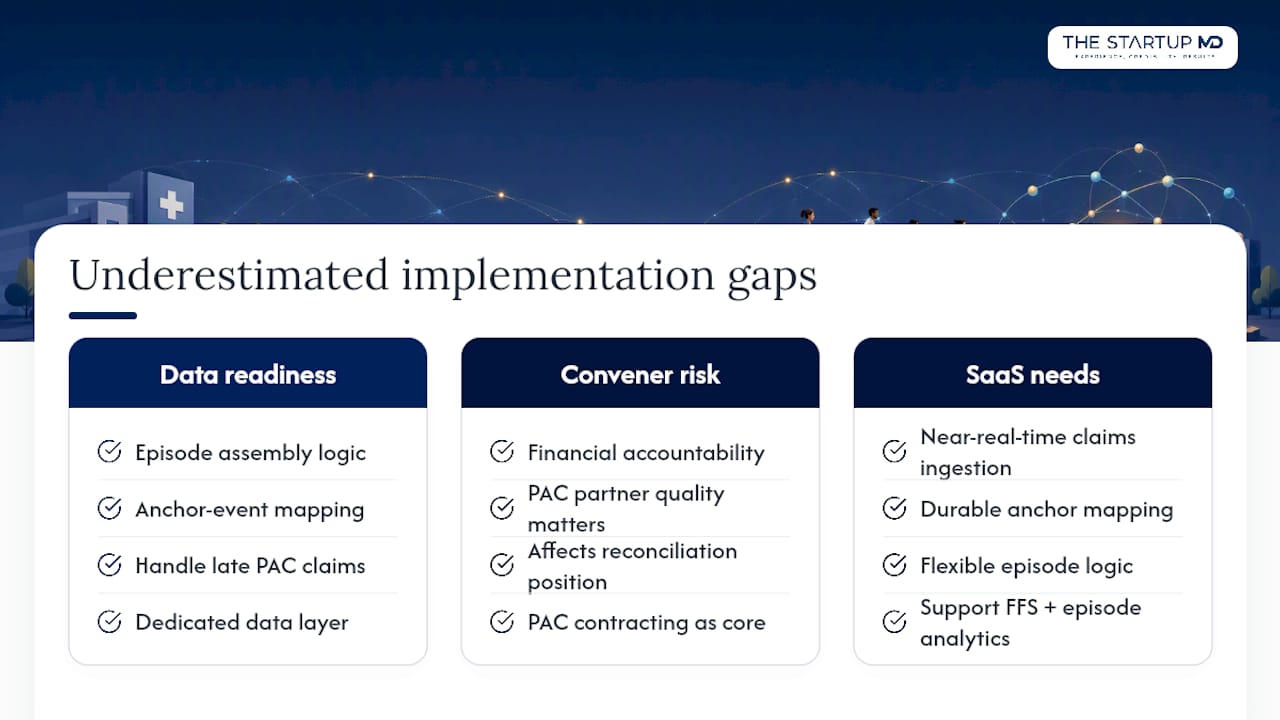
The two areas I see consistently underestimated are data interoperability and convener accountability. Most organizations assume their EHR and claims systems can assemble episodes automatically. In practice, the episode assembly logic, mapping anchor events across claims and EHR records, handling late-arriving PAC claims, and applying the correct episode window, requires purpose-built engineering. Off-the-shelf EHR reporting modules do not do this. It requires a dedicated data layer, and building it takes longer than most pilots budget for.
The convener role is equally underestimated. Accepting convener status means accepting financial accountability for services your organization does not directly control. A skilled nursing facility that places patients in higher-acuity settings than necessary, or a home health agency with a high rehospitalization rate, directly affects your reconciliation position. Conveners who succeed treat PAC contracting as a core strategic function, not an afterthought.
For healthcare SaaS teams building products in this space, the engineering requirements are specific: near-real-time claims ingestion, durable anchor event mapping, and flexible episode-assembly logic that supports multiple episode definitions and post-acute windows. Products that support only FFS workflows leave their provider customers flying blind during the reconciliation period. The healthcare SaaS revenue model implications are significant: vendors who build for dual-system compatibility, supporting FFS operations while delivering episode analytics, are positioned where the market is heading.
My recommendation for policymakers: mandatory models work, but only when paired with genuine technical assistance and transparent pricing methodology. Voluntary models alone will not move the system. My recommendation for provider organizations: do not accept convener status until you have completed an honest data readiness audit and negotiated PAC partner agreements that share both financial and quality accountability.
Sources
The sources below are the primary references for administrators, policymakers, and healthtech teams working in this space.
- What Are Bundled Payments? | NEJM Catalyst
- Bundled Payments | CMS
- Innovation
- Bundled / Episode-based contracts guidance | American Medical Association (AMA)
- Episode-based payment evaluations (NCBI / PMC article)
This article is general information, not a substitute for advice from a qualified financial advisor. Consult a qualified financial professional about your own circumstances before acting on anything here.