

A Chief Medical Officer is not optional for most healthcare SaaS companies; it is the difference between a product that clinicians trust and one they quietly ignore. If your startup must prove clinical value, close enterprise contracts, or responsibly deploy AI in care workflows, you need clinical executive leadership now. The decision is which model fits your stage: fractional CMO, full-time CMO, or a Medical Advisory Board (MAB) as a bridge.
Clinical leadership correlates with funding: 14% of U.S.-based digital health companies at $1–10M in funding have executive clinical leadership, compared to 62% at $500M+.
Your immediate decision path:
- Early prototype, limited clinical touchpoints: Start with a MAB or a scoped fractional CMO engagement.
- Product-market fit established, enterprise sales underway: Hire a fractional CMO now; plan the full-time transition at Series B or when clinical complexity demands it.
- Large clinical risk, population health commitments, or active AI deployment: A full-time CMO is warranted sooner than most founders expect.
Table of Contents
- Why the CMO role in healthtech has become strategically critical
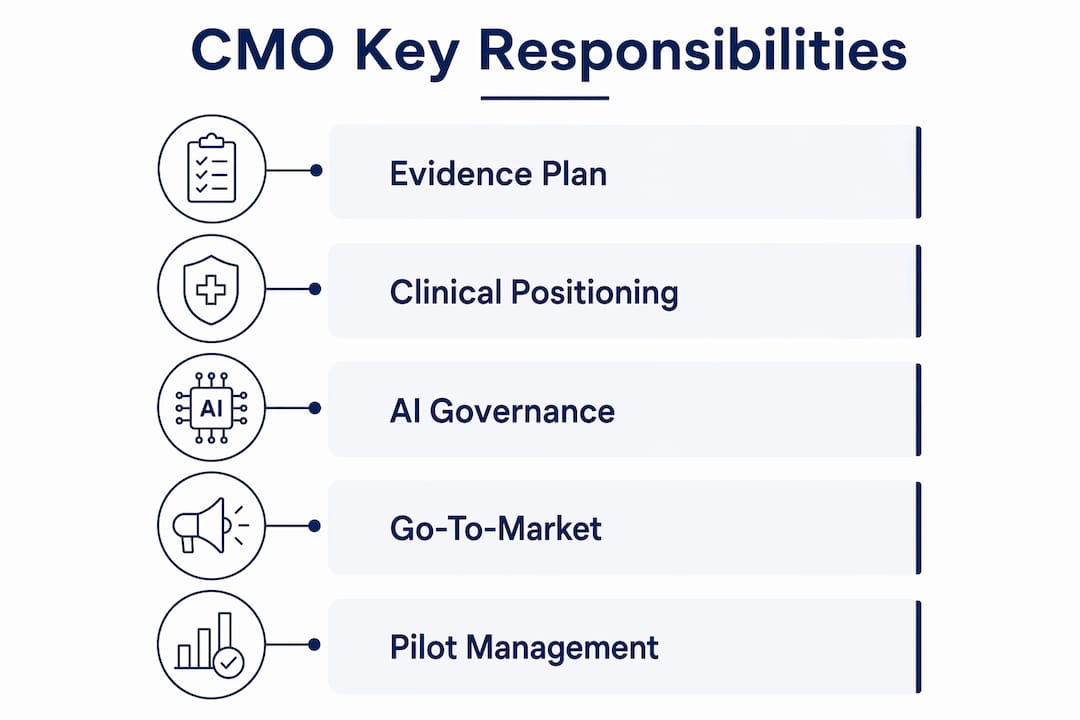
- What a CMO should actually own at a healthcare SaaS startup
- Fractional vs. full-time CMO: which model fits your stage?
- How to evaluate and hire a CMO for your healthtech startup
- How to measure a CMO's value in real terms
- Key Takeaways
- The CMO hire most founders get wrong
- The StartupMD's fractional CMO and advisory services
- Useful sources for further research
Why the CMO role in healthtech has become strategically critical
The CMO title used to signal credibility without carrying real authority. That era is over, post-pandemic investor scrutiny, enterprise buyer risk aversion, and the rapid deployment of AI in clinical settings have pushed the CMO role from ornamental to strategic; boards and enterprise procurement teams now ask pointed questions about evidence, safety, and workflow integration — questions only a credentialed clinical executive can answer convincingly.
Dr. Geeta Nayyar has made the same point from a different angle: a CMO treated as a check-the-box hire delivers nothing. When integrated as a core executive with real authority over product, go-to-market, and evidence strategy, the CMO accelerates growth and de-risks the business.
The practical shift looks like this:
- CMOs now sit in product reviews, not just advisory calls.
- They lead enterprise sales conversations and physician engagement with health systems.
- They own the clinical narrative in investor due diligence.
- They govern AI safety protocols and escalation paths for adverse events.
Avoiding common go-to-market mistakes in healthtech almost always requires someone who understands both the clinical workflow and the commercial model. That is the CMO's lane.
What a CMO should actually own at a healthcare SaaS startup

Early-stage CMOs are generalists who pivot between product evangelism, clinical operations, and external stakeholder engagement depending on what the company needs that quarter. The role is not a single archetype. What it must cover:
Core responsibility areas:
- Clinical validation and evidence generation (study design, outcomes reporting)
- Physician and KOL engagement
- Regulatory and quality input (FDA strategy, clinical risk frameworks)
- Product design and workflow integration
- AI governance: embedding safety guardrails, clinical workflow alignment, and adverse event escalation paths
- Sales enablement and enterprise credibility
- Clinical operations for pilot programs
| Deliverable | Early-Stage (Pre-Series A) | Growth-Stage (Series B+) |
|---|---|---|
| Evidence plan | Pilot protocol, outcomes KPIs | Peer-reviewed study design |
| Physician engagement | KOL identification, advisory board | Formal engagement program |
| AI governance | Safety checklist, escalation path | Ethics framework, audit process |
| Sales support | Clinical FAQ, demo support | Enterprise RFP responses |
| Regulatory input | Risk assessment | FDA pre-submission strategy |
The distinction between what must be in the job spec versus what can be delegated matters. Evidence generation and AI governance require seniority. Literature reviews and clinical FAQ documents can be delegated to advisors or vendors under CMO direction.
Fractional vs. full-time CMO: which model fits your stage?
Fractional and advisory roles are often the pragmatic choice before a company reaches the scale and clinical complexity that justifies full-time executive payroll. The staged approach — fractional too milestone-based to full-time — frequently delivers better ROI than hiring too early.
| Factor | Fractional CMO | Full-Time CMO |
|---|---|---|
| Stage fit | Pre-Series A, early pilots | Series B+, enterprise contracts |
| Budget | Lower; scoped engagement | Full executive compensation |
| Availability | Part-time, defined scope | Dedicated, embedded |
| Speed to value | Fast; focused deliverables | Longer ramp, broader mandate |
| Risk | Lower commitment | Higher if role is misscoped |
Stage signals that favor fractional:
- You need clinical credibility for investor conversations but lack the budget for a full-time executive.
- Your product has limited direct clinical risk and a narrow initial use case.
- You are preparing for a Series A and need a clinical narrative, not a clinical department.
Stage signals that favor full-time:
- Enterprise contracts require a named clinical executive in the agreement.
- You are running or planning a clinical trial or population health program.
- AI deployment creates direct patient safety obligations.
- Headcount is growing and clinical oversight cannot be scoped to part-time hours.
A practical 6–12 month transition: months 1–3, fractional CMO scopes evidence plan and clinical positioning; months 4–6, fractional CMO leads first enterprise pilot; months 7–12, evaluate whether complexity warrants converting to full-time or extending the fractional engagement. For founders weighing advisory structures, understanding the full scope of clinical advisory options before committing to a model saves both time and money.
How to evaluate and hire a CMO for your healthtech startup
Russell Reynolds research makes a useful point: most CMOs cannot span more than two archetypes effectively. Define the specific business problem first, then hire solving it.
Core competencies to assess:
- Clinical credibility in your target care setting
- Product fluency — can they read a sprint backlog and contribute meaningfully?
- Commercial experience — have they closed or supported enterprise deals?
- AI and health IT literacy
- Stakeholder influence — physicians, regulators, investors
- Operational execution — not just strategy, but delivery
Interview questions that reveal real capability:
- "Walk me through a time you had to push back on a product decision for clinical safety reasons. What happened?"
- "How would you design a 90-day evidence plan for a new clinical AI feature with no prior outcomes data?"
- "Describe how you have engaged skeptical physicians during an enterprise rollout. What worked?"
- "What is your process for evaluating an AI model's readiness for clinical deployment?"
Red flags to watch for:
- A purely academic CV with no product or operational examples
- Unwillingness to join sales calls or engage directly with enterprise buyers
- Vague answers about AI governance that default to "we'll figure it out"
- No clear view on how to measure their own success
A simple scorecard: rate each candidate 1–5 on clinical credibility, product fluency, commercial experience, AI literacy, and stakeholder influence. Weight clinical credibility and commercial experience most heavily for a growth-stage startup.
How to measure a CMO's value in real terms
The CMO's impact should show up in numbers your board can read. CMOs accelerate enterprise diligence by owning clinical narratives and evidence plans — which directly shortens sales cycles and reduces investor friction.
KPI categories to track:
- Adoption: provider activation rate, 90-day retention among clinical users
- Evidence: time to first completed pilot study, outcomes report completion
- Revenue: enterprise conversion rate before vs. after CMO engagement
- Safety: clinical incident rate, AI adverse event escalation response time
- Fundraising: investor conversations led by CMO, pilot enrollment rate
30/90/180-day milestone checkpoints:
- Day 30: Clinical pilot agreement signed; AI governance framework drafted.
- Day 90: First outcomes data collected; sales enablement materials complete; at least two KOL relationships active.
- Day 180: Outcomes report published or in review; enterprise pipeline influenced; evidence plan for next funding round in place.
Connecting CMO activity to dollars is straightforward when you track enterprise conversion rate and sales cycle length before and after clinical leadership is in place. The cost-avoidance case is equally strong: a single regulatory misstep or AI safety incident can cost far more than a year of fractional CMO fees.
Key Takeaways
A CMO is a measurable growth lever for healthcare SaaS startups — not a ceremonial title — and the right engagement model depends entirely on your stage, clinical risk, and enterprise sales demands.
| Point | Details |
|---|---|
| Hire signal | Clinical leadership correlates with funding: 14% of companies at $1–10M have it vs. 62% at $500M+. |
| Fractional first | Pre-Series A startups benefit most from a scoped fractional CMO before committing to full-time executive payroll. |
| AI governance | The CMO owns clinical workflow integration, safety guardrails, and adverse event escalation — not the product or engineering team. |
| Measure impact | Track enterprise conversion rate, pilot enrollment, and 90-day clinical user retention as primary CMO KPIs. |
| The StartupMD | Paul Bergeron, MD, MBA leads fractional CMO and advisory engagements through The StartupMD for healthcare SaaS startups at every stage. |
The CMO hire most founders get wrong
Most founders either wait too long or hire too broadly. They wait until a deal falls through because a health system asked for a clinical executive they did not have. Or they hire a full-time CMO at Series A, scope the role loosely, and watch a talented physician spend their first six months without a clear mandate.
The CMOs who deliver real value in healthtech are not the ones with the longest publication lists. They are the ones who can sit in a product review on Monday, lead an enterprise demo on Wednesday, and present a clinical outcomes framework to an investor on Friday. That combination is rare, and it is worth scoping carefully before you post the role.
AI governance is where I see the most dangerous gaps right now. Founders assume their engineering team can own clinical AI safety. They cannot. The CMO's job is to translate what a model does into what a clinician experiences — and to own the escalation path when something goes wrong. That responsibility cannot be delegated to a product manager.
A small, dedicated budget for pilot evidence generation — even $50,000–$100,000 allocated before a Series B — often shortens enterprise sales cycles more than any marketing spend. Buyers want outcomes data. A CMO who can produce it early changes the entire commercial conversation.
The StartupMD's fractional CMO and advisory services
The StartupMD works with healthcare SaaS founders who need clinical executive leadership without the overhead of a full-time hire. Paul Bergeron, MD, MBA brings over 25 years of combined medical and business experience to every engagement — from scoped fractional CMO work to MAB design and interim clinical leadership.
Engagements typically begin with a diagnostic discovery session to define the clinical gap, scope deliverables, and set measurable milestones. From there, The StartupMD provides hands-on support across product, go-to-market, evidence generation, and fundraising preparation. Founders working with The StartupMD have used this model to secure funding, activate enterprise pilots, and build the clinical credibility their sales teams needed to close. If your startup is at an inflection point — a pending enterprise deal, an AI feature ready for clinical deployment, or a funding round that needs a clinical narrative — book a discovery call to see whether a fractional engagement is the right next step.
Useful sources for further research
- Beyond the Bedside: A Primer for Aspiring Startup CMOs — NEJM CareerCenter; covers role variability and the generalist demands of early-stage CMO work.
- If and When to Hire a Chief Medical Officer — Massively Better Healthcare; includes the funding-stage data and expert commentary from Dr. Dana Udall and Dr. Geeta Nayyar.
- Chief Medical Officers Are Driving Tech Innovation — MarketScale; documents the shift from ceremonial to strategic CMO roles in healthtech.
- A New Era for CMOs in HealthTech — Russell Reynolds Associates; defines CMO archetypes and hiring frameworks for healthtech companies.
- Why Health Tech Firms Must Hire Chief Medical Officers — HIT Consultant; makes the fundraising and enterprise diligence case for clinical executive leadership.
- The Role of the CMO — American Association for Physician Leadership; authoritative overview of CMO responsibilities across healthcare settings.
- What Is a CMO in a Healthcare Startup? — The StartupMD; Paul Bergeron's framework for defining and scoping the CMO role at early-stage companies.
- How to Structure a Healthcare Startup Medical Advisory Board — The StartupMD; practical guidance for founders building clinical advisory structures before a full CMO hire.
- Digital Health Market Entry Strategies — The StartupMD; go-to-market planning resource relevant to CMO-supported enterprise adoption strategies.