

Start your evidence pipeline now: define one regulatory-grade clinical claim, freeze how you will measure it, and launch a matched observational study alongside a pre-specified pilot. That single decision, made early and made specifically, determines whether your evidence program produces something regulators, payers, and providers can act on, or a folder of pilot data nobody trusts.
Here is the minimum viable path:
- Pick the claim. One primary claim, tied to a real buyer decision. Not five.
- Freeze the endpoint. Define how success is measured before you collect a single data point.
- Build the pipeline. Sequence observational evidence, a feasibility pilot, and a pre-specified pivotal study rather than betting everything on one underpowered trial.
The strongest early signal of a credible evidence program isn't a completed trial. It's a registered claim, a frozen endpoint, and a pipeline sequence you committed to before the data came in.
Anchor your approach to three references: the Evidence DEFINED framework for screening and evidence assessment, the FDA's pre-submission process for regulatory alignment, and ClinicalTrials.gov for registration and transparency. GRADE, the methodology long used in clinical guideline development, is worth adapting here too, since Evidence DEFINED borrows its structure. The StartupMD works with founders on exactly this sequencing, as a fractional CMO resource rather than a hard sell.
Key Takeaways
Regulatory-grade clinical evidence comes from freezing one claim and endpoint early, sequencing observational-to-pivotal study designs, and validating digital tools through the V3 paradigm before scaling.
| Point | Details |
|---|---|
| Freeze the claim first | Pick one buyer-relevant claim and endpoint before collecting any data, not after a pilot looks promising. |
| Screen before you spend | Run the Evidence DEFINED checklist in under 30 minutes to catch privacy, population, and endpoint disqualifiers early. |
| Sequence your studies | Move from observational to retrospective cohort to pragmatic pilot to pivotal trial, never straight to an underpowered proof of concept. |
| Validate through V3 | Confirm verification, analytical validation, and clinical validation in stages, and document any prior work you leverage. |
| Register and report | Commit to ClinicalTrials.gov registration and timely results reporting to build regulator and payer trust. |
| Get fractional support early | The StartupMD's fractional CMO model helps founders align study design with regulatory and payer expectations before budget is spent. |
This article is general information, not a substitute for advice from a qualified lawyer. Consult a qualified legal professional about your own circumstances before acting on anything here.
Table of Contents
- Clinical Evidence Building Best Practices: The Quick-Start Checklist
- How Do You Define a Clinically Significant Threshold?
- Which Study Design Fits Your Evidence Stage?
- What Does DHT Validation Actually Require?
- When Should You Engage Regulators and Payers?
- How Long and Costly Is an Evidence Program?
- What Founders Get Wrong About Evidence Timelines
- How The StartupMD Supports Your Evidence Program
- Sources
Clinical Evidence Building Best Practices: The Quick-Start Checklist
Most digital health startups don't fail their first evidence attempt because the science is wrong. They fail because nobody screened for basic disqualifiers before spending six figures on a study. The Evidence DEFINED framework formalizes this as a four-step process: screen for absolute requirements, apply an established evidence methodology like GRADE, run the Evidence DEFINED checklist, and finish with evidence-to-recommendation guidance that tells you what your data is actually worth to a decision-maker.
Run this screen in under 30 minutes before committing budget:
- Does your privacy and security posture support research-grade data collection, not just commercial use?
- Does your target population in the study match your actual commercial population?
- Do you have one measurable, pre-defined endpoint, not a vague "engagement improved" claim?
- Is there prior validation work (yours or a comparable product's) you can legitimately leverage?
Go/no-go triggers that should stop you immediately: no research consent pathway, no technical ability to link outcomes to EHR or claims data, or data quality issues you cannot resolve within the study timeline.
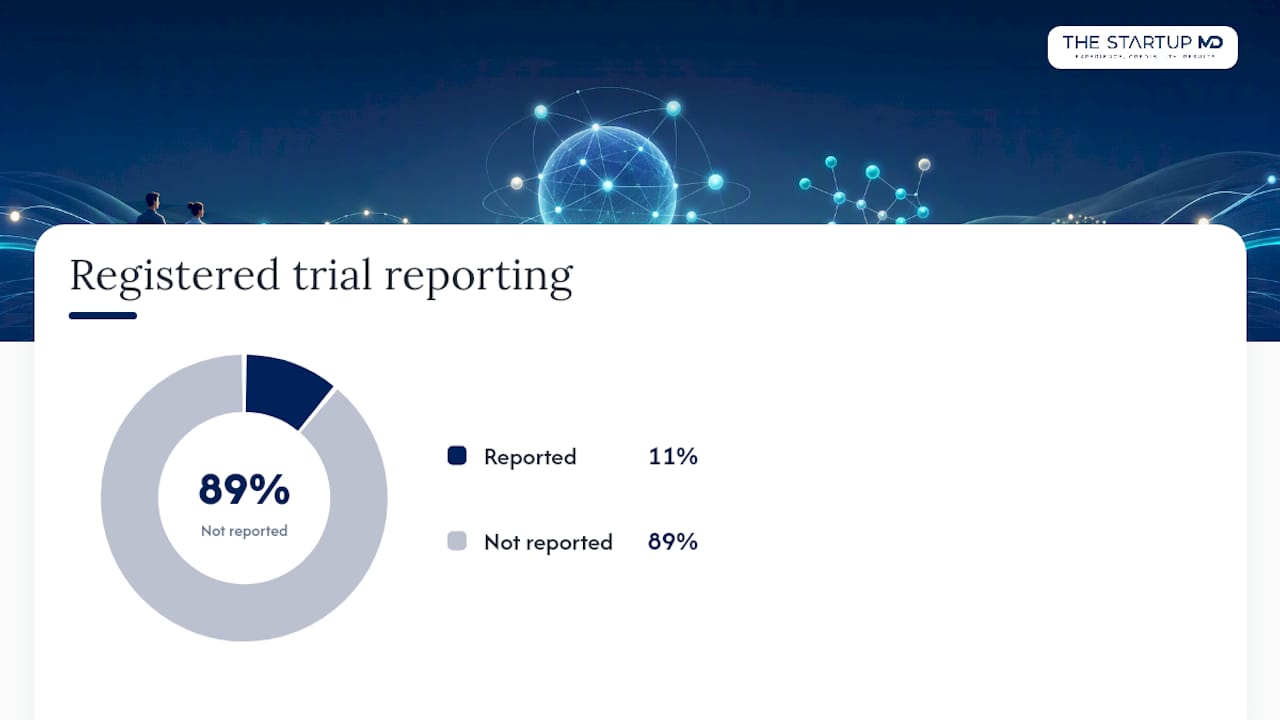
One statistic should worry every founder here: an estimated 11% of registered digital health trials actually report public results. That nonreporting problem is exactly what regulators and payers now screen for, so registering on ClinicalTrials.gov and committing to timely reporting is a credibility signal, not paperwork.
How Do You Define a Clinically Significant Threshold?
Your primary claim has to tie directly to a buyer's decision, not a marketing headline. Ask which decision you're actually trying to move: an FDA clearance pathway, a payer coverage determination, a health system procurement committee, or an investor milestone. Each demands a different endpoint.
Payers and providers respect endpoints they can verify against their own systems: clinical outcomes, utilization changes, validated patient-reported outcome measures, or total cost of care. A self-reported satisfaction score rarely moves a coverage decision.
Setting your threshold of clinical significance means working backward from reality:
- Pull real-world baseline data for your target population before you guess at an effect size.
- Ask a clinical advisor what change would actually shift practice or coverage, not what would look good in a deck.
- Set the threshold before you see pilot data, and document why.
Pro Tip: Use your real-world baseline, not your best-case pilot number, to size your pivotal study. Startups that power studies off optimistic small-sample pilots almost always end up with an underpowered proof of concept that convinces no one outside the company.
Which Study Design Fits Your Evidence Stage?
Choosing the wrong design wastes 12 to 18 months you don't have. The JMIR framework on evaluating digital health solutions argues that many digital health evaluations fail specifically because they borrow trial designs built for drugs, ignoring the fact that software updates, user attrition, and version drift behave nothing like a fixed molecule.
A practical decision sequence:
- Retrospective matched cohort or observational analysis when you have existing usage data and need a fast, low-cost signal before committing to a prospective trial.
- Single-site feasibility pilot when the intervention or workflow is new and you need to confirm recruitment, retention, and usability before scaling.
- Pragmatic or cluster-randomized trial when you need real-world generalizability across sites, and a strict RCT would strip out the workflow variation payers actually care about.
- Platform or adaptive trial when you're testing multiple product variants or subpopulations simultaneously and want to preserve statistical efficiency.
- Registry or post-market study once you have a cleared or launched product and need longitudinal, real-world durability data.
Before locking a sample size, predefine the minimal clinically important difference, expected variance from your baseline data, and a realistic attrition allowance. Digital health products lose participants at rates clinical trialists find alarming, so pad your recruitment target accordingly. If you're running a cluster design, factor in the intraclass correlation, which shrinks your effective sample size more than most founders expect.
Pro Tip: Model product versioning directly into your statistical plan. If a feature update lands mid-study, pre-specify a bridging analysis now, not after a reviewer asks why your intervention changed halfway through data collection.
What Does DHT Validation Actually Require?
Digital health technology validation runs on the V3 paradigm: verification, analytical validation, and clinical validation. The framework for leveraging prior work in clinical trials lays this out as a staged process, and skipping a stage is the single most common reason why regulators send validation packages back for revision.
- Verification confirms your sensor, algorithm, or software does what it claims technically, under controlled conditions.
- Analytical validation confirms it performs accurately against a reference standard in your intended use environment.
- Clinical validation confirms the output actually predicts or reflects the clinical outcome you claim.
Before you build anything new, run a gap assessment: what verification and validation artifacts already exist, what usability data you have in your actual target population, your current regulatory classification, and whether you have rights to reference any third-party datasets.
Leveraging prior work is not a shortcut around rigor. It's a documented argument that the gap between someone else's validation and your product is small enough for a regulator to accept, and that argument has to be written down, not assumed.
Two failure modes recur constantly: reporting per-protocol results when intention-to-treat would tell a very different (and less favorable) story, and skipping usability testing in the actual population you'll serve, only to discover an elderly cohort or a low-literacy population interacts with your interface in ways your internal QA team never anticipated.
When Should You Engage Regulators and Payers?
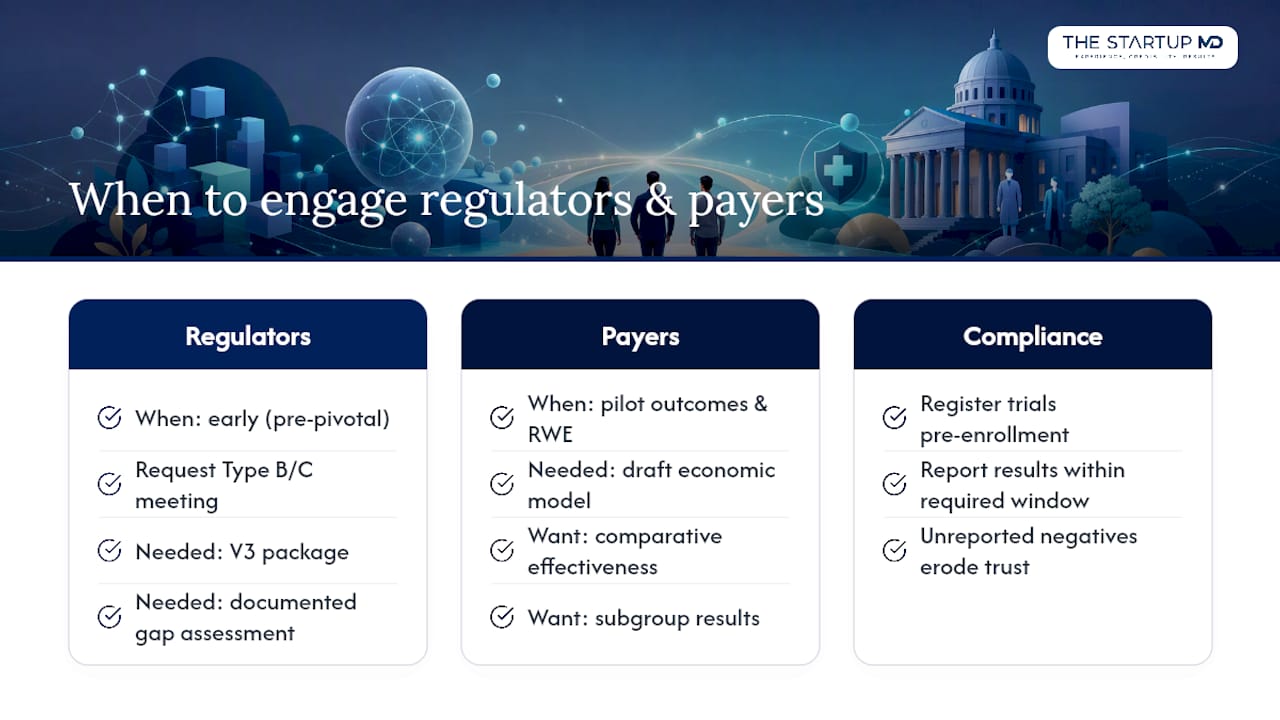
Earlier than feels comfortable. A Type B or Type C meeting with the FDA (or the equivalent pre-submission touchpoint with another regulator) is worth requesting once you have a V3 package, a documented gap assessment, and locked endpoint definitions, even if your pivotal study hasn't started. Walking in with open questions about acceptable endpoints wastes the meeting; walking in with a proposed design and asking for feedback gets you actual answers.
Payers move on a different clock. The earliest useful payer signals come from pilot outcomes, retrospective comparative analyses, and a draft economic model, well before a pivotal trial reads out. What payers actually want to see: a robust comparative effectiveness analysis, subgroup results showing where your effect is strongest, and economic assumptions transparent enough to survive their own actuarial review.
Evidence DEFINED's evidence-to-recommendation step matters here because it translates raw study results into an adoption tier, telling decision-makers whether your evidence supports a strong recommendation, a conditional one, or none yet. That translation step is often what a clinical content strategy for healthtech companies gets wrong, presenting data without framing it against what the buyer's committee is actually voting on.
Register every trial on ClinicalTrials.gov before enrollment starts, and commit to reporting results within the required window regardless of outcome. Unreported negative trials are one of the fastest ways to lose payer trust once discovered.
How Long and Costly Is an Evidence Program?
Budget realistically. An observational study using existing data can produce a publishable paper in 9 to 12 months. A retrospective matched cohort study typically runs 12 to 18 months once you account for data linkage delays. A prospective pragmatic trial spans 12 to 36 months depending on site count and enrollment complexity, and delaying clinical evaluation planning until late in development routinely adds significant time to the launch timeline.
Cost drivers rarely surprise anyone in isolation, but they compound fast: participant recruitment, clinical monitoring, EHR or claims data linkage fees, biostatistics support, contract research organization costs if you outsource execution, and publication or conference costs once results are ready.
Resourcing this well means naming one owner, whether a Head of Clinical Evidence or a fractional CMO, supported by a clinical advisory board, a data engineering function that can actually build your research database, and someone accountable for getting results published. A fractional CMO engagement, the model The StartupMD runs with clients, compresses time-to-decision specifically because that person has sat on the other side of payer and regulatory conversations before and knows which endpoints will survive scrutiny before you spend a year collecting the wrong ones.
What Founders Get Wrong About Evidence Timelines
Most founders treat clinical evidence as a checkbox that happens after product-market fit, something to bolt on before a Series B raise or a payer conversation. That sequencing is backward, and it's the single most expensive mistake I see in this category.
Evidence generation is infrastructure, not a deliverable. The startups that move fastest through payer and regulatory conversations are the ones who froze their endpoint definitions and started tagging outcomes data in the product from day one, long before anyone asked for a study. Retrofitting outcome capture onto a product that was never built to measure it costs more time than building the pipeline correctly the first time.
Freeze the therapeutic core per version, and tag every dataset with a version ID. Digital products change constantly, and a study that spans three feature releases without version tracking produces results nobody can defend under scrutiny.
The StartupMD works with healthcare SaaS leadership teams on exactly this kind of study planning and fractional clinical leadership, not as a substitute for a biostatistician, but as the operational bridge between clinical rigor and commercial reality.
How The StartupMD Supports Your Evidence Program
Building regulatory-grade evidence without an internal clinical executive usually means one of two outcomes: you hire a full-time Chief Medical Officer before you can justify the cost, or you run your study design past nobody with regulatory and payer experience until it's too late to fix. The StartupMD exists for the gap in between.
As a fractional CMO and advisory partner, The StartupMD helps healthcare SaaS and digital health leadership teams set clinical strategy, plan studies against the design options above, prepare for regulatory pre-submission conversations, and align evidence generation with what payers and investors actually need to see. That includes translating a completed evidence package into commercial and revenue strategy, which is where many technically sound studies fail to land with investors. If you're weighing how your evidence plan connects to your broader growth model, the Healthcare SaaS Revenue Model Evaluation is a practical place to start that conversation.
Sources
- Key Considerations for Designing Clinical Studies to Evaluate Digital Health Solutions — JMIR
- Evidence DEFINED: a framework for assessing evidence in digital health — Nature Digital Medicine (preview)
- Framework for leveraging prior work when incorporating digital health technologies into clinical trials — Nature Digital Medicine
- Designing Evidence Pipelines: RWE Strategies for Digital Therapeutics — ResidencyAdvisor
- Digital Health Regulatory Compliance Checklist for Startups in 2026 — Zechmeister Solutions