

The mistakes that most reliably derail population-health SaaS launches follow a predictable order: chasing product-market fit without clinician validation, underestimating EHR interoperability, skipping governance and IT resourcing, and launching without a reimbursement-backed business model. Each has a one-line fix: validate with 15+ buyers before building, sequence one data source before scaling connectors, assign a named IT owner before pilot, and price against a documented payer pathway. The PLOS Digital Health research on digital health integration and the GARDE implementation study both point to the same root cause: teams treat technology as the starting point instead of the last step. The 30/90/180 day playbook below turns these fixes into a sequence you can run this quarter.
Key Takeaways
Population-health SaaS pilots fail primarily from skipped clinical validation, brittle data integration, absent governance, and reimbursement models nobody has tested with a real payer.
| Point | Details |
|---|---|
| Validate before building | Deliver outcomes manually for early customers and confirm demand with 15+ real buyers first. |
| Sequence data integration | Start with one or two sources and prioritize identity resolution before adding predictive scoring. |
| Assign clear governance | Use a RACI structure with a named clinical champion, PM, and integration engineer before pilot launch. |
| Build KPIs before launch | Track gap closure, time to action, and utilization change on one shared dashboard. |
| Get advisory support early | The StartupMD's fractional CMO model catches workflow, compliance, and reimbursement gaps before they sink a pilot. |
Table of Contents
- Common Population Health Implementation Mistakes Ranked by Risk
- Why Data Integration and Identity Resolution Break First
- Why Clinicians Abandon Tools That Add Extra Clicks
- Why Reimbursement Ambiguity Sinks Otherwise Good Pilots
- What Happens When Nobody Owns Implementation Governance
- What to Measure During Pilot and What Changes at Scale
- The Vendor and Security Mistakes That Create Legal Exposure
- How Long Population Health Implementation Actually Takes
- A 30/90/180 Day Playbook to Rescue or Validate Your Pilot
- Poor Product-Market Fit Starts With Skipped Validation
- When Clinical, Product, and Business Teams Don't Talk the Same Language
- Why Patient Engagement Plans Fail Before They Start
- What Happens After Deployment When Training Stops
- Why Products Without Feedback Loops Stop Improving
- The Compliance Gaps That Extend Beyond HIPAA
- Why These Mistakes Keep Repeating Across Startups
- How The StartupMD Helps You Fix These Mistakes Before They're Expensive
- Frequently Asked Questions
- Sources
Common Population Health Implementation Mistakes Ranked by Risk
Not every mistake carries the same weight. Some kill a pilot outright. Others quietly cap your ability to scale past three or four health systems. Here's the ranked list, with an owner and a fix for each.
- No identity resolution strategy (pilot killer). Fix before pilot. Owner: CTO. Duplicate patient records break trust in the registry before clinicians see one insight.
- No clinical champion (pilot killer). Fix before pilot. Owner: founder. Without a physician advocate, adoption stalls regardless of product quality.
- Unclear reimbursement pathway (scale blocker). Fix before pilot. Owner: founder/product. Selling on hope rather than a payer mechanism collapses renewal conversations.
- Workflow requires leaving the EHR (pilot killer). Fix before pilot. Owner: product lead. Extra clicks are the fastest way to lose clinician goodwill.
- No governance or RACI (scale blocker). Fix during pilot setup. Owner: founder. Ambiguous ownership means nobody catches problems early.
- Under-resourced IT integration (scale blocker). Fix before pilot. Owner: CTO. Interoperability work routinely takes longer than founders plan for.
- No KPI framework (medium risk). Fix during pilot. Owner: product. Without linked clinical and financial metrics, you can't prove ROI at renewal.
- Weak vendor security review (scale blocker). Fix before signing contracts. Owner: CTO/legal. A missing BAA or unclear data-return clause becomes a liability later.
- No post-launch training plan (medium risk). Fix during pilot. Owner: clinical lead. Skills decay fast without reinforcement.
- No patient engagement design for tech inequity (scale blocker). Fix during pilot. Owner: product. Device and broadband gaps quietly shrink your enrolled population.
Why Data Integration and Identity Resolution Break First
Poor identity resolution and premature assumptions about EHR connectors are the single most common reason population-health registries fail before a pilot finishes. Teams try to ingest every available feed on day one, and the resulting duplicate and mismatched records erode clinical trust in the entire platform.
A sequenced technical checklist works better:
- Start with one or two data sources (typically the primary EHR feed via FHIR or HL7 v2), not every claims and lab feed at once.
- Prioritize identity resolution logic before adding predictive scoring or risk stratification.
- Normalize a common patient model before building analytics on top of it, a sequencing approach SpeedMVPs recommends for MVP-stage teams.
- Budget realistically: enterprise-grade interoperability, including mapping layers, claims workflows, and audit logging, commonly takes 6 to 12 months of engineering effort.
Pro Tip: Treat interoperability as a platform layer you build once, not a series of one-off connectors you rebuild for every new health system. The upfront cost is higher; the marginal cost of your fifth integration drops sharply.
Why Clinicians Abandon Tools That Add Extra Clicks
If a clinician has to leave the EHR, log into a separate system, or add steps to their existing routine, adoption fails within weeks. This is the pattern behind most "successful pilot, stalled scale" stories in population health.
Map the clinician's actual task sequence before writing product requirements. Shorten the path to action rather than adding a new dashboard they have to remember to check. Embed insights inside notes or existing dashboards wherever workflow-native design is technically possible.
Track adoption with real signals: time-on-task, task completion rate, and clinician Net Promoter Score, not just login counts. Assign a clinical champion, a dedicated trainer, and a product liaison who owns the feedback loop, guidance covered in more depth in developing a physician engagement strategy.
Why Reimbursement Ambiguity Sinks Otherwise Good Pilots
An unclear financial model, not a weak product, is usually why population-health pilots don't renew. If nobody can say who pays and how much value that payment buys, the pilot dies in the budget cycle after launch.
Before you pitch, build a simple pilot ROI template: what gets measured (gap closure, avoided admissions, time to action), who pays for it (health system, payer, employer), and over what period you expect payback. Pricing models vary: per-covered-life, per-seat, or value-share tied to outcomes. Each fits a different buyer.
Target buyers strategically early on. ACOs, Medicaid MCOs, and self-insured employer pilots tend to have clearer incentive alignment than fee-for-service hospital departments. Avoid the common go-to-market misstep of pitching a hospital IT committee before you've validated the economic case with the people who actually control the budget, a mistake detailed further in common healthtech go-to-market mistakes.
What Happens When Nobody Owns Implementation Governance
The absence of governance and under-allocated IT resources is consistently the largest feasibility risk in population health deployments. Teams at five health systems studied in the GARDE research rated "allocate sufficient IT resources" as highly important, yet feasibility on that exact item was often low.
Build a lightweight RACI before your first pilot kickoff:
- Responsible: integration engineer and clinical champion for day-to-day execution.
- Accountable: founder or product lead for milestone delivery.
- Consulted: CTO on architecture decisions, compliance lead on data handling.
- Informed: executive sponsor at the health system, monthly.
Ensure clear resourcing before pilot with specified roles including clinical champion, project management, and dedicated engineering support who isn't shared across three other projects. When pitching internally for that budget, adapting to local context and training stakeholders rank among the most evidence-backed strategies for closing feasibility gaps.
What to Measure During Pilot and What Changes at Scale
Without linked clinical, operational, and financial KPIs, it is hard to demonstrate the product's effectiveness. Simple usage metrics alone are insufficient to support renewal discussions.
Keep the KPI set tight:
- Gap closure rate (clinical outcome proxy)
- Time to action after an alert or flag
- Utilization change (ED visits, admissions, or specialist referrals avoided)
- Months to payback on program cost
Review cadence should scale with the audience: weekly for the operations team, monthly for the executive sponsor, quarterly for the board or health system leadership. Build one dashboard that all three audiences can read at their own cadence rather than three separate reports.
The Vendor and Security Mistakes That Create Legal Exposure
Vendor and data-security oversights create outsized legal and operational risk compared to almost any other implementation mistake, because a breach or audit failure can end a contract instantly regardless of clinical performance.
Before signing any health system contract, confirm you have: a signed Business Associate Agreement, a documented penetration testing cadence, segregated production and test environments, and audit logs that satisfy the health system's compliance team. Request specific contract clauses: uptime SLAs, indemnity language, and a clear data-return process if the relationship ends.
Build a basic incident-response plan before you need one. And when designing patient-facing features, account for device and broadband inequity directly. A patient portal that assumes reliable home internet quietly excludes the population most likely to benefit from the program, a techquity gap that patient engagement technology design decisions must address explicitly rather than as an afterthought.
How Long Population Health Implementation Actually Takes
Most teams underestimate integration time, clinical validation cycles, and the ongoing cost of support staff once the product goes live. The pilot phase itself is rarely the expensive part.
| Phase | Typical duration | Who typically pays |
|---|---|---|
| Pilot | 3 to 6 months | Health system innovation budget or grant |
| Expansion | 6 to 12 months | Departmental or payer budget |
| Scale | 12+ months | Enterprise contract or value-based payer |
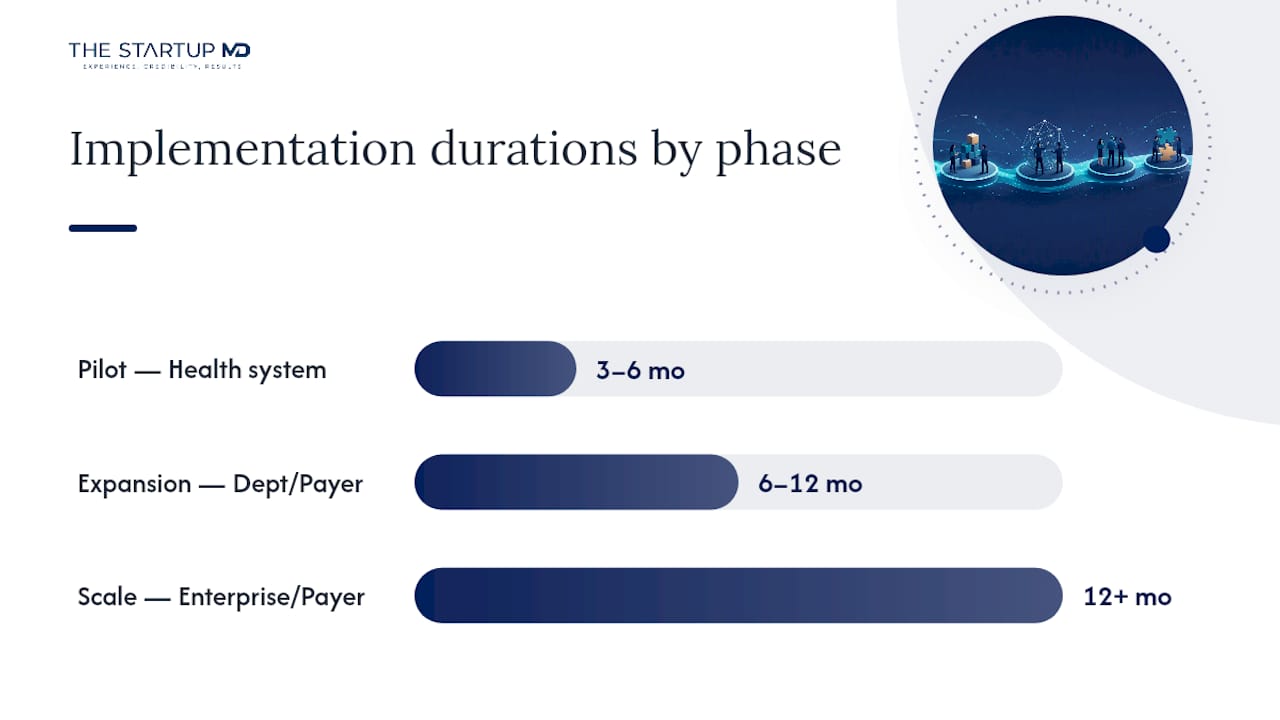
Common cost drivers founders miss: integration engineering hours beyond the initial estimate, ongoing clinical support staffing, and certification or security review cycles required before enterprise procurement will sign. Scope your MVP to prove one clinical hypothesis well rather than building enterprise-ready infrastructure before you have a paying customer, the sequencing validated MVP guidance recommends for early-stage teams.
A 30/90/180 Day Playbook to Rescue or Validate Your Pilot
These 30/90/180 day steps will tell you within six months whether your product is genuinely pilot-ready or needs a strategic pause before more capital goes in.
- Days 1 to 30: Draft a one-page pilot charter (goal, KPIs, owner, budget). Run clinical ride-alongs to map real workflow. Confirm your identity-resolution approach with the CTO.
- Days 31 to 90: Launch with one or two data sources only. Stand up your KPI dashboard fields (gap closure, time to action, utilization change). Assign a clinical champion and training lead.
- Days 91 to 180: Review adoption metrics against target. Revisit your reimbursement model with the actual payer or budget holder. Decide: scale, iterate, or pause.
Watch for these signals that external advisory help is warranted: adoption metrics flat after 60 days, no clear IT owner three months in, or a pricing model your finance team can't defend to a board. A short diagnostic engagement, roadmap review, and clinical validation plan are typically what an advisory relationship delivers first, before any longer commitment.
Poor Product-Market Fit Starts With Skipped Validation
Most population-health products fail the same way traditional SaaS products fail: teams build before confirming anyone will pay for the specific outcome they're solving. The difference in healthcare is that the cost of building the wrong thing is higher, because clinical workflows are harder to unwind once embedded.
The fix isn't complicated, but it is uncomfortable for engineering-led founding teams. Deliver the outcome manually for your initial customers before automating processes. Validate the core value proposition with 15 or more real buyers before committing engineering resources to a full build. This surfaces pricing resistance, workflow objections, and data availability gaps while they're still cheap to fix.
Founders often confuse interest with validation. A health system CIO saying "this looks interesting" in a demo is not the same as a department head committing budget and clinical staff time to a pilot. The gap between those two signals is where most population-health startups lose six months chasing a customer who was never going to sign.
Product-market fit in this category also means fit with a specific buyer's incentive structure, not just a clinical problem. A tool that reduces readmissions matters enormously to a value-based ACO and barely at all to a fee-for-service specialty practice. Validating the problem without validating the buyer's economic motivation to solve it is validation in name only. Strategic positioning work, covered in more depth in startup population health strategy, usually catches this gap before it costs a founding team a year of runway.
When Clinical, Product, and Business Teams Don't Talk the Same Language
Interdisciplinary misalignment shows up quietly at first: a clinical lead assumes a feature means one thing, engineering builds something adjacent, and the business team is selling a third version to prospects. By the time anyone notices, the pilot deadline has passed.
The root problem is usually structural, not personal. Clinical staff think in patient outcomes and workflow friction. Engineers think in sprints and technical debt. Business leaders think in contract value and renewal risk. Without a shared vocabulary and a regular forum to reconcile these views, each team optimizes for its own metric while the product drifts from what the customer actually needs.
Fixing this doesn't require a heavier process, just a more disciplined one. A weekly cross-functional standup with a fixed agenda, product decisions, clinical feedback, and business signals, forces the translation to happen early rather than at contract renewal. Document decisions in one shared source of truth rather than three separate Slack channels and a spreadsheet nobody updates.
The health system side needs the same discipline. IT, clinical informatics, and the department sponsoring your pilot often have different priorities and different definitions of success. If your internal champion at the health system isn't actively managing that alignment, your product becomes the scapegoat for organizational friction that has nothing to do with your code. Operational alignment practices from outside healthcare, like the governance frameworks in operational alignment guidance, translate directly to this problem: name the decision rights before the disagreement happens, not after.
Why Patient Engagement Plans Fail Before They Start
Low patient participation is rarely a marketing problem. It's usually a design problem baked in before the first patient ever sees the product. Teams design engagement flows around the patients they imagine, not the patients enrolled in the actual pilot population.
Three failure patterns repeat across population-health launches. First, engagement channels assume smartphone ownership and reliable broadband, which excludes a meaningful share of Medicaid and rural populations, the exact groups where population health interventions often matter most. Second, onboarding requires too many steps for a population already managing chronic conditions and competing life demands. Third, the messaging cadence is calibrated for an engaged, health-literate user rather than someone who needs shorter, more frequent, lower-friction touchpoints.
Adherence follows engagement, not the other way around. A patient who never successfully logs in on day one won't engage with a care plan on day thirty regardless of how clinically sound that plan is. Building for the actual technology access and health literacy of your enrolled population, not an idealized user, is the difference between a participation rate that supports a renewal case and one that doesn't.
The fix starts with segmenting your patient population by access and literacy before building outreach flows, then testing the lowest-friction version first: phone calls or text messages, not app downloads, for populations with lower digital access. Layering in more sophisticated digital tools once the baseline engagement channel proves it works avoids the common mistake of launching the most technically impressive option first and watching enrollment stall.
What Happens After Deployment When Training Stops
The most predictable adoption failure in population health has nothing to do with the product itself. It happens three months after go-live, when the initial training wears off, staff turnover introduces new users who never saw the original onboarding, and nobody owns ongoing support.

Clinical staff learn a new tool during a structured training session, use it correctly for a few weeks with a trainer nearby, and then quietly revert to old habits once that support disappears. This isn't a failure of the training itself. It's a failure to plan for the fact that healthcare staff turnover is high, and workflows compete constantly for attention.
Sustainable adoption needs a support model built for the long term, not just the launch week. That means designated super-users at each site who can answer questions without escalating to your team, refresher training scheduled quarterly rather than once, and a clear channel for staff to report friction without waiting for the next scheduled check-in.
This is also where customer success operations matter as much as product design. A population-health SaaS company that treats post-launch support as a cost center rather than a retention driver will see usage decay exactly when the renewal conversation approaches. Structuring that ongoing support function well, covered in customer success best practices for healthcare SaaS, is often the difference between a pilot that renews and one that quietly gets replaced.
Why Products Without Feedback Loops Stop Improving
A product that launches and then goes twelve months without a formal feedback mechanism from clinicians and patients isn't standing still, it's actively falling behind what the health system needs. Clinical workflows shift, staff turn over, and payer requirements change. A static product becomes a liability.
The teams that scale well build lightweight feedback mechanisms into the operating rhythm from day one: a short structured survey after key workflow moments, a standing agenda item in the monthly health system check-in specifically for friction points, and a visible process for triaging that feedback into the product roadmap. The visibility matters as much as the collection. Clinicians stop reporting problems once they conclude nothing happens with what they report.
Feedback loops also protect against a subtler risk: building features the loudest customer wants instead of the features that matter across your broader base. A rigorous process weighs frequency, clinical impact, and strategic fit before committing engineering time, rather than reacting to whichever health system complained most recently.
The Compliance Gaps That Extend Beyond HIPAA
HIPAA compliance is table stakes, and treating it as the finish line rather than the floor is one of the more expensive mistakes healthcare SaaS founders make. Population health software that touches clinical decision support, risk stratification, or predictive scoring can trigger FDA scrutiny as software as a medical device, depending on the specific claims the product makes about diagnosis or treatment recommendations.
The Office of the National Coordinator for Health IT (ONC) also sets certification and interoperability requirements that matter directly to population-health vendors, particularly around information blocking rules that govern how you're allowed to restrict data sharing with the health systems you serve. A vendor that unintentionally violates information-blocking provisions by gating data access behind a paywall can face regulatory exposure that has nothing to do with a clinical mistake.
The practical fix is early legal and regulatory review, not a compliance audit bolted on before a big enterprise deal closes. Understand upfront whether your product's specific features (automated risk scores, clinical alerts, decision-support recommendations) put you in FDA software as a medical device territory, and build your data-sharing architecture to satisfy ONC's information-blocking rules from the start rather than retrofitting them under deadline pressure during a health system's procurement review.
Why These Mistakes Keep Repeating Across Startups
The recurring pattern across advisory engagements is almost always the same: strong technical teams underestimate how much of population health success depends on clinical workflow and organizational readiness, not code quality. A well-built product with no clinical champion and no reimbursement model fails for the same reasons every time.
One pattern shows up often enough to be worth naming without identifying any specific company: a startup with a technically sound platform stalls at three pilots because nobody owns governance internally, then recovers within two quarters once a clinical champion is named and a KPI dashboard forces a shared definition of success between engineering and the health system sponsor.
If your pilot has stalled and you're not sure whether the problem is the product or the process around it, a diagnostic conversation usually clarifies that faster than another engineering sprint.
How The StartupMD Helps You Fix These Mistakes Before They're Expensive
The StartupMD gives healthcare SaaS founders something a generic startup advisor cannot: a fractional Chief Medical Officer who has spent decades inside both clinical practice and business strategy, so the gaps above get caught in a diagnostic call instead of a failed pilot.
The engagement model is straightforward. A diagnostic review identifies where your product, workflow, or business model has the highest-risk gaps. A roadmap translates that into a prioritized sequence, governance structure first, KPI framework second, go-to-market alignment third. Execution support carries you through the pilot itself, with clinical strategy input on workflow design, product evaluation, and reimbursement positioning.
Services include fractional CMO leadership, clinical strategy development, product evaluation, regulatory guidance, and go-to-market advisory built specifically for healthcare SaaS. If your business model or pricing strategy is the piece you're least confident about, the revenue model evaluation service is a focused starting point.
If two or more of the mistakes above sound familiar in your own pilot, the next step is a conversation, not another sprint. Reach out to The StartupMD to schedule a diagnostic call.
Frequently Asked Questions
What are the most common population health implementation mistakes founders make?
The most damaging mistakes are building before validating product-market fit, underestimating EHR interoperability timelines, launching without a clinical champion, and lacking a reimbursement-backed business model. Each of these tends to surface within the first two pilot quarters.
How long does population health software implementation usually take?
A realistic pilot runs three to six months, expansion six to twelve months, and full enterprise scale beyond a year, with interoperability and clinical validation as the most commonly underestimated cost centers.
What frameworks help avoid implementation errors in health programs?
CFIR (Consolidated Framework for Implementation Research) and ERIC (Expert Recommendations for Implementing Change) both offer evidence-based structures for identifying barriers and matching them to specific implementation strategies, as referenced in the GARDE study.
When should a healthcare SaaS startup bring in outside advisory help?
Bring in advisory support when adoption metrics stay flat after 60 days, no one internally owns IT integration, or your pricing model can't be defended to a board or investor. A short diagnostic engagement usually clarifies whether the issue is product, process, or positioning.
Sources
- Integrating digital health under real-world constraints (PLOS Digital Health)
- GARDE EHR-integrated population health implementation study (BMC Health Services Research / Springer)
- Why healthcare AI startups underestimate EHR interoperability — Mindbowser
- Population health management software MVP guide — SpeedMVPs