

The FDA regulates Software as a Medical Device through a risk-based framework built on the IMDRF categorization model, with multiple guidances covering premarket submissions, AI/ML lifecycle management, and clinical data collection. The Digital Health Center of Excellence is the hub for all of it. Your first move: run your product through the DHCoE Guidance Navigator and map its intended use against IMDRF and FDA risk categories before you write a single line of your submission.
TL;DR:
- Running your product through the DHCoE Guidance Navigator and mapping it against IMDRF and FDA risk categories is essential before starting your submission.
- The FDA classifies SaMD risk based on the clinical impact of errors or delays, with higher categories assigned if the software makes diagnostic or treatment decisions directly affecting vulnerable populations.
- Premarket documentation must include requirements, design, verification, system testing, risk analysis, and usability evidence, with lifecycle data built from the start to facilitate review.
- Adaptive AI/ML models require a Predetermined Change Control Plan that details training data, performance metrics, change limits, and monitoring protocols to avoid multiple submissions.
- Many startups improperly delay clinical evidence planning until after product completion and overlook establishing a change-control plan for adaptive models, risking costly rework and prolonging approval.
Table of Contents
- Which FDA SaMD Guidance Documents Actually Apply to You?
- How Does the FDA Classify SaMD Risk?
- What Documentation Does FDA Expect in a Premarket Submission?
- How Do PCCPs Change AI/ML Submission Strategy?
- What Counts as Verification vs. Validation for Clinical Evidence?
- Startup Checklist: From Guidance to Regulatory-Ready Evidence
- What Startups Get Wrong About SaMD Regulatory Planning
- How The StartupMD Helps You Move From Guidance to Submission
- Sources
Which FDA SaMD Guidance Documents Actually Apply to You?
Reading every FDA guidance document cover to cover is a waste of a regulatory lead's week. The Software as a Medical Device (SaMD) landing page is where FDA defines SaMD and points to the IMDRF risk framework that underpins nearly everything downstream. Start there, then narrow.
The documents that matter most for a working team:
- SaMD landing page — the definitional anchor and gateway to IMDRF adoption materials.
- Content of premarket submissions for device software functions — spells out what reviewers expect in your filing, from design controls to test summaries.
- Guidances with Digital Health Content — the indexed master list, showing issue dates and which documents are final versus draft. It's the fastest way to confirm you're not citing a withdrawn guidance.
- Artificial Intelligence in Software as a Medical Device — lifecycle expectations and Predetermined Change Control Plan concepts for adaptive models.
- Digital Health Technologies for Remote Data Acquisition in Clinical Investigations — governs how DHTs collect trial endpoints.
Feed your product's function and intended user into the Guidance Navigator, and it returns the specific documents relevant to your case rather than the entire library.
How Does the FDA Classify SaMD Risk?
FDA leans on the IMDRF's four-category framework, which sorts SaMD by the clinical impact of a wrong or delayed output, not by how sophisticated the code is. A symptom-tracking app and a sepsis-prediction algorithm can share a tech stack and land in entirely different categories.
Several factors push a product toward a higher category:
- The software makes or strongly informs a diagnostic claim.
- It directly controls treatment (dosing, therapy delivery) rather than just informing a clinician.
- It's intended for use in emergency or time-critical situations.
- The affected patient population is vulnerable (pediatric, critical care, oncology).
Before you guess at a pathway, run a short internal checklist: Who is the actual user, a clinician or a patient? Is the output directly actionable, or does a human interpret it first? What happens clinically if the output is wrong? And how serious is the underlying condition for the population you're targeting? Answering these four questions honestly saves months of rework later.
What Documentation Does FDA Expect in a Premarket Submission?
Your submission pathway typically follows your risk category: lower-risk SaMD often clears through 510(k) with a predicate device, novel lower-to-moderate risk products may go through De Novo, and higher-risk SaMD (particularly anything approaching Class III clinical impact) faces PMA-level scrutiny. The pathway decision should happen early, not after your engineering team has already built to a different assumption.
Regardless of pathway, FDA's guidance on the content of premarket submissions tells you exactly what reviewers expect to see:
- Software requirements specification tied to intended use.
- Design documentation, including architecture and data flow.
- Verification test results for each requirement.
- System-level integration testing.
- A traceability matrix linking requirements to tests to results.
- Risk analysis under your quality management system.
- Usability and human-factors testing where relevant.
Evidence built across the lifecycle, not assembled at the last minute, is what reviewers can actually trace and trust.
Pro Tip: Request a Q-Submission meeting before you finalize your test protocols. A 30-minute conversation with FDA about your verification plan can save you an entire testing cycle if your approach needs adjustment.
Budget review cycles generously. FDA's timeline clock pauses whenever they issue an Additional Information request, and software-heavy submissions generate more of those requests than hardware-only devices.
How Do PCCPs Change AI/ML Submission Strategy?
If your SaMD uses a model that updates after clearance, you need to understand the Predetermined Change Control Plan. FDA's AI/ML guidance describes the PCCP as a pre-authorized description of how your model is allowed to change, so you don't need a new submission for every retrain.
A submission-ready PCCP typically includes:
- A description of your training and validation data, including how representative it is of the intended population.
- Defined performance metrics and acceptance thresholds.
- A bounded "change envelope" describing exactly what kinds of updates are covered.
- Monitoring protocols and rollback triggers if performance drifts.
A clear, bounded plan with real monitoring thresholds reduces friction with reviewers down the road. If your team is running adaptive models now, draft your PCCP alongside your initial submission rather than treating it as a postscript.
What Counts as Verification vs. Validation for Clinical Evidence?
Verification and validation get used interchangeably in casual conversation and treated as entirely separate requirements by FDA. Verification asks whether your software measures what it claims to measure, a technical accuracy question. Validation asks whether it works for its intended clinical purpose in the intended population, a fit-for-purpose question.
This distinction matters most when digital health technologies collect trial endpoints. FDA's DHT guidance expects:
- Documented evidence of the DHT's form and function relative to what it's measuring.
- Usability testing with representative users.
- Data integrity controls covering transmission and storage.
- A clear justification for why the collected endpoint is clinically meaningful.
When presenting DHT-collected data in a submission, show your statistical analysis plan alongside the validation evidence, not as a separate afterthought.
Startup Checklist: From Guidance to Regulatory-Ready Evidence
Turning guidance documents into an actual submission plan comes down to sequence. Skip a step and you'll likely redo work later.
- Map your intended use and users through the DHCoE Guidance Navigator.
- Run the IMDRF risk checklist and settle on a likely pathway.
- Build lifecycle documentation, requirements through design through V&V through risk analysis, anchored by a traceability matrix.
- Prepare focused questions for a Q-Submission meeting rather than a general "review our plan" ask.
- If you're shipping AI/ML, draft your PCCP and monitoring plan before, not after, your initial filing.
- Define post-market surveillance metrics for algorithm performance now, so you're not building that infrastructure under deadline pressure later.
Pro Tip: Treat your traceability matrix as a living document from day one of development. Teams that start it at submission time almost always discover gaps they can't close without new testing.
What Startups Get Wrong About SaMD Regulatory Planning
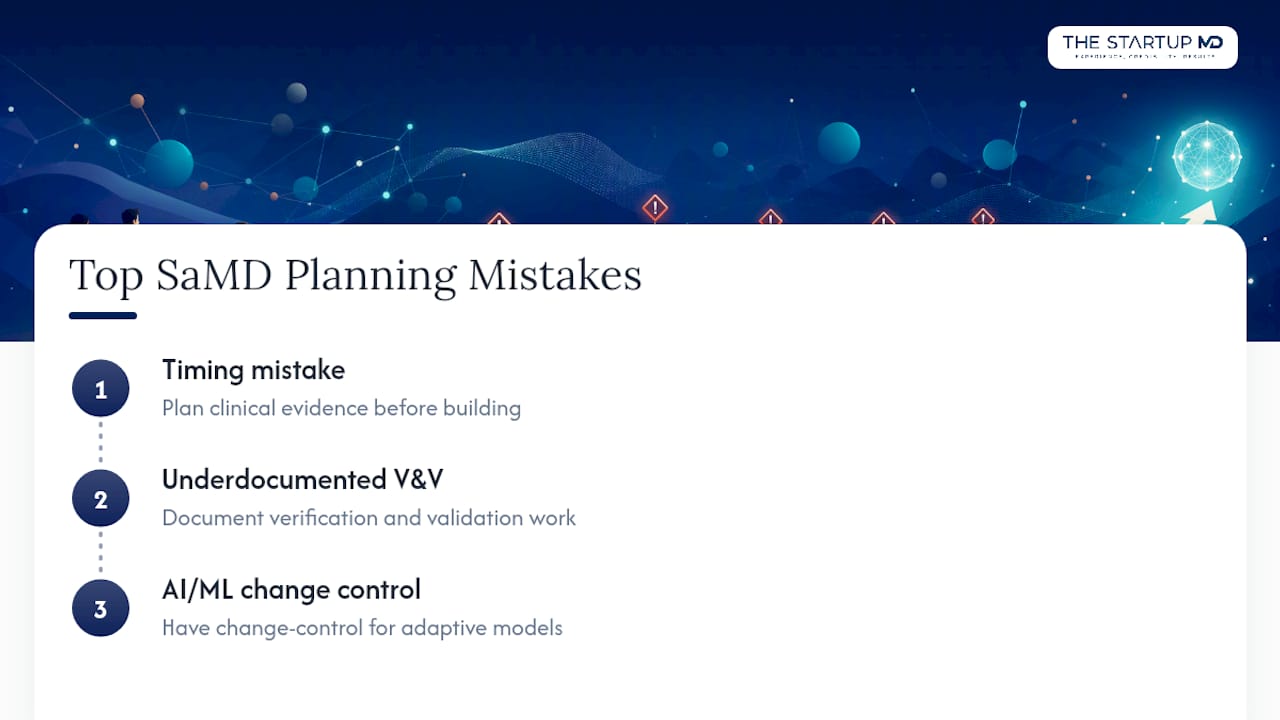
The most common mistake I see is timing: teams treat clinical evidence planning as something that happens after the product is built, when it needs to shape the build itself. Underdocumented verification and validation work is the second most frequent gap, closely followed by AI/ML teams that ship adaptive models with no change-control plan at all.
Fractional regulatory and clinical leadership exists precisely to catch these gaps early, when a documentation fix costs a week instead of a quarter. That's the clinical advisory scope The StartupMD brings to healthcare SaaS teams navigating this exact terrain.
— Paul Bergeron MD, MBA
How The StartupMD Helps You Move From Guidance to Submission
Reading FDA guidance is one thing. Translating it into a submission timeline your investors and engineering team can actually plan around is another. The StartupMD works as a fractional Chief Medical Officer for healthcare SaaS startups, closing the exact gap between "we read the guidance" and "we have a defensible regulatory strategy," without the overhead of a full-time executive hire.
Our engagements cover regulatory strategy mapping, clinical-evidence planning, and hands-on preparation for Q-Submission meetings, the kind of work that determines whether your review cycle takes months or drags into years. If you're weighing your pathway, building your traceability matrix, or drafting a PCCP for an adaptive model, visit our services overview to see how a fractional CMO engagement fits your stage, or book a consult to walk through your specific SaMD classification and submission plan.
This article is general information, not a substitute for advice from a qualified doctor. Consult a qualified healthcare professional about your own circumstances before acting on anything here.
Sources
- Software as a Medical Device (SaMD) | FDA
- Artificial Intelligence in Software as a Medical Device
- Content of premarket submissions for device software functions
- Digital Health Technologies for Remote Data Acquisition in Clinical Investigations
- Guidances with Digital Health Content | FDA