

Start active vendor engagement 6 to 9 months before a community hospital's annual budget planning window opens, and 9 to 18 months ahead for large academic health systems. That range is not a guess. A 125-day average buying cycle has been documented for mid-market healthcare IT purchases, and complex, multi-stakeholder procurements at academic centers routinely stretch to 9 to 18 months. If you have a fixed deadline, whether a grant expiration or a board commitment, build in a 150-day buffer before it.
Three gates in the health system IT budget cycle will not move for you, no matter how good your product is:
- Budget cadence — most systems lock capital plans months before the fiscal year starts.
- Compliance and security review — HIPAA, BAA, and SOC 2 documentation gets checked before anyone evaluates features.
- Capital allocation scoring — big-ticket purchases get ranked numerically against competing requests, not approved on merit alone.
Miss any one of these windows and you are not delayed by weeks. You are delayed by a full fiscal year.
Key Takeaways
Vendors who engage 6 to 9 months before a community hospital's budget window, or 9 to 18 months before a large system's, and who run compliance, pilot, and legal review in parallel consistently close faster than vendors who treat these as sequential steps.
| Point | Details |
|---|---|
| Start early | Engage 6 to 9 months out for community hospitals and 9 to 18 months for large systems; build in a 150-day buffer before fixed deadlines. |
| Map the committee | Identify the CIO, CMIO, CFO, and CISO priorities separately; know when the Value Analysis Committee meets. |
| Watch the funding classification | Confirm whether your deal is capex or opex early; a subscription structure can open off-cycle approval paths. |
| Front-load compliance | Send SOC 2 mapping and a BAA draft before the prospect asks; missing artifacts commonly disqualify vendors before functional review. |
| Get expert help on timing | The StartupMD runs budget-mapping workshops and RFP readiness reviews built specifically around health system procurement gates. |
Table of Contents
- What are the procurement stages in a health system IT budget cycle?
- Who controls the budget approval gates?
- How does capex vs opex classification change deal timing?
- A 90-day playbook to compress the sales cycle
- Practitioner perspective from The StartupMD
- When does the fiscal year actually start for a health system?
- Why do health system IT budgets get delayed or rejected?
- How do grants and external funding affect IT budget timing?
- How should SaaS founders plan features around multi-year IT investment cycles?
- What the research gets right, and what it misses
- How The StartupMD helps you time and win health system deals
- Sources
What are the procurement stages in a health system IT budget cycle?
Health system procurement typically moves through three formal stages, and each one has a predictable duration if you know where to look. Understanding these stages lets you calendarize your entire sales motion instead of guessing.
- Market sounding and requirements definition (12 to 16 weeks). This is where the buying committee defines what problem it's actually solving and who might solve it. Vendors who engage here shape the requirements document itself. Vendors who show up after it's published are reacting to specs written by a competitor.
- Detailed bid and RFP evaluation (12 to 20 weeks). Evaluators score submissions against total cost of ownership, clinical benefit, and integration complexity. Completeness matters as much as quality. A missing BAA or SOC 2 attestation can disqualify a technically superior proposal before anyone reads the functional response.
- Contract negotiation and execution (4 to 12 weeks). Legal review of data-use terms and liability language is the most common bottleneck here, especially when a startup's standard contract wasn't built with a compliance officer in mind.
Add these together and you get 12 to 24 months for a complex, multi-stakeholder procurement. But not every deal looks like that. A $75,000 point solution sold into a community hospital, with a small buying committee and no board-level capital review, can close in 3 to 6 months. An enterprise platform sale into a health system with a formal capital allocation committee and a dozen stakeholders will run 9 to 18 months, almost regardless of how strong your champion is internally. Know which deal you're in before you build your forecast.
Who controls the budget approval gates?
Every health system has a buying committee, and every member on it is optimizing for something different. Selling to the whole group with one message is how deals stall in stage two.
- CIO — cares about integration burden and security posture. This is usually the first gate you'll hit.
- CMIO — wants clinical validation. If you can't show outcome data from a comparable environment, expect a pilot requirement.
- CFO — evaluates budget fit and return on investment against competing capital requests, not just your ROI in isolation.
- CISO or compliance lead — reviews BAAs, SOC 2 reports, and HITRUST mapping. This person can stop a deal that everyone else loves.
- Supply chain and clinical champions — influence scoring but rarely hold veto power alone.
Formal bodies compound this. A Value Analysis Committee might meet monthly and only accept new submissions on a set schedule. A capital allocation committee scores requests numerically and ranks them against every other technology ask that quarter, a process Geisinger Health System has documented in detail. Miss a submission deadline for either body and you don't get a second try until the next cycle, often three months later.
Pro Tip: Ask your champion directly, "When does the Value Analysis Committee next meet, and what's the submission cutoff?" That single question tells you more about your real close date than any discovery call about pain points.
How does capex vs opex classification change deal timing?
Whether your deal gets classified as a capital expense or an operating expense determines which approval path it takes, and vendors who ignore this leave months on the table.
Purchases above roughly $50,000 to $100,000 tend to trigger capital review in most health systems, though the exact threshold varies by organization. Capital expenditures usually require inclusion in the annual capital plan and, for larger amounts, a line in the board packet. If you miss that planning window, you wait for the next budget cycle, full stop. Operating expenses, by contrast, can sometimes get approved off-cycle, though they still typically require finance sign-off and budget-line availability.
This is where deal structure becomes a sales lever, not just a finance detail:
- Subscription pricing often reclassifies what would be a capital purchase into an operating expense, opening off-cycle approval paths.
- Amortized multi-year contracts can spread cost in a way that fits under a smaller annual threshold.
- Pilot-to-capex conversion lets you start with a small opex-funded pilot, then convert to a larger capital agreement once clinical outcomes justify it, running the pilot in parallel with the capital planning cycle instead of waiting for it.
Surface these options during discovery, not during final negotiation. Asking "would a subscription structure fit your current budget cycle better than a capital purchase?" in your second call can shift a 14-month timeline into a 5-month one.
A 90-day playbook to compress the sales cycle
Two discovery questions will tell you more about your real timeline than anything in a demo: "When does your capital planning cycle start?" and "When does your Value Analysis Committee next meet?" Answers to those two questions should reshape your entire account plan.
Here's how the first 90 days should run once you have a live opportunity:
- Day 1 to 3: Send security documentation and a BAA draft immediately, before the prospect asks. This signals readiness and removes the most common cause of stage-two delay.
- Day 1 to 7: Schedule a joint CMIO and CISO discovery call. Getting clinical and security stakeholders in the same room early prevents sequential, months-apart conversations later.
- By call 2: Pull in the health system's EHR architect to scope integration complexity honestly. Surprises here in month six kill deals that looked closed.
- By day 7: Deliver a pilot statement of work with named, measurable clinical outcomes, not vague "improved efficiency" language. Reduction in documentation time, readmission rate change, or turnaround time on a specific workflow are the kinds of metrics a CMIO can defend to a committee.
Running your pilot, your security audit, and your legal review in parallel, rather than sequentially, is the single highest-leverage move available to you. Healthcare SaaS sales cycles run structurally longer than general B2B precisely because vendors treat these as sequential steps instead of parallel tracks. Vendors who pre-position before the formal RFP and clear compliance early see materially better conversion than vendors who respond cold.
Pro Tip: Build your compliance packet before you have a live deal, not during one. A pre-built SOC 2 mapping and BAA redline can turn a two-week delay into a same-day email.
Before outreach begins, have these ready: a SOC 2 mapping document, a redlined BAA template, a pilot SOW with clinical metrics attached, an integration appendix your engineering lead can defend live, and a financial model showing total cost of ownership over a multi-year term, not just year-one pricing.
Practitioner perspective from The StartupMD
Paul Bergeron, MD, MBA, brings more than 25 years across medicine and business to advising healthcare SaaS founders on go-to-market timing and clinical strategy. The StartupMD runs engagements built specifically for the mechanics covered above: budget-mapping workshops that identify a target account's fiscal calendar and committee cadence, RFP readiness reviews that catch missing compliance artifacts before submission, and pilot design work that ties outcomes to metrics a CMIO can actually defend internally.
Bring in outside help when your team has never navigated a capital allocation committee before, or when your pilot design lacks clinical rigor a skeptical CMIO would trust. Keep it in-house once you've closed two or three deals in the same buyer category and your team has internalized the cadence.
When does the fiscal year actually start for a health system?
Most health systems run a July 1 to June 30 fiscal year, though a meaningful share, particularly systems tied to state government budgets or certain academic medical centers, use a calendar-year or October-start cycle. Confirm this early. Assuming the wrong fiscal year is one of the most common and avoidable errors a vendor makes.
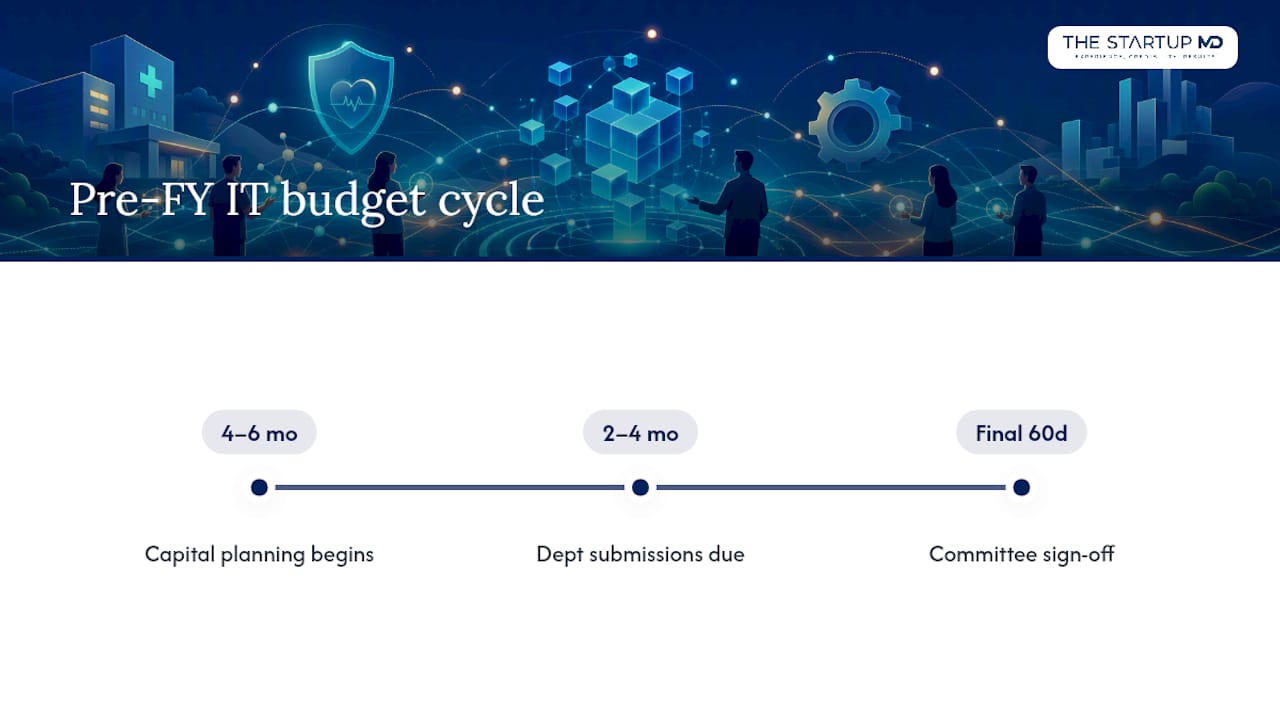
Regardless of the exact start date, the internal calendar tends to follow a consistent rhythm. Capital planning discussions typically begin four to six months before the fiscal year starts, department heads submit budget requests two to four months out, and the finance and capital committees finalize allocations in the final 60 days before the new fiscal year begins. This is why engaging 6 to 9 months ahead of a community hospital's fiscal year, or 9 to 18 months ahead for a large system, isn't excessive caution. It's the only window where your proposal can actually get written into next year's plan rather than waiting for the year after.
Internal deadlines compound the pressure. A department that misses its own submission deadline to finance often loses its slot regardless of how strong the vendor case is. If your champion tells you their budget request deadline is in six weeks, that date matters more to your close timeline than anything happening in your sales process.
Why do health system IT budgets get delayed or rejected?
The most common approval delay isn't disinterest. It's incomplete information reaching the capital committee at the wrong time. A champion who is excited about your product but hasn't built a defensible TCO model will get sent back to gather more data, and that round trip alone can cost a full committee cycle, often another month or more.
Competing capital requests are the second major friction point. Your proposal isn't evaluated in isolation. It's ranked against every other technology ask that quarter, from imaging equipment to EHR upgrades. A numeric scoring model means your product can be excellent and still lose to a higher-scored request with stronger clinical urgency.
Staff turnover creates a quieter but equally damaging delay. When a champion or CIO leaves mid-cycle, momentum resets, and a new stakeholder often wants to revisit assumptions the prior owner had already accepted.
Finally, compliance gaps stop deals cold. A missing or incomplete BAA doesn't just slow evaluation. It can remove you from consideration entirely, since procurement teams increasingly treat compliance documentation as a pass/fail gate before functional review even begins. Vendors who assume they can supply this paperwork "later in the process" consistently lose weeks they never get back.
How do grants and external funding affect IT budget timing?
External funding sources change the budget cycle in ways that cut both directions. A federal or state grant with a hard spend deadline can compress a health system's internal timeline dramatically, because finance leadership suddenly has a use-it-or-lose-it incentive to move fast on procurement.

That urgency comes with a catch. Grant-funded purchases often carry their own compliance and reporting requirements layered on top of the health system's normal review, which can add steps rather than remove them. A vendor selling into a grant-funded initiative should ask directly what reporting obligations the grant imposes and whether those requirements affect the RFP evaluation criteria.
Philanthropic and foundation funding tends to move on a different clock entirely, often tied to a donor's own fiscal year or a specific board approval meeting that has nothing to do with the health system's normal capital cycle. This can either open an off-cycle purchasing window or introduce a second layer of approval, depending on how the foundation's governance structure interacts with hospital administration.
The practical takeaway: when a prospect mentions grant or foundation funding, treat it as a signal to ask more questions, not fewer. Find out whether the funding source shortens the internal approval timeline or simply adds another stakeholder to the committee you already have to satisfy.
How should SaaS founders plan features around multi-year IT investment cycles?
Health systems build multi-year IT investment plans, typically spanning three to five years, that prioritize categories like interoperability, cybersecurity, and clinical decision support well before any specific vendor gets evaluated. A founder who understands which category a health system has already prioritized can position a product as fulfilling an existing plan rather than introducing a new, unbudgeted ask.
This means product roadmap conversations with prospects should start earlier than most founders assume, often during the market-sounding stage described earlier, not after an RFP is published. Asking a CIO which categories are already funded in their three-year plan tells you whether your product fits an existing budget line or requires you to create a new one, and creating a new budget line takes far longer.
Forecasting your own pipeline against this reality matters just as much. If a target account's multi-year plan prioritizes interoperability this year and clinical decision support next year, a feature roadmap that arrives a year ahead of their stated priority will sit unevaluated no matter how strong the demo is. Aligning your go-to-market sequencing to a buyer's stated multi-year priorities, rather than your own launch calendar, is consistently what separates startups that close in one cycle from those that wait two.
What the research gets right, and what it misses
The data on procurement stage durations and committee structures is solid, and it supports a clear conclusion: timing discipline matters more than almost any other variable in a healthcare SaaS sales motion. But most vendor advice treats this as a pipeline management problem, something to track in a CRM, when it's actually a calendar-mapping problem that has to start before pipeline exists.
The conventional wisdom oversells the demo and undersells the discovery question. I've seen founders spend enormous energy perfecting a product walkthrough while never asking a prospect when their capital committee meets. That single omission explains more stalled deals than any competitive loss does.
What should the reader prioritize first? Stop treating security documentation, pilot design, and legal review as sequential steps that happen after a verbal yes. Running them in parallel from the first serious conversation is not a nice operational upgrade. It is the difference between a 6-month close and an 18-month one, and in this market, that difference decides which startups survive to their next funding round.
— Paul Bergeron MD, MBA
How The StartupMD helps you time and win health system deals
Understanding the budget cycle is one thing. Executing against it while running a startup is another. The StartupMD works directly with healthcare SaaS founders and sales leaders to close that gap, through fractional Chief Medical Officer engagements, RFP readiness reviews, and pilot design work built around the exact gates covered above: capital allocation scoring, compliance documentation, and clinical validation.
A typical engagement starts with a budget-mapping workshop that identifies your target accounts' fiscal calendars and committee cadences, followed by a readiness audit of your RFP artifacts, including BAA language, SOC 2 mapping, and TCO models, so nothing disqualifies you before evaluators reach the functional review. For teams preparing a pilot, The StartupMD helps design outcome measures a CMIO can defend to a Value Analysis Committee, not just metrics that sound good in a sales deck.
If your team is heading into a health system sales cycle in the next two quarters, the highest-value next step is a strategy session to map your go-to-market sequencing against real budget windows. Start with The StartupMD's guide to building a healthcare SaaS go-to-market strategy and reach out to schedule a working session before your next fiscal year planning window closes.
Sources
- Digital health procurement guide (DOI entry)
- Geisinger Health System's 360-degree approach to capital technology assessment (ECRI guidance)
- Timing is everything: healthcare IT buying cycles (NexusTek)
- How to sell software to hospitals (MDliaison)