

Consumer ChatGPT is not appropriate for protected health information, full stop. OpenAI's enterprise offerings, including ChatGPT for Healthcare and the API with Modified Retention, can support HIPAA-compliant workflows, but only under a signed Business Associate Agreement and with the right controls turned on. If your team is pasting patient notes into a free or personal ChatGPT account right now, stop. Verify your BAA and configuration before another prompt goes through.
TL;DR:
- Using consumer ChatGPT for healthcare PHI exposes organizations to legal and operational risks, as it is not covered by HIPAA protections or BAAs.
- HIPAA compliance for ChatGPT requires enterprise products configured with specific controls, signed BAAs, and active management of feature scope.
- Admin controls like role-based access, audit logs, and retention settings are critical for compliance and must be regularly reviewed and properly configured.
- Common risk patterns include copying clinical notes into consumer chatbots, using AI for audio capture without safeguards, and relying on vendors that decline to sign appropriate BAAs.
- A phased governance approach involving risk assessments, BAA negotiations, controlled pilots, and ongoing audits is essential for legally safe AI deployment in healthcare.
Table of Contents
- What "HIPAA-Eligible" ChatGPT Products Actually Cover
- Why Consumer ChatGPT Creates Legal and Operational Risk
- How to Evaluate, Contract, and Deploy ChatGPT Where PHI Is Involved
- Which Technical Controls and Admin Settings Actually Matter
- Where AI Deployments Most Often Trigger a HIPAA Violation
- What HHS and OCR Guidance Says About AI and Cloud Services
- The StartupMD's 90 to 180 Day Governance Roadmap
- Perspective: Innovation With Defensible Compliance
- How The StartupMD Helps You Get This Right
- Sources
What "HIPAA-Eligible" ChatGPT Products Actually Cover
"HIPAA-eligible" is a specific term, not a marketing flourish, and it does not mean every ChatGPT surface is safe for PHI. OpenAI documents a defined set of HIPAA-eligible products and functionality, and coverage only applies when a customer is operating inside an eligible workspace under an active BAA.
The eligible tier generally includes:
- ChatGPT for Healthcare and ChatGPT Enterprise, configured as regulated workspaces with admin controls.
- The OpenAI API with Modified Retention, which shortens or restricts how long prompts and outputs are stored.
- A contractual commitment that inputs from eligible workspaces are not used to train OpenAI's models.
- Role-based access control (RBAC), audit logging, and, in some configurations, options for customer-managed encryption.
None of that matters if the workspace itself is misconfigured or the BAA doesn't match how your team actually uses the tool. A hospital system could sign a BAA and still expose PHI if a clinician logs into a personal ChatGPT account on a break room laptop instead of the sanctioned enterprise instance. Administrators need to verify, in writing, exactly which features are covered, which are off by default, and which require explicit activation. The HIPAA Journal's 2026 analysis is blunt on this point: generic ChatGPT is not HIPAA compliant, and only the enterprise offerings can support compliant use, and only when governed correctly.
Why Consumer ChatGPT Creates Legal and Operational Risk
HIPAA applies to covered entities and their business associates, not to every company that touches health data. When a patient types symptoms into the free version of ChatGPT, that conversation typically sits entirely outside HIPAA's protections, because OpenAI is not acting as a covered entity or business associate in that exchange. Harvard Law Today's analysis makes this gap explicit: what you tell a consumer chatbot about your health is not shielded the way it would be in a clinical record.
The operational risk cuts both ways:
- Patients lose protection the moment they describe symptoms, medications, or diagnoses to a consumer AI tool, since there's no BAA and no Privacy Rule coverage attached to that input.
- Clinicians create exposure when they paste real patient identifiers into a personal ChatGPT session to draft a note or summarize a chart faster.
- Front-desk and billing staff sometimes feed insurance details or appointment histories into public tools without realizing those platforms have zero contractual obligation to protect that data.
None of these are hypothetical edge cases. They're the predictable result of a workforce reaching for the fastest tool available, without anyone flagging that the fast tool and the compliant tool are not the same product.
How to Evaluate, Contract, and Deploy ChatGPT Where PHI Is Involved
Rolling out AI in a clinical or health-data environment isn't a procurement decision you make in an afternoon. It's a governance project with a procurement step buried inside it. Here's the sequence that holds up under audit:
- Run a Security Rule risk analysis scoped to the AI workflow. Don't reuse a generic risk assessment. Map exactly where PHI enters the AI system, where it's processed, and where it lands in logs or backups. A structured approach like the one outlined in our HIPAA risk assessment framework gives compliance teams a repeatable model rather than a one-off exercise.
- Negotiate a BAA that matches your actual feature set. A signed BAA covering "ChatGPT Enterprise" in general terms isn't enough if your team plans to use agent-owned connections or memory features that OpenAI excludes from its standard BAA scope. Our breakdown of HIPAA BAA requirements walks through the clauses that most often get glossed over.
- Document the Privacy Rule basis for every PHI use case, and default to de-identification wherever the workflow allows it. De-identified data still needs documented methodology; it isn't a free pass just because names are stripped out, as TechTarget's HealthTech Analytics coverage points out. Our guide to audit-ready de-identification methods covers what that documentation needs to look like.
- Define acceptable use cases and train the workforce accordingly. Clinical documentation support is a different risk profile than patient-facing triage chat. Write the boundary down, then train to it.
- Pilot under tight RBAC with active audit log review, before scaling to a full department or health system. A 30 to 60 day pilot with a small, monitored user group surfaces misconfigurations while the blast radius is still small.
Pro Tip: Treat "the vendor says it's HIPAA compliant" as the beginning of due diligence, not the end. Ask the vendor to show you, in the contract, exactly which features are excluded from the BAA. If they can't answer that question specifically, you don't have a real answer yet.
Which Technical Controls and Admin Settings Actually Matter
The gap between "we have a BAA" and "we are actually compliant" almost always lives in the admin console. OpenAI's own documentation on HIPAA-eligible products and functionality is explicit that certain features, including some agent-owned connections and improved memory settings, sit outside standard BAA coverage and must be disabled or specifically accounted for.
Four settings deserve direct sign-off from your compliance lead, not just your IT administrator:
- Role-based access control and SSO, scoped so that only staff with a documented need can reach PHI-adjacent workflows.
- Audit log retention, configured to capture who accessed what, when, and through which feature, reviewed on a defined cadence rather than left to accumulate unread.
- Modified retention settings on the API, alongside customer-managed encryption keys where the deployment supports them.
- Third-party plugins and connectors, which frequently introduce a data path nobody mapped during the original risk analysis.
A defensible deployment requires tracing the entire data path, prompts, intermediate logs, outputs, backups, and any connector, against contractual and technical safeguards at every point. Skipping that mapping exercise is the single most common reason a well-intentioned pilot fails an audit later.
Where AI Deployments Most Often Trigger a HIPAA Violation
Certain patterns show up again and again in real deployments, and they're worth naming directly:
- Copying full clinical notes into a consumer chatbot to draft a summary or letter, bypassing the enterprise tool entirely because it's slower to log in.
- AI scribe tools capturing audio without a clear answer on how long the vendor retains that recording or transcript.
- Shared GPTs or custom agents built with agent-owned connections that quietly sit outside the organization's BAA scope.
- A vendor that won't extend or narrows the BAA to exclude a feature your workflow depends on. Treat that refusal as a stop condition, not a negotiating detail to revisit later.
If a vendor doesn't sign a BAA matching your actual operational workflow, the safe move is to halt PHI processing through that vendor for that specific use case until the contract catches up.
What HHS and OCR Guidance Says About AI and Cloud Services
HIPAA was written to be technology-neutral, which means it never anticipated large language models specifically, but it also never exempted them. Responsibility for compliance stays with the covered entity or business associate, regardless of which AI vendor sits underneath the workflow.
Key points that carry directly into 2026 planning:
- HHS's Office for Civil Rights has long applied cloud-computing guidance requiring a BAA any time a vendor creates, receives, maintains, or transmits ePHI, and that same logic extends cleanly to AI vendors.
- Covered entities must complete a Security Rule risk analysis before deployment, not after an incident forces one, according to HIPAA Journal's analysis of AI and healthcare data.
- No AI system is "HIPAA certified." Compliance is a property of how the organization documents its Privacy Rule basis, signs its BAAs, and configures its safeguards, not a badge a vendor can slap on a product page.
Legal commentary throughout 2026 continues to emphasize that enforcement risk concentrates on the customer organization, not the AI vendor, which is exactly why internal governance matters more than vendor selection.
The StartupMD's 90 to 180 Day Governance Roadmap
Startups and provider organizations that treat AI governance as a phased project, not a single approval meeting, get to a defensible posture faster and with fewer surprises.
- Phase 1 (Days 1 to 45): Scoped risk assessment and BAA negotiation. Identify every PHI touchpoint in the proposed AI workflow and negotiate BAA language that matches it feature by feature.
- Phase 2 (Days 45 to 120): Controlled pilot. Launch with a small user group under strict RBAC, active audit log review, and a defined rollback plan if something looks wrong.
- Phase 3 (Days 120 to 180): Scale, train, and reassess. Expand access, formalize workforce training, and set a recurring review cadence tied to any vendor feature updates, following a structure similar to our 90 to 180 day data governance roadmap.
Pro Tip: Build your reassessment calendar around the vendor's release notes, not your own. OpenAI updates feature scope and BAA coverage periodically, and a control that was compliant in January can quietly fall out of scope by summer if nobody's watching.
Perspective: Innovation With Defensible Compliance
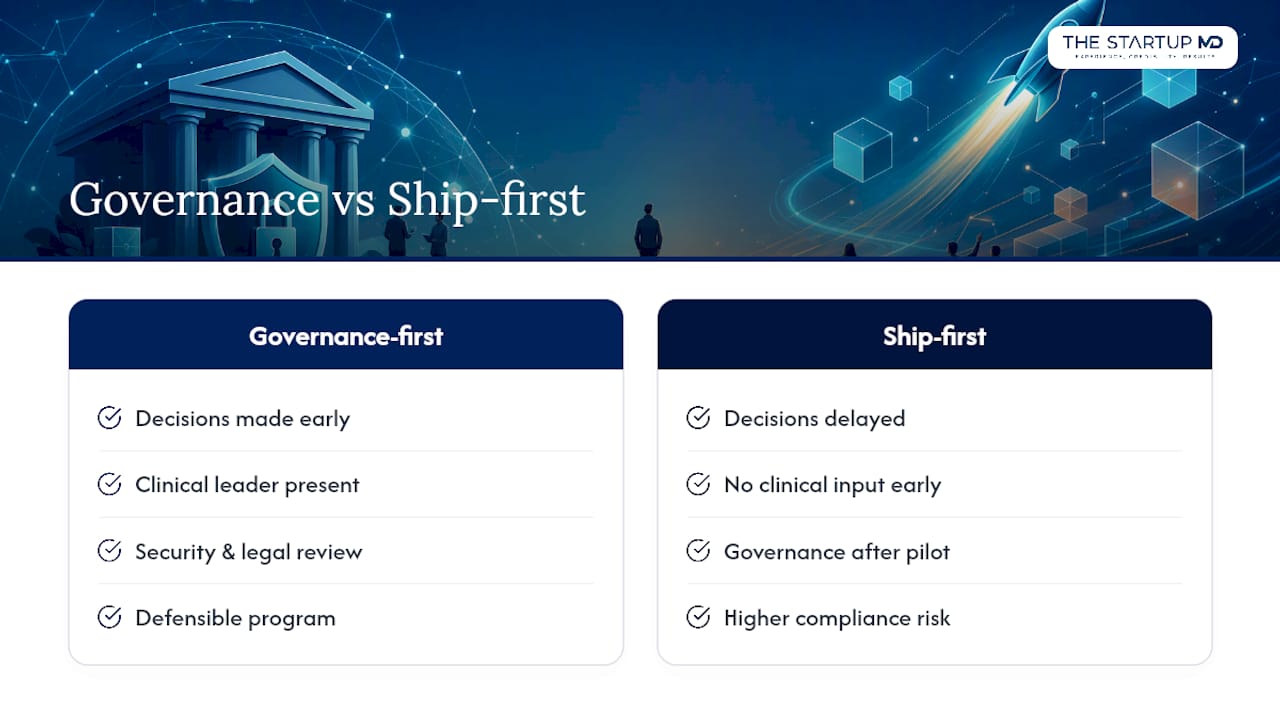
Healthcare startups move fast, and AI adoption often outruns the governance conversation that should have happened first. That's backwards. Pairing clinical leadership with security and legal review at the start of an AI rollout, not after the pilot has already touched real patient data, is what separates a defensible program from an expensive reversal six months in.
The organizations getting this right aren't the ones with the most sophisticated AI medical intake assistant stack. They're the ones who decided, early, which use cases were worth the regulatory weight and which weren't, and who had someone with clinical judgment in the room when that decision got made. Product timelines will always push toward "ship now." Compliance risk doesn't negotiate on that timeline, and pretending otherwise is how a promising pilot turns into a breach notification.
— Paul Bergeron MD, MBA
How The StartupMD Helps You Get This Right
Getting from "we want to use ChatGPT" to a documented, defensible AI workflow takes clinical judgment layered on top of legal and technical review, and most healthtech teams don't have that combination in-house yet. The StartupMD works with healthcare SaaS companies and provider organizations on exactly this gap: scoped risk assessments, BAA readiness review, governance roadmaps, and fractional Chief Medical Officer support for teams that need clinical leadership at the table before an AI pilot goes live.
If your organization is evaluating an AI vendor relationship right now, the highest-leverage next step is a structured review of your current advisory scope. Explore The StartupMD's fractional clinical advisory services to see how a fractional CMO engagement fits into your governance timeline, or visit the services overview to schedule a conversation about where your AI deployment currently stands.
This article is general information, not a substitute for advice from a qualified doctor. Consult a qualified healthcare professional about your own circumstances before acting on anything here.
Sources
- Is ChatGPT HIPAA Compliant? Updated for 2026 — HIPAA Journal
- Does HIPAA protect what you tell ChatGPT? — Harvard Law Today