

Healthcare data governance is an enterprise program that makes patient and operational data trustworthy, auditable, and usable for clinical and business decisions while protecting health information. The AHIMA practice brief frames this as an interdisciplinary responsibility, not an IT project. Get it right and leaders get defensible metrics, clean audit trails, and a data asset that supports real decisions. Get it wrong and you get shadow spreadsheets, failed payer audits, and a compliance team scrambling every quarter.
TL;DR:
- Ensuring clear ownership of critical clinical quality definitions and data stewards is essential to prevent scope creep and maintain program credibility.
- Starting with a small, focused pilot that targets high-impact use cases allows organizations to demonstrate measurable improvements within 90 to 180 days.
- Governance success depends on explicit decision rights, a well-defined operating cadence, and linking metrics directly to organizational outcomes.
- Implementing metadata catalogs, lineage tracking, and role-based access controls through layered technical controls safeguards data throughout its lifecycle.
- Regular KPI tracking, including data quality, reconciliation rates, and audit outcomes, is vital for maintaining executive support and demonstrating ROI.
Table of Contents
- Why Data Governance in Healthcare Matters Right Now
- A Practical Framework: Core Components and Governance Pillars
- Building a 90 to 180 Day Governance Roadmap
- Who Owns What: Roles, Decision Rights, and Operating Cadence
- Data Lifecycle Management: Cataloging, Lineage, and Access Controls
- Mapping Governance to Regulatory and Payer Standards
- Measuring ROI: KPIs That Prove the Program Works
- Common Pitfalls and How to Avoid Them
- How The StartupMD Helps Healthcare Startups Build Governance That Sticks
- Three Questions Every Governance Sponsor Should Answer Now
- Sources
Why Data Governance in Healthcare Matters Right Now
Healthcare organizations are drowning in data they can't fully trust. A single patient generates an estimated 80 megabytes of clinical data per year across EHRs, claims systems, wearables, and lab feeds. Multiply that across a patient panel of any size and you have a volume problem layered on top of a trust problem. Most organizations don't lack data. They lack a defensible way to prove that data means what they say it means.
The value drivers are concrete. Clean, governed data improves clinical decision support, because a clinician trusts a dashboard only if the underlying numbers reconcile to the chart. It also determines whether an organization passes payer audits tied to HEDIS measures, where a mismatched denominator can cost real reimbursement. Analytics teams that build on governed data ship faster because they stop re-verifying the same fields every quarter.
The risk side is just as real. Protected health information breaches remain one of the costliest categories of data incident in any industry, and inconsistent metric definitions across departments quietly erode leadership's confidence in every report that follows. A scoping review of health information governance found that governance programs consistently improve data quality, support research use cases, and, maybe most importantly, build the kind of institutional trust that lets an organization actually act on its own data.
Here's what tends to break without governance in place:
- Clinical quality metrics that differ depending on who pulled the report
- Audit preparation that takes weeks instead of days because nobody owns the data dictionary
- Duplicate or conflicting patient records across systems that never got reconciled
- Analytics projects that stall because nobody can say who is authorized to approve a new data element
- Compliance teams discovering PHI exposure only after a vendor questionnaire flags it
Pro Tip: If your organization can't name the person who owns your core clinical quality definitions today, that's your governance program's first assignment, not its fifth.
None of this requires a massive transformation initiative. It requires a framework, a small set of owners, and a prioritized starting point.
A Practical Framework: Core Components and Governance Pillars
Every credible healthcare data governance program rests on the same seven pillars, regardless of organization size. The AHIMA practice brief recommends establishing clear decision rights and retention and sharing policies before any technical work begins, and that sequencing matters more than most organizations realize.
Policy and standards define what "good data" means at your organization, including naming conventions, definitions, and acceptable use rules. Stewardship and roles assign named individuals, not departments, to be accountable for specific data domains. Data quality covers the measurable dimensions of accuracy, completeness, timeliness, and consistency that turn a claim about "clean data" into something you can actually check. Metadata and cataloging create the searchable inventory that tells staff where a data element lives, who owns it, and how it's defined. Access and security enforce who can see, edit, or export data, mapped to role and purpose. Lifecycle and retention govern how long data lives in each system and when it gets archived or destroyed. Compliance and evidence turn all of the above into artifacts an auditor or payer can actually review.
Ownership tends to follow a predictable pattern across healthcare organizations that have matured past ad hoc data management:
| Pillar | Typical owner | Core artifact |
|---|---|---|
| Policy and standards | Chief Data Officer or VP of Data | Data governance charter |
| Stewardship and roles | Data stewardship council | RACI matrix by data domain |
| Data quality | Data steward, clinical owner | Data quality scorecard |
| Metadata and cataloging | Data architecture team | Enterprise data dictionary |
| Access and security | Chief Information Security Officer | Role-based access policy |
| Lifecycle and retention | Compliance officer, IT | Retention and disposition schedule |
| Compliance and evidence | Chief Medical Information Officer, compliance | Audit evidence repository |
A Chief Data Officer, where one exists, typically chairs the governance council and owns the charter. A Chief Privacy Officer or compliance lead owns retention and access policy language, while a Chief Medical Information Officer bridges clinical workflows and the metric definitions clinicians actually rely on day to day. Data stewards, drawn from both clinical and operational teams, own the day-to-day accuracy of specific domains like problem lists, medication data, or claims fields.
The documents worth building first are narrower than most teams expect:
- A one-page governance charter naming the sponsor, scope, and decision rights
- A data dictionary covering your highest-priority critical data elements, not your entire schema
- An access policy mapped to roles, not individuals, so it survives staff turnover
- A retention schedule that reconciles federal minimums with your state's specific requirements
Skip the temptation to build a comprehensive enterprise data model before you've proven the framework on one use case. A health data management systems review found that real-time access, secure sharing, and clear data provenance are consistent system requirements, and those requirements are far easier to satisfy for one well-scoped domain than for an entire enterprise on day one.
Building a 90 to 180 Day Governance Roadmap
Governance programs that succeed almost always start small. Programs that try to govern everything at once tend to stall in committee before they touch a single data element. A phased, five-step sequence lets you show measurable results inside two quarters.
1. Identify priorities and pick a pilot use case (weeks 1 to 4). Interview clinical, compliance, and finance leaders to find where bad data is already causing pain. A HEDIS reporting gap, a recurring audit finding, or a stalled analytics project all make strong pilot candidates because the cost of the current mess is already visible to leadership, which helps prioritize pilots.
2. Scope the pilot and assign stewards (weeks 3 to 8). Define the critical data elements that matter for your chosen use case, typically a limited number of fields rather than many. Name a data steward for each domain and get executive sign-off on a one-page charter before any technical work starts.
3. Implement technical controls and cataloging (weeks 6 to 14). Stand up a metadata catalog entry for each critical data element, document its source system and lineage, and apply the access controls your policy pillar already defined. This is where the framework pillars stop being documents and start being enforced.
4. Measure outcomes and gather audit evidence (weeks 12 to 20). Track data quality improvement against your baseline and package the evidence a payer or auditor would want to see, whether that's HEDIS reconciliation or a clean chain-of-custody log. Reconciling metric-layer definitions to source systems within a timely window is a common expectation when payers audit HEDIS measures quarterly.
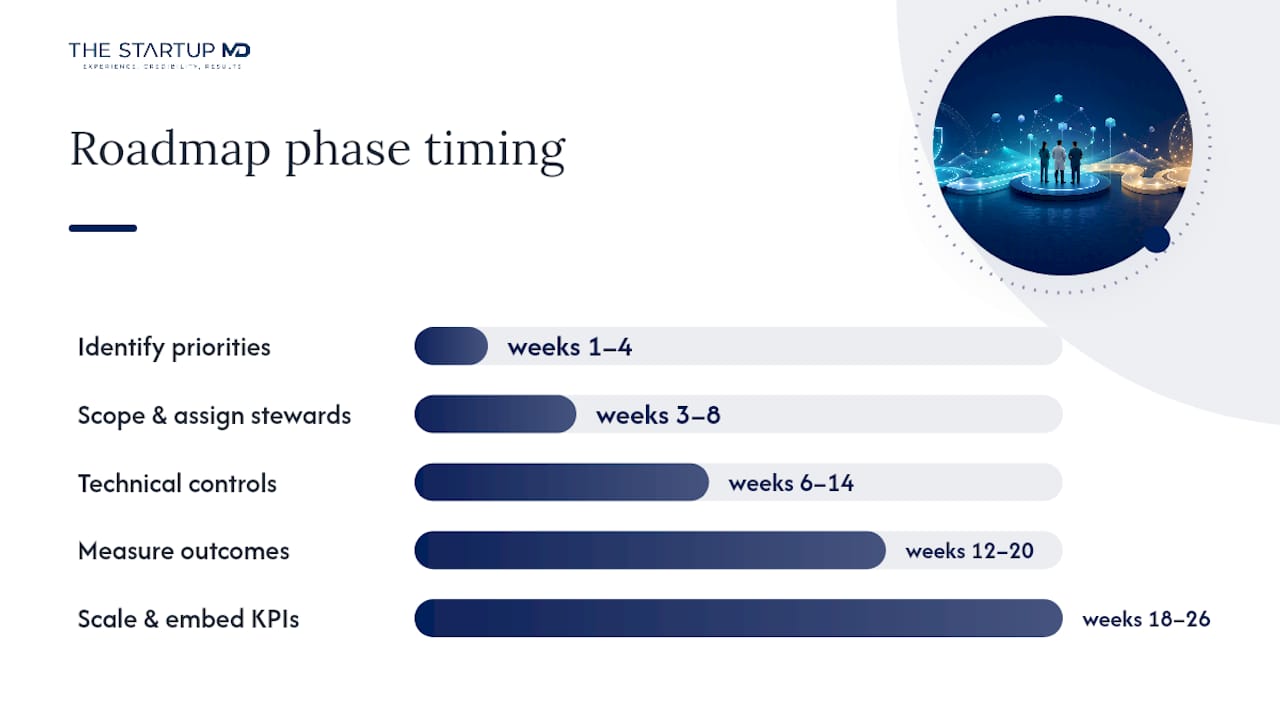
5. Scale horizontally and embed KPIs (weeks 18 to 26). Take the operating model that worked for one domain and apply it to the next priority area, carrying forward the same charter template, steward structure, and metrics rather than reinventing the process.
Quick-win signals worth tracking at each stage:
- A measurable reduction in time spent reconciling conflicting reports
- A documented data dictionary entry for every critical data element in the pilot
- At least one successful audit or payer review citing the new evidence trail
- A named steward who can answer a data question without escalating it
Pro Tip: Choose your pilot around a metric that already has an executive sponsor demanding better numbers. Governance programs die in committees; they survive when someone with budget authority already wants the outcome.
This sequencing mirrors what the AHIMA practice brief describes as a repeatedly successful pattern: prove value on one high-stakes use case before asking the organization to trust the framework anywhere else. Teams building analytics capability on top of a governed pilot dataset often find the downstream work, described in more detail in this explainer on health data analytics, moves noticeably faster once the underlying data has a clear owner and definition.
Who Owns What: Roles, Decision Rights, and Operating Cadence
Governance fails most often not because the framework is wrong but because nobody can say who actually decides. A functioning operating model needs a small number of clearly defined roles, each with distinct authority.
The executive sponsor, usually a CMO, CIO, or Chief Data Officer, secures budget and removes organizational roadblocks but doesn't approve individual data definitions. The steering committee, meeting monthly or quarterly, resolves cross-departmental disputes and approves policy changes. The data steward, assigned per domain, owns day-to-day data quality and is the first point of contact when a definition question comes up. The clinical owner, often a physician or nurse informaticist, validates that clinical definitions match how care is actually delivered, which matters enormously for measures tied to HEDIS or quality reporting. IT and security enforce the access controls the policy pillar defines but don't set the policy themselves.
Decision rights need to be explicit about who approves versus who enforces:
- Data stewards propose and document definitions for their domain
- The steering committee approves definitions that cross departmental boundaries
- IT and security enforce access rules but escalate exceptions rather than approving them unilaterally
- The clinical owner has veto authority over any clinical metric definition, even if IT built the underlying query
A workable governance charter is short. It names the sponsor, lists the steering committee members, defines the pilot scope, and states the escalation path when a steward and a clinical owner disagree. Meeting cadence matters more than most teams expect: a steward-level working group that meets biweekly catches problems early, while a steering committee that meets monthly keeps policy decisions from becoming a bottleneck. Programs that skip the steering committee layer entirely tend to see stewards making policy calls they don't have authority to make, which erodes trust in the whole framework within a few months.
Data Lifecycle Management: Cataloging, Lineage, and Access Controls
Every data element moves through four stages: creation, active use, archival, and deletion. Policy documents describe how that movement should work; technical controls are what actually make it happen. Data lifecycle management uses metadata and policy engines to automate these transitions, which matters because manual enforcement simply doesn't scale across the hundreds of systems a typical health system runs.
A metadata catalog is the foundation. It records where each critical data element lives, who owns it, how it's defined, and what systems consume it. Lineage tracking extends that by showing how a data point moved and transformed from its source system to the report a clinician or executive ultimately sees, which is exactly the kind of evidence an auditor asks for when a number looks off. Fine-grained access controls enforce who can view or export a given field based on role and purpose, not just department membership. Masking techniques let analytics teams work with de-identified versions of sensitive fields without ever touching the raw PHI. Immutable audit logging records every access and change, which becomes the backbone of your compliance evidence.
Technically, these controls work best as three connected layers rather than isolated tools:
- A metadata catalog that indexes every critical data element and its lineage
- A policy engine that translates governance rules into enforceable access and retention actions
- Storage-tier lifecycle rules that automatically archive or delete data once retention windows close
Pro Tip: Don't buy a catalog tool before you've documented your critical data elements on a spreadsheet. The tool only becomes useful once you know what you're cataloging; buying first almost always means re-implementing later.
Organizations evaluating HIPAA-compliant infrastructure for these controls often start with cloud hosting decisions, and resources like this guide to HIPAA-compliant cloud providers walk through the practical tradeoffs. On the services side, firms like Collett Systems specialize in implementing the HIPAA-compliant IT patterns that make lifecycle automation enforceable rather than theoretical. A health data management systems review also flags patient participation and provenance as system requirements worth designing for early, since retrofitting patient-facing access after the fact is far harder than building it in from the start.
Mapping Governance to Regulatory and Payer Standards
Compliance in healthcare data governance isn't one standard. It's a layered stack, and treating any single framework as sufficient is how organizations end up surprised during an audit.
HIPAA sets the federal floor for privacy and security, but it's a minimum, not a ceiling. State retention statutes frequently require longer retention periods than HIPAA's own guidance implies, so your retention schedule needs to reconcile both, keeping whichever requirement is stricter for each data category. HITRUST has become the de facto baseline that payers and larger health systems expect from vendors and partners, layering a certifiable framework on top of HIPAA's requirements. HEDIS technical specifications, maintained by NCQA, govern the metric-layer evidence payers scrutinize during quality audits, which is why reconciling your HEDIS definitions to source systems needs to be prioritized early in any pilot. For any AI model that touches clinical decisions, the NIST AI Risk Management Framework provides the governance scaffolding regulators increasingly expect, and it only works when it sits on top of solid data and information governance rather than replacing it.
| Standard or framework | What it governs | Who expects it |
|---|---|---|
| HIPAA | Federal privacy and security baseline | Federal regulators, all covered entities |
| State retention statutes | Minimum and maximum retention periods by data type | State regulators, auditors |
| HITRUST | Certifiable security and privacy control framework | Payers, health system partners |
| HEDIS (NCQA) | Metric-layer technical specifications for quality measures | Payers, quality auditors |
| NIST AI RMF | Risk governance for AI systems affecting clinical decisions | Regulators, health system AI review boards |
| 21 CFR Part 11 | Electronic records and signatures in research contexts | FDA, research sponsors |
Research and clinical trial data introduces an additional layer: 21 CFR Part 11 governs electronic records and signatures for any dataset that feeds FDA-regulated research, which matters if your organization runs or supports clinical trials alongside routine care data. Skipping the AI governance layer is one of the more expensive mistakes healthcare organizations make right now. A model built without documented lineage back to governed source data creates an audit gap that surfaces exactly when a payer or regulator asks how a clinical recommendation was generated. Organizations preparing for HEDIS-specific readiness reviews can find more detail in this HEDIS performance guide, which walks through the reconciliation work payers expect to see documented.
Measuring ROI: KPIs That Prove the Program Works
Governance programs lose executive sponsorship when they can't show measurable progress. The fix is picking a small set of KPIs tied directly to outcomes leadership already cares about, and reporting on them consistently rather than producing a one-time slide deck.
The core metrics worth tracking from day one:
- Data quality score by domain, measured against accuracy, completeness, and timeliness thresholds
- Reconciliation pass rate for metric-layer definitions against source systems, especially for HEDIS measures
- Audit pass rate across payer and regulatory reviews touching governed data
- Issue resolution time, meaning how long it takes a reported data problem to reach a documented fix
- Data literacy scores, tracked through simple staff surveys on whether people trust and understand the definitions they're using
Tying these to financial outcomes is where governance earns its budget. Faster reconciliation means less rework for analytics teams chasing conflicting numbers. Higher audit pass rates translate directly into avoided payer penalties and faster reimbursement cycles. Reduced issue resolution time means fewer executive escalations over "which number is right," which is a hidden cost most organizations never formally measure but everyone feels.
A quarterly reporting cadence works well for most programs: a one-page dashboard covering the five KPIs above, reviewed by the steering committee, with a short narrative on what changed and why. Reconciling HEDIS metric definitions to source systems within a 90-day audit window, a common expectation among payers running quarterly quality reviews, is exactly the kind of concrete benchmark that turns an abstract governance program into something leadership can hold the team accountable to.
Organizations preparing governance evidence for a funding round or acquisition often need this same measurement discipline for a different audience. The due diligence guidance in this healthcare SaaS M&A resource covers exactly the kind of governance evidence investors and acquirers expect to see documented before closing.
Common Pitfalls and How to Avoid Them
Most governance programs fail for one of four predictable reasons, and each has a straightforward fix if caught early.
Lack of clinical sponsorship is the most common failure mode. A governance program run entirely by IT or compliance, without a physician or clinical informaticist validating definitions, loses credibility the first time a clinician disputes a metric. The fix is naming a clinical owner before the pilot starts, not after the first dispute.
Scope creep kills momentum fast. Teams that try to govern the entire enterprise data model in their first pilot spend months in committee before touching a single field. The fix is holding the pilot to 15 to 40 critical data elements and refusing to expand scope until the first cycle is complete.
A technology-first approach puts tool selection ahead of policy and ownership decisions. Organizations that buy a catalog or governance platform before naming stewards end up with expensive software and no one accountable for using it. The fix is sequencing policy and roles before procurement, every time.
Insufficient metrics leave a program unable to defend its own value. Without a KPI dashboard, governance becomes a cost center nobody can justify at budget review. The fix is committing to the five core KPIs from day one, even if they start ugly.
Red flags worth watching for:
- Steering committee meetings that repeatedly get postponed or skipped
- A pilot scope that keeps expanding before the first milestone is reached
- No clinical owner named for a clinically sensitive metric
- Zero KPI reporting after the first 90 days
Pro Tip: If your governance program has been running for six months and still can't produce a one-page KPI dashboard, that's not a data problem. That's a sponsorship problem, and it needs an executive conversation, not another data team.
How The StartupMD Helps Healthcare Startups Build Governance That Sticks
Healthcare SaaS companies rarely have the luxury of a dedicated governance team when they're scaling. What they need is a compressed version of the same framework, applied fast enough to satisfy an investor's due diligence checklist or a payer's compliance review before either deadline arrives.
A typical 90-day advisory engagement follows the same sequence outlined in the roadmap above, adapted for a startup's resource constraints: a governance charter scoped to the company's actual data footprint, a critical data element list tied to the product's core clinical or quality claims, and pilot metrics that demonstrate measurable improvement before the engagement ends. The deliverables are deliberately narrow rather than exhaustive.
Startups that treat data governance as a fundraising checkbox usually build it too late and too shallow. The organizations that get real value name a clinical owner, pick one defensible metric, and prove it holds up under audit before they ever put it in a pitch deck.
Typical deliverables from an engagement like this include:
- A one-page governance charter naming decision rights and pilot scope
- A critical data element list mapped to the product's core clinical claims
- A stewardship model appropriate to a small team, often combining roles that a larger health system would split
- Pilot metrics packaged as audit-ready evidence for investors or payer reviews
Deciding when to bring in fractional help versus building internally usually comes down to timeline and clinical credibility. A startup racing toward a funding round or a payer contract rarely has 12 months to build a governance function from scratch, and a technically sound framework without clinical validation tends to fall apart the moment a physician reviewer asks a hard question. That's the gap a fractional Chief Medical Officer role is built to close. Founders exploring what that scope actually looks like in practice can review the startup clinical advisory scope breakdown for more detail on how engagements are typically structured.
Three Questions Every Governance Sponsor Should Answer Now
The organizations that get healthcare data governance right treat it as an outcomes program, not a documentation exercise. They prioritize defensible evidence over comprehensive coverage, and they pilot before they scale. That ordering matters more than any framework detail, because a governance program that can't produce evidence for one metric will never produce it for a hundred.
If you sponsor a governance initiative, three questions will tell you where it actually stands. First: can your team name the steward and clinical owner for your highest-stakes metric, right now, without checking a document? Second: what specific evidence would you hand a payer auditor tomorrow, and how long would it take to assemble it? Third: has your pilot's scope grown since it started, and if so, why?
If any of those answers feels shaky, that's a governance gap worth closing before it becomes an audit finding. Healthcare SaaS leaders navigating this alongside broader go-to-market and revenue questions can find related guidance in this healthcare SaaS revenue model evaluation, or explore The StartupMD's advisory services directly to discuss where a fractional medical leader could accelerate the work.
— Paul Bergeron MD, MBA
Sources
- Healthcare Data Governance (AHIMA practice brief)
- A framework for health information governance: a scoping review (PMC/NIH)