

The FDA now requires "cyber devices" to include documented security objectives, a Security Risk Management Report, and a machine-readable software bill of materials in premarket submissions under Section 524B. The single most important next step is building a Secure Product Development Framework into your quality management system before you draft a single premarket document. Manufacturers who wait until submission time to think about cybersecurity documentation are the ones who get hit with deficiency letters.
TL;DR:
- Manufacturers must integrate a Secure Product Development Framework into their quality system before drafting premarket cybersecurity documentation to avoid deficiency letters.
- The FDA applies cybersecurity requirements across multiple submission pathways, including 510(k), De Novo, PMA, and others, targeting devices with software, internet connectivity, and cybersecurity vulnerability potential.
- Key documentation includes a Security Risk Management Report, a machine-readable SBOM with support dates and vulnerabilities, system diagrams, threat models, and testing evidence specific to the device's attack surface.
- Postmarket plans should have measurable metrics like vulnerability triage speed, patch timeframes, and disclosure response, with clear incident reporting protocols based on event severity.
- Building cross-functional, lifecycle-focused cybersecurity processes early—supported by external advisory if needed—improves compliance and reduces review delays.
Table of Contents
- What Falls Under Medical Device Cybersecurity FDA Rules?
- What Premarket Cybersecurity Documentation Does FDA Expect?
- How Do You Meet SBOM Requirements for FDA Submissions?
- What Postmarket Vulnerability Management Does FDA Require?
- How Does the QMSR Change Cybersecurity Design Controls?
- What Security Testing Does FDA Expect in Submissions?
- Premarket Submission Checklist: What to Prepare and When
- What Cybersecurity Information Belongs in Device Labeling?
- What Are FDA's Incident Reporting Requirements for Cybersecurity Events?
- How Does Interoperability Affect Medical Device Cybersecurity?
- What Risk Assessment Methods Go Beyond Basic Security Risk Management?
- What Do Key FDA Cybersecurity Terms Actually Mean?
- Which FDA Guidance Documents Govern Medical Device Cybersecurity?
- Expert Perspective: Operationalizing FDA Cybersecurity Requirements
- How The StartupMD Helps You Prepare for FDA Cybersecurity Review
- Sources
- FAQ
What Falls Under Medical Device Cybersecurity FDA Rules?
Section 524B applies to any device that meets a three-part definition of "cyber device." A product qualifies if it includes software validated, installed, or authorized by the sponsor, has the ability to connect to the internet, and contains technological characteristics that could be vulnerable to cybersecurity threats. All three elements have to be present. A standalone piece of software with no connectivity does not trigger the requirement on its own, and neither does a networked device with no software the sponsor controls.
The statute covers several submission pathways, not just one. FDA's final guidance applies cybersecurity documentation expectations across:
- 510(k) premarket notifications
- De Novo classification requests
- Premarket Approval (PMA) applications
- Humanitarian Device Exemption (HDE) submissions
- Product Development Protocols (PDP)
- Investigational Device Exemption (IDE) applications where cybersecurity risk is relevant to study safety
In practice, this catches a wide swath of the industry. Software as a Medical Device (SaMD) platforms, infusion pumps with wireless updates, remote patient monitoring devices, and anything running firmware that talks to a cloud service or companion app almost always qualifies. If you genuinely believe your device falls outside the definition, FDA's cybersecurity FAQ page walks through the reasoning reviewers expect you to document, and you'll want that rationale on file before you submit. Choosing the right pathway matters here too. Our guide on De Novo vs 510(k) strategy covers how pathway selection interacts with cybersecurity documentation timing.
What Premarket Cybersecurity Documentation Does FDA Expect?
FDA organizes premarket cybersecurity review around five core security objectives. Reviewers expect you to show how your design addresses each one, not just claim compliance in a paragraph.
- Authenticity and integrity: proof that data and code haven't been altered without authorization
- Authorization: controls that limit system access to verified users and processes
- Availability: assurance the device performs its function even under attack or during recovery
- Confidentiality: protection of sensitive data, including patient information, from unauthorized disclosure
- Secure and timely updatability: a documented mechanism for patching vulnerabilities without disrupting clinical use
The centerpiece document is the Security Risk Management Report. FDA's guidance points manufacturers toward AAMI TIR57 as the structural reference reviewers are familiar with, so building your report around that framework, with threat modeling, exploitability analysis, mitigations, and traceability to clinical risk, cuts down on review cycles significantly.
Architectural evidence matters just as much as narrative. Reviewers want system diagrams, a traceability matrix linking threats to mitigations, and a threat model scoped to your device's actual attack surface. The depth of that evidence should scale with risk: a Class III implantable with wireless telemetry needs far more rigor than a low-risk SaMD tool with no network exposure.
Pro Tip: Build your traceability matrix before you write the narrative report. Reviewers read the matrix first to decide how carefully to scrutinize the prose that follows.
How Do You Meet SBOM Requirements for FDA Submissions?
FDA expects a machine-readable software bill of materials aligned to the NTIA's baseline attributes, not a static PDF table buried in an appendix. A reviewer should be able to ingest your SBOM into standard tooling and cross-reference components without manual reformatting.
Build your SBOM package with these elements in order:
- Component inventory listing every software element, including third-party and open-source libraries, with version numbers and supplier identifiers.
- Support and end-of-life dates for each component, so reviewers can see which pieces are approaching unsupported status.
- Known vulnerability assessments tied to each component, even when that detail lives in a companion document rather than the SBOM file itself.
- Supplier monitoring capability documentation showing how you'll track new vulnerabilities in components you didn't build.
- Format validation confirming the file opens cleanly in common SBOM tools (CycloneDX or SPDX formats) before submission.
The most common mistake is submitting an SBOM that lists components but omits support windows or vulnerability context entirely. FDA's guidance is explicit that manufacturers should provide this additional layer even if it's not embedded directly in the SBOM file. A second frequent gap: SBOMs generated once during development and never refreshed before submission, which means the file no longer reflects the actual shipped build.
What Postmarket Vulnerability Management Does FDA Require?
A compliant postmarket cybersecurity plan has four working parts: continuous monitoring for new vulnerabilities, a triage process that scores severity and exploitability, defined timelines for remediation, and a coordinated vulnerability disclosure (CVD) policy that tells outside researchers how to report issues responsibly.
FDA generally does not treat routine, risk-based cybersecurity patches as reportable corrections or removals under 21 CFR Part 806. That distinction gives manufacturers room to patch proactively without triggering a reporting event every time, but it only holds when the patch is genuinely routine and the underlying risk assessment supports that classification. A patch addressing an actively exploited vulnerability with patient-harm potential is a different situation entirely, and treating it as routine when it isn't can create exposure during an FDA inspection.
Build your postmarket program around measurable operations, not just policy documents:
- Time-to-triage: how quickly a reported vulnerability gets a severity score
- Time-to-patch for critical vulnerabilities: the window from confirmed exploitability to deployed fix
- CVD response time: how fast you acknowledge and route external researcher reports
- Patch delivery reliability: the percentage of fielded devices that actually receive the update
These metrics do double duty. They demonstrate operational maturity to FDA reviewers, and they give your leadership team something concrete to track quarter over quarter. Our breakdown of postmarket clinical surveillance covers how monitoring obligations overlap between safety and security domains.
Pro Tip: Draft your CVD policy in plain language a security researcher outside your company can follow in under five minutes. Overly legalistic disclosure policies discourage the exact reporting behavior you want to encourage.
How Does the QMSR Change Cybersecurity Design Controls?
FDA's Total Product Lifecycle (TPLC) approach treats cybersecurity as an operational requirement that continues long after clearance, not a box checked once before submission. The Secure Product Development Framework (SPDF) is the mechanism for building that lifecycle thinking into your engineering process from the first design input.
The Quality Management System Regulation, effective February 2, 2026, aligns FDA's quality system expectations with ISO 13485 and reinforces this lifecycle emphasis through updated design control and risk management requirements. For cybersecurity specifically, that means:
- Design inputs must explicitly capture security requirements alongside functional and safety requirements
- Risk management files need traceability linking cybersecurity risks to the same risk register used for clinical safety, not a separate siloed document
- Supplier controls must extend to third-party software components, including how you verify a supplier's own security practices
- Change control records need to document cybersecurity impact assessments for every design modification, not just functional changes
Reviewers commonly flag submissions where security risk management runs as a parallel, disconnected process from safety risk management. That siloing is one of the more frequent causes of deficiency letters, because it signals the organization hasn't actually integrated cybersecurity into how it builds devices. Our guide on design controls for SaMD software covers how 21 CFR 820.30 and IEC 62304 intersect with this integration work in more technical detail.
What Security Testing Does FDA Expect in Submissions?
Reviewers want evidence of testing that maps directly to your threat model, not a generic penetration test report purchased off the shelf. Three categories carry the most weight.
- Threat modeling that identifies attack vectors specific to your device's architecture and connectivity, updated as the design evolves rather than done once at the start.
- Vulnerability scanning and static/dynamic analysis covering the actual software components in your SBOM, with results tied back to specific findings.
- Independent penetration testing, ideally performed by a team not involved in building the device, since FDA reviewers scrutinize testing independence when assessing credibility of results.
When presenting results, specify scope clearly: what was tested, what methods were used, what was found, and what remains unresolved. Submissions that gloss over unresolved anomalies or omit them entirely raise more questions than they answer. If a finding was accepted as residual risk rather than fixed, say so and explain the rationale.
Exploitability and severity together drive how FDA classifies the urgency of any finding. A theoretical vulnerability requiring physical device access and specialized equipment gets treated very differently than one exploitable remotely over a hospital network with no authentication barrier. Your remediation timeline should reflect that same logic, and reviewers expect to see it reflected explicitly in your risk classification, not just asserted.
Premarket Submission Checklist: What to Prepare and When
A reviewer-ready cybersecurity package generally includes seven core items, and missing any one of them is a near-guaranteed cause for an additional information request.
- Security Risk Management Report structured around AAMI TIR57
- Machine-readable SBOM with support dates and vulnerability context
- Postmarket surveillance and vulnerability management plan
- System architecture diagrams and a threat-to-mitigation traceability matrix
- Threat model scoped to actual device connectivity and use environment
- Security test reports covering vulnerability scanning and independent penetration testing
- Labeling language addressing update mechanisms and end-of-support communication
The most common deficiencies come from submissions that treat these as separate, disconnected exhibits instead of a coherent narrative. A traceability matrix that doesn't match the threat model, or an SBOM that lists a different software version than the one described in the architecture diagram, both trigger reviewer questions that could have been caught internally.
Run an internal review sequence before your pre-submission meeting: complete the risk management report first, since it drives requirements for everything else, then build the SBOM and architecture documentation in parallel, then finish testing last so results reflect the final design. For 510(k) and De Novo submissions, budget cybersecurity documentation development as a parallel workstream starting at the same time as design freeze, not after. PMA submissions typically need this work started even earlier given the added rigor of clinical and manufacturing documentation running concurrently.
Pro Tip: Request an FDA pre-submission meeting specifically to review your cybersecurity documentation package before your formal submission. It's one of the more efficient ways to surface gaps while there's still time to fix them.
What Cybersecurity Information Belongs in Device Labeling?
Labeling and user instructions need to tell the end user, whether that's a clinician, IT administrator, or patient, how the device handles updates and what to do if support ends. FDA expects this information to be specific enough that a hospital's biomedical engineering team can plan around it.
At minimum, labeling should describe how security updates get delivered (automatic, manual, or a hybrid model), what connectivity the device requires functioning as intended, and what happens to device functionality if it loses network access. If the device has a defined end-of-support date for security patching, that date, or the criteria for determining it, belongs in the documentation available to purchasers, not buried in a support contract.
Instructions for use should also address user-facing security responsibilities where they exist. If a hospital IT team needs to configure network segmentation or apply institutional access controls for the device to operate securely, say so explicitly rather than assuming sophisticated buyers will infer it. Reviewers increasingly expect this kind of labeling to be treated as part of the cybersecurity submission package itself, not an afterthought handled by a separate marketing or technical writing team disconnected from the regulatory file.
What Are FDA's Incident Reporting Requirements for Cybersecurity Events?
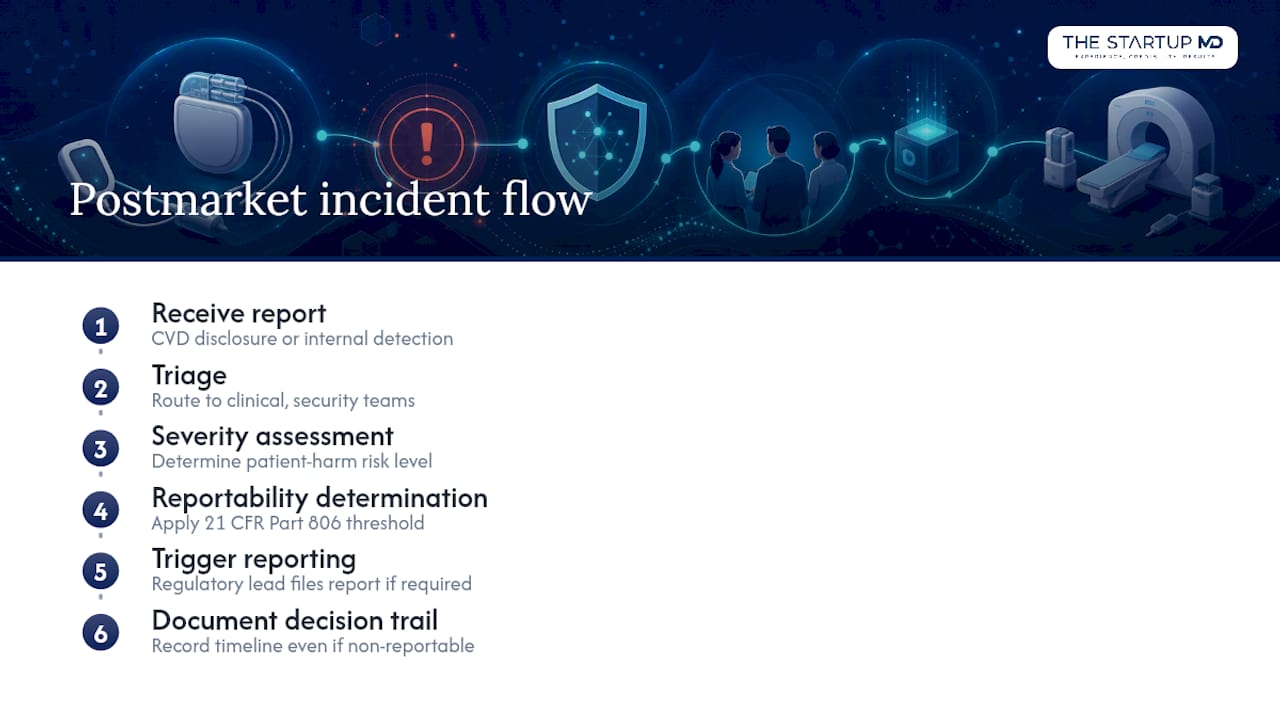
When a cybersecurity vulnerability or exploit affects a fielded device, the reporting obligation depends on whether the event meets the threshold for a correction or removal under 21 CFR Part 806. Routine, risk-based patches generally don't trigger that reporting requirement, but an event involving actual patient harm, or a vulnerability serious enough that the fix constitutes a correction to reduce a health risk, does.
Your incident response plan should define, in advance, who makes that reportability determination and how quickly. Waiting until after an incident to figure out your internal escalation path is how companies miss reporting deadlines. A workable structure assigns a specific role, often a regulatory affairs lead working alongside clinical and security teams, the authority to classify an event and trigger the reporting workflow without waiting for executive sign-off on every step; learning from resources like why your business needs a Data Protection Officer in Singapore can provide useful governance insights even across jurisdictions.
Coordinated vulnerability disclosure ties directly into this. If an external researcher reports a vulnerability through your CVD channel, your internal process needs to move that report through triage, severity assessment, and reportability determination on a defined timeline. FDA's FAQ guidance clarifies expectations around CVD programs and how they interact with postmarket reporting obligations. Document every step of that response, even for incidents ultimately classified as non-reportable, since FDA inspectors will want to see the decision trail during an audit.
How Does Interoperability Affect Medical Device Cybersecurity?
Devices designed to connect with electronic health records, hospital networks, or other medical devices carry cybersecurity risk that extends beyond the device itself. Every interface is a potential attack surface, and FDA reviewers expect manufacturers to account for that in their threat model rather than treating interoperability as purely a functional feature.
A device that integrates with a hospital's EHR system needs documented assumptions about the security posture of that connection: what authentication is required, what data flows in each direction, and what happens if the connected system is compromised. If your device depends on a third-party API or a cloud service for core functionality, your risk management file should address what happens when that dependency becomes unavailable or behaves unexpectedly.
Interoperability also raises questions about shared responsibility. A device manufacturer can't fully control the security posture of every hospital network its product connects to, but FDA still expects manufacturers to design for a reasonably hostile network environment rather than assuming a trusted, well-secured deployment context. This is one of the areas where architecture diagrams earn their weight in a submission. Reviewers want to see interface boundaries drawn explicitly, with trust assumptions labeled at each connection point, so they can assess where risk actually concentrates.
What Risk Assessment Methods Go Beyond Basic Security Risk Management?
A Security Risk Management Report satisfies the baseline requirement, but manufacturers building genuinely resilient programs layer additional methodologies on top of it. Threat modeling frameworks like STRIDE or PASTA give teams a structured way to enumerate attack vectors systematically rather than relying on ad hoc brainstorming, and reviewers recognize these named methodologies when they see them cited.
Attack surface mapping, done separately from general threat modeling, helps identify every point where the device accepts input or exchanges data, including maintenance ports, wireless interfaces, and third-party integrations that engineering teams sometimes overlook because they weren't part of the original design brief. Combining this with a formal exploitability scoring system, such as CVSS scoring adapted for medical device context, gives you a defensible, repeatable way to prioritize remediation instead of relying on subjective severity judgments that shift depending on who's in the room.
Cross-functional risk review is the methodology piece most companies skip. Bringing clinical, engineering, and regulatory perspectives into the same risk assessment session catches gaps that a purely technical security review misses, particularly around how a theoretical vulnerability translates into actual patient harm scenarios. That integration is exactly the friction point FDA reviewers flag most often when security and safety risk processes run separately.
What Do Key FDA Cybersecurity Terms Actually Mean?
FDA's guidance uses several terms precisely, and misreading them causes avoidable submission problems. A "cyber device" is not simply any connected device; it requires the full three-part definition covered earlier, and treating any networked product as automatically in scope, or automatically out of scope, is a common misstep.
"Security Risk Management Report" refers specifically to the structured document assessing threats, vulnerabilities, and mitigations, distinct from the broader risk management file required under ISO 14971 for overall device safety, though the two must connect. "SBOM" means a software bill of materials in machine-readable form, not a narrative description of software components; FDA has been explicit that a document listing components in prose doesn't satisfy the requirement.
"Coordinated vulnerability disclosure" describes a formal program and policy for receiving and responding to externally reported vulnerabilities, not simply having a general contact email available. "Total Product Lifecycle" and "Secure Product Development Framework" are related but distinct: TPLC describes the overarching regulatory philosophy that cybersecurity obligations extend from design through end-of-life, while SPDF is the specific engineering process framework manufacturers adopt to operationalize that philosophy. Getting these definitions right in your own documentation signals to reviewers that your team understands the regulatory framework rather than copying template language without grasping what it means.
Which FDA Guidance Documents Govern Medical Device Cybersecurity?
Three FDA documents form the backbone of current cybersecurity expectations, and manufacturers should treat them as a set rather than picking one and ignoring the others. The final guidance on premarket submissions is the primary reference for what documentation to prepare and how reviewers will evaluate it, covering everything from security objectives to SBOM format.
The Federal Register notice published on June 27, 2025, documents the formal availability of that guidance and traces its statutory origin back to the Food and Drug Omnibus Reform Act's Section 3305, which added Section 524B to the FD&C Act. Reading this notice gives useful context for why the guidance is structured the way it is, particularly for teams trying to understand which submissions fall under transition provisions.
FDA's digital health cybersecurity hub functions as the ongoing resource center, linking to mitigation strategies, testing recommendations, and the process for reporting cybersecurity issues to the agency outside the submission context. For postmarket-specific questions, the agency's separate postmarket guidance framework addresses ongoing monitoring and disclosure obligations that extend well past initial clearance. Manufacturers who only reference the premarket guidance frequently miss postmarket obligations that carry equal regulatory weight.
Expert Perspective: Operationalizing FDA Cybersecurity Requirements
The technical requirements in FDA's guidance are clear enough on paper. What trips up healthcare SaaS companies is organizational, not technical: security risk management and clinical safety risk management often live in separate teams that don't talk to each other until a submission deadline forces the conversation. That siloing is exactly what reviewers flag as a deficiency, and it's preventable with the right cross-functional ownership structure from day one.
Most early-stage device and SaMD companies don't need a full-time Chief Medical Officer to close this gap. A fractional clinical and regulatory leader who understands both the clinical risk side and the security documentation side can integrate these processes faster than two disconnected specialists working in parallel. Pair that with a third-party testing vendor for independent penetration testing and SBOM tooling that automates support-date tracking, and most startups can build a defensible cybersecurity package without hiring a large internal team.
The right time to bring in outside advisory support is before your pre-submission meeting, when a gap analysis can still change your documentation strategy rather than just flag problems after the fact.
— Paul Bergeron MD, MBA
How The StartupMD Helps You Prepare for FDA Cybersecurity Review
Most healthcare SaaS teams don't lack technical talent. They lack someone who has sat on both sides of the clinical and regulatory table and knows exactly what a reviewer flags versus what actually threatens patient safety. The StartupMD closes that gap without the overhead of a full-time executive hire, giving you clinical and regulatory judgment exactly when your submission timeline needs it.

Through Fractional Chief Medical Officer and Advisory Services, The StartupMD works directly with device and digital health teams on regulatory readiness review, premarket submission support, and pre-submission meeting preparation. A typical engagement starts with a gap analysis against your current cybersecurity documentation, moves into remediation of specific weak points, whether that's an underdeveloped risk management report or an SBOM missing support-date context, and finishes with hands-on prep for your FDA pre-submission meeting. Paul Bergeron, MD, MBA brings over 25 years of combined medical and business experience to that process, which means the guidance you get accounts for both what satisfies a reviewer and what actually protects patients.
If your team is heading toward a 510(k), De Novo, or PMA submission with cybersecurity documentation still in draft form, visit The StartupMD's services page to schedule a readiness assessment before your next regulatory milestone.
This article is general information, not a substitute for advice from a qualified doctor. Consult a qualified healthcare professional about your own circumstances before acting on anything here.
Sources
- Cybersecurity in Medical Devices: Quality Management System Considerations and Content of Premarket Submissions
- Federal Register notice of availability: Cybersecurity in Medical Devices: Quality System Considerations and Content of Premarket Submissions
FAQ
What Are the FDA Cybersecurity Requirements for Medical Devices?
Devices meeting the "cyber device" definition under Section 524B must include a Security Risk Management Report, a machine-readable SBOM, and a postmarket vulnerability management plan in their premarket submission. FDA's final guidance details the specific documentation and evidence reviewers expect for each of these elements.
Is 21 CFR 820 Still Valid?
21 CFR Part 820 remains valid, but it has been restructured into the Quality Management System Regulation, effective February 2, 2026, which aligns FDA's quality system requirements with ISO 13485. Manufacturers should be building toward QMSR alignment now rather than waiting for the effective date.
Does the FDA Regulate Medical Device Cybersecurity Directly?
Yes. The FDA regulates cybersecurity as part of premarket review and postmarket surveillance for devices meeting the cyber device definition, with legal authority established under Section 524B of the FD&C Act. This extends beyond software function safety into how well a device resists and recovers from security threats.
What Cybersecurity Documentation Does FDA Require in a Submission?
FDA requires a Security Risk Management Report, a machine-readable SBOM, architecture and threat-model documentation, security test results, and a postmarket vulnerability monitoring plan. These elements are outlined in detail in FDA's final cybersecurity guidance and apply across 510(k), De Novo, and PMA pathways.
Can The StartupMD Help With FDA Cybersecurity Submission Prep?
Yes. The StartupMD provides fractional CMO and advisory support for regulatory readiness review, cybersecurity documentation remediation, and pre-submission meeting preparation. Pricing and engagement details are available through The StartupMD's services page.