

The minimum necessary standard requires covered entities and business associates to make reasonable efforts to limit access, use, disclosure, and requests for protected health information to only what a specific task requires. It applies to PHI in every form, electronic, paper, and oral, and it governs both internal teams and vendors. Six categories of activity fall outside its scope, starting with treatment.
TL;DR:
- The minimum necessary standard applies to all formats of PHI and mandates limiting access, use, and disclosure to what is strictly needed, except for six specific exceptions.
- Ownership of compliance primarily falls on covered entities and their direct vendors, with clear roles including privacy officers, HIM, CIO/IT, and legal counsel responsible for enforcement and documentation.
- Building standard protocols for routine disclosures can streamline compliance by documenting and automating the process for recurring data exchanges; non-routine disclosures require case-by-case documentation and approval.
- Technical controls like role-based access and field-level data masking are essential to enforce least privilege, especially for automated and service account access, with thorough audit logging as a critical component.
- Regular self-audits should verify role-to-PHI mappings, policy documentation, vendor agreements, and audit logs, with immediate revocation and remediation for any overprivileged access identified.
Table of Contents
- What Does the Minimum Necessary Standard Actually Require?
- Who Owns Minimum Necessary Compliance in Your Organization?
- How Do You Build Standard Protocols for Routine Disclosures?
- [What Technical Controls Actually Enforce Least Privilege?](#what-technical-controls-actually-enforce-least-privilegehttpstotalcybercomhipaa-risk-assessment)
- What Documentation Do Auditors Actually Expect to See?
- What Do Minimum Necessary Violations Actually Look Like?
- How Should You Audit Your Own Minimum Necessary Compliance?
- The StartupMD Perspective: Applying Minimum Necessary in Healthcare SaaS Startups
- How The StartupMD Turns Minimum Necessary Into an Audit-Ready Program
- Sources
What Does the Minimum Necessary Standard Actually Require?
The HHS guidance on HIPAA laws and regulations makes the core obligation plain: covered entities and business associates must limit PHI access, use, and disclosure to the minimum amount needed for the intended purpose. That obligation does not switch off for convenience or efficiency. A billing coordinator pulling a full chart to verify a single copay is technically out of bounds, even if nothing malicious happens.
Six exceptions carve out where the standard does not apply, and knowing them saves compliance teams from over-engineering controls where none are legally required. The HHS minimum necessary requirement page lists them clearly:
- Treatment disclosures. Clinicians coordinating care can share what they judge clinically relevant, without a minimum necessary review.
- Disclosures to the individual. Patients can request and receive their own full record.
- Authorizations. When a patient signs a valid authorization, the disclosure follows the authorization's terms, not the minimum necessary standard.
- HHS enforcement. Disclosures made to HHS for compliance investigations are exempt.
- Required by law. Court orders, subpoenas, and statutory reporting obligations override the standard.
- HIPAA transaction standards. Standardized electronic transactions, like eligibility checks, are exempt because their format is already regulated.
Outside those six categories, the standard applies regardless of the data's format. A verbal handoff at a nursing station, a printed discharge summary, and a query against an EHR database all carry the same obligation. The treatment exemption is the one most healthcare professionals actually rely on daily. It's why a specialist reviewing a primary care note doesn't need a role-based permission slip first. But that exemption ends the moment the purpose shifts from treatment to billing, research, or marketing.
Who Owns Minimum Necessary Compliance in Your Organization?
Minimum necessary compliance fails most often not because policies don't exist, but because no one owns them past the day they're written. Covered entities, the hospitals, health plans, and providers directly regulated by HIPAA, carry the primary legal obligation. Business associates, the vendors and SaaS platforms that touch PHI on a covered entity's behalf, inherit that same obligation through contract and through HIPAA's own text.
Governance typically splits across four roles, and clarity here prevents the finger-pointing that shows up in OCR investigations:
- Privacy officer. Owns the policy itself and signs off on non-routine disclosure criteria.
- Health Information Management (HIM). Manages the actual role-to-data mappings and processes routine disclosure requests.
- CIO or IT security lead. Translates policy into technical access controls, RBAC schemas, and audit logging.
- Legal counsel. Reviews BAA language and advises on gray-area disclosures, particularly research and law enforcement requests.
The AHIMA practitioner brief on implementing the minimum necessary standard recommends defining "classes of persons" rather than individual employees. A class might be "billing staff processing claims" or "care coordinators managing referrals." Document what PHI category each class needs, not just which system they can log into. Then build an escalation path: when someone outside a defined class requests access, who reviews it, and how fast? Most organizations that fail an OCR audit on this point don't lack a policy. They lack a record showing anyone actually enforced it.
How Do You Build Standard Protocols for Routine Disclosures?
Most PHI disclosures are repetitive: the same insurance claim format, the same quality report, the same referral packet. HHS explicitly allows covered entities to build standard protocols for these routine disclosures rather than reviewing each one individually. That's the efficient path, and it's the one most compliance programs underuse.
Building a defensible routine protocol takes four steps:
- Inventory recurring disclosure types. List every recurring export: claims submissions, eligibility verifications, quality reporting, referral packets.
- Define the PHI subset for each. Specify exactly which fields a claims export needs versus what a full chart contains.
- Get privacy officer sign-off on the template. Document the approval date and the rationale in policy, not in an email thread.
- Automate where the data supports it. Standard protocols are ideal candidates for system-enforced templates rather than manual review each time.
Non-routine disclosures need a different structure entirely. These are one-off requests, a researcher wanting historical data, an attorney requesting records outside a standard subpoena format, an internal audit pulling PHI for a special investigation. HHS requires documented criteria and case-by-case review for these, which means you need:
- A written intake form capturing who is requesting, why, and what specific PHI category they need.
- A designated approver (usually the privacy officer or HIM director) who signs off before release.
- A record retained for audit purposes showing the criteria applied and the decision reached.
There's one more scenario worth building explicit policy language around: releasing an entire medical record. HHS permits this without a fresh case-by-case justification, but only if your written policy already documents that the full record is reasonably necessary for that identified purpose. A malpractice defense review might qualify. A routine billing inquiry almost never does. Write the justification into policy ahead of time rather than trying to reconstruct it after an OCR request lands on your desk.
What Technical Controls Actually Enforce Least Privilege?
Policy documents don't stop an overprivileged service account from pulling an entire patient table. Technical controls do, and healthcare SaaS companies get audited on both. Industry guidance increasingly frames minimum necessary as a least-privilege control objective, not just a paperwork exercise, and that framing should drive product architecture decisions from day one.
Role-based access control (RBAC) is the starting point, but it only works if roles map to specific PHI fields, not entire tables or modules. A billing role should see charge codes and insurance data, not clinical notes. Field-level masking and limited data sets let you build one interface that shows different data depending on who's logged in, rather than maintaining separate systems for each department.
Machine identities need the same discipline as human users, arguably more, since they run unattended:
- Scope every API key and service account to the narrowest data set it needs, never a blanket "read all PHI" permission.
- Rotate credentials on a schedule and revoke immediately when an integration is deprecated.
- Log every automated query the same way you log human access, since routine electronic disclosures can often be automated, but automation still needs an audit trail.
Break-glass access, emergency override for clinicians who need immediate record access outside their normal role, deserves its own control set: time-limited sessions, mandatory justification entry, and automatic flagging for post-hoc review. If break-glass access never gets reviewed after the fact, it's not a control, it's a loophole with a badge.
Pro Tip: Audit log completeness matters more than audit log volume. A system that logs every field access but can't tell you who justified a break-glass override is harder to defend than one with fewer logs but complete context on the exceptions.
What Documentation Do Auditors Actually Expect to See?
Written policy needs to name specific roles, specific PHI categories, and the justification for any whole-record disclosure exception, not generic language borrowed from a template. The UW-Madison policy library offers a useful model for how institutions phrase role definitions and disclosure procedures in a way that survives audit scrutiny.
Reasonable reliance is a documentation category compliance teams frequently overlook. HHS permits covered entities to reasonably rely on another covered entity, a public official, a business associate, or a researcher with IRB documentation, when that party represents that the requested information is the minimum necessary. But "reasonable reliance" is not a blank check. Record who made the representation, when, and what documentation supported it.
Your BAA language should hold every business associate to the same standard your organization follows internally:
- Require explicit minimum necessary language in every Business Associate Agreement, not a vague reference to "HIPAA compliance."
- Obligate subcontractors of business associates to flow down the same requirement.
- Reserve audit rights so you can verify a vendor's access controls match their contractual claims.
What Do Minimum Necessary Violations Actually Look Like?
The violations that show up in real audits are rarely dramatic. They're operational drift: a report export that pulls twelve fields when three would do, a service account provisioned with admin-level access because it was faster than scoping it properly, a customer support team that inherited clinical-note visibility during a system migration and never lost it.
Short-term remediation follows a predictable sequence:
- Revoke the excess access immediately, don't wait for a scheduled review cycle.
- Pull audit logs to determine how long the overbroad access existed and whether it was used.
- Document the incident, including discovery date, scope, and remediation timeline, since regulators expect this record during any follow-up inquiry.
Longer-term fixes require going back to the role-to-data map and asking why the gap existed in the first place. Usually it's a policy that never accounted for a new integration, or an RBAC schema that was never redesigned after the product added a feature. Document the corrective action plan with dates and owners; a plan that exists only as a verbal commitment carries no weight with OCR.
How Should You Audit Your Own Minimum Necessary Compliance?
A working audit checklist should confirm these items exist and are current:
- A documented role-to-PHI map showing which classes of persons can access which data categories.
- Approved standard protocol templates for every recurring disclosure type.
- A retained record of non-routine disclosure reviews, including approver and justification.
- BAAs with explicit minimum necessary clauses for every vendor touching PHI.
- A sample of audit logs pulled quarterly to verify access matches the documented role map.
- Training completion records for staff in each defined access class.
Sample disclosures are recommended periodically, with smaller organizations reviewing at reasonable intervals and high-volume health systems reviewing more frequently; any access outside the documented role map should be escalated immediately. Package findings for leadership as a short summary: what was tested, what passed, what didn't, and the remediation timeline. That same package, kept current, is what you hand an OCR investigator if the question ever comes up.
The StartupMD Perspective: Applying Minimum Necessary in Healthcare SaaS Startups
Startups treat access control as a scaling problem to solve later, and that's backwards. Baking least-privilege into your data model before your first enterprise customer signs is far cheaper than retrofitting RBAC across a live product with real patient data flowing through it.
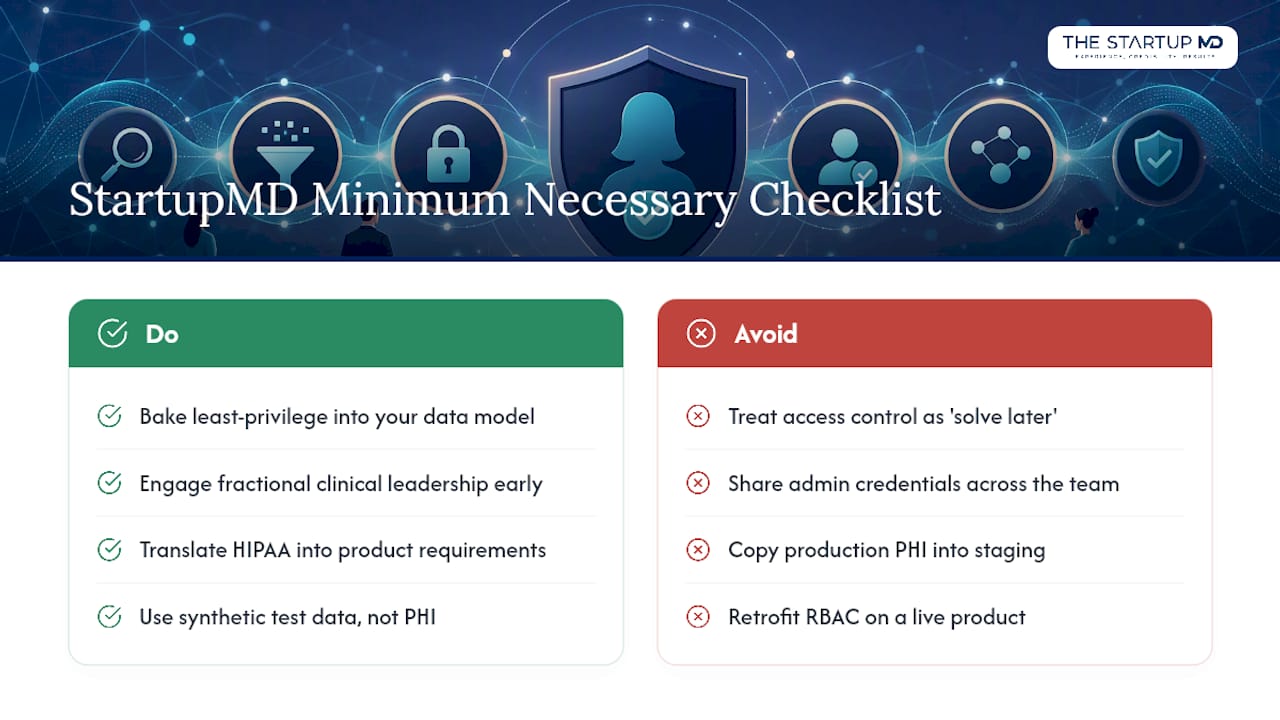
The shortcuts I see most often: shared admin credentials across a small engineering team, and production PHI copied into a staging environment because nobody built proper synthetic test data. Both create findings that surface at exactly the wrong moment, during a health system's vendor security review.
Fractional clinical leadership exists to catch this early, translating HIPAA obligations into product requirements before they become technical debt, without stalling your development velocity.
— Paul Bergeron MD, MBA
How The StartupMD Turns Minimum Necessary Into an Audit-Ready Program
The StartupMD is the alternative to hiring a full-time compliance executive before you can justify the payroll. As a fractional Chief Medical Officer resource for healthcare SaaS companies, The StartupMD builds the actual artifacts OCR and enterprise customers ask to see: documented role-to-PHI maps, standard protocol templates for routine disclosures, non-routine review criteria, and vendor BAA language that holds up under scrutiny.
For a healthtech founder navigating both product velocity and regulatory exposure, that means someone with clinical and operational credibility reviewing your access architecture before an investor's due diligence team or a hospital system's security review finds the gap first. Deliverables are concrete: written policy, remediation plans with owners and dates, and audit evidence you can hand to a customer's compliance team without scrambling. Review The StartupMD's advisory and fractional CMO services or start with a look at how healthcare SaaS revenue models intersect with compliance readiness, then reach out to scope an engagement.
This article is general information, not a substitute for advice from a qualified doctor. Consult a qualified healthcare professional about your own circumstances before acting on anything here.