

A precision medicine platform is a clinical SaaS product that combines genomic, lab, and clinical data with analytics to generate explainable treatment recommendations, delivered directly into a clinician's workflow through the EHR. That is the whole definition. It is not a research database, not a genomics analytics sandbox, and not a data lake with a dashboard bolted on top.
Three things follow immediately from that definition, and each one changes what you build first.
- EHR integration is not optional. If the recommendation does not appear where the clinician is already working, adoption fails regardless of model accuracy.
- Explainability determines your regulatory category. The FDA's clinical decision support framework draws a hard line between software that supports clinician judgment and software that replaces it.
- Production readiness is a governance problem, not just an engineering one. Versioning, audit trails, and reproducibility have to exist before your first pilot, not after your first incident.
Key Takeaways
A precision medicine platform succeeds by pairing explainable, rules-first clinical logic with versioned data governance and an FDA-aware regulatory strategy from day one.
| Point | Details |
|---|---|
| Definition matters | A precision medicine platform is clinical SaaS delivering explainable recommendations in-chart, not a research analytics tool. |
| Start with rules, not ML | Deterministic logic simplifies clinical auditing and preserves non-device CDS status under FDA criteria. |
| Regulatory path shapes budget | Non-device CDS MVPs run $40,000–$120,000 over 2–8 weeks; SaMD pathways take far longer. |
| Treat interpretation logic as a product | Version every rule and pipeline change to support audits, reproducibility, and legal defensibility. |
| Get advisory support early | The StartupMD's fractional CMO and clinical strategy services help founders resolve regulatory and product-readiness decisions before they become costly rebuilds. |
This article is general information, not a substitute for advice from a qualified doctor. Consult a qualified healthcare professional about your own circumstances before acting on anything here.
Table of Contents
- How Does a Precision Medicine Platform Work Inside the EHR?
- When Does the FDA Regulate Your Precision Medicine Software?
- What Architecture Makes a Precision Medicine Platform Production-Ready?
- How Should You Scope a Precision Medicine MVP?
- What Drives Clinical Adoption of a Precision Medicine Platform?
- Why Work With The StartupMD on Precision Medicine Strategy
- Who Are the Key Users of a Precision Medicine Platform?
- Where Do Precision Medicine Platforms Deliver the Most Clinical Value?
- How Do Leading Precision Medicine Platforms Differ?
- What Should You Look for When Choosing a Precision Medicine Platform?
- The Real Bottleneck Isn't the Science
- Get Hands-On Help Taking Your Platform from Pilot to Production
- Sources
How Does a Precision Medicine Platform Work Inside the EHR?
The mechanics come down to four layers, and each one maps to a specific clinical outcome you're trying to produce. Get the mapping wrong and you'll build features nobody asked for.
Ingestion pulls genomic files, lab results, and structured clinical data from multiple sources. This typically means FHIR resources alongside legacy HL7 v2 feeds, since most health systems still run both. Skipping HL7 v2 support because FHIR is the modern standard is a common early mistake. It locks you out of the majority of existing hospital interfaces.
Normalization handles the messy reality of clinical data, including genomic batch effects that can make identical samples look different depending on sequencing run or lab. Without normalization, your interpretation layer inherits noise it can't distinguish from signal.
Interpretation logic should start deterministic. Rules-based logic built on validated evidence is easier to audit, easier to explain to a clinician, and easier to clear regulatory review than a model no one can fully interrogate. Add machine learning only where rules demonstrably fail to capture clinical nuance.
The explainable decision layer is what actually reaches the clinician, usually through CDS Hooks or SMART on FHIR, surfaced as a decision card inside the chart. Founders who over-invest in model sophistication and under-invest in this layer routinely find that transparency and workflow fit drive adoption more than algorithmic novelty.
- Ingestion: FHIR plus HL7 v2, not FHIR alone.
- Normalization: address genomic batch effects before interpretation.
- Interpretation: rules-first, ML only where justified.
- Delivery: CDS Hooks or SMART on FHIR, in-chart.
Pro Tip: Prototype your decision card in a FHIR sandbox before you write a single line of interpretation logic. If clinicians can't understand the card format, the underlying model quality won't save the product.
When Does the FDA Regulate Your Precision Medicine Software?
Whether your product is exempt from device regulation or requires clearance depends on how it's built, not how it's marketed. Under FDA guidance, software qualifies as non-device clinical decision support only when it meets a narrow set of criteria: it can't process raw signals from a medical device, it has to support rather than replace provider judgment, and it must let the clinician independently review the basis for each recommendation.
Miss any one of those criteria and your software likely becomes Software as a Medical Device, triggering a 510(k) or De Novo pathway with a materially different budget and timeline.
Design choices that preserve non-device status include:
- Showing the underlying rule or evidence behind every recommendation, not just the output.
- Requiring clinician confirmation before any action is taken on the recommendation.
- Avoiding direct processing of raw device or waveform data.
A narrowly scoped, non-device CDS MVP typically costs $40,000 to $120,000 and takes 2 to 8 weeks to build when it targets a single clinical decision. A SaMD pathway extends both figures substantially, since clinical validation and FDA review add months, not weeks.
Plan your HIPAA posture from day one: signed BAAs with every data processor, encryption at rest and in transit, and PHI-scoped access controls. Retrofitting compliance after a pilot is far more expensive than designing for it upfront. Our regulatory basics guide for founders covers the sequencing in more depth.
What Architecture Makes a Precision Medicine Platform Production-Ready?
Production readiness is less about picking the right toolkit and more about treating your pipelines and interpretation logic as versioned data products with explicit ownership. That framing, emphasized by production-readiness guides in this space, changes how you staff and budget the build.
The core stack breaks into five layers:
- Ingestion that handles multiple source formats without silently dropping malformed records.
- Normalization that corrects for known sources of variance, particularly in genomic data.
- Versioned interpretation pipelines where every rule change or model update gets a version number tied to the recommendations it produced.
- An explainability layer that reconstructs, on demand, why a specific recommendation fired for a specific patient.
- Audit and logging infrastructure that captures every recommendation, its version, and the data inputs behind it.
Versioning matters because clinical recommendations get challenged. When a clinician or a malpractice attorney asks why the system recommended a specific therapy eighteen months ago, "we don't know, we've updated the model since" is not an acceptable answer. Treat genomic files, lab results, and interpretation outputs as versioned data products with immutable lineage, and you can answer that question in minutes instead of weeks.
Operationally, budget for monitoring that catches silent data drift, a disaster recovery plan tested at least annually, and alignment with SOC 2 controls alongside HIPAA. Cost predictability matters too. Genomic storage and compute costs scale unevenly, and founders who don't model this early get surprised by cloud bills that outpace revenue growth.
Pro Tip: Assign a single owner for your interpretation logic, the way you'd assign an owner for a core database schema. Diffuse ownership is the fastest way to end up with undocumented rule changes nobody can explain during a regulatory audit.
How Should You Scope a Precision Medicine MVP?
The lowest-risk MVP pattern is a single clinical question, resolved with deterministic rules, delivered in-chart. Pick one decision, such as a pharmacogenomic dosing flag, and prove it works before expanding scope. A hybrid approach works best here: validated rules for the core recommendation, with machine learning or LLMs reserved for supporting tasks like evidence summarization.
| MVP Type | Typical Timeline | Typical Cost Range |
|---|---|---|
| Rules-based, non-device CDS | 2–8 weeks | $40,000–$120,000 |
| ML-enabled decision support | 3 months | Higher than rules-based, scales with data complexity |
| SaMD pathway (510(k)/De Novo) | months | Substantially higher, driven by clinical validation and regulatory review |
Validate before you scale. Useful pilot metrics include clinician adoption rate (do they act on the recommendation or override it), documentation time saved, and care coordination measures like time to specialist referral. The trade-off is straightforward: a rules-based MVP gets you to a pilot fast with modest regulatory exposure. Reaching for ML or a SaMD pathway on day one buys you a more sophisticated product and a much longer runway before you see a single real patient interaction.
- Start with one decision, not a platform.
- Validate in a FHIR sandbox with backtested data before any live pilot.
- Measure adoption and documentation time, not just model accuracy.
What Drives Clinical Adoption of a Precision Medicine Platform?
Adoption lives or dies on workflow integration. A recommendation buried in a separate portal that requires a clinician to log into a second system gets ignored, no matter how accurate it is. The same recommendation, surfaced as a decision card inside the chart via CDS Hooks, gets used.
Explainability builds the trust that drives repeat use. Clinicians need to see the evidence or rule behind a recommendation and verify it independently, which is both a regulatory expectation and a commercial advantage.
For pilot design, agree on operational KPIs with your health system partner before launch: override rates, time-to-decision, and documentation burden are more persuasive to a CMIO than raw model performance.
- Embed recommendations in-chart, never in a standalone portal.
- Version every recommendation so clinicians can trace the evidence behind it.
- Negotiate specialty clinic pilots first; payer conversations come after you have adoption data, not before.
Pro Tip: Bring your pilot health system a one-page KPI sheet before the kickoff meeting. Systems that don't know what success looks like rarely renew after the pilot ends.
Why Work With The StartupMD on Precision Medicine Strategy
Paul Bergeron, MD, MBA, brings more than 25 years of combined clinical and business experience to founders navigating exactly these build-versus-regulate tradeoffs. The StartupMD's advisory work spans fractional Chief Medical Officer engagements, clinical strategy development, regulatory planning, and product-market fit assessment.
- Fractional CMO leadership for teams without in-house clinical executive bandwidth.
- Regulatory strategy guidance to clarify non-device CDS versus SaMD pathways early.
- Product evaluation and investor readiness support for precision medicine and clinical decision-support startups.
Who Are the Key Users of a Precision Medicine Platform?
A precision medicine platform serves several distinct roles inside a health system, and each one needs something different from the product. Design for one and ignore the rest, and adoption stalls.
Clinicians are the primary decision-makers. They need the recommendation in-chart, with the supporting evidence visible in one click, not buried three menus deep. Their tolerance for extra clicks or context-switching is close to zero during a patient encounter.
Genetic counselors often sit between the raw genomic interpretation and the treating physician. They need more detail than a physician does: variant classifications, confidence levels, and links to the underlying evidence base, since part of their job is explaining uncertainty to patients directly.
IT and integration staff own the technical relationship with the EHR. They care about interface stability, FHIR resource versioning, and whether an upgrade to the platform will break an existing CDS Hooks integration. Founders who treat this group as an afterthought during procurement conversations tend to see deals stall in technical review.
Compliance and quality officers need audit trails and documentation showing how recommendations are generated and how often clinicians override them. This group is often the actual gatekeeper for a health system pilot, even when the clinical champion is the one who found your product.
Administrators and CMIOs care about a different set of numbers entirely: adoption rates, documentation time saved, and whether the platform reduces or adds friction to existing workflows. They're the ones who decide whether a successful pilot becomes a system-wide contract.
Mapping your onboarding, training materials, and support model to each of these roles separately, rather than treating "the hospital" as a single buyer, shortens sales cycles measurably. Our EHR integration guide for investors breaks down how these stakeholder groups typically influence procurement timelines.
Where Do Precision Medicine Platforms Deliver the Most Clinical Value?
Three use cases dominate the current commercial landscape, and each demands a slightly different data architecture.
Oncology is the most mature application. Precision medicine platforms here integrate tumor genomic profiling with treatment guidelines to recommend targeted therapies or clinical trial matches. The data complexity is high, since tumor sequencing produces large variant files that require careful normalization, but the clinical payoff (matching a patient to a therapy their tumor's mutation profile actually responds to) is well established.
Rare disease diagnosis uses precision medicine platforms to shorten the diagnostic odyssey many patients face. These platforms often combine phenotype data with genomic variant analysis, drawing on data-driven frameworks that classify patient presentations against known disease patterns to surface candidate diagnoses far faster than manual specialist review alone.
Pharmacogenomics is arguably the lowest-friction entry point for a new platform because the decision logic is often deterministic: a patient's genetic variant indicates a drug will be less effective or riskier at standard dosing, and the system flags it. This maps almost directly to the rules-based, non-device CDS MVP pattern, which is why many founders choose pharmacogenomic dosing alerts as their first product.
Each use case has a different reimbursement and adoption pathway, so choosing your first vertical should depend as much on your team's regulatory tolerance and go-to-market access as on the underlying science.
How Do Leading Precision Medicine Platforms Differ?
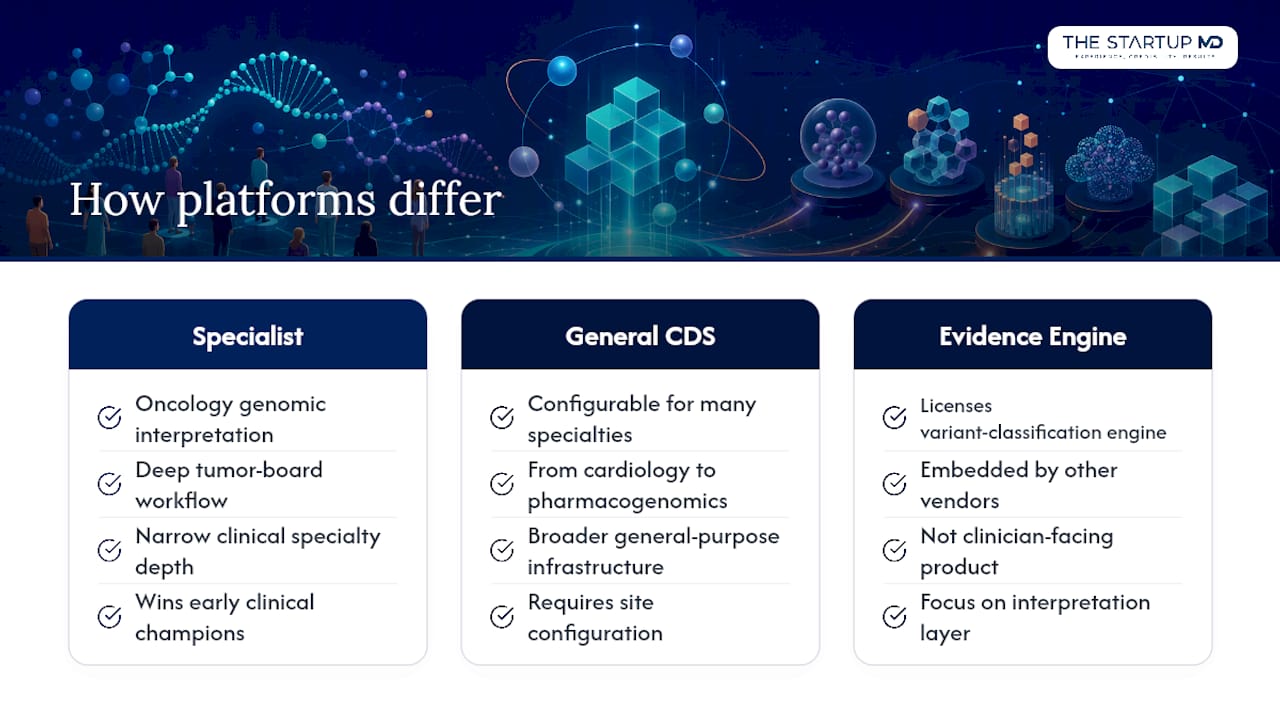
Commercial precision medicine platforms tend to differentiate along three axes: clinical specialty depth, integration breadth, and where they sit on the explainability spectrum.
Some platforms specialize narrowly, focusing exclusively on oncology genomic interpretation with deep tumor board workflow integration. Others build broader, general-purpose CDS infrastructure that health systems configure for multiple specialties, from cardiology risk scoring to pharmacogenomics. A third category focuses on the interpretation and evidence layer itself, licensing genomic variant classification as an engine that other software vendors embed rather than selling a clinician-facing product directly.
Integration breadth varies just as much. Some vendors support only a handful of major EHR platforms with deep, certified integrations. Others build broader but shallower FHIR-based connectivity that works across more systems with less customization per site.
The explainability differentiator matters most for regulatory positioning. Platforms that expose their full rule sets and evidence citations to clinicians tend to have an easier path to non-device CDS status and faster procurement cycles, since compliance officers can evaluate the logic directly. Platforms relying more heavily on proprietary or black-box scoring face longer procurement reviews and, in many cases, a SaMD pathway they didn't originally plan for.
For founders evaluating where to position a new product, the practical takeaway is that specialty depth wins early clinical champions, while integration breadth and explainability win procurement committees. Few platforms lead on all three simultaneously, which leaves room for a well-scoped, single-specialty entrant with strong FHIR connectivity and full rule transparency.
What Should You Look for When Choosing a Precision Medicine Platform?
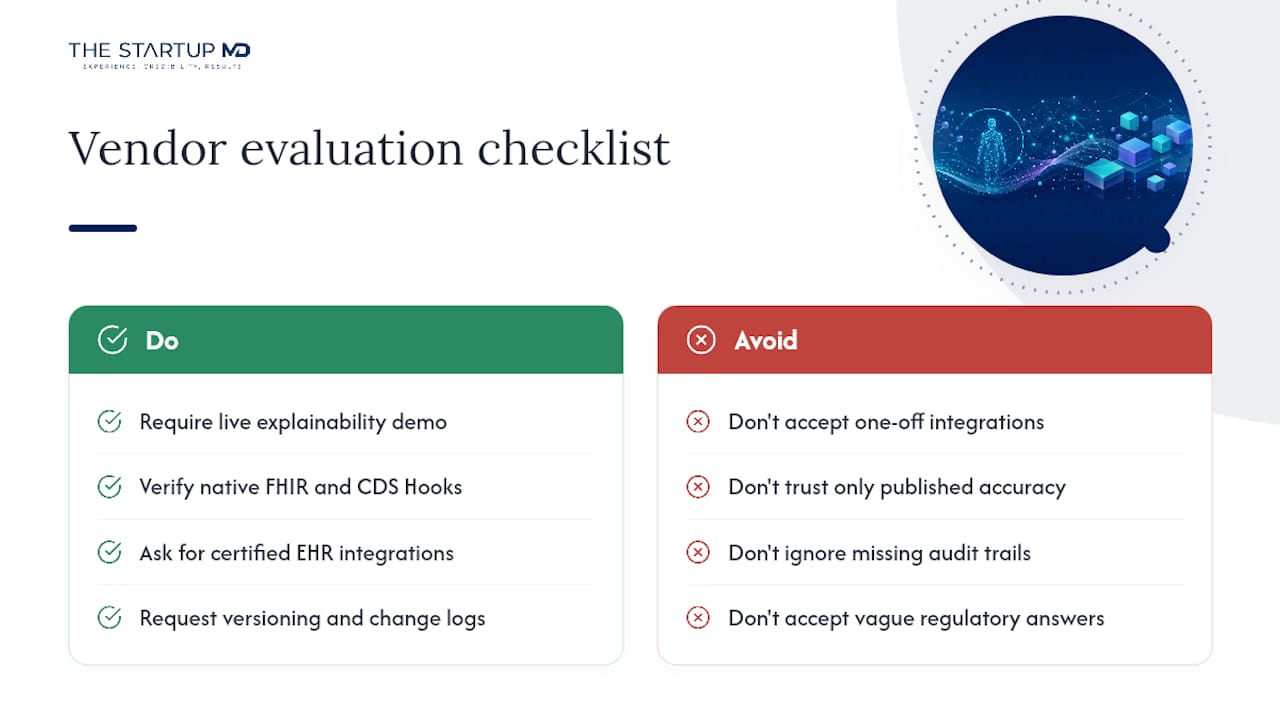
Vendor evaluation for a precision medicine platform should weight production readiness and regulatory clarity as heavily as clinical accuracy claims. A model with impressive published performance is worthless if it can't produce an audit trail during a compliance review.
Start with explainability. Ask any vendor to show you, live, how a specific recommendation traces back to its underlying rule or evidence. If they can't do this in the sales demo, they likely can't do it during an audit either.
Next, verify integration standards. Confirm the platform supports FHIR and CDS Hooks natively rather than through a custom, one-off interface that becomes a maintenance burden. Ask specifically which EHR platforms they've completed certified integrations with, not just which ones they claim to support.
Check governance maturity directly. Does the vendor version their interpretation logic? Can they produce a change log showing when a rule was updated and why? This single question filters out a large share of vendors who talk about "production-ready" without the underlying data product discipline to back it up.
Finally, confirm the regulatory classification the vendor is claiming for their own product, and ask them to explain why. A vendor who can clearly articulate why their software qualifies as non-device CDS, citing the specific criteria it meets, is a different caliber of partner than one who waves away the question. Our clinical product development guide walks through a fuller due diligence checklist for teams evaluating build-versus-buy decisions.
The Real Bottleneck Isn't the Science
Most of the public conversation about precision medicine focuses on the science: better genomic panels, richer datasets, smarter models. That framing misleads founders. The actual bottleneck is almost always operational. It's whether a team can produce a versioned, auditable, explainable pipeline that a compliance officer trusts and a clinician will actually use during a fifteen-minute patient visit.
The conventional advice tells founders to differentiate on algorithm sophistication. The evidence points the other way. Transparent, rules-first systems with strong EHR integration consistently outperform more sophisticated but opaque ones on the metric that actually matters commercially: sustained clinical adoption.
If you're building in this space, prioritize your regulatory strategy and your explainability layer before you invest heavily in model complexity. Get the non-device CDS criteria right from the architecture stage, not as a retrofit. Treat every interpretation rule as a versioned artifact from day one. The founders who get burned in this category almost never get burned by bad science. They get burned by an architecture that couldn't survive its first serious audit.
Get Hands-On Help Taking Your Platform from Pilot to Production
Building a precision medicine platform that survives regulatory scrutiny and earns clinician trust takes more than a strong engineering team. It takes someone who has sat on both sides of the table: the clinical workflow and the boardroom. That's the specific gap The StartupMD is built to close.
Founders working through non-device CDS classification, versioned data governance, or MVP scoping decisions get hands-on guidance through The StartupMD's fractional Chief Medical Officer engagements and clinical strategy advisory. That means direct input on regulatory positioning before you write your first line of interpretation logic, product evaluation frameworks that catch design flaws before a pilot health system does, and investor-ready narratives that translate clinical validation into commercial traction. The outcome founders consistently walk away with is regulatory clarity, a pilot-ready product, and a story investors and health systems both understand.
If you're scoping a precision medicine MVP or preparing for your first health system pilot, visit The StartupMD's services page to see how a fractional CMO engagement fits your timeline and stage.
Sources
- What It Takes to Build a Production-Ready Precision Medicine Platform — NonStopio
- Build AI Clinical Decision Support Software — SpeedMVPs