

If your platform touches protected health information or sells into hospital systems and health plans, HITRUST is usually the framework procurement teams expect. If you're selling broadly into enterprise tech and healthcare adjacent buyers, SOC 2 Type II often clears the bar on its own. Many healthcare SaaS companies eventually need both, because certification and attestation answer different buyer questions. The at-a-glance comparison below shows why.
TL;DR:
- SOC 2 is a principles-based attestation, while HITRUST provides a prescriptive certification across multiple assessment tiers, with HITRUST r2 being comprehensive and longer to attain.
- Most healthcare providers accept SOC 2 Type II initially but often require HITRUST once sensitive data or PHI are involved at scale.
- Preparing for HITRUST r2 can take up to a year, while e1 assessments take weeks, and SOC 2 Type II typically requires six to twelve weeks of readiness.
- Mapping controls between SOC 2 and HITRUST can streamline evidence collection and reduce duplicate work across frameworks.
- The sequencing of compliance efforts should align with buyer requirements, starting with SOC 2 for speed and progression to HITRUST as deals and data complexity grow.
Table of Contents
- HITRUST vs SOC 2: The At-a-Glance Comparison
- What Does SOC 2 Actually Cover?
- What Is HITRUST Certification and How Do the Assessment Tiers Work?
- Prescriptive vs Principles Based: The Difference That Actually Changes Your Strategy
- Which Framework Should You Pursue First?
- Can You Pursue HITRUST and SOC 2 at the Same Time?
- What Will This Actually Cost You in Time and Budget?
- How Should You Prepare in the Next 90 Days?
- The StartupMD's Perspective for Healthcare SaaS Leaders
- Editorial Take: HITRUST vs SOC 2 for Healthcare SaaS Vendors
- How The StartupMD Helps You Sequence Compliance Without Burning Runway
- Primary Sources for Readers and Auditors
- Sources
HITRUST vs SOC 2: The At-a-Glance Comparison
The core distinction is structural: HITRUST issues a certification against a prescriptive control framework, while SOC 2 produces an attestation report built on principles-based criteria from the AICPA. That difference shapes everything downstream, from how long the process takes to what a buyer's security team does with the result.
| Factor | HITRUST | SOC 2 |
|---|---|---|
| Type of assurance | Certification (pass/fail against scored controls) | Attestation (CPA opinion on controls) |
| Governing body | HITRUST Alliance | AICPA |
| Approach | Prescriptive, harmonized controls | Principles-based Trust Services Criteria |
| Coverage | 44 controls (e1) to 300–500+ controls (r2) | 5 Trust Services Criteria, org-defined controls |
| Report type | Certification letter and scorecard | Type 1 or Type 2 report |
| Typical timeline | Weeks (e1) to a full year (r2) | several weeks of Type 2 observation, plus prep |
| Best for | Covered entities, health systems, PHI-heavy vendors | SaaS and tech vendors selling to general enterprise |
A few things stand out once you sit with this table. First, HITRUST isn't one thing. The e1, i1, and r2 tiers exist precisely because organizations of varying sizes and risk profiles have different needs. Second, SOC 2 has no certification tier at all. It's an opinion from an independent CPA firm, not a scored pass or fail, which matters more than most founders realize when a health plan's security questionnaire asks "are you certified?" and the honest answer for SOC 2 is "no, but we're attested." Third, plenty of healthcare buyers will accept SOC 2 Type II as a starting point, then require HITRUST once the contract touches claims data, EHR integration, or PHI at scale.
What Does SOC 2 Actually Cover?
SOC 2 is an attestation report, not a certification, and that distinction trips up a lot of first-time compliance leads. An independent CPA firm evaluates your controls against the AICPA's Trust Services Criteria: security, availability, processing integrity, confidentiality, and privacy. You choose which criteria apply to your service, then the auditor tests whether your actual controls meet them.
There are two report types, and the difference matters for procurement. A Type 1 report evaluates whether your controls are designed appropriately at a single point in time. A Type 2 report tests whether those controls operated effectively over a period, typically three to twelve months. Enterprise buyers almost always ask for Type 2, because a Type 1 report only proves you wrote good policies, not that anyone followed them.
Auditors typically request evidence across a predictable set of domains:
- Access control logs and offboarding records showing timely account removal
- Change management tickets tied to code deployments
- Vendor risk assessments for subprocessors touching customer data
- Incident response records, even for minor events
- Encryption configuration for data at rest and in transit
- Employee security training completion records
SOC 2 tends to satisfy procurement checkpoints at the vendor security review stage, especially for buyers whose own compliance obligations are lighter than HIPAA. It's also faster to stand up than a full HITRUST validated assessment, which is why many healthcare SaaS startups pursue SOC 2 Type II first, then layer HITRUST on top once a health system customer requires it.
What Is HITRUST Certification and How Do the Assessment Tiers Work?
HITRUST built the CSF (Common Security Framework) to solve a specific problem: healthcare organizations were drowning in overlapping requirements from HIPAA, NIST, ISO 27001, PCI DSS, and state privacy law, each with its own audit cycle. The CSF harmonizes those requirements into one control set, so a single validated assessment can demonstrate alignment across most of them at once.
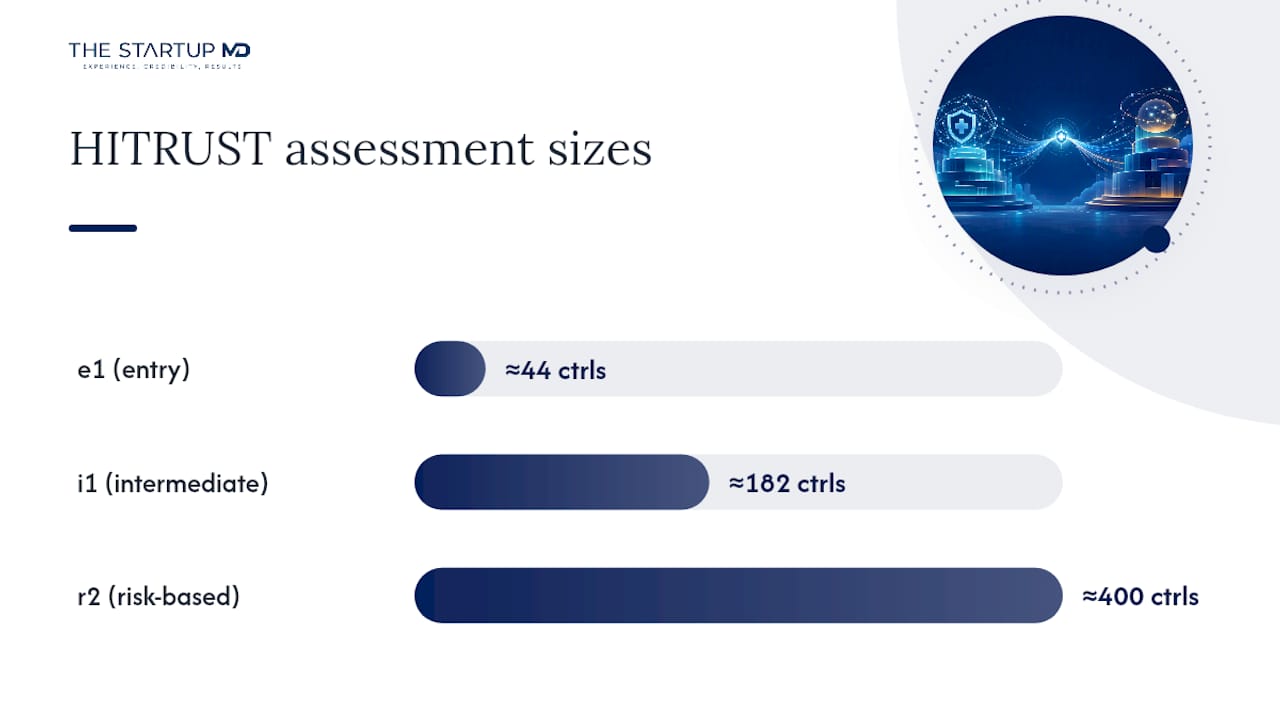
HITRUST certification requirements now sit across three assessment tiers, and picking the right one is the first real decision a compliance lead has to make:
- HITRUST e1 covers roughly 44 foundational controls and works as an entry point, typically completed in a matter of weeks. It's designed for organizations that need to demonstrate basic cyber hygiene without the resource commitment of a full assessment.
- HITRUST i1 expands to about 182 controls, giving moderate assurance for organizations with more mature security programs but not yet ready for a full risk-based review.
- HITRUST r2 is the tailored, risk-based assessment covering 300 to 500 plus controls depending on your organizational risk factors, and it carries a two-year certification life with an interim review.
Every tier runs through a validated assessment process, not a self-attestation. An authorized external assessor firm tests your evidence, submits results through the MyCSF platform, and HITRUST's own quality assurance team reviews the submission before certification is issued. The Assessment Handbook spells out exactly what assessors must document, which is part of why HITRUST certification carries more uniform weight across buyers than a SOC 2 report, whose depth can vary by auditor.
For covered entities and business associates under HIPAA, that harmonization is the real draw. One assessment cycle can stand in for evidence a health plan or hospital system would otherwise ask you to prove five separate ways.
Prescriptive vs Principles Based: The Difference That Actually Changes Your Strategy
The prescriptive versus principles-based split isn't academic. It changes how your engineering team builds, how consistent your audit outcomes are year over year, and how much your customers' security teams trust the result without follow-up questions.
Because HITRUST specifies almost exactly what a control has to look like, two organizations certified at the same tier have comparable security postures. SOC 2 doesn't work that way. You define your own controls to meet the Trust Services Criteria, which gives you flexibility, but it also means a rigorous internal security team produces a materially stronger SOC 2 report than a company checking boxes to pass. A Security Boulevard analysis puts it plainly: SOC 2's flexibility can become a liability without experienced internal security leadership shaping what "adequate" actually means.

That gap shows up most clearly in reliance. A hospital system's vendor risk team can read a HITRUST r2 certification and know, without reading the full report, roughly what controls exist. A SOC 2 report requires someone to actually read it, understand which criteria were in scope, and judge whether the auditor's testing was rigorous.
The good news is these frameworks aren't strangers to each other. Documented mapping between SOC 2 controls and the HITRUST CSF means most of your SOC 2 evidence carries over directly into a HITRUST assessment.
When you evaluate any assessor or auditor, check three trust signals: whether they're an authorized HITRUST external assessor firm (not every CPA firm is), how they describe their sampling methodology for Type 2 testing, and whether HITRUST's own QA process has flagged issues with their past submissions.
Pro Tip: Ask any prospective SOC 2 auditor for a sample report with the identifying details redacted. If the control descriptions read like generic boilerplate rather than specifics tied to your actual architecture, that's a preview of how little scrutiny your real audit will get.
Which Framework Should You Pursue First?
The right starting point depends on four things: who your buyers are, what data you touch, how big your team is, and how much runway you have before a deal is at risk.
- You're a covered entity or a business associate handling PHI at scale. Start planning for HITRUST i1 or r2 now, even if SOC 2 comes first tactically. Health systems and payers increasingly name HITRUST specifically in vendor security addenda.
- You're an early-stage healthcare SaaS company with a handful of pilot customers. SOC 2 Type I, moving to Type II within a year, is the more realistic first move. It's faster, cheaper, and satisfies most early enterprise procurement gates while you build the internal maturity a HITRUST assessment assumes.
- You're an established vendor already selling into three or more health systems. You've likely already heard "do you have HITRUST" in a sales cycle. Budget for i1 as a bridge, with r2 as the target once your control environment can support it.
- You're a general enterprise SaaS company with healthcare as one vertical among several. SOC 2 Type II is probably sufficient unless a specific healthcare account requires more, in which case pursue HITRUST reactively rather than speculatively.
- You're planning both. Sequence SOC 2 Type II first if you need faster market validation, then map your existing evidence into a HITRUST i1 or r2 engagement rather than starting from zero. That sequencing avoids duplicating evidence collection you've already done once.
Company size and internal maturity matter as much as industry. A twelve-person startup attempting HITRUST r2 before it has a dedicated security function will likely stall, burn budget, and still fail scoring thresholds.
Can You Pursue HITRUST and SOC 2 at the Same Time?
Yes, and for mid-market healthcare SaaS vendors selling into regulated buyers, it's increasingly the default path rather than the exception. The mechanics are worth understanding before you commit budget.
Start with a control mapping exercise. Documented guidance shows substantial overlap between SOC 2's Trust Services Criteria and the HITRUST CSF, particularly around access control, change management, and incident response. A mapping document lets your team and your assessors identify which SOC 2 evidence transfers directly and which gaps need net-new work.
The roles differ, and this is where teams get tripped up: SOC 2 requires a licensed CPA firm to issue the attestation, while HITRUST requires an authorized external assessor organization to run the validated assessment. These are not always the same firm, so confirm credentials for both engagements separately rather than assuming one vendor covers both.
Common pitfalls worth avoiding:
- Using incompatible sampling periods between the two engagements, which forces duplicate evidence pulls
- Attempting HITRUST before your evidence repository is mature enough to survive validated testing
- Assuming any CPA firm can perform HITRUST assessments without confirming HITRUST authorization
- Treating the mapping exercise as a one-time task instead of an ongoing part of your compliance calendar
What Will This Actually Cost You in Time and Budget?
Budget conversations go smoother when you set expectations early with your board and finance team. SOC 2 Type II preparation and observation windows commonly run six to twelve weeks once your control environment is genuinely ready, not counting the months of remediation many first-time companies need beforehand.
HITRUST timelines vary sharply by tier. An e1 assessment can close in weeks. An r2 assessment, given its 300 to 500 plus control scope, commonly stretches to a full year including remediation, and recertification runs on a two-year cycle with an interim check.
Staffing needs scale with scope: expect a security or compliance lead coordinating internally, plus external audit or assessor fees that rise substantially from SOC 2 to HITRUST i1 to HITRUST r2. Before signing an engagement letter, confirm:
- Whether the quoted fee includes remediation support or only the assessment itself
- How readiness gaps discovered mid-engagement are billed
- Whether your assessor is authorized for the specific HITRUST tier you're targeting
Pro Tip: Get a written scope letter before any assessment kicks off. Vague fee quotes are the single biggest source of budget overruns in first-time compliance projects.
How Should You Prepare in the Next 90 Days?
Waiting until a deal is stuck in security review is the most expensive way to start this work. A staged plan gets you ahead of it.
- Days 1 to 30: Inventory your data flows, especially anywhere PHI is stored or transmitted. Build a control baseline against whichever framework (SOC 2 criteria or HITRUST CSF domains) matches your near-term buyer expectations.
- Days 31 to 60: Stand up a centralized evidence repository. Start collecting access logs, change tickets, and vendor risk assessments now, since Type 2 and validated assessments both require evidence spanning a period, not a snapshot.
- Days 61 to 90: Run a gap assessment against your target framework and build a remediation backlog with owners and deadlines. Start vetting audit or assessor firms in parallel so you're not choosing under deadline pressure.
When you interview auditors or assessors, ask directly: What's your sampling methodology for Type 2 testing? Are you an authorized HITRUST external assessor, and for which tiers? Can you show a redacted sample report?
Red flags to walk away from: an assessor who guarantees certification before reviewing your environment, vague answers about sampling rigor, or a CPA firm that can't clearly explain the difference between Type 1 and Type 2 scope.
The StartupMD's Perspective for Healthcare SaaS Leaders
The mistake we see most often isn't picking the wrong framework. It's sequencing compliance work around an audit calendar instead of a business calendar. Controls should get prioritized by what they unlock, whether that's a stalled enterprise contract sitting in security review or an investor diligence checklist ahead of a Series A.
Fractional executive advisory earns its keep here by scoping the assessment to the buyer you're actually trying to close, not the most impressive-sounding certification. A health system contract stuck on HITRUST doesn't need you to boil the ocean with an r2 assessment when i1 satisfies the actual requirement this year. A general enterprise SaaS deal doesn't need HITRUST at all if SOC 2 Type II closes it.
For investor diligence specifically, the minimum credible evidence set is usually a current SOC 2 Type II report plus a documented security roadmap showing when HITRUST work begins, not a completed certification. Investors want proof you understand the requirement and have sequenced it sensibly, not proof you've already spent the runway on it.
Editorial Take: HITRUST vs SOC 2 for Healthcare SaaS Vendors
The conventional advice tells founders to "just get SOC 2" because it's faster and cheaper, full stop. That advice is incomplete for anyone selling into covered entities. It treats compliance as a checkbox exercise rather than a sales and fundraising lever, and it ignores that health systems increasingly name HITRUST specifically in procurement language, not "SOC 2 or equivalent."
The judgment the evidence actually supports is more specific: SOC 2 Type II first for speed and general market validation, HITRUST layered in the moment your pipeline includes covered entities or PHI at meaningful scale. Waiting until a deal stalls to start HITRUST work costs more in lost sales cycles than starting it a year early.
What's overrated is treating HITRUST r2 as the default target. Most startups don't need it yet; e1 or i1 satisfies far more buyer requirements than founders assume. What's underrated is control mapping between the two frameworks. Do it early, and you'll avoid paying for the same evidence twice.
— Paul Bergeron MD, MBA
How The StartupMD Helps You Sequence Compliance Without Burning Runway
Compliance work either accelerates your fundraise and your sales pipeline, or it quietly drains both while you chase the wrong certification tier first. The StartupMD works with healthcare SaaS founders to scope HITRUST and SOC 2 decisions around actual buyer requirements, not generic checklists, so you spend engineering time and audit budget on the controls that unlock the deal in front of you.
Our advisory engagements include readiness assessments that identify which framework and tier fit your current customer pipeline, remediation planning that sequences fixes by business impact, and fractional executive support that helps you talk credibly to enterprise security reviewers and investor diligence teams alike. If you're weighing whether HITRUST or SOC 2 comes first, or how to frame your compliance roadmap for an upcoming raise, start with our healthcare SaaS revenue model evaluation guide to see how compliance milestones tie directly to investor expectations, then reach out through our services page to scope an engagement.
Primary Sources for Readers and Auditors
- HITRUST Assessments and Certifications: official breakdown of e1, i1, and r2 tiers and control counts.
- The HITRUST Assessment Handbook: validated assessment rules, assessor responsibilities, and QA steps.
- AICPA: official source for SOC 2 Trust Services Criteria and reporting standards.
- HITRUST vs. SOC 2 Whitepaper, Barr Advisory: control mapping guidance and evidence reuse strategies.
Sources
- Cybersecurity Compliance Certifications and Assessments | HITRUST
- The HITRUST Assessment Handbook
- AICPA (American Institute of CPAs)