

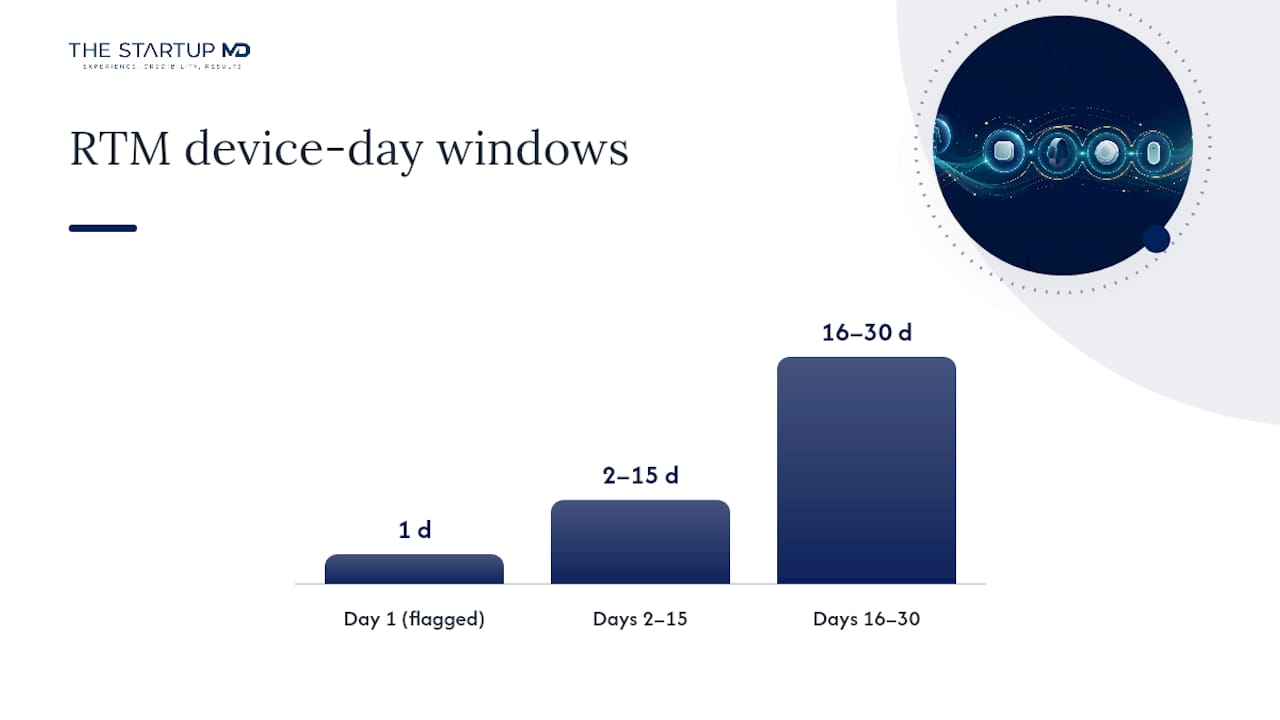
As of January 1, 2026, CMS added three new short-duration device-supply codes, 98984, 98985, and 98986, covering 2 to 15 days of remote therapeutic monitoring, plus a new 10 to 19 minute treatment-management code, 98979. Billing teams need to match the code family to documented device-days, confirm at least one real-time interaction is logged for any management claim, and update EHR edits before the first 2026 claims go out the door.
TL;DR:
- The new short-duration device-supply codes cover 2 to 15 days and require precise day counting to avoid misclassification and denials.
- Billing for RTM must include documented real-time clinician interaction, not just passive device data uploads, each month.
- RTM and remote patient monitoring cannot be billed simultaneously for the same patient within a 30-day period; the primary therapeutic focus determines the code family.
- Correct use of therapy modifiers and documentation of PTA/OTA involvement are crucial to prevent common claim rejections.
- Early implementation, including system updates and staff training, mitigates errors and aligns clinical workflows with new billing rules before January 2026.
Table of Contents
- RTM CPT Codes 2026: Device Supply vs. Treatment Management
- Therapy Designation, Modifiers, and Mutual Exclusions You Can't Skip
- Documentation That Survives an Audit
- Your 2026 RTM Rollout Checklist
- Why 2026's RTM Changes Are a Strategic Signal, Not Just a Coding Update
- How The StartupMD Helps You Bill RTM Correctly the First Time
- Sources
- FAQ
RTM CPT Codes 2026: Device Supply vs. Treatment Management
The 2026 RTM code set splits into two families, and confusing them is the single fastest way to trigger a denial. Device-supply codes pay for the monitoring hardware and data transmission. Treatment-management codes pay for the clinical time spent reviewing that data and interacting with the patient.
Here's the full 2026 lineup billing staff need memorized, not just filed away:
- 98975: Initial setup and patient education for the RTM device.
- 98976/98977: Device supply for respiratory or musculoskeletal systems, revised for 2026 to cover 16 to 30 days of monitoring.
- 98978: Device supply for cognitive behavioral therapy (CBT) monitoring, also on the 16 to 30 day cycle.
- 98984, 98985, 98986: New for 2026. These mirror 98976, 98977, and 98978 respectively, but cover a shorter 2 to 15 day device-supply window.
- 98980/98981: Treatment management, first 20 minutes and each additional 20 minutes, requiring live clinical interaction.
- 98979: New for 2026. Treatment management for 10 to 19 minutes, filling the gap below the 98980 threshold.
The 2 to 15 day tier exists for a practical reason: patients who enroll mid-cycle, discontinue early, or use a device for a short therapeutic course no longer force a claim into a 16 to 30 day bucket that doesn't match reality, according to McGovern Medical School's RTM guidance. That flexibility comes with a catch. Shorter tiers mean day-counting precision matters more than ever, since a miscount of even one or two days can shift a claim into the wrong code family entirely.
One coding wrinkle deserves attention before you build your fee schedule assumptions: CBT-based device-supply codes, including 98978 and the new 98986, are often contractor-priced rather than nationally set. Don't assume a standard Medicare Physician Fee Schedule rate applies. Check your Medicare Administrative Contractor's (MAC) local coverage determination before quoting reimbursement to clinical leadership or investors.
Therapy Designation, Modifiers, and Mutual Exclusions You Can't Skip
The therapy designation question decides which modifier goes on the claim, and getting it wrong is one of the most common reasons RTM claims bounce back. CMS's MM14250 transmittal designates 98984 and 98985 as "sometimes therapy," meaning they require a GP, GO, or GN modifier and a documented plan of care only when a physical therapist, occupational therapist, or speech-language pathologist delivers the service under a therapy plan. When a physician or non-physician practitioner bills the same code outside a formal therapy plan, no modifier applies.
Four RTM codes, 98975, 98979, 98980, and 98981, fall under the de minimis 10% policy. If a physical therapy assistant (PTA) or occupational therapy assistant (OTA) contributes more than 10% of the billed service, the claim needs a CQ or CO modifier. Track PTA/OTA time as a percentage of the total service, not a yes/no flag, because that percentage is exactly what auditors ask to see.
Two mutual exclusions cause more denials than any coding error on this list:
- One device code per patient per 30-day period. You cannot stack a 2 to 15 day code with a 16 to 30 day code for the same monitoring episode.
- RTM and Remote Patient Monitoring (RPM) cannot both be billed for the same patient in the same period. Pick the monitoring family that matches the primary therapeutic focus and stay with it for that cycle, a rule confirmed in CCN Health's 2026 RTM billing guide.
A single practical number to remember: 98979 and 98980 cannot both be billed in the same calendar month for the same patient. Choose the treatment-management code based on total documented minutes, 10 to 19 for 98979, 20 or more for 98980, not on which one pays more. Payment setting also shifts the math: rates and coverage differ between the Physician Fee Schedule and the Hospital Outpatient Prospective Payment System, and Medicaid coverage varies by state, so a code that pays cleanly under Medicare may need separate verification for commercial and Medicaid claims. Readers comparing this to remote patient monitoring rules should see how the RPM CPT code structure lines up, since the exclusion logic runs both directions.
Documentation That Survives an Audit
Auditors don't ask what your device recorded. They ask what a clinician did with it, and that distinction drives every documentation requirement below.
- Log a real-time interaction, not an automated ping. Treatment-management codes require at least one synchronous, live interaction per calendar month. Automated text reminders, app notifications, or passive data uploads do not satisfy this requirement, a point McGovern Medical School and the AMA's digital medicine coding handbook both stress explicitly.
- Count device-supply days accurately. Store enrollment start and stop dates in a structured field, not a note. A patient who enrolls on day 12 of a monitoring cycle needs a device-day counter that reflects actual usage, not calendar assumptions.
- Keep FDA device-status evidence on file. The AMA's coding handbook clarifies that an RTM device must meet the FDA's definition of a medical device. A consumer wellness app without that designation cannot support a device-supply claim.
- Track PTA/OTA contribution time as a documented percentage, ready to justify any CQ/CO modifier on demand.
The four most common audit triggers show up in nearly every denial pattern: missing plan-of-care documentation for therapy-designated codes, duplicate device-supply billing across overlapping periods, EHR systems that lack a hard edit preventing simultaneous RTM and RPM billing, and management claims with no synchronous interaction logged.
Pro Tip: Build a device-day counter field directly into your EHR's RTM module rather than relying on a biller to calculate it manually. A single automated field that flags claims outside the 2 to 15 or 16 to 30 day windows catches more errors than any manual review process.
Your 2026 RTM Rollout Checklist
Treat this as three parallel tracks, not a single sequential project. Systems, clinical workflow, and revenue cycle all need attention before your first 2026 claim goes out.
- Update the EHR and billing engine. Add the four new codes, their descriptors, and hard edits that block concurrent RTM and RPM billing for the same patient. Build a device-day counter that automatically routes claims to the 2 to 15 or 16 to 30-day family.
- Rebuild clinical workflow templates. Add structured consent capture, therapy plan-of-care fields tied to GP/GO/GN modifier logic, and a mandatory synchronous-contact field for every management-code claim. Include PTA/OTA supervision tracking as a percentage field, not a checkbox.
- Train coders on the 2026 changes specifically. Don't assume last year's RTM training transfers. Run a payer-verification playbook for contractor-priced CBT codes like 98978 and 98986 before your team quotes reimbursement estimates to anyone.
- Set up monthly denial reviews. Watch denial rates on the new short-duration codes closely for the first two billing cycles. A spike tied to a specific code almost always points to a day-counting or modifier error, not a payer policy problem.
For teams managing broader telehealth reimbursement friction beyond RTM specifically, the operational fixes overlap heavily with common telehealth reimbursement challenges worth reviewing alongside this checklist. Patient-facing consent language around RTM enrollment also benefits from clear communication practices, an area where resources on healthcare patient outreach can help clinical teams frame enrollment conversations correctly.
Pro Tip: Run a 30-day pilot on just the new 2 to 15 day codes before flipping the switch organization-wide. It surfaces EHR gaps and staff training holes while the exposure is still limited to a small patient cohort.
Why 2026's RTM Changes Are a Strategic Signal, Not Just a Coding Update
Most organizations will treat these code changes as a billing department problem. That's a mistake. A shorter device-supply tier signals that CMS expects more granular, shorter-cycle monitoring programs, which changes how a digital health company should design its clinical engagement model, not just its claims logic.
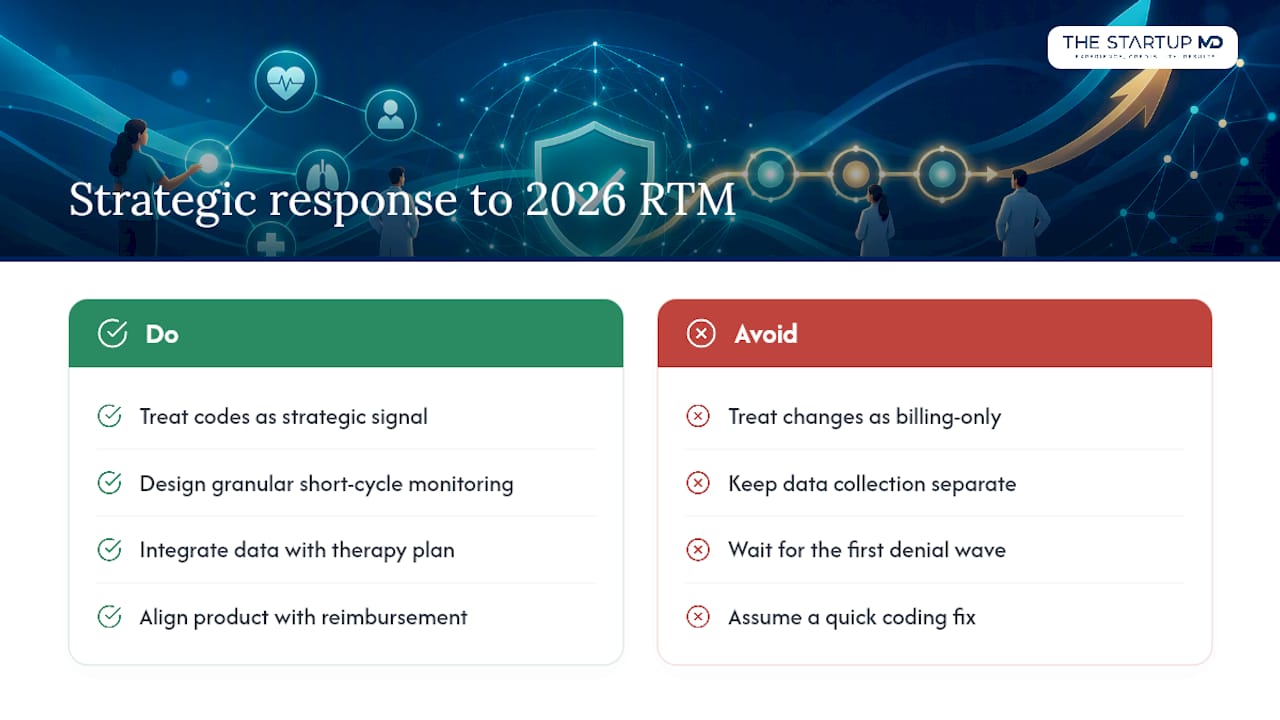
The pitfall I see most often in healthcare SaaS companies building RTM-adjacent products is data collection built entirely separate from a documented therapy plan. The device generates readings, but no one connects those readings to a synchronous clinical interaction that a payer will actually recognize. That gap doesn't show up until the first denial wave hits, and by then it's a product redesign problem, not a quick coding fix.
Getting this right from day one, aligning product architecture with reimbursement mechanics, is exactly the kind of clinical-and-business alignment a fractional Chief Medical Officer is built to close.
— Paul Bergeron MD, MBA
How The StartupMD Helps You Bill RTM Correctly the First Time
Most healthcare SaaS teams don't have a physician on staff who also understands CPT coding mechanics, payer policy, and product strategy at the same time. That's the specific gap The StartupMD closes. Founder Paul Bergeron, MD, MBA brings direct clinical and business expertise to the exact problem this article covers: translating a CMS coding update into a workflow your team can actually bill against.

Through fractional Chief Medical Officer engagements and advisory services, support is provided to healthcare SaaS founders and executives on payer policy review, revenue-cycle workflow design, and clinical documentation standards that hold up under audit. For teams building RTM or RPM-adjacent products, that means faster payer acceptance and fewer avoidable denials because the clinical and coding logic were built together, not bolted on after launch. If your team is heading into 2026 without a clear answer for how your device-day counting or modifier logic will hold up, visit The StartupMD's services page to start a conversation about a fractional CMO engagement built around your specific product and payer mix.
This article is general information, not a substitute for advice from a qualified financial advisor. Consult a qualified financial professional about your own circumstances before acting on anything here.
Sources
- Remote Therapeutic Monitoring (RTM) | McGovern Medical School
- MM14250 - Therapy code list: 2026 annual update
- Digital medicine clinical scenarios coding handbook | AMA
- Remote Therapeutic Monitoring CPT Codes & Billing Guide 2026 | CCN Health
FAQ
What Are the New RTM CPT Codes for 2026?
CMS added 98984, 98985, and 98986 for 2 to 15 day device-supply monitoring, plus 98979 for 10 to 19 minutes of treatment management, effective January 1, 2026. These sit alongside the existing 98975 through 98981 code set, with 98976 and 98977 revised to specify 16 to 30 day windows.
Can RTM and RPM Be Billed Together for the Same Patient?
No. RTM and Remote Patient Monitoring are mutually exclusive for the same patient within the same 30-day period, according to CCN Health's billing guide. Choose the monitoring family that matches the primary therapeutic focus and document that choice clearly.
Does an Automated Message Count as the Required Live Interaction?
No. Treatment-management codes require at least one synchronous, real-time interaction per calendar month, and automated texts or app notifications don't satisfy that requirement, per McGovern Medical School's guidance. Log the interaction with a timestamp and clinician note.
When Do I Need a CQ or CO Modifier on an RTM Claim?
You need a CQ or CO modifier when a PTA or OTA contributes more than 10% of the billed service under the de minimis policy, which applies to codes 98975, 98979, 98980, and 98981. Document that contribution as a percentage in the clinical note, not just a checkbox.
What Does The StartupMD Charge for RTM Billing Advisory?
The StartupMD's Fractional Chief Medical Officer and Advisory Services pricing is available on request through its services page. Engagements are structured around each company's specific product and payer mix rather than a fixed published rate.