

The types of telehealth reimbursement challenges facing healthcare organizations fall into six categories: payer policy fragmentation, coding and modifier errors, licensure and credentialing gaps, payment parity shortfalls, documentation and audit risk, and infrastructure funding for safety-net providers. Each one drains revenue differently, but all six share a root cause: policy that changes faster than billing systems can adapt.
HHS guidance confirms Medicare's major telehealth flexibilities now run through December 31, 2027, giving executives a fixed runway rather than year-to-year uncertainty. Peer-reviewed research in JAMA Network Open ties reimbursement policy directly to workforce retention at federally qualified health centers. Start with these four moves this quarter:
- Audit telehealth rules for your top five payers by claim volume
- Run a POS/modifier accuracy check on the last 90 days of telehealth claims
- Confirm credentialing status in every state where you deliver remote care
- Model your FQHC or RHC revenue exposure under current Medicaid parity rules
Key Takeaways
Telehealth reimbursement challenges cluster into payer fragmentation, coding errors, credentialing gaps, and parity shortfalls, and fixing coding discipline first delivers the fastest revenue protection.
| Point | Details |
|---|---|
| Six challenge categories | Payer fragmentation, coding errors, credentialing gaps, parity shortfalls, audit risk, and safety-net funding all drive denials differently. |
| 2027 is a deadline, not stability | Medicare flexibilities run through December 31, 2027, but 2028 remains an unresolved policy risk to plan for now. |
| Coding fixes pay off fastest | POS and modifier errors are among the most common and most preventable denial causes across specialties. |
| Parity affects workforce, not just revenue | Medicaid parity rollbacks correlate with staff attrition and access loss at FQHCs, per JAMA Network Open research. |
Table of Contents
- What Payment Models Does Telehealth Fall Under?
- Why Do Telehealth Claims Get Denied So Often?
- How Do Medicare, Medicaid, and Commercial Payers Differ?
- Building an Audit-Ready Telehealth Billing Process
- Turning Compliance Fixes Into an Executive Strategy
- How The StartupMD Approaches Telehealth Revenue Risk
- What Policy Changes Are Coming for Telehealth Reimbursement?
- Ready to Protect Your Telehealth Revenue Model?
- Editorial Take: What Executives Keep Getting Wrong
- Sources
What Payment Models Does Telehealth Fall Under?
Most telehealth claims move through fee-for-service billing, using standard evaluation and management (E/M) codes paired with a place-of-service code and a modifier that signals the visit happened remotely. That structure works fine until a payer disagrees with your interpretation of "remote."
Beyond straight fee-for-service, four other models show up across the industry:
- Medicare Physician Fee Schedule alignment: telehealth codes are cross-walked to in-person E/M codes, but payment rates and originating-site rules still diverge by service type.
- Bundled or global payments: a single payment covers an episode of care, which can include telehealth touchpoints without separate line-item billing.
- Capitation: a fixed per-member payment removes per-visit billing risk but requires strong utilization tracking to stay solvent.
- Episode-based payment: providers get paid for an entire clinical episode, folding telehealth follow-ups into one negotiated rate.
- Value-based arrangements: payment ties to outcomes rather than visit count, an approach a 2024 systematic review in JMIR found is gaining traction internationally as telehealth scales.
Fee-for-service gives you predictable, transaction-level revenue but exposes you to coding risk on every claim. Capitation and episode-based models smooth revenue but demand data infrastructure most digital health startups haven't built yet. Knowing which model governs each payer relationship is step one in avoiding preventable denials.
Why Do Telehealth Claims Get Denied So Often?
The gap between "care delivered" and "care paid for" usually traces back to one of six operational failures, not clinical quality.
- Payer policy fragmentation. Medicare, Medicaid, and commercial payers each maintain separate rules for eligible services, modifiers, and originating sites, so a claim built for one payer's logic often fails another's.
- Coding errors. The most common mistakes are POS 02 versus POS 10 confusion, missing or incorrect modifiers (95, GT, 93), and lingering use of retired audio-only codes like 99441 through 99443.
- Audio-only ambiguity. Payers differ on which services qualify for audio-only reimbursement and what documentation proves the modality was clinically appropriate.
- Credentialing and licensure gaps. A provider licensed and credentialed in one state but treating a patient physically located in another can trigger an automatic denial, regardless of clinical quality.
- Audit exposure. Practices with unusually high telehealth-visit proportions draw payer scrutiny faster, and thin documentation makes recoupment demands hard to fight.
- Safety-net strain. Medicaid parity rollbacks hit FQHCs particularly hard, correlating with workforce attrition and reduced patient access, according to the JAMA Network Open study cited above.
Billing firms tracking 2026 claims report that some specialties see denial rates that can be quite high, driven almost entirely by avoidable administrative errors rather than clinical appropriateness.
Pro Tip: Pull a denial report segmented by payer and reason code every 30 days. If POS or modifier errors account for more than 10 percent of denials, that's a process fix, not a training problem.
How Do Medicare, Medicaid, and Commercial Payers Differ?
Forecasting telehealth revenue means modeling three distinct payer behaviors, not one.
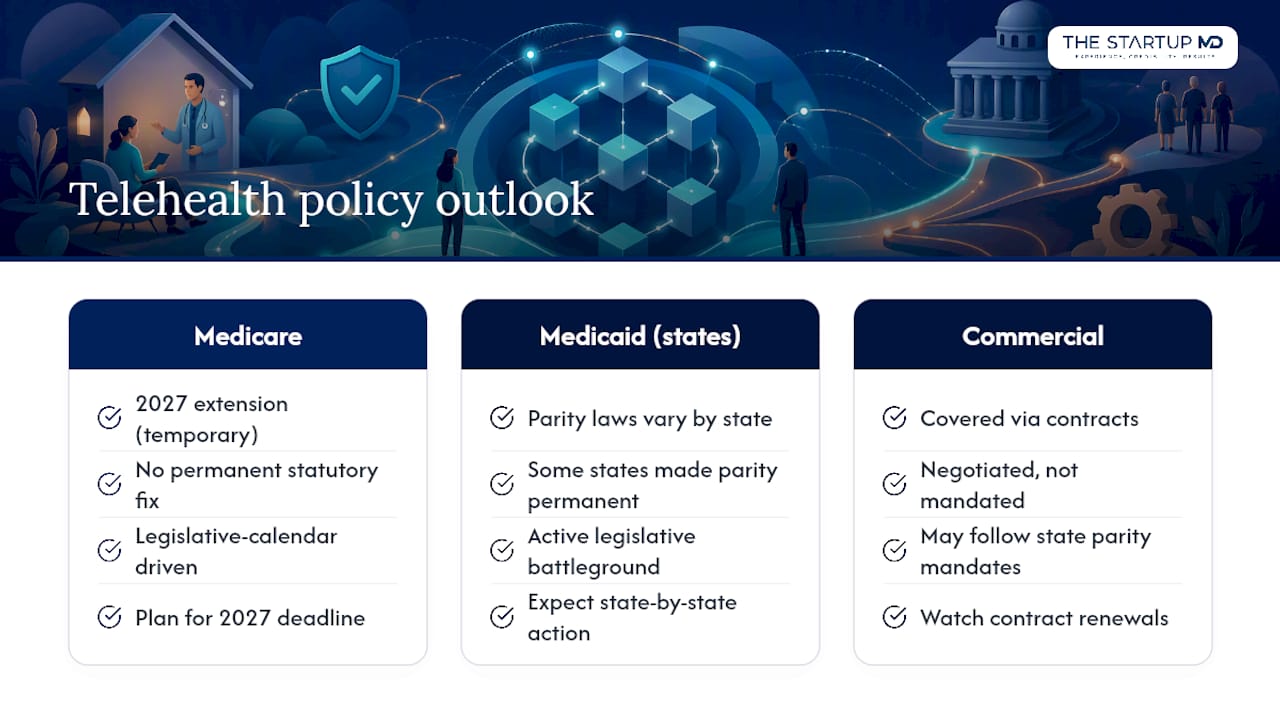
Medicare offers the most stability right now. Flexibilities including home-based originating sites and audio-only options for many services run through 2027, and behavioral health telehealth flexibilities are permanent. Watch the 2028 horizon closely: industry analysis warns the 2027 extension buys time but doesn't settle long-term policy, so treat a potential 2028 reversion as a real planning risk, not a remote one.
Medicaid varies by state, and that variability is where the sharpest access problems emerge. States with strong telehealth parity laws tend to see better FQHC staff retention; states that rolled back parity saw measurable workforce and access losses.
Commercial payers are the least predictable of the three. Modifier and code acceptance differ by plan, audio-only restrictions vary widely, and credentialing/enrollment requirements often lag behind a provider's actual practice footprint.
For revenue modeling, that means:
- Stress-test forecasts against a scenario where one major commercial payer tightens audio-only rules mid-year
- Weight payer-mix risk by state, especially where Medicaid parity is politically contested
- Separate Medicare behavioral health revenue from general Medicare telehealth revenue, since the rules genuinely diverge
Building an Audit-Ready Telehealth Billing Process
Getting reimbursement right consistently comes down to five operational disciplines, applied in this order:
- Match POS to setting, not habit. POS 10 applies when the patient is at home; POS 02 applies when the patient is at a different originating site. Confirm which one each payer expects before submitting, because Medicare and commercial rules don't always align.
- Choose the modifier the payer actually wants. Modifier 95 is the most widely accepted, but some payers still require GT, and modifier 93 flags audio-only encounters specifically. Industry billing guidance stresses verifying payer-specific rules before assuming 95 works everywhere.
- Select the correct code series. Medicare largely uses standard E/M codes with telehealth modifiers, while some commercial plans recognize newer telehealth-specific code sets. Coding staff need a payer-by-payer reference, not a single default. Providers billing remote monitoring adjuncts should also check current RPM CPT code requirements to avoid mixing up monitoring and visit codes.
- Document every required element. That means patient and provider location, informed consent, modality used, medical necessity, and start/end times, every time. 2026 industry coding updates list incomplete documentation as one of the top drivers of denial and recoupment.
- Confirm credentialing before the visit, not after the denial. Multi-state practices should evaluate the Interstate Medical Licensure Compact to speed up licensure in participating states.
Pro Tip: Treat behavioral health telehealth billing as a separate compliance track. Its rules are permanent and different from general medical telehealth, and mixing the two workflows is a common source of preventable errors.
Turning Compliance Fixes Into an Executive Strategy
Operational fixes only protect revenue if leadership treats them as strategic priorities, not back-office cleanup.
- Build a payer-rule tracker updated quarterly, tied to denial rate and days-in-A/R as core KPIs
- Prioritize credentialing and multi-state licensing where telehealth coverage is a competitive differentiator
- Negotiate contract language explicitly addressing telehealth parity and carve-outs for high-value service lines like behavioral health and chronic care management
- Pilot an episode-based payment or bundled arrangement for a defined chronic care population, with clear outcome metrics and stop-loss protection
- Fund patient access programs (device support, broadband subsidies) and document the costs, since that data strengthens both payer negotiations and grant applications
A mixed payment strategy, blending fee-for-service with value-based elements, tends to hold up better as telehealth scales, according to the JMIR review cited earlier. Executives building or refining a go-to-market plan around telehealth services should also review how go-to-market strategy decisions interact with payer contracting timelines, since the two are rarely sequenced correctly in early-stage healthtech companies.
| Priority | Action |
|---|---|
| Build payer tracker | Update telehealth rules quarterly for top-volume Medicare, Medicaid, and commercial payers. |
| Fix coding process | Standardize POS and modifier selection by payer to cut avoidable denials. |
| Secure multi-state coverage | Use licensure compacts where telehealth reach is strategic to the business. |
| Protect safety-net revenue | Track state Medicaid parity status and model FQHC/RHC exposure. |
How The StartupMD Approaches Telehealth Revenue Risk
Paul Bergeron, MD, MBA, brings more than 25 years of combined medical and business experience to healthcare SaaS advisory work, giving The StartupMD a rare dual lens on clinical operations and commercial strategy.
The firm's fractional Chief Medical Officer engagements typically focus on three levers:
- Billing and process audits that identify where coding or documentation gaps are creating denial risk
- Payer contracting and negotiation support, particularly around parity language and telehealth carve-outs
- Telehealth revenue-model evaluation to determine whether fee-for-service, episode-based, or blended arrangements fit a company's growth stage
Clients pursuing this work generally aim for fewer denials, more reliable forecasting, and stronger retention among remote-friendly clinical staff.
What Policy Changes Are Coming for Telehealth Reimbursement?
The 2027 extension of Medicare's telehealth flexibilities settles near-term uncertainty, but it is a deadline, not a resolution. Congress has repeatedly used temporary extensions rather than permanent statutory fixes, which keeps telehealth reimbursement tied to legislative calendars instead of clinical evidence.
Behavioral health telehealth flexibilities are the clearest exception. Their permanent status signals where policymakers see the strongest case for durable reimbursement, and it offers a template other service lines may eventually follow.
At the state level, Medicaid parity laws remain the most active legislative battleground. Some states have moved to lock in payment parity permanently; others have let pandemic-era parity provisions lapse, creating the access gaps documented in FQHC workforce research. Expect continued state-by-state legislative activity here rather than a uniform national standard anytime soon.
Commercial payer behavior will likely keep evolving through contract renewal cycles rather than legislation, since most commercial telehealth coverage rules are negotiated, not mandated. Executives should watch for state parity mandates that extend to commercial plans, since several states have already moved in that direction and more may follow as data on access and outcomes accumulates.
The practical takeaway for 2026 planning: treat the 2027 deadline as a fixed point to build contracts and forecasts around, not a settled policy environment to assume will continue unchanged into 2028.
Ready to Protect Your Telehealth Revenue Model?
Telehealth reimbursement risk isn't a billing problem you can delegate away and forget. It's a strategic variable that touches contracting, workforce planning, and how investors evaluate your revenue model. If your organization is heading into a fundraising cycle or a payer renegotiation, an outside evaluation of your telehealth revenue model can surface risks before a term sheet or contract renewal locks them in.
The StartupMD's Healthcare SaaS Revenue Model Evaluation engagement examines exactly this kind of exposure, pairing clinical fluency with the financial rigor investors and boards expect. For organizations also rethinking technology workflows around telehealth delivery, Kontrol Media's guidance on integrating new technologies into business strategy offers a useful complementary framework for operational planning.
Editorial Take: What Executives Keep Getting Wrong
Most telehealth reimbursement advice treats 2027 as a finish line. It isn't. The extension is a planning window, not a settlement, and organizations that build five-year strategy around "the rules are fixed now" are setting themselves up for the same scramble that happened in earlier telehealth policy cycles.
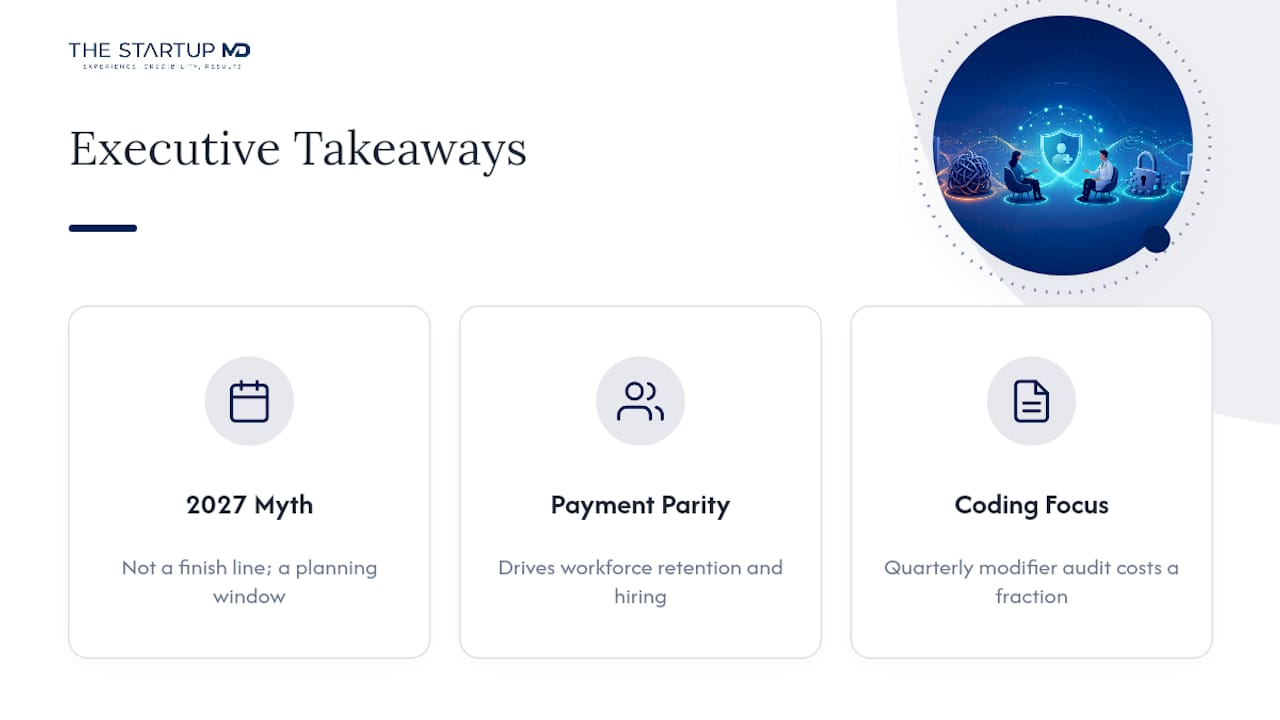
The bigger blind spot is treating payment parity as purely a Medicaid or advocacy issue. It's a workforce retention lever. The FQHC research on staffing attrition tied to reimbursement changes should be read by every executive planning a telehealth-heavy service line, not just policy teams. If your care model depends on remote clinicians staying engaged, payment parity affects your hiring pipeline as directly as your revenue.
What deserves more attention than it gets: coding discipline is cheaper to fix than almost any other lever in this list, yet it's usually the last thing executives prioritize. A quarterly modifier audit costs a fraction of what a specialty's 25 percent denial rate costs in lost revenue. Start there. Everything else, credentialing, contracting, policy monitoring, works better once the basic claims are clean.
— Paul Bergeron MD, MBA
Sources
- HHS Telehealth billing and reimbursement guidance
- Experiences of Telehealth Reimbursement Policies in Federally Qualified Health Centers | JAMA Network Open
- Telehealth payment models review | JMIR (2024)
- Telehealth billing rules in 2026: What changed and what to watch | Healix RCM