
Seven CPT codes govern remote patient monitoring billing in 2026: 99453, 99454, 99445, 99457, 99470, 99458, and 99091. The headline change is two brand-new codes effective January 1, 2026: 99445 (device supply and data transmission for 2 to 15 days in a 30-day period) and 99470 (first 10 to 19 minutes of treatment management in a calendar month), according to CMS's Physician Fee Schedule.
Here's the implication that matters most for your revenue cycle right now: these two codes close billing gaps that have existed since RPM codes were introduced. Before 2026, a patient who transmitted device data for only 10 days in a month, or a care team that spent 15 minutes reviewing readings and adjusting a treatment plan, generated zero reimbursement. Those encounters happened. They just weren't billable. CMS's CY2026 Physician Fee Schedule final rule fixes that, and it means clinics running RPM programs likely have unclaimed revenue sitting in claims they wrote off months ago.
Before you touch a single claim, run these checks:
- Pull your patient-level device transmission logs for recent months and flag anyone who fell within the shorter transmission-day thresholds in any 30-day window.
- Review time logs for care management encounters under 20 minutes that were previously left unbilled.
- Update your billing software's code library to include 99445 and 99470 with correct place-of-service and frequency edits.
- Retrain coders on the mutual-exclusivity rules between 99454/99445 and 99457/99470 before the next billing cycle.
- Identify patients who were "written off" as non-billable under the old thresholds and reassess them under the new code set.
Key Takeaways
The 2026 RPM code additions, 99445 and 99470, create billable revenue tiers for previously excluded patients, and capturing them requires updated day-count and time-tracking workflows now.
| Point | Details |
|---|---|
| Two new codes in 2026 | 99445 covers 2 to 15 device days; 99470 covers 10 to 19 minutes of treatment management. |
| Mutual exclusivity applies | Never bill 99454 with 99445, or 99457 with 99470, in the same period. |
| Reconcile logs before billing | Match device platform exports against EHR data monthly to prevent denials. |
| Reassess "non-billable" patients | Patients under 16 transmission days or under 20 minutes are now billable revenue. |
| Get implementation support | The StartupMD's advisory services help provider groups and health SaaS teams rebuild RPM workflows around the 2026 code set. |
Table of Contents
- RPM CPT Codes 2026 Quick Reference
- Device-Based Codes: 99453, 99454, and 99445 Explained
- Time-Based Treatment Management Codes: 99457, 99458, and 99470
- How RPM Codes Interact With 99091, E/M, and CCM Billing
- 2026 RPM Reimbursement Rates and Revenue Examples
- Documentation Checklist for Audit-Ready RPM Claims
- Medicare, FQHC, and Commercial Payer Differences You Need to Check
- Common RPM Billing Denials and How to Prevent Them
- Operationalizing RPM Billing: A Practical Implementation Checklist
- What the 2026 Changes Mean for Practice and Product Leadership
- Get Help Operationalizing the 2026 RPM Coding Changes
- Frequently Asked Questions
- Sources
RPM CPT Codes 2026 Quick Reference
Billing teams need a fast lookup, not a policy memo, when they're coding claims at volume. The table below covers the full 2026 RPM code set and how each one is billed.
| CPT Code | What It Covers | Billing Unit | Notes |
|---|---|---|---|
| 99453 | Initial setup and patient education on RPM device use | One-time, per episode of care | Not billed monthly; billed once per new monitoring episode |
| 99454 | Device supply, data collection, and transmission for 16+ days | Once per 30-day period | Mutually exclusive with 99445 in the same period |
| 99445 | Device supply and transmission for 2 to 15 days | Once per 30-day period | New for 2026; mutually exclusive with 99454 |
| 99457 | First 20 minutes of treatment management with interactive communication | Once per calendar month | Requires at least one interactive communication with the patient |
| 99470 | First 10 to 19 minutes of treatment management | Once per calendar month | New for 2026; mutually exclusive with 99457 in the same month |
| 99458 | Each additional 20 minutes of treatment management | Add-on to 99457 | Billable multiple times per month if time supports it |
| 99091 | Collection and interpretation of physiologic data, 30+ minutes | Once per 30-day period | Physician or qualified health professional time; distinct from clinical staff time under 99457/99458 |
A few things this table can't show you: locality adjustments, payer-specific edits, and how commercial insurers apply these codes differently than Medicare. National averages under the Medicare Physician Fee Schedule are a starting point, not a promise of what lands in your bank account. Every Medicare Administrative Contractor applies its own geographic practice cost index, so the same code pays differently in rural Nebraska than in downtown Boston.
Device-Based Codes: 99453, 99454, and 99445 Explained
The device side of RPM billing runs on days, not minutes, and getting the day count wrong is the single most common reason clinics leave money on the table.
99453 covers the one-time setup: educating the patient on how to use the device, configuring it, and getting the first data transmission flowing. You bill it once per new monitoring episode, not once per month. If a patient discontinues monitoring and restarts three months later with a new order, you can bill 99453 again. Bill it too often within a continuous episode, though, and you're inviting a denial.
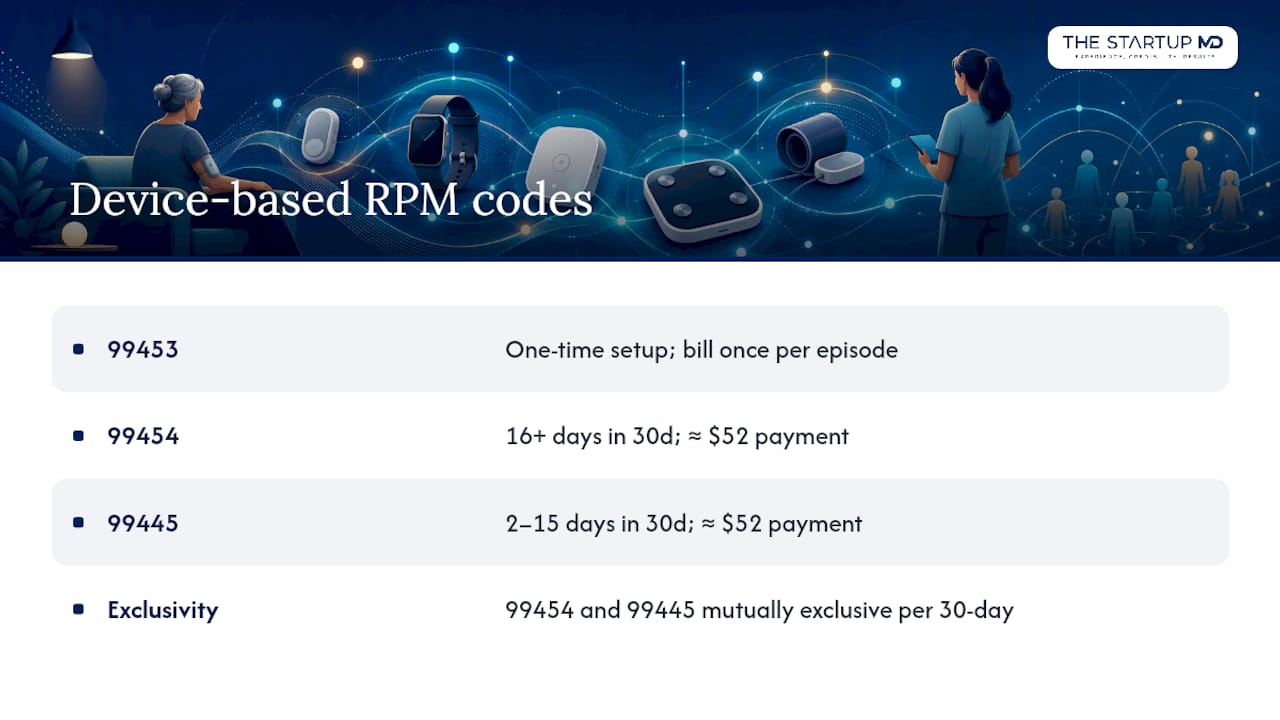
99454 and 99445 are where the 2026 update actually changes your workflow. Both codes cover the same underlying activity, supplying the device and collecting transmitted data, but they split on day count within a rolling 30-day period. Sixteen or more days of transmission gets you 99454. Two to 15 days gets you the new 99445. CMS built these as mutually exclusive: you bill one or the other in a given 30-day period, never both. That's a hard edit, and claims that try to submit both will bounce.
Here's where clinics get tripped up operationally. Counting "transmission days" sounds simple until you're reconciling a device manufacturer's platform export against your EHR's date fields, and the two don't always agree. A blood pressure cuff that syncs at 11:58 PM one night and 12:02 AM the next can register as either one day or two, depending on which system's timestamp you trust. Assign a specific staff member, usually a clinical assistant or RPM coordinator, to validate the raw device log against the billing platform before the claim goes out. Don't let the software's summary count stand alone as your audit trail.
Pro Tip: Build a mid-month check into your workflow around day 20 of each 30-day cycle. If a patient is trending toward the 2 to 15 day range instead of 16-plus, you can still capture 99445 instead of losing the encounter entirely. Waiting until month-end to review counts means you've already missed the chance to prompt the patient toward more consistent transmission.
On payment, CMS set 99445 at national-average parity with 99454, both landing around $52 under the 2026 non-facility Medicare Physician Fee Schedule. That parity is deliberate. CMS isn't treating shorter-duration monitoring as a lesser service; it's treating the underlying clinical value, and the administrative burden of supplying and reconciling a device, as roughly equivalent regardless of exactly how many days data came through.
Time-Based Treatment Management Codes: 99457, 99458, and 99470
Where the device codes count days, the treatment management codes count minutes spent on interactive communication and clinical decision-making tied to the monitored data.
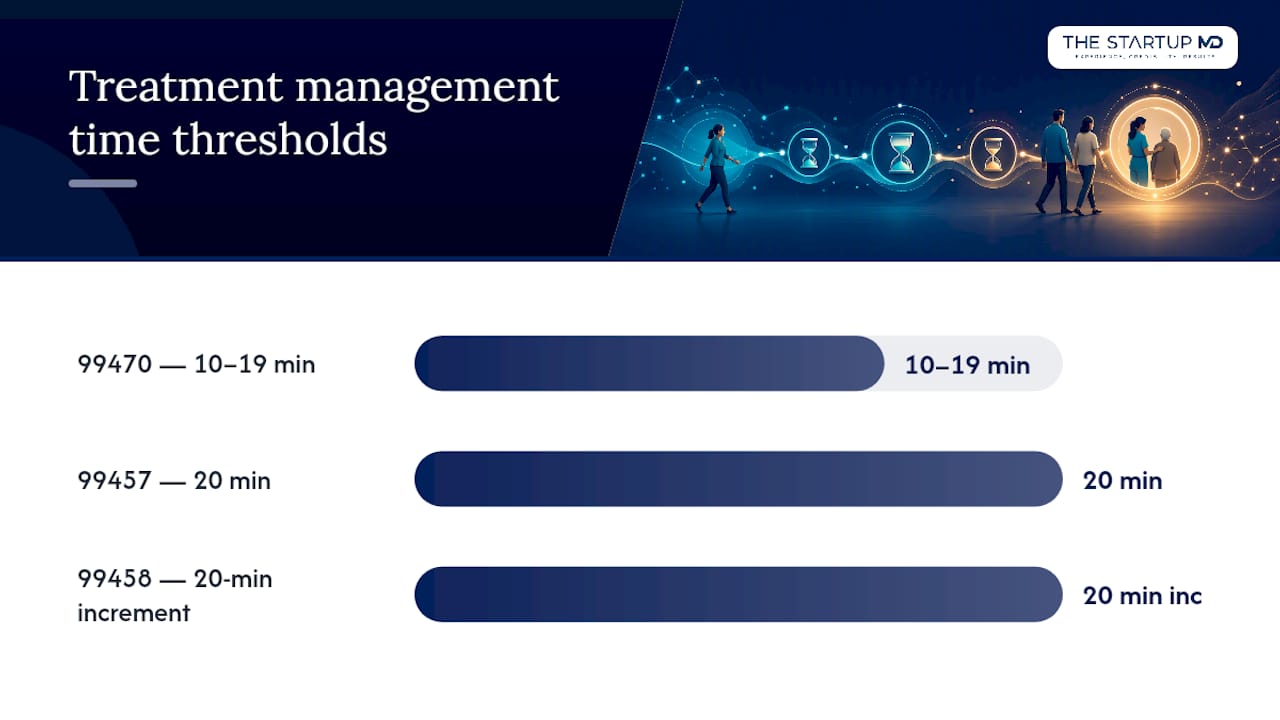
99470 is the new arrival: the first 10 to 19 minutes of treatment management in a calendar month. 99457 covers the first 20 minutes. Like the device codes, these two are mutually exclusive. If your clinical staff logs 14 minutes of time with a patient in a month, that's 99470. Hit 20 minutes or more, and you bill 99457 instead, then stack 99458 for each additional 20-minute increment beyond that.
Who can perform the billable time matters as much as how much time they spend. Clinical staff working under general supervision of the billing practitioner can perform and log this time, which means a medical assistant or RPM nurse reviewing trends and reaching out to a patient counts, provided the supervising physician or qualified health professional remains available. Incident-to billing rules apply here the same way they do elsewhere in Medicare Part B, so confirm your supervision documentation matches what CMS's telehealth and RPM operational guidance expects before you lean on non-physician staff time.
A defensible note for 99457, 99458, or 99470 needs four elements: the date of service, the exact duration of time spent, evidence of interactive communication (a phone call, a secure message exchange, a video visit), and a description of the clinical activity performed, whether that's medication adjustment, escalation to the physician, or patient coaching on device use.
The most common pitfalls billing teams hit:
- Rounding 17 minutes up to "20 minutes" to justify 99457 instead of correctly billing 99470. This is the fastest way to draw a payer audit.
- Failing to document evidence of interactive communication for 99470 claims, since the code still requires real-time or near-real-time contact, not just passive data review.
- Aggregating time across multiple staff members without a clear log showing who did what and when, which makes the total unverifiable if a payer asks for backup.
Pro Tip: Have your time-tracking software log start and stop times automatically rather than relying on staff to estimate minutes at the end of a shift. Self-reported "about 20 minutes" entries are exactly what auditors flag first, because they cluster suspiciously at code thresholds.
How RPM Codes Interact With 99091, E/M, and CCM Billing
RPM doesn't exist in a billing vacuum. It sits alongside data-interpretation services, evaluation and management visits, and chronic care management, and knowing where the lines fall keeps your claims clean.
99091 covers collection and interpretation of physiologic data by a physician or qualified health professional, requiring at least 30 minutes in a 30-day period. It's distinct from 99457/99470 because it captures the higher-level clinical interpretation time of the billing provider, not the interactive communication time of clinical staff. You can bill 99091 alongside 99457 or 99470 in the same period, but only if the time counted toward each is separate and separately documented. Double-counting the same 15 minutes toward both codes is a denial waiting to happen.
E/M visits and chronic care management (CCM) can also run concurrently with RPM in the same month, but distinct-time documentation is non-negotiable. If a physician bills an E/M visit and also wants to bill 99457 that same month, the time spent on the RPM treatment management activity has to be clearly separated from the E/M encounter itself. CCM's own time thresholds (typically 20 minutes for the base code) can't share minutes with RPM's 99457, 99458, or 99470 time either.
A worked example makes the stacking logic concrete. Consider a Medicare patient enrolled in a hypertension RPM program who also qualifies for CCM:
- Clinic bills 99453 once, in the patient's first month, for device setup and education.
- In month two, the patient transmits blood pressure readings for 12 days; the clinic bills 99445 instead of 99454.
- Clinical staff spend 16 minutes that month reviewing trends and adjusting the care plan by phone; the clinic bills 99470.
- The billing physician separately documents 22 minutes of chronic care management coordination unrelated to the RPM review; CCM's base code bills alongside 99470 without time overlap.
That's four distinct line items in a single month, each resting on its own documented time or day count, none of them borrowing minutes from another.
2026 RPM Reimbursement Rates and Revenue Examples
National-average, non-facility Medicare rates for 2026 give you a starting benchmark, though every figure below shifts with your local geographic adjustment and whether you're billing facility or non-facility rates. Per CMS's Medicare Physician Fee Schedule, approximate national averages run: 99453 around $22 (one-time), 99454 around $52, 99445 around $52, 99457 around $52, 99470 around $26, 99458 around $41, and 99091 around $58.
Here's how those numbers translate into a monthly revenue model you can drop straight into a spreadsheet:
- Minimum engagement scenario: A patient transmits data for 12 days and receives 14 minutes of treatment management. Bill 99445 plus 99470 for a combined reimbursement that represents revenue from patients with lower engagement., revenue that simply didn't exist under the pre-2026 code set.
- Standard engagement scenario: A patient transmits data for 22 days and receives 24 minutes of treatment management. Bill 99454 plus 99457 for a combined reimbursement representing higher engagement monthly revenue.
- Extended engagement scenario: Same standard engagement, plus an additional 20 minutes of treatment management time and 32 minutes of physician data interpretation. Bill 99454, 99457, 99458, and 99091 for a total monthly reimbursement that reflects an extended engagement scenario.
Run this math across a 200-patient RPM panel and the spread between capturing minimum-engagement patients versus writing them off entirely is the difference between meaningful incremental revenue and none at all. Commercial payers frequently diverge from these Medicare figures, sometimes paying more, sometimes bundling RPM into a broader care management fee, so treat the numbers above as your Medicare floor, not your ceiling.
Documentation Checklist for Audit-Ready RPM Claims
Every RPM claim you submit should be able to survive a payer request for records without a scramble. That starts well before the claim ever gets coded.
Patient consent has to be documented and on file, confirming the patient agreed to RPM monitoring and understands the associated cost-sharing. CMS guidance treats this as a baseline requirement for an established patient relationship, not a box you check retroactively after a denial. Device supply proof means keeping a handoff record showing when the device was provided, along with platform-generated transmission logs that show the actual dates data came through, not just a summary count your billing software calculated.
Time tracking needs the same rigor: cumulative logs that show timestamps, which staff member performed the work, and what role they held at the time (clinical staff versus the billing physician). A coder reusing a documentation template should be able to fill in five fields without guessing: date of service, duration, mode of communication, staff role, and clinical action taken.
A recurring theme in HHS OIG's oversight of remote patient monitoring billing is that claims lacking clear platform-to-EHR reconciliation are the ones most likely to draw scrutiny. Programs that can show a clean paper trail from device transmission to claim submission fare far better under review than those relying on summary reports alone.
Pro Tip: Export your device platform's raw transmission log monthly and store it alongside the claim, even if your EHR already summarizes it. If a payer requests documentation eighteen months from now, you want the original source data on hand, not a recalculated report from a system that may have changed its counting logic since.
For 99445 and 99470 specifically, since they're new codes with no established audit history, collect evidence proactively: the exact day count with source timestamps, and a time log showing the interactive communication that justifies the 10 to 19 minute claim. Payers scrutinize new codes harder in their first year simply because there's no baseline pattern to compare against yet.
Medicare, FQHC, and Commercial Payer Differences You Need to Check
Medicare's own rules aren't uniform across every setting, and assuming your reimbursement matches a colleague's practice down the street is a mistake that shows up on your first remittance advice.
Facility versus non-facility rates diverge under the Medicare Physician Fee Schedule, with non-facility rates (the ones cited throughout this article) generally applying to independent practices, while hospital-based settings often see different, typically lower, professional-component rates because the facility captures a separate payment for overhead. Confirm your specific locality adjustment through CMS's fee schedule lookup tool before you build a revenue projection off national averages.
- Federally Qualified Health Centers and Rural Health Clinics bill RPM differently than standard fee-for-service practices, often under a bundled payment methodology rather than line-item CPT billing, so confirm with your regional CMS contractor which billing pathway applies to your site before assuming standard rates apply.
- Critical Access Hospitals have their own cost-based reimbursement structure that can change how RPM revenue flows through compared to a physician office.
- Accountable Care Organizations and Medicare Advantage plans sometimes apply their own utilization edits or require prior authorization for ongoing RPM services, even when traditional Medicare doesn't. Check your ACO's specific quality and utilization requirements before scaling an RPM program across an at-risk population.
Commercial payers add another layer of variance entirely. Confirm each payer actually recognizes 99445 and 99470 before billing them, since adoption of new CPT codes isn't instantaneous across every commercial plan's claims-processing system. Check for bundling edits that might combine RPM codes with other care management services in that payer's system, and confirm whether preauthorization is required for RPM enrollment at all, a requirement Medicare doesn't impose but some commercial plans do.
Common RPM Billing Denials and How to Prevent Them
Most RPM denials trace back to a handful of repeatable mistakes, and nearly all of them are preventable with a pre-bill review step.
Incorrect code pairing tops the list: submitting both 99454 and 99445 in the same 30-day period, or both 99457 and 99470 in the same calendar month, triggers an automatic mutual-exclusivity edit rejection. Missing transmission logs is the second most common cause, particularly when a practice bills 99454 or 99445 but can't produce day-by-day evidence if a payer requests it. Poor time documentation for 99457, 99458, or 99470, especially vague notes like "reviewed patient data" with no duration or communication evidence, invites denial or, worse, a post-payment audit recoupment.
Auditors specifically look for a few red flags: time entries that cluster suspiciously at exact code thresholds (always exactly 20 minutes, never 18 or 23), device transmission counts that don't reconcile between platform export and claim, and identical boilerplate documentation language copied across multiple patients. Remediate each one individually rather than treating documentation as a single blanket fix. Vary your time entries to reflect actual clinical variation, reconcile platform data before billing rather than after, and require coders to write patient-specific clinical notes even when using a template.
On the electronic claims side, preflight these before submission: incorrect place of service codes (RPM typically bills as if performed in the office setting, POS 11, regardless of where the patient physically is), missing modifiers where a payer requires one for RPM services, and incorrect billing frequency, submitting 99454 or 99445 more than once in the same 30-day window for the same patient.
Pro Tip: Run a pre-bill audit on any claim involving a new code, 99445 or 99470 especially, for the first two full billing cycles after implementation. New codes attract more scrutiny in their first year, and catching your own errors before submission beats fighting a denial after the fact.
- Reconcile RPM platform exports against your EHR weekly, not monthly, to catch discrepancies while they're still fixable before claim submission.
- Build a coder training session specifically around the mutual-exclusivity logic between 99454/99445 and 99457/99470, since this is the single most common source of automatic denials in the first quarter of 2026.
Operationalizing RPM Billing: A Practical Implementation Checklist
Coding rules only translate into revenue when your operational workflow actually captures them. Here's a sequence that turns the 2026 code updates into a functioning process rather than a policy memo nobody reads.
- Assign governance. Name a single owner, often a billing manager or RPM program coordinator, responsible for monitoring day counts and time logs across the patient panel every month.
- Verify your platform requirements. Confirm your RPM device platform can export transmission logs with exact timestamps and that your EHR can ingest or cross-reference that data without manual re-entry.
- Map roles clearly. Document who validates transmission counts, who logs treatment management time, and who signs off on the claim before submission.
- Build the required EHR fields. Make sure your documentation template captures date of service, duration, communication mode, staff role, and clinical action as discrete fields, not free text buried in a progress note.
- Run the revenue model quarterly. Recalculate your panel's monthly revenue using the formula from the reimbursement section above, adjusting for actual local Medicare rates and any commercial payer contracts.
Prioritize quick wins first. Patients who fell below the 16-day threshold or logged 10 to 19 minutes of treatment management under the old rules were previously non-billable; identifying them takes a data pull, not a system overhaul. Longer-term projects, like automating platform-to-EHR reconciliation or building real-time alerts when a patient's transmission count crosses a billing threshold, take more engineering time but reduce the manual audit burden considerably.
- Quick win: reassess your last 90 days of "non-billable" RPM encounters against the new 2026 thresholds.
- Longer-term: automate day-count and time-threshold alerts so staff get notified before month-end, not after.
- Longer-term: standardize documentation templates across every clinician using the RPM platform to eliminate coder guesswork.
Pro Tip: If your practice or digital health platform is scaling an RPM program across multiple sites, the operational complexity multiplies fast, different EHRs, different staff training levels, different payer mixes per location. A fractional Chief Medical Officer engagement can help standardize clinical governance and documentation protocols across sites before inconsistency turns into a compliance liability.
What the 2026 Changes Mean for Practice and Product Leadership
The 2026 code updates don't just add two line items to a fee schedule. They shift the economics of who's worth enrolling in an RPM program in the first place. Before this year, a patient with inconsistent device engagement, say, someone who transmitted readings sporadically rather than daily, looked like a poor candidate for RPM from a billing standpoint. Now that same patient can generate real, defensible revenue through 99445 and 99470, which changes the patient-selection calculus for every practice running or considering an RPM service line.
My recommendation for practice leadership is straightforward: audit your existing panel against the new thresholds this quarter, not next year's budget cycle. The patients you previously excluded as "too inconsistent to bill" are sitting in your EHR right now, and reassessing them costs a data pull, not new infrastructure. For digital health product teams building RPM platforms, the strategic implication runs deeper. Your platform's ability to track granular day counts and minute-level time logs, and to make that data auditable, just became a genuine competitive differentiator rather than a nice-to-have feature. RPM's evolving code structure is one more sign that remote care delivery is moving from a pandemic-era workaround toward a permanent, increasingly granular pillar of how Medicare pays for chronic disease management, and the practices that adapt their coding infrastructure fastest will capture that revenue first.
Get Help Operationalizing the 2026 RPM Coding Changes
Reading the new rules is one thing. Rebuilding your workflow, retraining coders, and reconciling platform data against them under deadline pressure is another. The StartupMD works with healthcare SaaS teams and provider groups who need that operational lift handled by someone who understands both the clinical workflow and the business model behind it, not a generalist consultant learning RPM coding for the first time on your account.

The StartupMD's advisory engagements typically focus on three areas relevant to this shift: redesigning documentation and time-tracking workflows so they hold up under audit, building the revenue model your finance team or investors will actually trust, and establishing clinical governance that keeps RPM programs compliant as they scale across sites. Founder-led health SaaS platforms building RPM features into their product often need this same clinical grounding before they go to market. If your team needs a structured revenue projection built around the 2026 code set, start with The StartupMD's healthcare SaaS revenue model evaluation to see how the new codes translate into your specific patient panel and payer mix.
Frequently Asked Questions
What are the RPM CPT codes for 2026? The core set includes 99453, 99454, 99445, 99457, 99470, and 99458, with 99091 covering related data-interpretation services. The two newest additions, 99445 and 99470, took effect January 1, 2026.
What is the difference between CPT 99454 and 99445? Both cover device supply and data transmission over a 30-day period. 99454 applies when the patient transmits data for 16 or more days; 99445 applies for 2 to 15 days. They're mutually exclusive, so you bill only one per period.
Can you bill 99457 and 99470 in the same month? No. These are mutually exclusive time-based codes. Use 99470 for 10 to 19 minutes of treatment management and 99457 for 20 minutes or more in the same calendar month.
Does Medicare reimburse RPM codes differently by location? Yes. National-average rates from the Medicare Physician Fee Schedule serve as a baseline, but each Medicare Administrative Contractor applies a geographic adjustment, and facility versus non-facility settings can also change the payment amount.
Do commercial insurers cover the new 2026 RPM codes? Coverage varies by payer, and adoption of new CPT codes isn't automatic across every commercial claims system. Confirm with each payer whether 99445 and 99470 are recognized and check for bundling edits before billing them.
This article is general information, not a substitute for advice from a qualified financial advisor. Consult a qualified financial professional about your own circumstances before acting on anything here.
Sources
Verify every figure in this article against the primary source before finalizing a claim or a revenue projection, since payer-specific edits and locality adjustments will shift the exact numbers you see.
- CMS — Medicare Physician Fee Schedule (Physician Fee Schedule Search)