

Before any pitch deck or discovery call, map the account's decision architecture and find the loudest pressure point, whether that's a CMS regulatory measure, a bond covenant, or an accreditation cycle. Pull public data first: CMS performance scores, accreditation status, and recent financial filings or 990s. Then schedule an internal account brief before you request a single meeting. Expect a longer sales cycle than a single hospital deal and be ready to bring committee-grade evidence, not just a product demo.
TL;DR:
- Understanding an IDN's level of integration influences whether you pursue regional or facility-specific sales, affecting your sales cycle and proposal strategy.
- Recognizing whether decision-making is driven by regulatory, financial, accreditation, state, or strategic priorities helps tailor your messaging and strengthens your case in complex negotiations.
- Securing early GPO engagement and aligning proposals with proven clinical and financial metrics significantly increases contract conversion chances.
- Building customized briefs for clinical, pharmacy, and finance stakeholders enhances committee approval and internal champion effectiveness.
- Tracking deal stages separately for each decision-maker and aligning outreach with budget cycles improves velocity and reduces delays in IDN sales.
Table of Contents
- What Is an IDN in Healthcare, and Why Does It Change How You Sell?
- Who Are the Five Bosses Inside an IDN's Decision Architecture?
- How Do GPOs and Procurement Models Affect Your Path to Contract?
- Building Committee-Ready Messaging and Internal Champions
- What Technical and Compliance Proof Do IDNs Actually Require?
- When Should You Time Outreach Against Budget and Capital Cycles?
- The 48-Hour Account-Mapping Exercise
- Challenges and Common Objections When Selling to IDNs
- Post-Sale Account Management and Relationship Building With IDNs
- Metrics and KPIs to Track Success When Selling to IDNs
- What's Changed for IDN Sellers, and Where to Invest Now
- How The StartupMD Helps Commercial Teams Win Inside IDNs
- Authoritative Data and Reference Links for Account Research
- Sources
- FAQ
What Is an IDN in Healthcare, and Why Does It Change How You Sell?
An IDN, or integrated delivery network, is a network that owns or affiliates multiple hospitals, clinics, and post-acute sites, often centralizing purchasing, strategy, and clinical protocols across the system. Integration runs on a spectrum. Some IDNs operate as loosely affiliated hospitals sharing a brand and little else. Others function as fully integrated, vertically aligned systems where a single value analysis committee decides what every facility buys, according to Definitive Healthcare.
That distinction changes everything about your go-to-market motion. Selling to hospitals as standalone entities means courting a department head or a single champion physician. Selling to IDNs means your product has to clear a much wider net of stakeholders before a single unit ever gets used.
Practical implications for your team's segmentation:
- Strategic/system IV integration: one enterprise contract can cover dozens of facilities, but the sales cycle stretches to match.
- Affiliation models: individual hospitals retain more purchasing autonomy, closer to a traditional hospital sale.
- Hybrid systems: some categories (capital equipment, EHR modules) run centralized while others (staffing, local services) stay decentralized.
Knowing which model you're facing before your first call determines whether you build a regional pilot or an enterprise proposal from day one.
Who Are the Five Bosses Inside an IDN's Decision Architecture?
Every major purchasing decision inside a large health system answers to five distinct pressures, according to Sell to Hospitals. Identify which one is loudest at your target account, and your messaging writes itself.
- The regulator. CMS programs like the Hospital Readmissions Reduction Program, Value-Based Purchasing, and the TEAM bundled-payment model drive real financial penalties. A product that reduces readmissions has an easy story here.
- The financier. Bond covenants, days cash on hand, and operating margin targets shape what the CFO will approve. Public financial filings reveal which ratios are under stress.
- The accreditor. Joint Commission and other accrediting bodies set standards tied to survey cycles. A system approaching a survey window prioritizes anything that shores up compliance gaps.
- The state. Certificate of Need filings and state health department activity signal expansion plans, capacity constraints, or new service lines.
- The board. Strategic plans set multiyear priorities that filter every major spending decision.
Pro Tip: Before requesting an executive meeting, pull the system's most recent CMS star rating, its latest 990 or bond disclosure, and any public board strategic plan excerpt. Walking in already speaking to their pressure, not yours, is what separates a first call from a wasted one.
How Do GPOs and Procurement Models Affect Your Path to Contract?
Centralized procurement means one value analysis committee and one enterprise contract cover every facility in the network. Decentralized procurement means each hospital or region negotiates separately, closer to selling to hospitals one at a time. Most large IDNs sit somewhere in between, with capital equipment and clinical IT centralized while smaller operational purchases stay local.
Group purchasing organizations set baseline pricing and contract terms for a large share of supply and device spend, and many IDNs require vendors to hold a GPO contract before a value analysis committee will even review them. Engaging the relevant GPO early, rather than after a pilot succeeds, often saves months.
Getting onto a formulary or enterprise contract typically means:
- Submitting a formal value analysis request with clinical and financial evidence.
- Presenting to the Pharmacy and Therapeutics committee for drug or device categories that touch clinical protocols.
- Aligning your pricing structure to the GPO tier the account already uses.
- Building in lead time for procurement's own internal review cycle, which commonly runs longer than the clinical evaluation itself.
Skipping the GPO conversation is one of the more common reasons a clinically strong pilot never converts to a signed contract.
Building Committee-Ready Messaging and Internal Champions
Winning committee approval means arming three different audiences with three different one-page briefs, because clinical, pharmacy/operations, and finance stakeholders read evidence differently.
- Clinical brief: outcome data, workflow impact, and integration requirements stated in plain terms.
- Pharmacy/operations brief: formulary fit, supply chain implications, and staffing or training burden.
- Finance brief: total cost of care, reimbursement impact, and payback period tied to the system's own financial pressures.
Your internal champion carries these briefs into rooms you'll never enter, which makes champion enablement a real skill, not a courtesy. That means coaching them on likely committee objections, giving them slide-ready visuals instead of raw data, and rehearsing the actual committee presentation before the real one happens. IDN decisions are inherently committee-based, and reps who train for multi-stakeholder dynamics through simulation close more of these deals than those who rely on relationship-building alone, according to TrainBox.
Pro Tip: Design your pilot's reporting cadence around the committee's own meeting schedule. A pilot that produces a results' readout two weeks before the value analysis committee meets gets referenced; one that lands mid-cycle gets forgotten until next quarter.
What Technical and Compliance Proof Do IDNs Actually Require?
Integration reality checks come before clinical enthusiasm gets you anywhere. Most large systems run Epic or Oracle Health as their core EHR, and they expect HL7 or FHIR-based interfaces with a named integration resource on your side, not a generic support ticket queue.
Realistic timelines matter here: EHR integration for large systems commonly runs 12 to 20 weeks, according to MDliaison, and quoting a faster number than that erodes credibility fast with an IT steering committee.
Security and regulatory expectations to prepare for:
- SOC 2 Type II reporting, often requested before a vendor security questionnaire is even reviewed.
- Detailed vendor security assessments covering data handling, access controls, and breach response.
- HIPAA business associate documentation ready before contract discussions begin.
- FDA pathway clarity for any clinical decision support or diagnostic functionality.
- State-specific licensure or telehealth rules if your solution touches direct patient care.
A strong governance framework for this documentation, similar to what DocuPOW outlines for vendor readiness, shortens the review cycle considerably.
When Should You Time Outreach Against Budget and Capital Cycles?
Large systems plan capital and operating budgets on annual cycles, and most of that planning happens months before the fiscal year starts. Aligning outreach two to three months before an account's budget planning window opens meaningfully improves deal velocity, according to MDliaison. Miss that window and your proposal waits a full year, regardless of how strong the pilot data looks.
A pilot that actually produces committee-ready evidence needs:
- A defined scope tied to one measurable clinical or financial outcome.
- A duration long enough to show a trend, typically 60 to 90 days minimum.
- A reporting cadence matched to the committee's own meeting schedule.
- Clear decision gates: what result triggers expansion, what triggers termination.
When you present pricing, frame it the way a CFO already thinks: total cost of care, reimbursement impact, penalty avoidance under CMS programs, and hard operational savings. A number without that framing is just a line item competing against every other line item on the budget cycle the system is managing that quarter.
The 48-Hour Account-Mapping Exercise
Before your team requests a first executive meeting, run this exercise using only public sources.
- Hours 0 to 12: Pull CMS star ratings, HRRP/VBP penalty data, and any TEAM program exposure for the target system.
- Hours 12 to 24: Review the most recent 990 or bond disclosure for margin pressure, days cash on hand, and capital spending trends.
- Hours 24 to 36: Check accreditation cycle timing and any recent state CON filings signaling expansion or service-line shifts.
- Hours 36 to 48: Pull any public strategic plan or board presentation excerpts and draft the one-page brief.
The brief itself should capture five fields: the loudest boss identified, the supporting evidence, the fastest realistic pilot path, the top two blockers, and named owners with target dates.
Pro Tip: Most commercial teams skip the 990 review because it feels like finance homework. It's usually the single fastest way to find out whether a system is under margin pressure severe enough to make your ROI story the priority conversation, not a nice-to-have.
Fractional CMO engagements in this space often start exactly here, building this brief alongside a commercial team so the first executive meeting walks in already speaking the account's own language.
Challenges and Common Objections When Selling to IDNs
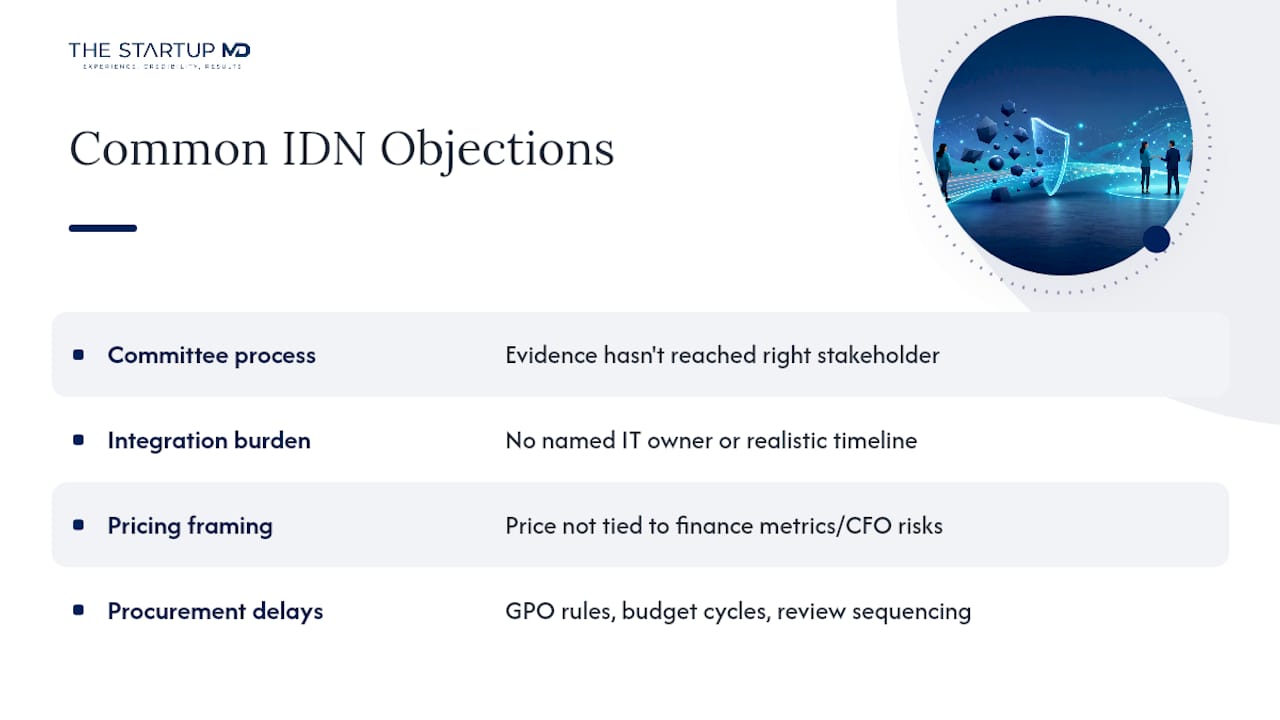
The most common objection isn't about your product. It's "we already have a committee process, and it's not moving fast enough for your timeline," which is really a signal that your evidence hasn't reached the right stakeholder yet. A clinical champion who loves your solution has almost no authority to override a finance objection, and vice versa. Sellers who treat one enthusiastic advocate as a green light routinely watch deals stall for a year in value analysis limbo.
A second recurring objection centers on integration burden. IT leadership will ask what named resource handles the interface build, what the realistic timeline looks like, and what happens if the integration slips. Vague answers here kill momentum faster than almost any clinical concern, because IT teams have been burned by vendors who underestimated their own timelines.
Pricing objections often mask a different problem: the proposal wasn't framed against the metric the finance committee actually tracks. A price that looks reasonable in isolation looks unjustified next to a CFO's own readmission penalty exposure or bond covenant pressure, unless you've done the work to connect the two.
Procurement delays are the most frustrating objection because they're rarely personal. GPO contract requirements, capital budget cycles, and internal review sequencing all move on their own schedules regardless of how ready your champion is. Teams that plan for this, rather than treating each delay as a red flag, close more of these deals over an 18 to 24 month horizon than teams that pull back at the first sign of a slow committee.
Post-Sale Account Management and Relationship Building With IDNs
Signing the contract is the easiest part of an IDN sale. Retaining and expanding it inside a system this large requires a different kind of discipline than managing a single hospital account.
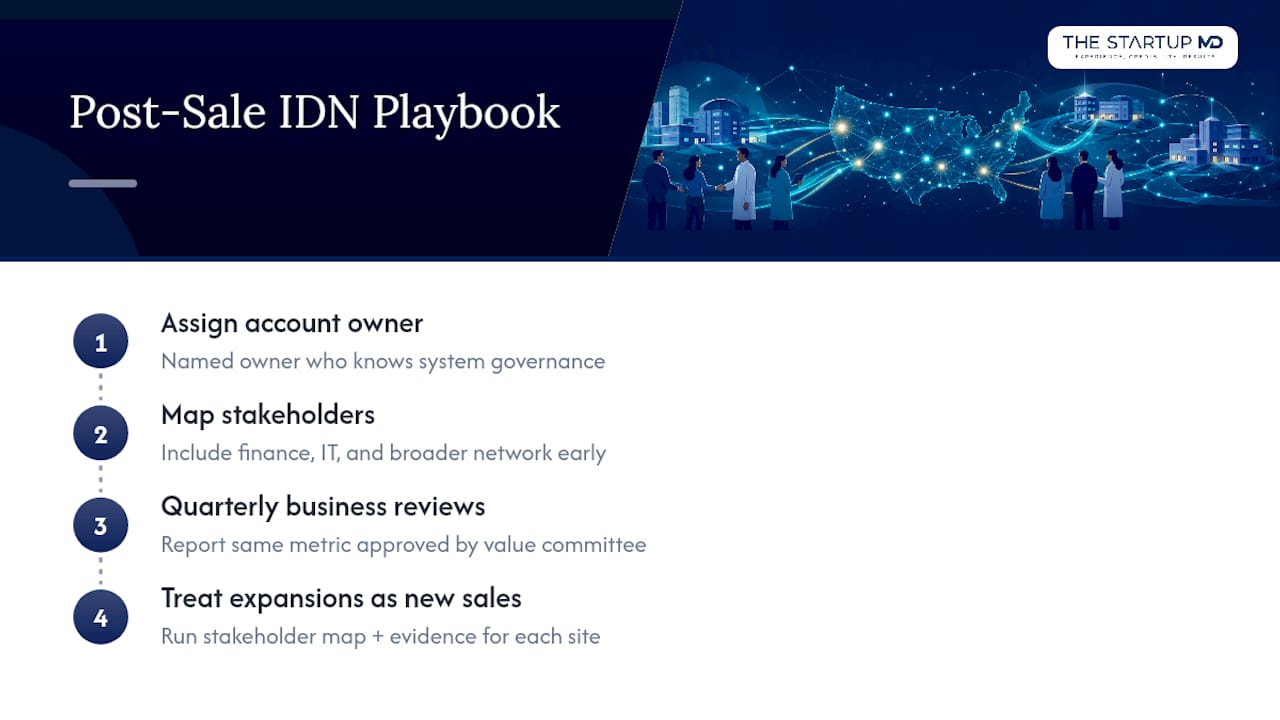
Assign a named account owner who understands the system's own governance structure, not just the champion who sponsored the deal. IDNs rotate leadership more often than smaller organizations, and a relationship built around one executive evaporates the moment that person changes roles. Map the broader stakeholder network early, including the finance and IT contacts who approved the deal but never touched daily usage.
Build a regular business review cadence tied to the metrics the value analysis committee originally approved. If your pilot promised a specific readmission reduction or cost avoidance figure, report against that same figure quarterly, not a different metric that happens to look better. Consistency here builds the credibility needed for expansion into additional facilities or service lines.
Expansion inside an IDN rarely happens automatically, even after a strong first deployment. Facilities within the same system often operate with enough autonomy that a successful pilot at one hospital needs its own internal advocate at the next. Treat each expansion conversation as a smaller version of the original sale, complete with its own stakeholder map and evidence package, rather than assuming system-wide success is inevitable once one site succeeds.
Metrics and KPIs to Track Success When Selling to IDNs
Tracking the right numbers during an IDN sale tells you whether the deal is actually progressing or just generating friendly meetings. Pipeline velocity by stakeholder group matters more than overall pipeline volume, since a deal can look active while sitting stalled in front of one committee for months.
Track time-in-stage for each of the five bosses separately: how long does regulatory review take, how long does the finance sign-off take, how long does the value analysis committee take. This reveals exactly where deals stall across your book of IDN accounts, not just in aggregate.
Post-signature, watch adoption rate by facility within the system, not just enterprise-wide usage. A contract that covers 40 facilities but sees real utilization in five tells you where your expansion conversations need to start. Pair that with the specific clinical or financial outcome metric the committee approved during the pilot, reported on the same cadence used during evaluation.
Champion retention is worth tracking as its own KPI. If your primary internal advocate leaves the account within the first year, and you have no relationship with the broader stakeholder group, that contract is now at real renewal risk regardless of how well the product performs.
What's Changed for IDN Sellers, and Where to Invest Now
Consolidation and value-based care have made the committee, not the clinician, the real buyer. That shift rewards teams who invest in multi-stakeholder training, name a dedicated integration resource before the first technical question arrives, and build pilot economics into every proposal from day one. Sellers still pitching single champions are pitching a buyer that no longer exists at most large systems.
— Paul Bergeron MD, MBA
How The StartupMD Helps Commercial Teams Win Inside IDNs
Most MedTech and healthtech commercial teams don't lack a good product story. They lack someone who's sat on the clinical side of these committees and knows exactly what evidence the value analysis committee, the CFO, and the CMO will actually ask for. That's the gap The StartupMD's fractional Chief Medical Officer and advisory services close for healthcare SaaS and healthtech teams selling into IDNs.
Engagements typically start with the same account-mapping work outlined above: a one-page account playbook identifying your target's loudest pressure point, training modules built around your own product's stakeholder briefs, and a pilot design template your team can reuse across the pipeline. Because these engagements are built around direct clinical and business experience, the guidance reflects what actually moves committees, not generic sales theory borrowed from other industries.
If your team is preparing a go-to-market push into IDN accounts this fiscal year, visit The StartupMD's services page to talk through what a short advisory engagement could deliver before your next capital planning window opens.
Authoritative Data and Reference Links for Account Research
- CMS performance datasets: star ratings and program penalty exposure.
- Definitive Healthcare market profiles: organizational structure and net patient revenue.
- Joint Commission accreditation lookups, state CON registries, and public 990 or audit filings: accreditation cycles and financial health signals.
Sources
- The hospital has five bosses (Sell to Hospitals)
- How to Sell Software to Hospitals 2026 Guide | MDliaison
- Integrated delivery network - Definitive Healthcare
- Selling in Integrated Delivery Networks: Why Multi-Stakeholder Pharma Selling Requires a Different Skill Set | TrainBox Blog
FAQ
Who Is the Largest Purchaser of Healthcare in the U.S.?
The federal government, through Medicare and Medicaid, is the largest single purchaser of healthcare services in the United States. That scale is exactly why CMS programs like value-based purchasing carry so much weight in IDN decision-making, since penalties and incentives tied to these programs directly affect system revenue.
How Much Do Hospitals Pay for Supplies?
Supply spending varies enormously by facility size, specialty mix, and whether the hospital is part of an IDN with GPO contracts already in place. IDNs generally use group purchasing organizations to negotiate baseline pricing across the network, which is why getting onto the right GPO tier often matters more than your standalone list price.
Is Kaiser Permanente an IDN?
Yes. Kaiser Permanente is widely cited as one of the most vertically integrated delivery networks in the country, combining insurance, hospitals, and physician groups under one strategic structure. It represents the system IV or fully integrated end of the IDN spectrum described by Definitive Healthcare.
What's the Difference Between an IDN and a Health System?
A health system typically refers to a group of hospitals and facilities under common ownership, while an IDN specifically implies a level of integrated strategy, purchasing, and care coordination across those facilities. Not every health system operates with the centralized decision architecture that defines a true IDN.
How Long Does It Typically Take to Close a Deal With an IDN?
IDN sales cycles commonly stretch well beyond a single hospital deal because multiple committees, from value analysis to finance to IT security, review the same proposal in sequence. Timing your outreach two to three months ahead of the account's capital planning window, as outlined in MDliaison's guidance, materially improves how fast that sequence moves.