

A hospital value analysis committee (VAC) is the governance body that approves and standardizes technologies, devices, and supplies by weighing clinical benefit against total cost. Its core output isn't a single purchase, it's a standard: a documented decision that a product, procedure, or category will be adopted, restricted, or rejected system-wide. The sections below cover who sits on a VAC, how it evaluates evidence, how to build a submission that gets approved, and how to measure whether the committee is actually working.
TL;DR:
- Effective VACs rely on diverse membership, including clinicians, finance, supply chain, and IT, with governance based on a written charter that sets clear rules.
- Committees organize review around cost, quality, and outcomes, requiring robust evidence such as peer-reviewed studies, FDA approval, reimbursement status, and total cost of ownership.
- Successful submissions depend on early clinical engagement, comprehensive evidence, a three-year financial model, and detailed operational and IT implementation plans.
- Prevention of groupthink involves strict conflict-of-interest disclosures, standardized scorecards, and structured decision escalation through executive sponsors.
- Regular tracking of KPIs like cost savings, utilization variance, and decision time improves committee transparency and system-level value measurement.
Table of Contents
- Hospital Value Analysis Committee Membership and Governance Structure
- The CQO Framework: How Committees Weigh Cost, Quality, and Outcomes
- Building a VAC Submission That Actually Gets Approved
- Why Value Analysis Committees Fail (And How to Fix It)
- Measuring Whether Your VAC Is Actually Working
- A Practitioner's Checklist for Faster, Better VAC Decisions
- A Clinician-Advisor's Take on Value Analysis Governance
- Getting Your VAC Submission or Governance Model Right the First Time
- Where to Go for VAC Standards and Templates
- Sources
- FAQ
Hospital Value Analysis Committee Membership and Governance Structure
A VAC only works if the room reflects the decision. Effective committees pull members from clinical, financial, and operational sides of the house, and effective governance operates under a written charter that aligns product adoption with clinical and financial mission.
Typical voting or advisory membership includes:
- A physician champion or medical director representing the affected specialty
- Nursing leadership, often a Chief Nursing Officer designee or unit-level clinical educator
- Supply chain and materials management leadership
- Finance or cost accounting representation
- Risk management and infection prevention
- Quality and patient safety officers
- Information technology, when a product touches the EHR or connected devices
Leadership models vary. A supply-chain-led VAC tends to move faster but can undervalue clinical nuance. A physician-chaired VAC carries more clinical credibility but sometimes stalls on consensus. Neither model is wrong, but each biases outcomes in a predictable direction, which is exactly why the charter matters: it should define voting thresholds, quorum rules, a conflicts-of-interest disclosure process, and how subcommittees handle categories like orthopedic implants or surgical robotics that need deeper technical review.
The CQO Framework: How Committees Weigh Cost, Quality, and Outcomes
A repeatable decision framework beats a case-by-case gut check every time. Most mature VACs organize their review around three pillars, often shortened to CQO: cost, quality, and outcomes. No single pillar wins automatically. A cheaper product that increases complication rates fails the quality test regardless of the price tag, and a clinically superior device with no reimbursement pathway can fail the cost test just as fast.
A standard evidence checklist for a VAC review typically includes:
- Peer-reviewed clinical literature supporting efficacy and safety
- FDA clearance or approval status, verified against the FDA's 510(k) database
- CMS reimbursement status and any billing code implications
- Total cost of ownership, not just unit price, including training, disposables, and maintenance
- Comparable outcomes data from existing formulary or contracted alternatives
Pilots and limited trials earn their place when the evidence is promising but thin, particularly for new device categories with no long-term outcomes data. A 60 to 90 day pilot with defined success metrics, agreed upfront, gives the committee real utilization and complication data instead of a vendor's marketing claims.
Statistic Callout: US healthcare spending hit $4.5 trillion in 2022 and is projected to reach $7.2 trillion by 2031, a trajectory that explains why VACs have shifted from a procurement afterthought to a standing governance function at most health systems.
Building a VAC Submission That Actually Gets Approved
Most submissions fail not because the product is weak, but because the packet is incomplete or the stakeholder work happened too late. Early, informal engagement with clinicians and securing a physician champion before the formal meeting is one of the most effective tactics for getting a product through committee, and it should happen weeks before the packet is finalized, not the day before the meeting.
A complete VAC submission packet generally includes:
- An executive summary stating the problem, the proposed solution, and the requested decision
- Clinical evidence: published studies, safety data, and comparison to current standard of care
- A financial model covering unit cost, total cost of ownership, and any contract levers like volume tiers or bundled pricing
- An implementation plan covering training, workflow changes, and IT or EHR integration needs
- A signed statement or verbal commitment from the physician champion
Pro Tip: Build your financial model around a three-year total cost of ownership, not the sticker price. Committees that scored a device on unit cost alone in year one routinely find the real number, once training, disposables, and service contracts are added, tells a very different story by year three.
Operational readiness deserves its own line item. If the product touches network infrastructure or connected devices, a structured change management process for IT rollout avoids the kind of last-minute technical objection that stalls an otherwise strong submission.
Why Value Analysis Committees Fail (And How to Fix It)
Groupthink is the quiet killer of good VAC decisions. A committee that defers to the loudest surgeon in the room, or rubber-stamps whatever the incumbent vendor already supplies, isn't doing value analysis. It's doing preference-card procurement with extra paperwork.

Peer-reviewed guidance on effective VACs points to five recurring principles: deliberate membership selection, a hard focus on safety and outcomes data, structured cost comparisons, subcommittees for complex categories, and explicit safeguards against groupthink.
Concrete governance fixes include:
- Requiring written conflict-of-interest disclosure and recusal for any member with a financial or personal tie to a vendor
- Standardizing scorecards so every submission is scored on the same weighted criteria, rather than an ad hoc discussion
- Routing high-cost or system-wide decisions through an executive sponsor with clear escalation authority
- Creating subcommittees for high-complexity categories like implants, capital equipment, or robotics
Surveys of hospital VACs find that priorities vary widely by organization size, and many systems still run one-off scorecards instead of a uniform methodology across service lines. That inconsistency is where standardization pays off fastest.
Measuring Whether Your VAC Is Actually Working
A VAC that can't show its numbers to the board loses budget and influence, regardless of how good its decisions actually are. The fix is a small set of KPIs, tracked consistently, rather than a narrative report written once a year.
Core metrics worth tracking:
- Cost avoidance and hard savings, attributed to specific decisions
- Utilization variance against the standardized product or protocol
- Clinical outcomes tied to adopted products, using defined outcomes metrics rather than anecdote
- Time-to-decision from submission to final vote
- Adherence rate to standardized formulary choices across service lines
| KPI | What it measures | Typical reporting cadence |
|---|---|---|
| Cost avoidance | Savings attributed to standardization decisions | Quarterly |
| Utilization variance | Adoption of the standardized product vs. outliers | Monthly |
| Time-to-decision | Days from submission to committee vote | Quarterly |
| Outcomes adherence | Clinical results tied to approved products | Quarterly to annual |
Attribution is the hard part. Savings claimed by the VAC, supply chain, and a service-line committee for the same contract renegotiation is a common double-counting trap. Assign one owner per savings line before the fiscal year starts, and reconcile against the broader data governance roadmap your organization already uses for other performance dashboards.
A Practitioner's Checklist for Faster, Better VAC Decisions
The gap between a slow VAC and a fast one is almost always preparation, not process complexity. A short, disciplined checklist closes most of that gap:
- Map stakeholders and secure a physician champion before the packet is finalized, not during the meeting
- Send a one-page pre-brief to voting members at least a week ahead, not the night before
- Use a standardized scorecard template for every submission, regardless of category
- Track utilization and compliance data with a tracking framework once a decision is adopted, not just before it
Fractional clinical leadership often fills a specific gap here: many hospitals and healthtech vendors don't have a physician executive available to translate clinical evidence into the language a VAC scores against. A fractional Chief Medical Officer can provide that credible clinical voice and help structure the evidence packet without the cost of a full-time executive hire.
A Clinician-Advisor's Take on Value Analysis Governance
Value analysis works when it functions as system-level standardization, not a gatekeeping exercise for one product at a time. The committees that get this right treat every decision as a template for the next one. The ones that don't end up relitigating the same argument every quarter.
The ethics matter as much as the process. Vendors, clinicians, and committee members owe each other transparency about financial ties and clinical stakes, disclosed before the vote, not discovered after.
— Paul Bergeron MD, MBA
Getting Your VAC Submission or Governance Model Right the First Time
Most hospitals building or overhauling a value analysis process hit the same wall: the clinical evidence exists, the financial case is plausible, but nobody on staff has the bandwidth or the physician credibility to translate either one into a submission the committee will actually approve. That's the gap a fractional Chief Medical Officer is built to close.

The StartupMD works with healthcare SaaS companies, digital health startups, and health system leaders who need a physician voice at the table, whether that means designing a VAC charter and scorecard from scratch, preparing a vendor's evidence packet before submission, or briefing internal stakeholders ahead of a vote. Engagements typically start with stakeholder mapping and agenda design, then move into building the specific templates a committee will use going forward. If your organization is preparing a submission or rebuilding its governance model, review The StartupMD's advisory and fractional CMO services and reach out to discuss what your VAC actually needs.
Where to Go for VAC Standards and Templates
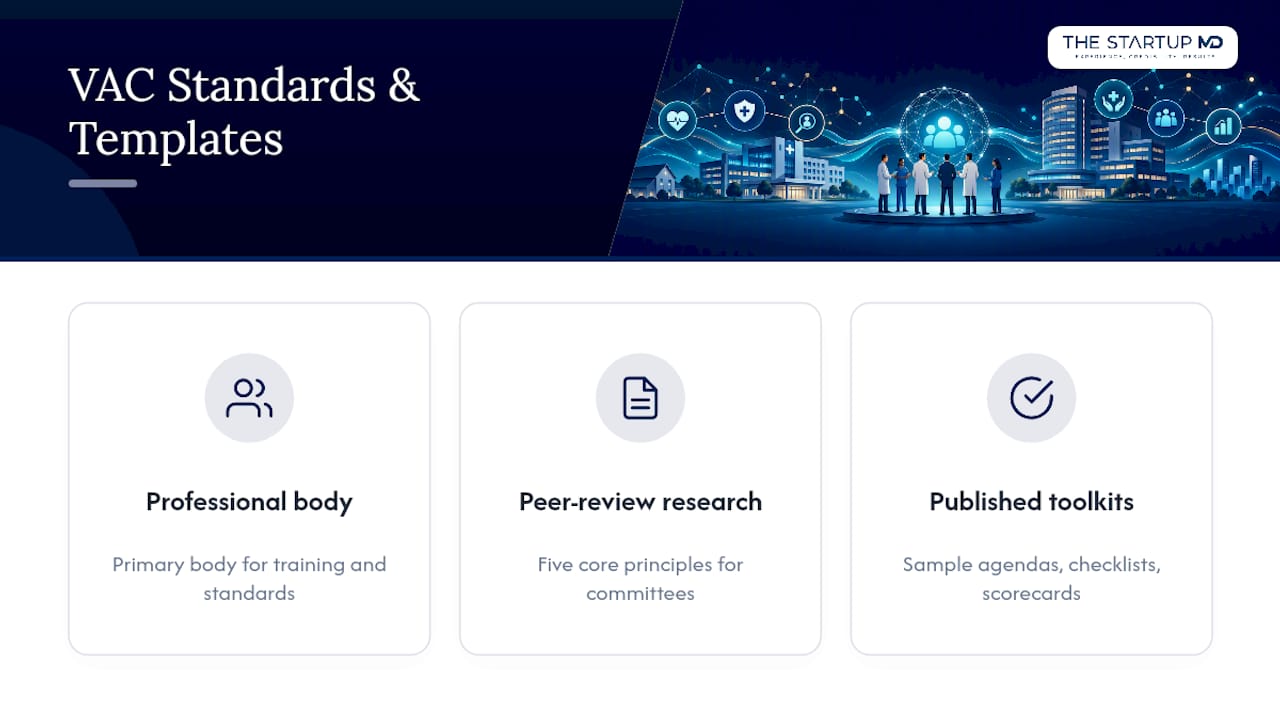
The Association of Healthcare Value Analysis Professionals defines value analysis as a systematic, evidence-based specialty spanning the full cost-quality continuum, and it remains the primary professional body for training and standards in this field. For the underlying research case, the peer-reviewed analysis in Clinical Orthopaedics and Related Research lays out the five core principles behind effective committees. For ready-to-adapt templates, including sample agendas, governance checklists, and scorecards, hospital systems commonly start from published value analysis toolkits.
Sources
- Controlling Costs Through a Value Analysis Committee (related peer-reviewed analysis)
- Association of Healthcare Value Analysis Professionals (AHVAP) — overview
- Hospital value analysis toolkit (symplr)
FAQ
What Is the Main Purpose of a Hospital Value Analysis Committee?
A VAC exists to standardize technology and supply decisions across a health system by weighing clinical evidence against total cost, rather than letting individual departments or physicians make one-off purchasing calls.
Who Typically Chairs a Value Analysis Committee?
Chairs are usually a physician champion, a Chief Nursing Officer designee, or a senior supply chain executive, and the choice shapes whether the committee leans clinical or operational in its priorities.
What Is the #1 Hospital in the United States?
National hospital rankings shift year to year and depend on the ranking methodology used; readers should check current rankings directly from a named ranking organization rather than relying on a fixed answer here.
Who Owns VA Hospitals?
Veterans Affairs hospitals are owned and operated by the federal government through the Veterans Health Administration, a division of the US Department of Veterans Affairs.
How Long Does a Typical VAC Submission Take to Get Approved?
Timelines vary by organization and category complexity, but submissions with a physician champion secured in advance and a complete evidence packet generally move faster than those without one.
Can Fractional Clinical Leadership Help With VAC Submissions?
Yes. A fractional Chief Medical Officer can help vendors and health systems build the clinical evidence case, structure the financial model, and provide the physician-level credibility a VAC scorecard expects.